

Here’s the question that derails most AI governance programs before they get started: “Which framework should we use?”
The answer that actually helps is not a single name. It’s a question back: what market are you in, who are you selling to, and what do you need to prove to whom?
The NIST AI RMF is the right operational foundation for most US organizations. ISO/IEC 42001 is the right certification standard if enterprise contracts require demonstrated governance maturity. The EU AI Act is the binding legal framework for anyone with EU market exposure — and it applies whether or not you’ve chosen to adopt the other two. These aren’t competing options. They’re a layered build, and which layer you start with depends on your specific regulatory and commercial context.
This guide covers the seven most important AI governance frameworks in 2026 — what each one is, what it requires, who it applies to, and how it relates to the others. At the end, a decision framework to help you determine the right sequence for your organization.
This article is part of our Complete Guide to AI Governance. For a grounding in the core concepts first, see What Is AI Governance? and The 5 Core Pillars of AI Governance.
All 7 Frameworks at a Glance
| Framework | Type | Who It Applies To | Certifiable? | Enforcement |
|---|---|---|---|---|
| NIST AI RMF 1.0 | Risk management framework | Any organization; mandatory for US federal agencies | No | Voluntary (de facto mandatory for federal) |
| ISO/IEC 42001 | Management system standard | Any organization globally | Yes — third-party audit | Market-driven (no regulatory penalty for non-cert) |
| EU AI Act | Binding regulation | Anyone serving EU residents with AI | N/A — conformity assessment required | Fines up to €35M / 7% global turnover |
| OECD AI Principles | International principles | Governments and organizations globally | No | Non-binding — influences national frameworks |
| Singapore IMDA | Voluntary framework | Organizations deploying AI in Singapore or with agentic AI | No | Voluntary — most advanced agentic AI framework |
| IEEE EAD | Engineering standards | AI/software engineers and technical teams | No | Voluntary — embedded in procurement specs |
| Colorado SB 24-205 | Binding state law | Any business deploying high-risk AI affecting Colorado residents | N/A — risk management program required | $20,000 per violation per consumer |
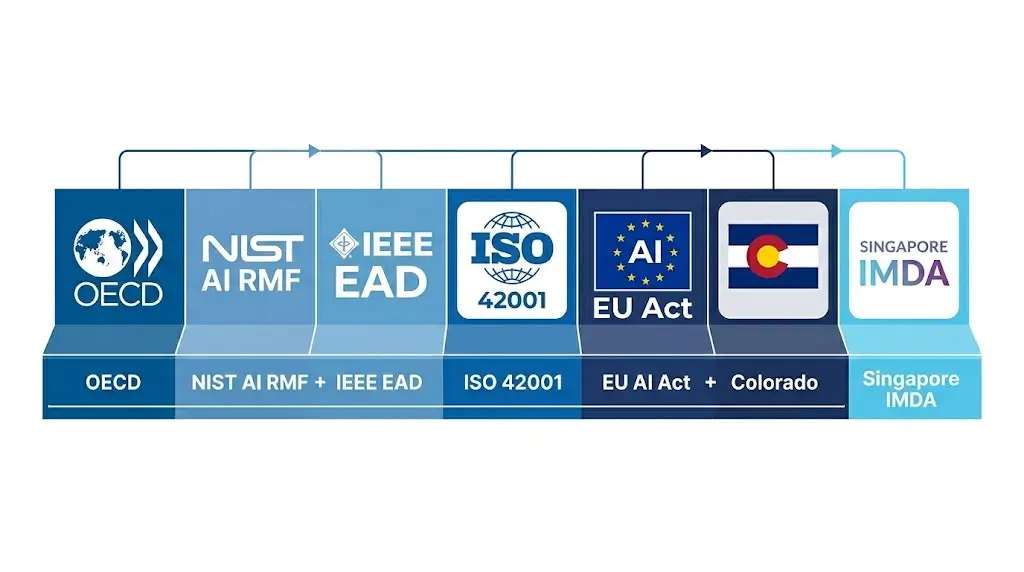
Framework 1: NIST AI RMF — The Operational Standard
NIST AI Risk Management Framework (AI RMF 1.0)
Voluntary (US)
De facto mandatory for federal
Published: January 26, 2023 | By: National Institute of Standards and Technology | Cost: Free | Certification: None
Best for: Any organization building a foundational AI risk management program; US federal agencies and contractors; organizations seeking a universal governance baseline
The NIST AI RMF is the closest thing to a universal AI governance standard in 2026 — not because it is mandated, but because it has been adopted at scale sufficient to make it the de facto baseline for AI governance maturity across sectors and geographies.[1]
Organized around four core functions, the framework is designed to be implemented iteratively rather than sequentially. GOVERN establishes the organizational culture, policies, accountability structures, and processes that apply across all AI risk management activities — it’s the continuous organizational foundation, not a one-time setup phase. MAP identifies and characterizes AI systems, their contexts, intended uses, potential harms, and the stakeholders affected. MEASURE analyzes and quantifies identified risks using both quantitative and qualitative methods, including bias testing, performance evaluation, and uncertainty quantification. MANAGE prioritizes risk responses, allocates resources, and implements treatments including mitigations, monitoring, and incident response.[2]
The NIST AI RMF’s most important practical feature is the GOVERN function’s position as a prerequisite for everything else. Organizations that implement MAP-MEASURE-MANAGE without GOVERN produce technically capable risk assessment without the organizational infrastructure to act on it. The governance culture has to come first.
Implementation timeline: 3–6 months for basic implementation with existing risk management processes; 9–12 months from scratch. NIST provides extensive supporting resources including the AI RMF Playbook, the Generative AI Profile (NIST AI 600-1), and an AI RMF for agentic AI currently in development.[3]
Relationship to other frameworks: NIST AI RMF maps to ISO/IEC 42001 with well-documented crosswalks. It provides the risk management substance that ISO 42001 requires as management system content. For EU AI Act compliance, NIST AI RMF’s GOVERN and MANAGE functions directly support the risk management system required by Article 9.
Framework 2: ISO/IEC 42001 — The Certification Standard
ISO/IEC 42001:2023 — AI Management System
Voluntary
Third-party certifiable
Published: December 2023 | By: International Organization for Standardization | Cost: Standard purchase + certification fees | Certification: Via accredited bodies (ISO/IEC 42006:2025)
Best for: Organizations that need to demonstrate AI governance maturity to enterprise customers, regulators, or international partners; organizations seeking a compliance “passport” across jurisdictions
ISO/IEC 42001 is the AI equivalent of ISO 27001 (information security) and ISO 9001 (quality management) — a certifiable management system standard that provides structured organizational requirements for governing AI, independently verifiable by a third-party audit.[4]
Unlike NIST AI RMF, which defines what organizations should achieve (outcomes), ISO 42001 defines what organizations must have (system requirements): documented policies, risk assessment processes, impact assessments, data management procedures, performance evaluation mechanisms, internal audit programs, and management review processes. Certification requires an external audit by an accredited certification body following ISO/IEC 42006:2025.
The commercial value of ISO 42001 certification is significant and growing. Enterprise procurement teams in financial services, healthcare, and government increasingly require demonstrated AI governance as a vendor qualification criterion — and ISO 42001 certification provides a credentialed answer that self-attestation cannot. For B2B AI companies, certification is increasingly what ISO 27001 certification became for cloud services ten years ago: table stakes for serious enterprise sales.[5]
Implementation timeline: 9–18 months for full implementation and certification. The ISO Harmonized Structure it shares with ISO 27001 and ISO 9001 makes integration with existing management systems significantly more efficient for organizations already certified in those standards.
Relationship to other frameworks: ISO 42001 and NIST AI RMF are complementary and explicitly designed to work together — automated crosswalk tools map between them. ISO 42001’s Annex A controls align closely with EU AI Act requirements, making it an efficient foundation for EU market compliance. Prof. Hung-Yi Chen describes ISO 42001 certification as providing a governance “passport” that demonstrates maturity to regulators across jurisdictions.[3]
Framework 3: EU AI Act — The Binding Regulatory Framework
EU AI Act — Regulation (EU) 2024/1689
Binding law
In force: August 1, 2024 | High-risk compliance deadline: August 2, 2026 | Max penalty: €35M or 7% global turnover | Conformity assessment: Required for high-risk AI
Applies to: Any organization serving EU residents with AI — regardless of HQ location
The EU AI Act is the world’s first comprehensive AI-specific regulation and the binding legal framework that shapes AI governance globally through the Brussels Effect — the phenomenon where organizations build to the strictest standard to avoid maintaining separate product versions. It applies to any organization placing AI systems on the EU market or affecting EU residents, regardless of corporate headquarters.[6]
The Act’s risk-based framework creates four categories. Prohibited AI (eight specific practices banned outright, including social scoring and real-time biometric surveillance) took effect February 2, 2025. GPAI model obligations (documentation, copyright compliance, systemic risk red-teaming for large foundation models) took effect August 2, 2025. High-risk AI obligations (risk management, Annex IV documentation, conformity assessment, human oversight) apply August 2, 2026. Annex I product AI has until August 2, 2027.
The critical governance obligations for high-risk AI include: a documented risk management system (Article 9), comprehensive technical documentation (Annex IV — 10 structured sections), Instructions for Use for deployers (Article 13), human oversight measures (Article 14), accuracy and robustness controls (Article 15), conformity assessment before market placement (Annex VI or VII), EU database registration, and post-market monitoring (Article 72).
For a full treatment of EU AI Act compliance requirements, see our companion EU AI Act Compliance Guide. For documentation specifics, see our Annex IV Documentation Guide.
Framework 4: OECD AI Principles — The Global Reference
OECD Recommendation on AI (2019, updated 2024)
Non-binding
Adopted: May 2019 | Updated: 2024 (generative AI additions) | Signatories: 44+ countries including all G7 nations
Best for: Understanding the global consensus on AI governance values; mapping your program to principles recognized across jurisdictions
The OECD AI Principles aren’t a compliance framework in the conventional sense — they’re the international consensus on AI governance values that underpins most national AI frameworks, including the EU AI Act, NIST AI RMF, and Singapore’s framework. Understanding them provides a map of the shared conceptual territory that connects these frameworks.
The five core principles: inclusive growth, sustainable development, and well-being; respect for rule of law, human rights, and democratic values (including fairness and privacy); transparency and explainability; robustness, security, and safety; and accountability.[7] Updated in 2024 to address generative AI specifically, the principles now include guidance on foundation model governance that informed the EU AI Act’s GPAI provisions.
Practical value: organizations that map their governance programs to OECD principles create a common language for cross-border compliance discussions and a basis for demonstrating alignment with international norms in jurisdictions that haven’t yet enacted specific AI legislation.
Framework 5: Singapore IMDA Framework — The Agentic AI Pioneer
Singapore Model AI Governance Framework for Generative AI
Voluntary
Published: January 2026 | By: Singapore Infocomm Media Development Authority (IMDA) | Distinction: World’s first governance framework specifically addressing agentic AI
Best for: Organizations deploying autonomous AI agents; organizations seeking forward-looking guidance on agentic AI governance
Singapore’s January 2026 update to its Model AI Governance Framework is the most significant recent development in AI governance frameworks — not because Singapore has regulatory reach, but because it is the only governance document currently addressing agentic AI directly and comprehensively.[8]
The framework introduces three key concepts that other frameworks lack. Agent Identity Cards — standardized documentation that describes an AI agent’s purpose, capabilities, constraints, and authorization scope, analogous to a passport for AI agents operating in enterprise environments. Graduated autonomy levels (Level 0–4), where Level 0 means fully human-controlled and Level 4 means fully autonomous with minimal human oversight, creating a calibrated risk classification specifically for agents. Operator-deployer responsibility framework that clarifies accountability when multiple parties are involved in agent operation — a critical gap in all other current frameworks.
For organizations running AI agents in production — using LLMs that can take actions, access systems, or interact with external services — Singapore’s framework provides the most mature current thinking on governance design, even if the specific mechanisms will be adapted to other jurisdictions’ requirements over time.
Relationship to GAICC analysis: “None of the three frameworks [NIST, ISO 42001, EU AI Act] was designed for agentic AI. Singapore’s January 2026 framework is the only governance document addressing autonomous agents directly. Organisations deploying agents must extend these frameworks to cover cascading failures, scope creep, and attribution gaps.”[1]
Framework 6: IEEE Ethically Aligned Design — The Engineering Standard
IEEE Ethically Aligned Design (EAD) Standards
Voluntary
Published: First edition 2019; ongoing | By: IEEE Global Initiative on Ethics of Autonomous and Intelligent Systems | Audience: Engineers and technical practitioners
Best for: Technical teams embedding ethical principles into AI system design from the earliest development stages
IEEE Ethically Aligned Design addresses a gap that all other frameworks leave to some degree: how do engineers actually embed ethical principles into AI systems at the design and implementation level? While governance frameworks address organizational processes and risk management, EAD addresses the technical translation of values into system design.[7]
EAD covers transparency and interpretability at the architectural level, privacy-by-design in AI system construction, fairness metrics in model design, safety constraints in autonomous system design, and sustainability considerations in AI development. It’s most useful for engineering and data science teams that want concrete technical guidance on translating the principles from governance frameworks into actual design decisions.
In practice, EAD is less a standalone governance framework and more a technical companion to NIST AI RMF and ISO 42001 — providing the engineering-level implementation detail that those frameworks intentionally leave to organizational discretion.
Framework 7: Colorado SB 24-205 — The US State-Level Benchmark
Colorado AI Act (SB 24-205)
Binding state law
Effective: June 30, 2026 | By: Colorado General Assembly | Penalty: $20,000 per violation per consumer | Safe harbor: NIST AI RMF compliance
Applies to: Any business deploying high-risk AI making consequential decisions about Colorado residents
Colorado’s AI Act is included here not because it is technically a “framework” — it’s a law — but because it is the clearest US signal of where state-level AI governance requirements are heading and what they look like in practice. It’s the US state law most structurally similar to the EU AI Act, and for US companies it is currently the most important binding AI governance requirement outside the federal sector.
The Colorado Act requires deployers of high-risk AI to implement a documented risk management program, conduct annual impact assessments, notify consumers when AI influences consequential decisions, and provide human review for adverse decisions. Its NIST AI RMF safe harbor provision — creating a rebuttable presumption of compliance for organizations following NIST AI RMF — directly links the framework and the law, making NIST AI RMF alignment doubly valuable for organizations with Colorado market exposure.
For the full Colorado AI Act compliance guide, see our dedicated article: Colorado AI Act 2026: Complete Compliance Guide.
Which Framework Should You Start With?
The frameworks above aren’t mutually exclusive choices — they’re complementary layers in a mature governance program. But organizations with limited governance resources need to sequence their investments. Here’s the decision logic.[5]
Start with NIST AI RMF if: You’re a US-based organization without immediate EU regulatory exposure, need a flexible foundation that integrates with existing risk processes, want to satisfy federal procurement expectations, or are building your first governance program. NIST AI RMF gives you the most flexibility, costs nothing, and provides the risk management substance every other framework requires.
Add ISO/IEC 42001 if: Enterprise customers, cyber insurers, or international regulators require certified governance evidence. You’re selling AI to enterprises in regulated industries. You need a governance credential that travels across jurisdictions. Build your program substance on NIST AI RMF, then structure and document it for ISO 42001 certification.
Add EU AI Act compliance if: You serve EU residents with any AI system — whether you’re EU-based or not. This is not optional and is not a framework choice — it’s a legal requirement. Layer EU AI Act-specific requirements (Annex IV documentation, conformity assessment, database registration) on top of your NIST AI RMF / ISO 42001 governance foundation.
Add Colorado SB 24-205 compliance if: You deploy AI making consequential decisions about Colorado residents. June 30, 2026 effective date. NIST AI RMF alignment satisfies the safe harbor provision — so NIST-aligned organizations are in the strongest position.
Reference Singapore IMDA if: You deploy autonomous AI agents. Apply the Agent Identity Card and graduated autonomy concepts to your agentic AI governance regardless of jurisdiction — these concepts will appear in future frameworks globally.
Reference IEEE EAD if: Your technical teams need engineering-level guidance on translating governance principles into system design decisions.
Continue building your governance program:
- → How to Build an AI Governance Framework from ScratchStep-by-step program development using NIST AI RMF as your foundation.
- → The 5 Core Pillars of AI GovernanceWhat each framework addresses — mapped to the five core pillars.
- → AI Governance vs. AI EthicsHow ethics principles connect to these frameworks — and why they require different implementation approaches.
- → AI Governance Checklist: 25 Questions Before Deploying AIFramework-agnostic diagnostic covering all five governance pillars.
Frequently Asked Questions
What is the best AI governance framework?
NIST AI RMF for operational foundation; ISO 42001 for certification; EU AI Act for EU regulatory compliance. These are not competing options — they are a layered build. Start with NIST AI RMF (free, flexible, widely adopted), add ISO 42001 when certification becomes a commercial necessity, and layer EU AI Act compliance for any AI with EU market exposure.[1]
What is the difference between NIST AI RMF and ISO 42001?
NIST AI RMF defines outcomes; ISO 42001 defines system requirements. NIST AI RMF is principle-based and flexible, organized around four functions, with no certification. ISO 42001 is a certifiable management system standard requiring full system implementation and third-party audit. NIST provides risk management substance; ISO 42001 provides certification structure. Most mature programs use both, with NIST AI RMF as the operational foundation and ISO 42001 as the certification layer on top.[4]
Is NIST AI RMF mandatory?
Voluntary for private sector; effectively mandatory for US federal agencies. OMB M-24-10 required all federal agencies to implement NIST AI RMF-aligned governance by December 2024. For federal contractors and regulated industry vendors, NIST alignment is increasingly expected in practice even when not formally required. For Colorado AI Act compliance, NIST AI RMF alignment provides a statutory safe harbor — making it de facto necessary for Colorado-facing AI deployers.
Which AI governance framework should I use first?
Start with NIST AI RMF for the operational foundation. It is free, flexible, widely adopted, and maps to all other frameworks. The recommended sequence: NIST AI RMF → ISO 42001 (when enterprise certification is needed) → EU AI Act specifics (when serving EU markets) → Colorado SB 24-205 specifics (when serving Colorado residents). Each layer adds to rather than replaces the previous one.
📚 References and Sources
- GAICC, “Global AI Governance Comparison 2026: EU AI Act vs NIST AI RMF vs ISO/IEC 42001,” March 2026. Comprehensive three-framework comparison; enforcement mechanisms; agentic AI governance gap; optimal implementation sequence. gaicc.org
- NIST, “AI Risk Management Framework (AI RMF 1.0),” NIST AI 100-1, January 26, 2023. Four core functions: GOVERN, MAP, MEASURE, MANAGE; seven characteristics of trustworthy AI. nist.gov
- Prof. Hung-Yi Chen, “AI Governance and Regulation 2026,” March 2026. ISO 42001 as governance passport; NIST agentic AI initiative (February 2026); partial convergence of frameworks. hungyichen.com
- HiComply, “ISO 42001 vs NIST AI RMF: How to Choose the Right Framework,” November 2025. Detailed comparison of NIST AI RMF and ISO 42001 differences; complementary nature; implementation guidance. hicomply.com
- SoftwareSeni, “EU AI Act NIST AI RMF and ISO 42001 Compared — Which Framework to Implement First,” November 2025. Decision framework for framework sequencing; ISO 42001 as enterprise sales qualifier; implementation timelines. softwareseni.com
- EC Council, “EU AI Act vs NIST AI RMF vs ISO/IEC 42001: A Plain English Comparison,” March 2026. Extraterritorial reach of EU AI Act; risk classification taxonomy; crosswalk methodology. eccouncil.org
- Bradley law firm, “Global AI Governance: Five Key Frameworks Explained,” August 2025. OECD AI Principles (2019, updated 2024); IEEE EAD; NIST AI RMF characteristics of trustworthy AI. bradley.com
- Singapore IMDA, “Model AI Governance Framework for Generative AI,” January 2026. World’s first agentic AI framework; Agent Identity Cards; graduated autonomy levels (0–4); operator-deployer responsibility framework. imda.gov.sg
Sources verified March 2026. This article does not constitute legal advice.
Leave a Reply