
Tag: ISO 42001

  • 7 AI Governance Frameworks You Should Know in 2026 (NIST, ISO 42001, EU AI Act & More)

    7 AI Governance Frameworks You Should Know in 2026 (NIST, ISO 42001, EU AI Act & More)

    7 AI Governance Frameworks 2026 – NIST AI RMF, ISO 42001, EU AI Act Comparison
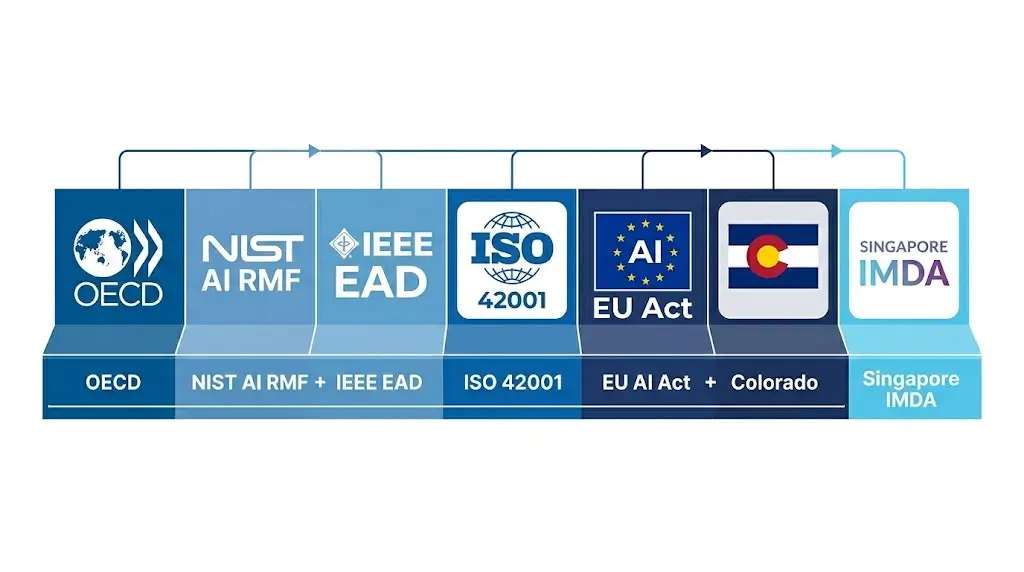
    Seven frameworks currently define how AI is governed globally. They aren’t competing alternatives — they’re a layered system where most organizations need elements of multiple frameworks simultaneously.

    Here’s the question that derails most AI governance programs before they get started: “Which framework should we use?”

    The answer that actually helps is not a single name. It’s a question back: what market are you in, who are you selling to, and what do you need to prove to whom?

    The NIST AI RMF is the right operational foundation for most US organizations. ISO/IEC 42001 is the right certification standard if enterprise contracts require demonstrated governance maturity. The EU AI Act is the binding legal framework for anyone with EU market exposure — and it applies whether or not you’ve chosen to adopt the other two. These aren’t competing options. They’re a layered build, and which layer you start with depends on your specific regulatory and commercial context.

    This guide covers the seven most important AI governance frameworks in 2026 — what each one is, what it requires, who it applies to, and how it relates to the others. At the end, a decision framework to help you determine the right sequence for your organization.

    This article is part of our Complete Guide to AI Governance. For a grounding in the core concepts first, see What Is AI Governance? and The 5 Core Pillars of AI Governance.

    All 7 Frameworks at a Glance

    Framework Type Who It Applies To Certifiable? Enforcement
    NIST AI RMF 1.0 Risk management framework Any organization; mandatory for US federal agencies No Voluntary (de facto mandatory for federal)
    ISO/IEC 42001 Management system standard Any organization globally Yes — third-party audit Market-driven (no regulatory penalty for non-cert)
    EU AI Act Binding regulation Anyone serving EU residents with AI N/A — conformity assessment required Fines up to €35M / 7% global turnover
    OECD AI Principles International principles Governments and organizations globally No Non-binding — influences national frameworks
    Singapore IMDA Voluntary framework Organizations deploying AI in Singapore or with agentic AI No Voluntary — most advanced agentic AI framework
    IEEE EAD Engineering standards AI/software engineers and technical teams No Voluntary — embedded in procurement specs
    Colorado SB 24-205 Binding state law Any business deploying high-risk AI affecting Colorado residents N/A — risk management program required $20,000 per violation per consumer

    7 AI Governance Frameworks 2026 – NIST AI RMF, ISO 42001, EU AI Act Comparison

    Framework 1: NIST AI RMF — The Operational Standard

    NIST AI Risk Management Framework (AI RMF 1.0)

    Voluntary (US)
    De facto mandatory for federal

    Published: January 26, 2023  |  By: National Institute of Standards and Technology  |  Cost: Free  |  Certification: None

    Best for: Any organization building a foundational AI risk management program; US federal agencies and contractors; organizations seeking a universal governance baseline

    The NIST AI RMF is the closest thing to a universal AI governance standard in 2026 — not because it is mandated, but because it has been adopted at scale sufficient to make it the de facto baseline for AI governance maturity across sectors and geographies.[1]

    Organized around four core functions, the framework is designed to be implemented iteratively rather than sequentially. GOVERN establishes the organizational culture, policies, accountability structures, and processes that apply across all AI risk management activities — it’s the continuous organizational foundation, not a one-time setup phase. MAP identifies and characterizes AI systems, their contexts, intended uses, potential harms, and the stakeholders affected. MEASURE analyzes and quantifies identified risks using both quantitative and qualitative methods, including bias testing, performance evaluation, and uncertainty quantification. MANAGE prioritizes risk responses, allocates resources, and implements treatments including mitigations, monitoring, and incident response.[2]

    The NIST AI RMF’s most important practical feature is the GOVERN function’s position as a prerequisite for everything else. Organizations that implement MAP-MEASURE-MANAGE without GOVERN produce technically capable risk assessment without the organizational infrastructure to act on it. The governance culture has to come first.

    Implementation timeline: 3–6 months for basic implementation with existing risk management processes; 9–12 months from scratch. NIST provides extensive supporting resources including the AI RMF Playbook, the Generative AI Profile (NIST AI 600-1), and an AI RMF for agentic AI currently in development.[3]

    Relationship to other frameworks: NIST AI RMF maps to ISO/IEC 42001 with well-documented crosswalks. It provides the risk management substance that ISO 42001 requires as management system content. For EU AI Act compliance, NIST AI RMF’s GOVERN and MANAGE functions directly support the risk management system required by Article 9.

    Framework 2: ISO/IEC 42001 — The Certification Standard

    ISO/IEC 42001:2023 — AI Management System

    Voluntary
    Third-party certifiable

    Published: December 2023  |  By: International Organization for Standardization  |  Cost: Standard purchase + certification fees  |  Certification: Via accredited bodies (ISO/IEC 42006:2025)

    Best for: Organizations that need to demonstrate AI governance maturity to enterprise customers, regulators, or international partners; organizations seeking a compliance “passport” across jurisdictions

    ISO/IEC 42001 is the AI equivalent of ISO 27001 (information security) and ISO 9001 (quality management) — a certifiable management system standard that provides structured organizational requirements for governing AI, independently verifiable by a third-party audit.[4]

    Unlike NIST AI RMF, which defines what organizations should achieve (outcomes), ISO 42001 defines what organizations must have (system requirements): documented policies, risk assessment processes, impact assessments, data management procedures, performance evaluation mechanisms, internal audit programs, and management review processes. Certification requires an external audit by an accredited certification body following ISO/IEC 42006:2025.

    The commercial value of ISO 42001 certification is significant and growing. Enterprise procurement teams in financial services, healthcare, and government increasingly require demonstrated AI governance as a vendor qualification criterion — and ISO 42001 certification provides a credentialed answer that self-attestation cannot. For B2B AI companies, certification is increasingly what ISO 27001 certification became for cloud services ten years ago: table stakes for serious enterprise sales.[5]

    Implementation timeline: 9–18 months for full implementation and certification. The ISO Harmonized Structure it shares with ISO 27001 and ISO 9001 makes integration with existing management systems significantly more efficient for organizations already certified in those standards.

    Relationship to other frameworks: ISO 42001 and NIST AI RMF are complementary and explicitly designed to work together — automated crosswalk tools map between them. ISO 42001’s Annex A controls align closely with EU AI Act requirements, making it an efficient foundation for EU market compliance. Prof. Hung-Yi Chen describes ISO 42001 certification as providing a governance “passport” that demonstrates maturity to regulators across jurisdictions.[3]

    Framework 3: EU AI Act — The Binding Regulatory Framework

    EU AI Act — Regulation (EU) 2024/1689

    Binding law

    In force: August 1, 2024  |  High-risk compliance deadline: August 2, 2026  |  Max penalty: €35M or 7% global turnover  |  Conformity assessment: Required for high-risk AI

    Applies to: Any organization serving EU residents with AI — regardless of HQ location

    The EU AI Act is the world’s first comprehensive AI-specific regulation and the binding legal framework that shapes AI governance globally through the Brussels Effect — the phenomenon where organizations build to the strictest standard to avoid maintaining separate product versions. It applies to any organization placing AI systems on the EU market or affecting EU residents, regardless of corporate headquarters.[6]

    The Act’s risk-based framework creates four categories. Prohibited AI (eight specific practices banned outright, including social scoring and real-time biometric surveillance) took effect February 2, 2025. GPAI model obligations (documentation, copyright compliance, systemic risk red-teaming for large foundation models) took effect August 2, 2025. High-risk AI obligations (risk management, Annex IV documentation, conformity assessment, human oversight) apply August 2, 2026. Annex I product AI has until August 2, 2027.

    The critical governance obligations for high-risk AI include: a documented risk management system (Article 9), comprehensive technical documentation (Annex IV — 10 structured sections), Instructions for Use for deployers (Article 13), human oversight measures (Article 14), accuracy and robustness controls (Article 15), conformity assessment before market placement (Annex VI or VII), EU database registration, and post-market monitoring (Article 72).

    For a full treatment of EU AI Act compliance requirements, see our companion EU AI Act Compliance Guide. For documentation specifics, see our Annex IV Documentation Guide.

    Framework 4: OECD AI Principles — The Global Reference

    OECD Recommendation on AI (2019, updated 2024)

    Non-binding

    Adopted: May 2019  |  Updated: 2024 (generative AI additions)  |  Signatories: 44+ countries including all G7 nations

    Best for: Understanding the global consensus on AI governance values; mapping your program to principles recognized across jurisdictions

    The OECD AI Principles aren’t a compliance framework in the conventional sense — they’re the international consensus on AI governance values that underpins most national AI frameworks, including the EU AI Act, NIST AI RMF, and Singapore’s framework. Understanding them provides a map of the shared conceptual territory that connects these frameworks.

    The five core principles: inclusive growth, sustainable development, and well-being; respect for rule of law, human rights, and democratic values (including fairness and privacy); transparency and explainability; robustness, security, and safety; and accountability.[7] Updated in 2024 to address generative AI specifically, the principles now include guidance on foundation model governance that informed the EU AI Act’s GPAI provisions.

    Practical value: organizations that map their governance programs to OECD principles create a common language for cross-border compliance discussions and a basis for demonstrating alignment with international norms in jurisdictions that haven’t yet enacted specific AI legislation.

    Framework 5: Singapore IMDA Framework — The Agentic AI Pioneer

    Singapore Model AI Governance Framework for Generative AI

    Voluntary

    Published: January 2026  |  By: Singapore Infocomm Media Development Authority (IMDA)  |  Distinction: World’s first governance framework specifically addressing agentic AI

    Best for: Organizations deploying autonomous AI agents; organizations seeking forward-looking guidance on agentic AI governance

    Singapore’s January 2026 update to its Model AI Governance Framework is the most significant recent development in AI governance frameworks — not because Singapore has regulatory reach, but because it is the only governance document currently addressing agentic AI directly and comprehensively.[8]

    The framework introduces three key concepts that other frameworks lack. Agent Identity Cards — standardized documentation that describes an AI agent’s purpose, capabilities, constraints, and authorization scope, analogous to a passport for AI agents operating in enterprise environments. Graduated autonomy levels (Level 0–4), where Level 0 means fully human-controlled and Level 4 means fully autonomous with minimal human oversight, creating a calibrated risk classification specifically for agents. Operator-deployer responsibility framework that clarifies accountability when multiple parties are involved in agent operation — a critical gap in all other current frameworks.

    For organizations running AI agents in production — using LLMs that can take actions, access systems, or interact with external services — Singapore’s framework provides the most mature current thinking on governance design, even if the specific mechanisms will be adapted to other jurisdictions’ requirements over time.

    Relationship to GAICC analysis: “None of the three frameworks [NIST, ISO 42001, EU AI Act] was designed for agentic AI. Singapore’s January 2026 framework is the only governance document addressing autonomous agents directly. Organisations deploying agents must extend these frameworks to cover cascading failures, scope creep, and attribution gaps.”[1]

    Framework 6: IEEE Ethically Aligned Design — The Engineering Standard

    IEEE Ethically Aligned Design (EAD) Standards

    Voluntary

    Published: First edition 2019; ongoing  |  By: IEEE Global Initiative on Ethics of Autonomous and Intelligent Systems  |  Audience: Engineers and technical practitioners

    Best for: Technical teams embedding ethical principles into AI system design from the earliest development stages

    IEEE Ethically Aligned Design addresses a gap that all other frameworks leave to some degree: how do engineers actually embed ethical principles into AI systems at the design and implementation level? While governance frameworks address organizational processes and risk management, EAD addresses the technical translation of values into system design.[7]

    EAD covers transparency and interpretability at the architectural level, privacy-by-design in AI system construction, fairness metrics in model design, safety constraints in autonomous system design, and sustainability considerations in AI development. It’s most useful for engineering and data science teams that want concrete technical guidance on translating the principles from governance frameworks into actual design decisions.

    In practice, EAD is less a standalone governance framework and more a technical companion to NIST AI RMF and ISO 42001 — providing the engineering-level implementation detail that those frameworks intentionally leave to organizational discretion.

    Framework 7: Colorado SB 24-205 — The US State-Level Benchmark

    Colorado AI Act (SB 24-205)

    Binding state law

    Effective: June 30, 2026  |  By: Colorado General Assembly  |  Penalty: $20,000 per violation per consumer  |  Safe harbor: NIST AI RMF compliance

    Applies to: Any business deploying high-risk AI making consequential decisions about Colorado residents

    Colorado’s AI Act is included here not because it is technically a “framework” — it’s a law — but because it is the clearest US signal of where state-level AI governance requirements are heading and what they look like in practice. It’s the US state law most structurally similar to the EU AI Act, and for US companies it is currently the most important binding AI governance requirement outside the federal sector.

    The Colorado Act requires deployers of high-risk AI to implement a documented risk management program, conduct annual impact assessments, notify consumers when AI influences consequential decisions, and provide human review for adverse decisions. Its NIST AI RMF safe harbor provision — creating a rebuttable presumption of compliance for organizations following NIST AI RMF — directly links the framework and the law, making NIST AI RMF alignment doubly valuable for organizations with Colorado market exposure.

    For the full Colorado AI Act compliance guide, see our dedicated article: Colorado AI Act 2026: Complete Compliance Guide.

    Which Framework Should You Start With?

    The frameworks above aren’t mutually exclusive choices — they’re complementary layers in a mature governance program. But organizations with limited governance resources need to sequence their investments. Here’s the decision logic.[5]

    Start with NIST AI RMF if: You’re a US-based organization without immediate EU regulatory exposure, need a flexible foundation that integrates with existing risk processes, want to satisfy federal procurement expectations, or are building your first governance program. NIST AI RMF gives you the most flexibility, costs nothing, and provides the risk management substance every other framework requires.

    Add ISO/IEC 42001 if: Enterprise customers, cyber insurers, or international regulators require certified governance evidence. You’re selling AI to enterprises in regulated industries. You need a governance credential that travels across jurisdictions. Build your program substance on NIST AI RMF, then structure and document it for ISO 42001 certification.

    Add EU AI Act compliance if: You serve EU residents with any AI system — whether you’re EU-based or not. This is not optional and is not a framework choice — it’s a legal requirement. Layer EU AI Act-specific requirements (Annex IV documentation, conformity assessment, database registration) on top of your NIST AI RMF / ISO 42001 governance foundation.

    Add Colorado SB 24-205 compliance if: You deploy AI making consequential decisions about Colorado residents. June 30, 2026 effective date. NIST AI RMF alignment satisfies the safe harbor provision — so NIST-aligned organizations are in the strongest position.

    Reference Singapore IMDA if: You deploy autonomous AI agents. Apply the Agent Identity Card and graduated autonomy concepts to your agentic AI governance regardless of jurisdiction — these concepts will appear in future frameworks globally.

    Reference IEEE EAD if: Your technical teams need engineering-level guidance on translating governance principles into system design decisions.

    Continue building your governance program:

    Frequently Asked Questions

    What is the best AI governance framework?

    NIST AI RMF for operational foundation; ISO 42001 for certification; EU AI Act for EU regulatory compliance. These are not competing options — they are a layered build. Start with NIST AI RMF (free, flexible, widely adopted), add ISO 42001 when certification becomes a commercial necessity, and layer EU AI Act compliance for any AI with EU market exposure.[1]

    What is the difference between NIST AI RMF and ISO 42001?

    NIST AI RMF defines outcomes; ISO 42001 defines system requirements. NIST AI RMF is principle-based and flexible, organized around four functions, with no certification. ISO 42001 is a certifiable management system standard requiring full system implementation and third-party audit. NIST provides risk management substance; ISO 42001 provides certification structure. Most mature programs use both, with NIST AI RMF as the operational foundation and ISO 42001 as the certification layer on top.[4]

    Is NIST AI RMF mandatory?

    Voluntary for private sector; effectively mandatory for US federal agencies. OMB M-24-10 required all federal agencies to implement NIST AI RMF-aligned governance by December 2024. For federal contractors and regulated industry vendors, NIST alignment is increasingly expected in practice even when not formally required. For Colorado AI Act compliance, NIST AI RMF alignment provides a statutory safe harbor — making it de facto necessary for Colorado-facing AI deployers.

    Which AI governance framework should I use first?

    Start with NIST AI RMF for the operational foundation. It is free, flexible, widely adopted, and maps to all other frameworks. The recommended sequence: NIST AI RMF → ISO 42001 (when enterprise certification is needed) → EU AI Act specifics (when serving EU markets) → Colorado SB 24-205 specifics (when serving Colorado residents). Each layer adds to rather than replaces the previous one.

    📚 References and Sources

    1. GAICC, “Global AI Governance Comparison 2026: EU AI Act vs NIST AI RMF vs ISO/IEC 42001,” March 2026. Comprehensive three-framework comparison; enforcement mechanisms; agentic AI governance gap; optimal implementation sequence. gaicc.org
    2. NIST, “AI Risk Management Framework (AI RMF 1.0),” NIST AI 100-1, January 26, 2023. Four core functions: GOVERN, MAP, MEASURE, MANAGE; seven characteristics of trustworthy AI. nist.gov
    3. Prof. Hung-Yi Chen, “AI Governance and Regulation 2026,” March 2026. ISO 42001 as governance passport; NIST agentic AI initiative (February 2026); partial convergence of frameworks. hungyichen.com
    4. HiComply, “ISO 42001 vs NIST AI RMF: How to Choose the Right Framework,” November 2025. Detailed comparison of NIST AI RMF and ISO 42001 differences; complementary nature; implementation guidance. hicomply.com
    5. SoftwareSeni, “EU AI Act NIST AI RMF and ISO 42001 Compared — Which Framework to Implement First,” November 2025. Decision framework for framework sequencing; ISO 42001 as enterprise sales qualifier; implementation timelines. softwareseni.com
    6. EC Council, “EU AI Act vs NIST AI RMF vs ISO/IEC 42001: A Plain English Comparison,” March 2026. Extraterritorial reach of EU AI Act; risk classification taxonomy; crosswalk methodology. eccouncil.org
    7. Bradley law firm, “Global AI Governance: Five Key Frameworks Explained,” August 2025. OECD AI Principles (2019, updated 2024); IEEE EAD; NIST AI RMF characteristics of trustworthy AI. bradley.com
    8. Singapore IMDA, “Model AI Governance Framework for Generative AI,” January 2026. World’s first agentic AI framework; Agent Identity Cards; graduated autonomy levels (0–4); operator-deployer responsibility framework. imda.gov.sg

    Sources verified March 2026. This article does not constitute legal advice.

  • AI Governance in 2026: Frameworks, Compliance, Risk Management & Best Practices

    AI Governance in 2026: Frameworks, Compliance, Risk Management & Best Practices


    AI Governance in 2026 Frameworks, Compliance, Risk Management & Best Practices
    AI governance is the operating framework that determines how AI systems are approved, deployed, monitored, and retired. In 2026, it is a compliance function — not an aspirational one.

    Let me start with a number that should make every business leader uncomfortable: 97% of enterprises that suffered AI-related breaches in 2025 lacked appropriate access controls and formal governance practices.[1] Not poor technology. Not sophisticated attackers. Poor governance.

    That same year, public trust in AI companies dropped to 53% — down from 61% just six years earlier.[2] And roughly 80% of AI projects still fail — at twice the rate of traditional IT projects — with the root cause traced not to the models themselves but to organizations that “do not have adequate infrastructure to manage their data and deploy completed AI models.”[3]

    This is what the absence of AI governance looks like in practice. Not in theory — in the actual performance data of organizations deploying AI at scale in 2025 and 2026.

    AI governance is no longer a concept that lives in ethics white papers and responsible AI manifestos. It’s a compliance function. It’s a risk management function. It’s a competitive differentiator. And for organizations operating in the EU, Colorado, or a growing number of other jurisdictions, it’s a legal requirement with enforceable penalties.

    “AI governance is the operating framework for approving, monitoring, and controlling AI systems with continuous, audit-ready evidence. It defines who can make decisions about AI, what evidence those decisions must produce, and how controls are enforced across the full lifecycle.”

    — Ethyca, AI Governance: Framework, Compliance & Operational Guide, 2026[3]

    This guide is the complete reference for understanding and building AI governance in 2026. It covers what AI governance actually is (not just the definition, but what it looks like when it works), the five core pillars every governance program must address, the major frameworks and how to choose between them, the regulatory landscape you need to navigate, the relationship between governance and ethics, and a practical path to building a program your organization can actually run — not just describe.

    Throughout this guide, you’ll find links to dedicated deep-dive articles on each major topic. Think of this as your navigation hub for the complete AI governance topic.

    What Is AI Governance? A Working Definition

    There’s a short answer and a useful answer. The short answer: AI governance is the system that ensures your AI does what you intend, doesn’t do what you don’t intend, and can prove both to anyone who asks.

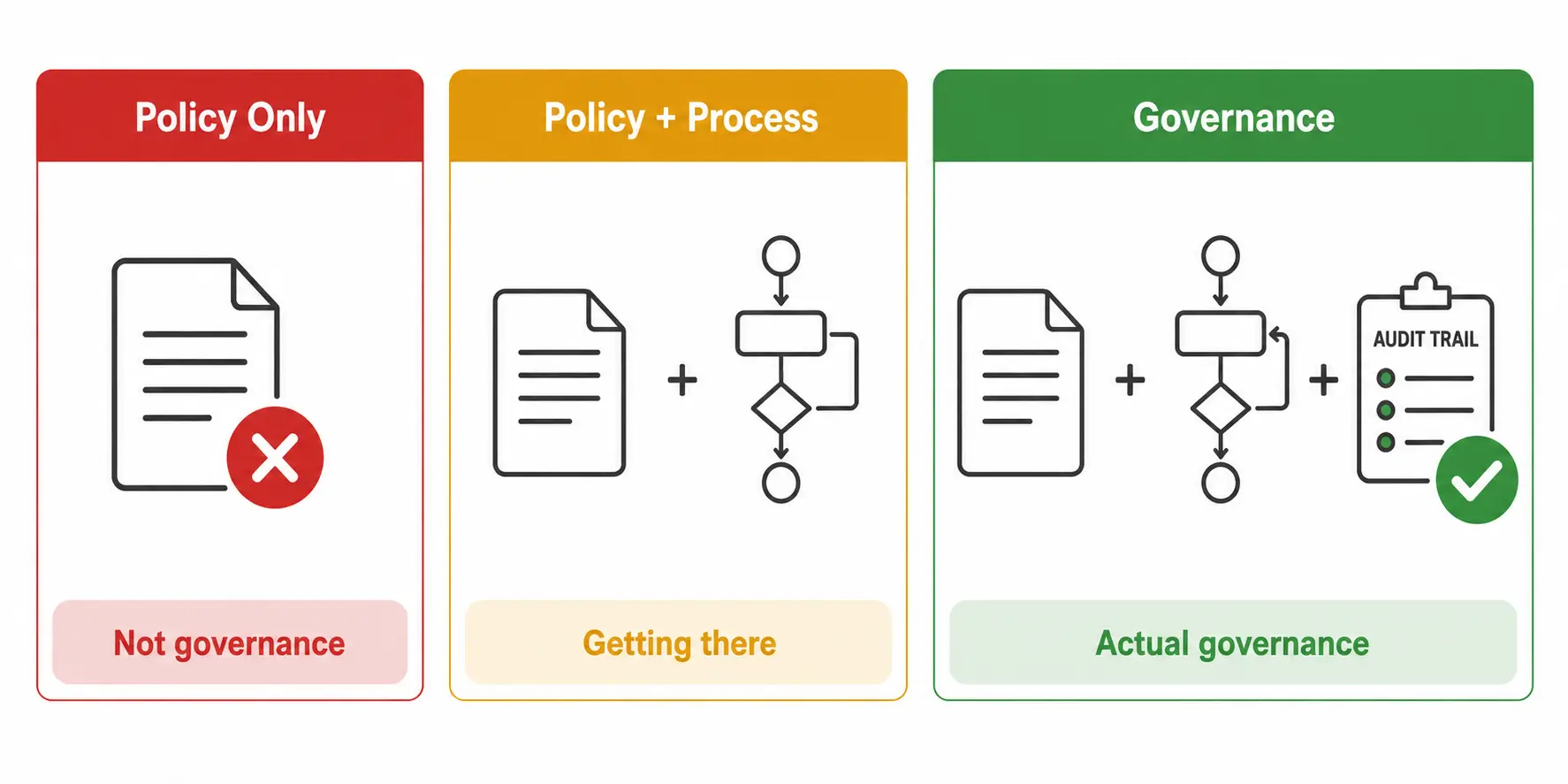
    The useful answer is more specific — because the short version is where most organizations stop, mistake it for a policy document exercise, and end up with governance theater rather than actual governance.

    AI governance is the operating framework comprising policies, processes, technical controls, and oversight mechanisms that governs how AI systems are approved, developed, deployed, monitored, and eventually retired within an organization.[4] It defines who has authority to make decisions about AI, what evidence those decisions must produce, and how accountability is maintained when things go wrong — as they inevitably do at scale.

    The key word in that definition is evidence. Governance that produces only policy documents — “we have a responsible AI policy” — is not functional governance. Governance that produces continuous, audit-ready evidence that controls were actually in place and actually functioning is. The distinction matters enormously in 2026, because regulators, enterprise buyers, auditors, and boards are no longer accepting policy assertions as proof. They’re asking for the evidence.

    AI Governance in 2026 Frameworks, Compliance, Risk Management & Best Practices

    Five Things AI Governance Is Not

    Clarifying what AI governance isn’t is as important as defining what it is, because governance programs often fail by conflating it with something adjacent but insufficient.

    AI governance is not just AI ethics. Ethics defines your values. Governance operationalizes them. You need both — but they are not the same thing. An ethics statement without governance infrastructure is an aspiration. See our dedicated article on AI governance vs. AI ethics for a full treatment of this distinction.

    AI governance is not just data governance. Data governance controls how data is stored, accessed, and processed. AI governance covers the full lifecycle of AI systems — including the algorithmic models, the human decision points, the output monitoring, and the accountability structures. AI systems depend on data governance but require much more.

    AI governance is not a one-time project. It is a continuous operational function — as ongoing as financial controls or IT security management. AI systems drift, degrade, and encounter new use cases. Governance that was adequate at launch becomes inadequate as deployment evolves.

    AI governance is not exclusively a technology function. It spans legal, compliance, risk, HR, product, engineering, and executive leadership. Organizations that locate AI governance purely within the CTO’s office or the data science team consistently miss the accountability and policy dimensions that live in legal and compliance.

    AI governance is not optional for long. It was optional five years ago. It is a legal requirement in the EU as of 2026, required for US federal agencies, mandated by insurance regulators in 24 US states, and increasingly a prerequisite for enterprise procurement and cyber insurance.

    🔗 Want a deeper introduction to AI governance from the ground up?

    Our dedicated explainer — What Is AI Governance? A Plain-English Definition for Business Leaders — covers the core concept, why it emerged when it did, and what it means for organizations that haven’t started yet.

    Why AI Governance Matters Now: The Business Case

    The business case for AI governance used to be primarily defensive — avoid the fine, prevent the scandal, satisfy the auditor. In 2026, the case is both defensive and offensive. Organizations with mature governance frameworks are demonstrating measurable competitive advantages that their ungoverned competitors can’t match.

    The Risk Side: What Poor Governance Actually Costs

    The numbers from 2025 research are striking. AI-associated data breaches added an average of $670,000 extra per incident compared to standard data breaches, per IBM’s 2025 Cost of a Data Breach Report.[5] Nearly all of those organizations — 97% — lacked adequate access controls and governance practices at the time of the breach.[1] The breach wasn’t a technology failure. It was a governance failure.

    Beyond breach costs, poor AI governance creates regulatory fine exposure that can dwarf breach costs. The EU AI Act’s fines reach up to €35 million or 7% of global annual turnover for the most serious violations. Multiply this across an organization with dozens of AI systems deployed without adequate governance, and the liability exposure becomes existential for mid-market companies.

    Operational costs are equally significant. Research consistently shows that AI projects without governance infrastructure fail at twice the rate of those with it. The cost of governance isn’t just what you spend building it — it’s what you save by not having to rebuild AI systems that failed in production, respond to discrimination lawsuits from biased AI decisions, or re-earn customer trust after a high-profile AI incident.

    The Opportunity Side: Governance as a Competitive Advantage

    Here’s what the defensive framing misses: governance maturity is becoming a procurement criterion. Enterprise buyers in regulated industries — financial services, healthcare, government — are increasingly requiring evidence of AI governance as a condition of vendor selection. A B2B software company with a mature AI governance program wins contracts that its ungoverned competitors can’t qualify for.

    The same dynamic operates in talent. AI researchers and engineers with options increasingly choose organizations they believe are deploying AI responsibly. The organizations that can credibly demonstrate governance — not just claim it — attract better AI talent.

    And customer trust, once quantified by McKinsey at 53% and declining,[2] is a real commercial asset. Organizations that earn back the 8 percentage points of trust lost since 2019 will do so by demonstrating that AI in their products works as described, is free from bias, protects user data, and can be held accountable when it fails. That’s a governance story, not a technology story.

    AI Governance in 2026 Frameworks, Compliance, Risk Management & Best Practices

    The 5 Core Pillars of AI Governance

    Despite the diversity of AI governance frameworks — NIST AI RMF, ISO/IEC 42001, EU AI Act, OECD AI Principles, Singapore’s Model Framework — a consistent set of five foundational pillars appears across virtually all of them.[6] Understanding these pillars is essential before selecting a framework or building a program, because the pillars define what you’re building toward — the frameworks define how to get there.

    Pillar 1: Accountability

    Accountability is the foundation that makes every other pillar functional. Without clear ownership of AI outcomes, governance becomes performative — everyone is nominally responsible, which means no one actually is.

    Accountability in AI governance means: named individuals or roles with authority over specific AI systems; documented decision rights covering who can approve, modify, or retire AI deployments; incident response ownership so that when something goes wrong, there’s no ambiguity about who investigates and who reports; and board-level visibility into AI risk so that governance isn’t siloed within technical teams.

    The structural failure pattern is well-documented: responsibility for AI outcomes fragments across data science (who builds the model), engineering (who deploys it), legal (who advises on it), and business (who benefits from it). Every team has a piece of accountability. No team has the whole picture. When bias manifests in production or a model produces harmful outputs, the accountability gap becomes a liability gap.

    Pillar 2: Transparency

    Transparency in AI governance has two distinct dimensions that organizations often conflate: internal transparency (the organization understands how its AI systems work and can document them) and external transparency (the organization honestly communicates to affected individuals and regulators what AI does, how decisions are made, and what the system’s limitations are).

    Both are required. Internal transparency without external transparency produces technically well-governed AI that erodes public trust because users don’t know how decisions affecting them are being made. External transparency without internal transparency produces honest communication based on partial information — which is better than dishonesty, but still creates governance gaps when the organization doesn’t fully understand its own AI.

    In practice, transparency requires explainability capabilities (the ability to provide meaningful explanations of AI-influenced decisions), documentation of capabilities and limitations, and proactive communication about when and how AI is being used in contexts that affect individuals.

    Pillar 3: Fairness

    Fairness — the prevention of algorithmic discrimination and the pursuit of equitable outcomes across demographic groups — is simultaneously the most technically complex and most legally consequential of the five pillars in 2026.

    It’s technically complex because “fairness” has multiple mathematical definitions that can conflict with each other. A model that is fair in one statistical sense (equal error rates across groups) may be unfair in another (equal false positive rates). Choosing which fairness definition to prioritize requires both technical judgment and ethical reasoning — and that reasoning must be documented.

    It’s legally consequential because algorithmic discrimination triggers civil rights law, EU AI Act non-discrimination requirements, and the anti-discrimination cores of Colorado’s AI Act and Illinois’ Human Rights Act amendment. The cost of getting fairness wrong is no longer just reputational — it’s regulatory and potentially criminal.

    Pillar 4: Security

    AI security is both broader and different from conventional cybersecurity. Beyond the standard concerns of unauthorized access and data breach, AI systems face adversarial threats specific to their nature: data poisoning (corrupting training data to manipulate model behavior), model inversion (extracting sensitive training data from model outputs), prompt injection (manipulating AI system behavior through crafted inputs), and model evasion (crafting inputs that cause systematic misclassification).

    A governance program that relies on conventional cybersecurity controls without AI-specific security testing is structurally incomplete. The technical controls for AI security — adversarial robustness testing, input validation, model monitoring for anomalous behavior — require deliberate investment and cannot be assumed from general IT security posture.

    Pillar 5: Privacy

    Privacy in AI governance sits at the intersection of data protection law and AI-specific risks. The AI-specific risks go beyond what GDPR’s Article 5 data minimization and purpose limitation principles were designed to address — specifically, the risk of AI systems inferring sensitive attributes from non-sensitive data, using personal data in ways incompatible with the purpose it was originally collected for, and creating surveillance or profiling capabilities that violate reasonable privacy expectations even when no individual data item is clearly “sensitive.”

    Effective privacy governance for AI requires a privacy-by-design approach embedded into AI development processes — not just GDPR compliance retrofitted at the end — and ongoing monitoring for privacy-infringing AI behaviors in production.

    🔗 Deep dive on all five pillars:

    Our dedicated article — The 5 Core Pillars of AI Governance: Accountability, Transparency, Fairness, Security, Privacy — covers each pillar in detail with practical implementation guidance, the most common failure modes per pillar, and how they connect to specific regulatory requirements.

    The Major AI Governance Frameworks

    The AI governance framework landscape in 2026 is active and increasingly differentiated. There is no single universally mandated framework — but there is a clear hierarchy of adoption, and choosing the wrong starting point creates rework that organizations with limited governance resources can’t afford.

    NIST AI RMF: The Operational Standard

    The NIST AI Risk Management Framework (AI RMF 1.0), released January 26, 2023,[7] is the closest thing to a universal AI governance standard in 2026 — not because it is mandated, but because it has been adopted at a scale that makes alignment with it the safe default for most organizations.

    NIST AI RMF is organized around four core functions. GOVERN builds the organizational risk culture and establishes the processes, accountability structures, and policies that apply across all AI risk management activities. MAP categorizes AI systems and contexts, identifies stakeholders and impacts, and assesses risk scope. MEASURE evaluates and tracks identified risks using quantitative and qualitative methods. MANAGE allocates resources to address risks, implements treatments, and maintains residual risk at acceptable levels.

    Critically, GOVERN applies across all activities — it is not one phase of a sequence but the continuous organizational culture that enables MAP, MEASURE, and MANAGE to function effectively. Many organizations implement the MAP-MEASURE-MANAGE functions while neglecting GOVERN, producing technically capable risk assessment without the organizational infrastructure to act on it. That is a governance failure masquerading as a governance program.

    ISO/IEC 42001: The Certification Standard

    ISO/IEC 42001:2023 is an international standard specifying requirements for establishing, implementing, maintaining, and continually improving an AI Management System (AIMS).[8] Unlike NIST AI RMF, which is a framework for risk management, ISO 42001 is a management system standard in the tradition of ISO 9001 (quality) and ISO 27001 (information security) — meaning it is designed for third-party certification.

    Organizations pursuing ISO 42001 certification are demonstrating to customers, regulators, and partners that their AI governance program meets an independently verified international standard. This carries significant commercial value in enterprise procurement and is increasingly a supplier qualification criterion in regulated industries.

    NIST AI RMF and ISO 42001 are complementary. Most organizations that pursue ISO 42001 certification build the underlying substance of their program on NIST AI RMF and then structure the documentation and management system processes to satisfy ISO 42001’s certification requirements.

    EU AI Act: The Binding Regulatory Framework

    For organizations operating in the EU or serving EU customers, the EU AI Act is not optional and is not a framework in the voluntary sense — it is binding regulation with enforceable penalties. The Act’s risk-based approach requires specific governance obligations for high-risk AI systems including risk management systems, technical documentation, human oversight, and conformity assessment. For GPAI model providers, additional documentation, copyright compliance, and — for systemic risk models — red-teaming and incident reporting obligations apply.

    The EU AI Act doesn’t replace NIST AI RMF or ISO 42001 — it adds specific regulatory requirements on top of the governance infrastructure those frameworks provide. Organizations using NIST AI RMF as their governance foundation are well-positioned to satisfy EU AI Act requirements with targeted additions rather than wholesale rebuilding.

    Other Frameworks Worth Knowing

    Beyond these three foundational frameworks, several others are relevant depending on sector and geography. The OECD AI Principles provide a values-based international reference that underpins most national AI governance frameworks. Singapore’s Model AI Governance Framework — recently updated in January 2026 to specifically address agentic AI[9] — is the most advanced framework for organizations deploying autonomous AI agents. The IEEE Ethically Aligned Design standards address AI ethics operationalization. And sector-specific frameworks in financial services (NAIC Model Bulletin), healthcare (ONC AI standards), and defense (DoD AI Ethical Principles) apply their own requirements to AI governance programs in those domains.

    🔗 Full framework comparison:

    Our dedicated article — 7 AI Governance Frameworks You Should Know in 2026 — covers NIST AI RMF, ISO 42001, EU AI Act, OECD AI Principles, Singapore’s framework, IEEE EAD, and Colorado’s approach, with a comparison table and guidance on which frameworks apply to your organization.

    AI Governance vs. AI Ethics: Not the Same Thing

    Here’s a source of genuine confusion that creates real compliance gaps: treating “AI ethics” and “AI governance” as interchangeable terms, or assuming that having an AI ethics program means you have AI governance.

    They’re not the same. And the gap between them is where most AI harms actually occur.

    AI ethics is concerned with what is right — the values, principles, and moral frameworks that should guide AI development and deployment. It asks questions like: What are the rights of individuals affected by AI decisions? What obligations do AI developers have to society? When is algorithmic decision-making fair, and when is it unjust?

    AI governance is concerned with what actually happens — the operational systems, documented processes, technical controls, and organizational structures that translate ethical principles into consistent, auditable practice. It asks questions like: Who has authority to approve this AI deployment? What evidence do we have that our model isn’t discriminating? When did we last audit this system, who conducted it, and what did they find?

    The relationship is clear: ethics defines the destination; governance is the mechanism for getting there and proving you arrived. Ethics without governance is aspiration. Governance without ethics is compliance theater — you meet the regulatory letter while missing the point entirely.

    The practical test: if something goes wrong with one of your AI systems tomorrow — biased hiring decisions, incorrect clinical recommendations, discriminatory credit scoring — can you produce a documented audit trail showing that the system was evaluated for those risks before deployment, that controls were in place, and that monitoring was running? If yes, you have governance. If all you can produce is an ethics statement, you have ethics but not governance.

    🔗 Full treatment of this distinction:

    AI Governance vs. AI Ethics: What’s the Difference and Why Both Matter — covers the conceptual distinction, why organizations confuse the two, how to build programs that integrate both, and the five ways that treating them as equivalent creates real-world harms.

    The 2026 Regulatory Landscape

    AI governance is becoming legally mandatory at a pace that has surprised even organizations tracking it closely. The regulatory landscape in 2026 is not unified — it’s a patchwork of binding regulations, voluntary frameworks with de facto mandatory status, and sector-specific requirements — but the direction of travel is unmistakable.

    The EU: Most Comprehensive Binding Framework

    The EU AI Act[10] is the world’s most comprehensive AI-specific regulation, applying to any organization — regardless of where it is headquartered — that places AI systems on the EU market or affects EU residents. Its risk-based framework creates specific governance obligations that scale with AI system risk level, with fines reaching €35 million or 7% of global turnover for the most serious violations. The August 2, 2026 compliance deadline for high-risk AI systems is the most urgent regulatory milestone for any organization with EU market exposure.

    The US: Fragmented but Tightening

    The United States has no equivalent federal AI Act, but governance requirements are arriving through multiple channels simultaneously. The OMB’s M-24-10 guidance required all federal agencies to implement NIST AI RMF-aligned governance by December 2024 — making NIST AI RMF effectively mandatory for federal sector work. Colorado’s AI Act (SB 24-205, effective June 30, 2026) requires documented risk management programs for deployers of high-risk AI affecting Colorado residents. The NAIC Model Bulletin, adopted by 24 US states, mandates AI governance for insurance sector AI. And existing civil rights enforcement by the EEOC, FTC, and CFPB applies anti-discrimination obligations to AI systems in employment, consumer finance, and housing.

    Global: Convergence Around Risk-Based Approaches

    Beyond the EU and US, AI governance requirements are proliferating globally. The UK’s AI Safety Institute is developing voluntary frameworks with growing influence. Canada’s Artificial Intelligence and Data Act (AIDA) is advancing through Parliament. Singapore’s IMDA framework is the most advanced for agentic AI governance. Brazil, Japan, South Korea, and several other major economies have active AI governance initiatives. The convergence — imperfect but real — is toward risk-based approaches that require organizations to classify AI systems by risk level and apply governance obligations proportional to that risk.

    Jurisdiction / Framework Type Status (March 2026) Key Governance Obligation
    EU AI Act Binding regulation In force — Annex III deadline Aug 2, 2026 Risk management, documentation, human oversight, conformity assessment for high-risk AI
    Colorado SB 24-205 Binding state law Effective June 30, 2026 Risk management program, annual impact assessments, consumer notification for high-risk AI deployers
    NIST AI RMF Voluntary framework (mandatory for US federal) Operational — federal agencies required by Dec 2024 GOVERN-MAP-MEASURE-MANAGE risk management across AI lifecycle
    ISO/IEC 42001 International standard (certifiable) Published 2023 — active certification market AI Management System with third-party certification
    NAIC Model Bulletin Regulatory guidance (24 US states adopted) Active Documented AI governance, bias controls, audit-ready logs for insurance AI
    Singapore IMDA Framework Voluntary framework Updated January 2026 for agentic AI Agent Identity Cards, graduated autonomy levels, operator-deployer responsibility

    How to Build an AI Governance Program

    The most common mistake organizations make when starting an AI governance program is trying to build the complete program before addressing their most urgent risk. They commission a framework design exercise, spend three months mapping principles and org structures, and meanwhile their highest-risk AI systems continue running without controls. Start with risk. Build controls for what matters most. Expand from there.

    Phase 1: Foundation (Months 1–3)

    Everything in AI governance starts with knowing what you have. Before you can classify risk, establish oversight, or build controls, you need a complete AI inventory — every AI system in production, every AI tool being used by employees (including shadow AI), every AI component embedded in third-party software. This inventory is consistently the most underestimated step. Most organizations discover 2–5x more AI systems than they initially estimated.

    With an inventory in hand, classify each system by risk level using the EU AI Act’s Annex III framework and/or NIST AI RMF’s risk categorization approach. This classification determines which systems require intensive governance controls and which can be governed more lightly. Not all AI requires the same treatment — and applying enterprise-grade governance to a spell-checker is as wasteful as applying minimal governance to an AI that makes credit decisions.

    Establish governance ownership in parallel. Assign a named individual or role accountable for AI governance overall, and system-level accountability for each high-risk AI system. Without named ownership, governance actions don’t get taken — every gap becomes “someone else’s problem.”

    Phase 2: Core Controls (Months 3–9)

    Build controls for your highest-risk AI systems first. For each system in that tier, implement the five core governance elements: a documented risk assessment; bias testing with disaggregated performance metrics by demographic group; human oversight protocols with clear override authority; logging and monitoring infrastructure; and an incident response process for AI-specific failures.

    Align your control documentation with NIST AI RMF’s GOVERN-MAP-MEASURE-MANAGE structure. This serves two purposes: it provides a battle-tested organizing principle for your documentation, and it produces artifacts that directly satisfy multiple regulatory requirements (EU AI Act, Colorado AI Act, NAIC Model Bulletin) from a single documentation program.

    Phase 3: Maturity (Months 9–18)

    Expand governance coverage to your full AI portfolio, implement continuous monitoring infrastructure, establish regular audit cycles, and build the cultural practices that make governance self-sustaining. A governance program that requires heroic individual effort to maintain will degrade over time. A program embedded in development pipelines, procurement processes, and performance management systems becomes organizational muscle memory.

    Consider ISO/IEC 42001 certification if your organization needs to demonstrate governance maturity to customers, regulators, or partners. The certification process validates your governance program against an international standard and produces a credential that increasingly has commercial value in enterprise markets.

    🔗 Step-by-step implementation guide:

    How to Build an AI Governance Framework from Scratch — a practical step-by-step guide covering every phase of governance program development, with templates, ownership models, and timeline guidance for organizations starting from zero.

    Common AI Governance Challenges (and How to Solve Them)

    The challenges that defeat AI governance programs appear with remarkable consistency across organizations. Understanding them in advance is far more useful than discovering them after they’ve derailed your program.

    Challenge 1: “We don’t know where to start.” Start with the AI inventory. Every other governance decision — risk classification, control design, framework selection — depends on knowing what AI you actually have. The inventory is unglamorous and time-consuming. It is also the single most important step.

    Challenge 2: Governance is treated as a compliance exercise, not an operational function. Compliance-driven governance produces documents. Operational governance produces evidence. Organizations that build governance to satisfy an auditor rather than to manage actual risk consistently end up with programs that look good on paper and fail in practice. Build to manage risk. The regulatory compliance will follow.

    Challenge 3: Ownership fragmentation. AI governance requires input from legal, compliance, engineering, data science, HR, product, and executive leadership. The risk is that no single function owns the outcome. Solve this by establishing a formal AI governance council with cross-functional membership and clear decision rights — not as a committee that writes policy, but as a body that makes binding governance decisions and owns accountability for outcomes.

    Challenge 4: The speed problem. AI systems can be developed and deployed in days. Traditional governance review processes were designed for software that took months to ship. The solution is not to slow down AI development — it’s to embed governance checkpoints into the development pipeline rather than bolting them on at the end. A model card requirement and a bias test as standard gates in the deployment pipeline adds days, not months, to delivery timelines.

    Challenge 5: Shadow AI. Every AI inventory has gaps. Employees using personal ChatGPT accounts, unapproved AI browser extensions, and AI-enhanced SaaS tools that were approved for basic use but are now handling sensitive data — these are AI governance gaps that most programs don’t have visibility into. For a full treatment of this challenge, see our guide on Shadow AI compliance risk from our companion EU AI Act series.

    Challenge 6: Governance doesn’t scale as AI portfolio grows. A governance program built around manual review and committee approval processes breaks down at scale. The solution is automation: model registries that capture governance artifacts automatically, monitoring dashboards that surface risk signals without human intervention, and policy-as-code controls that enforce governance requirements in the deployment pipeline. Governance must be designed from the start to scale with your AI portfolio — because your AI portfolio will grow faster than you expect.

    Deep Dive: The Complete AI Governance Series

    This pillar guide provides the framework-level overview. Each article below goes deep on a specific dimension of AI governance — with implementation guidance, templates, and the level of detail your team needs to actually build and run a governance program.

    📚 The Complete AI Governance Series

    Frequently Asked Questions: AI Governance

    What is AI governance?

    AI governance is the operating framework that determines how AI systems are approved, developed, deployed, monitored, and retired within an organization. It encompasses policies, processes, technical controls, and oversight mechanisms that produce continuous, audit-ready evidence of responsible AI use. The critical distinction from policy alone: governance produces evidence, not just statements. For a deeper introduction, see our dedicated explainer: What Is AI Governance?

    What are the core pillars of AI governance?

    Five pillars appear across virtually all major AI governance frameworks: Accountability (clear ownership of AI outcomes), Transparency (explainability and honest disclosure), Fairness (prevention of algorithmic bias), Security (protection against AI-specific threats), and Privacy (responsible personal data handling throughout the AI lifecycle).[6] These pillars define what your governance program must address — the frameworks define how to address them. Full treatment in our AI governance pillars guide.

    What is the difference between AI governance and AI ethics?

    Ethics defines values; governance operationalizes them. AI ethics addresses what is right — the principles that should guide AI development. AI governance is the operational system that translates those principles into enforced, auditable practice. Governance without ethics produces compliance theater. Ethics without governance produces aspirational statements that never get implemented. You need both, and they are not the same. Full treatment: AI Governance vs. AI Ethics.

    Which AI governance framework should my organization use?

    For most organizations: start with NIST AI RMF. It is comprehensive, free, sector-agnostic, and widely adopted — including as the de facto mandatory standard for US federal agencies. If you need third-party certification, layer ISO/IEC 42001 on top. If you have EU market exposure, add EU AI Act-specific requirements. These frameworks are complementary — don’t choose between them, sequence them. Full comparison: 7 AI Governance Frameworks You Should Know in 2026.

    How long does it take to build an AI governance program?

    Minimum viable: 90 days. Mature program: 12–18 months. A 90-day sprint can deliver AI inventory, risk classification, basic policies, and controls for your highest-risk systems. A mature program with full lifecycle controls, ISO 42001 certification readiness, and continuous monitoring infrastructure takes longer — but should be built incrementally from the 90-day foundation. Step-by-step guide: How to Build an AI Governance Framework from Scratch.

    Is AI governance legally required?

    Increasingly yes, depending on jurisdiction and industry. The EU AI Act mandates specific governance obligations for high-risk AI (effective August 2026). Colorado’s AI Act requires risk management programs for certain deployers (effective June 30, 2026). US federal agencies must implement NIST AI RMF-aligned governance. The NAIC Model Bulletin requires AI governance for insurance AI in 24 US states. Even where not yet legally required, AI governance is a growing requirement for enterprise procurement, cyber insurance, and board-level risk reporting.

    Where can I find a practical AI governance checklist?

    Our dedicated resource — AI Governance Checklist: 25 Questions Every Organization Must Answer Before Deploying AI — provides a comprehensive audit tool covering all five governance pillars, with yes/no questions that surface gaps in your current program before they become compliance incidents.

    📚 References and Sources

    1. Quickway Info Systems, “AI Governance Framework for Enterprises: 2026 Blueprint.” 97% of enterprises suffering AI-related breaches lacked adequate access controls and governance; governance maturity as competitive differentiator in 2026. quickwayinfosystems.com
    2. McKinsey, “Technology Trends Outlook 2025.” Trust in AI companies declined from 61% in 2019 to 53% in 2025. Cited in OneReach.ai, “AI Governance Frameworks & Best Practices for Enterprises 2026.” onereach.ai
    3. Ethyca, “AI Governance: Framework, Compliance & Operational Guide (2026).” Definition of AI governance as operating framework for continuous, audit-ready evidence; 80% AI project failure rate; root cause as inadequate data and deployment infrastructure. ethyca.com
    4. Databricks, “AI Governance Best Practices: How to Build Responsible and Effective AI Programs.” Enterprise AI governance principles; five foundational pillars; accountability fragmentation as primary organizational challenge. databricks.com
    5. IBM, “Cost of a Data Breach Report 2025,” Ponemon Institute, July 2025. AI-associated breaches add $670K premium per incident; shadow AI as major breach factor. ibm.com/reports/data-breach
    6. Fintech Global, “What is AI governance? frameworks, risks and best practices,” March 6, 2026. Five key pillars of strong AI governance: security, compliance, accountability, transparency, fairness. fintech.global
    7. National Institute of Standards and Technology (NIST), “AI Risk Management Framework (AI RMF 1.0),” NIST AI 100-1, January 26, 2023. Four core functions: GOVERN, MAP, MEASURE, MANAGE. nist.gov
    8. ISO/IEC 42001:2023, “Information technology — Artificial intelligence — Management system.” International standard for AI management systems; third-party certifiable. iso.org
    9. Singapore Infocomm Media Development Authority (IMDA), “Model AI Governance Framework for Generative AI,” January 2026. World’s first governance framework specifically addressing agentic AI; introduces Agent Identity Cards, graduated autonomy levels (Level 0–4), and operator-deployer responsibility framework. imda.gov.sg
    10. EU AI Act, Regulation (EU) 2024/1689. Official Journal of the European Union, 12 July 2024. Risk-based governance obligations for high-risk AI; GPAI requirements; fines up to €35M or 7% of global turnover. eur-lex.europa.eu

    Sources verified as of March 2026. AI governance regulatory landscape is evolving rapidly — monitor primary sources for updates. This article does not constitute legal advice.

    Download the AI Governance Program Starter Kit

    Everything your cross-functional team needs to launch an AI governance program in 90 days: AI Inventory Template, Risk Classification Framework, Governance Ownership Model, Core Policy Templates, and a 90-Day Implementation Roadmap.

    Aligned with NIST AI RMF, ISO 42001, and EU AI Act requirements. Built for legal, compliance, and technical teams working together on their first governance program.

    Download the AI Governance Starter Kit →