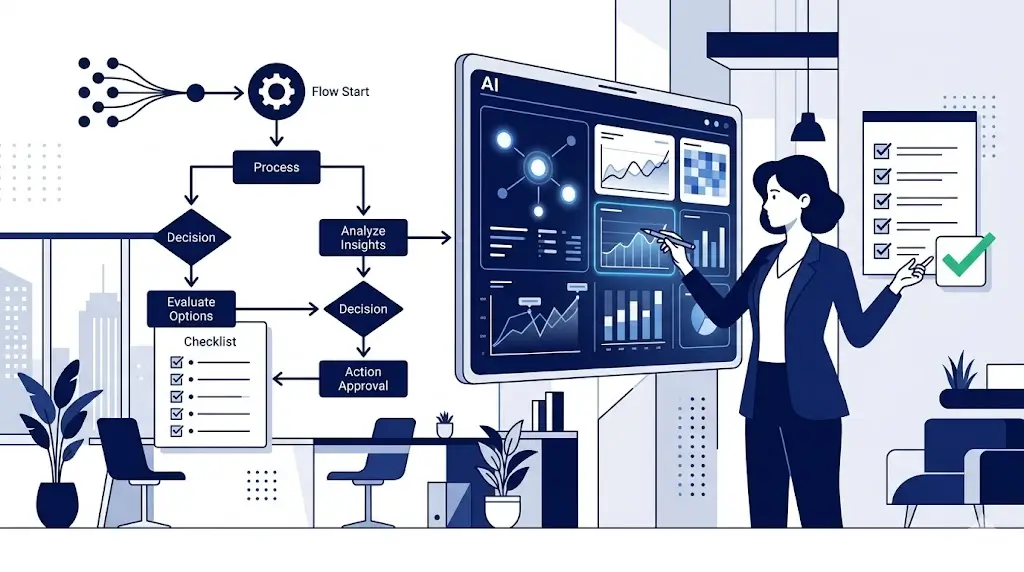
Start with a question. When your company’s AI makes a decision that harms a customer — a loan denial based on biased data, a hiring rejection from a flawed algorithm, a medical recommendation that turns out to be wrong — who is responsible? What process catches that error before it causes harm? What documentation exists that the system was properly evaluated before deployment?
If you don’t have clear answers, you don’t have AI governance. And you’re not alone: only 29% of organizations have comprehensive AI governance plans in place, despite 60% of legal, compliance, and audit leaders now citing technology as their top risk concern — above economic factors, above tariffs.[1]
That gap — between how seriously leaders take AI risk and how few have actually built the systems to manage it — is exactly what AI governance addresses.
This article explains what AI governance is, in plain English, without the jargon. No framework acronyms (yet). No regulatory citations (mostly). Just the core concept, why it matters for your business right now, and what it actually looks like in practice.
This article is part of our Complete Guide to AI Governance — the full hub covering frameworks, compliance requirements, and implementation guidance.
The Plain-English Definition
Here’s the simplest version: AI governance is the system that determines who controls your AI, what guardrails it operates within, and who is accountable when it causes harm.
Every AI system your organization uses — or plans to use — raises three basic questions. Who decided this AI should be deployed for this purpose? What prevents it from producing harmful, biased, or inaccurate outcomes? And if something goes wrong, who is responsible?
AI governance is the organizational infrastructure that answers those questions before something goes wrong — not after.
A slightly more formal definition, from IBM: AI governance refers to “the processes, standards and guardrails that help ensure AI systems and tools are safe and ethical” and addresses “risks such as bias, privacy infringement and misuse while fostering innovation and building trust.”[2]
Both definitions point to the same thing: governance is the control layer between your business and the risks that AI creates. It’s not the AI itself. It’s not the data. It’s the human and organizational system that manages how AI is used.
The One-Sentence Test
Here’s a practical test for whether your organization has AI governance. For any AI system you deploy, can you complete this sentence with specific, documented answers?
“Our [AI system name] was approved by [named person/role] for [specific purpose], evaluated for [specific risks] before deployment, is monitored for [specific performance signals] by [named function], and if it produces a harmful output, [named person/role] is responsible for investigating and responding within [timeframe].”
If you can fill in every blank, you have governance for that system. If any blank is genuinely empty — “uh, someone on the data team approved it” or “we don’t have a monitoring process yet” — you have an AI system without governance. And that’s where most organizations actually are.
What AI Governance Actually Covers
AI governance is broader than most business leaders initially assume. It’s not just about approving AI use cases (though that’s part of it). It spans the entire lifecycle of an AI system — from the moment someone proposes using AI for a new purpose, through development and testing, to deployment, ongoing monitoring, and eventual retirement.
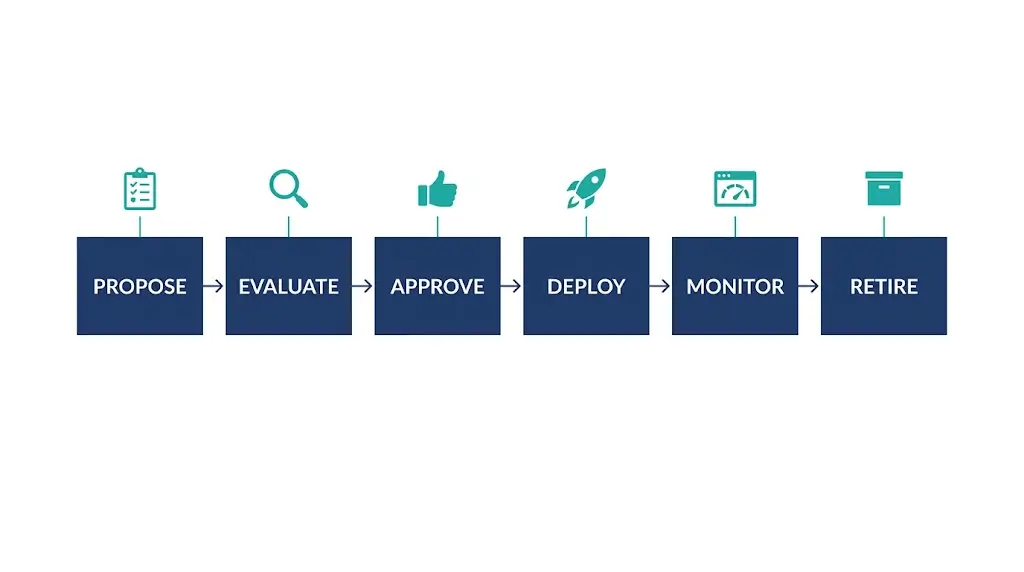
Across that lifecycle, governance covers five areas:
Accountability structures. Who has authority to approve AI systems for specific use cases? Who is responsible for a system’s performance once it’s running? What escalation path exists when problems emerge? Governance defines the ownership map so that accountability is named, not assumed.
Risk assessment. Before an AI system is deployed, has it been evaluated for the specific risks it poses? Bias in hiring decisions. Errors in clinical recommendations. Privacy violations from facial recognition. Discrimination in loan approvals. Governance requires that these risks are assessed before deployment — not discovered after a lawsuit.
Technical controls. What technical safeguards are in place? Performance monitoring that alerts when a model’s accuracy degrades. Logging that creates an audit trail of AI decisions. Access controls that prevent unauthorized use or modification. Bias detection tooling that flags emerging disparate impact. These are the engineering manifestations of governance.
Human oversight. For consequential decisions — who gets a loan, who gets hired, what medical treatment is recommended — what human review process exists? What authority does a human reviewer have to override an AI recommendation? Governance requires that humans maintain meaningful oversight of AI systems that affect people’s lives, not just theoretical override capability.
Documentation and transparency. Is there a record of how the AI was developed, what data it was trained on, what its performance characteristics are, and what limitations it has? Can this documentation be produced to a regulator, a board member, or a customer who asks? Governance requires that this evidence exists — not just that the AI works, but that you can prove it works as claimed.
Why It Matters Right Now — Not in Two Years
There’s a version of this conversation that happened five years ago where AI governance was interesting but optional. That version is over.
In 2026, the forces pushing AI governance from “good practice” to “essential function” are converging from three directions simultaneously.
Regulatory deadlines are real. The EU AI Act requires specific governance obligations for high-risk AI systems by August 2, 2026. Colorado’s AI Act requires documented risk management programs for certain AI deployers by June 30, 2026. US federal agencies were required to implement AI governance frameworks by December 2024. The NAIC Model Bulletin mandating AI governance for insurance AI has been adopted by 24 US states. This is no longer a future regulatory landscape — it’s the current one.
The cost of governance failure is quantifiable. AI-associated data breaches cost organizations an average of $670,000 more per incident than standard breaches, per IBM’s 2025 research.[3] The organizations that paid that premium consistently lacked adequate governance practices. Meanwhile, 80% of AI projects still fail — at twice the rate of traditional IT projects — with poor governance infrastructure cited as a primary cause.[4]
Governance is becoming a commercial prerequisite. Enterprise buyers in healthcare, financial services, and government are increasingly requiring evidence of AI governance as a vendor qualification criterion. Cyber insurers are asking about AI governance in underwriting assessments. Boards are requiring AI governance updates as standing agenda items. The World Economic Forum recently described effective AI governance as “a growth strategy” — not a compliance burden.[5]
The organizations that treat governance as a future-state aspiration are accumulating risk in the present.
What Happens Without It: Three Real Scenarios
Abstract arguments about governance rarely move business leaders as quickly as concrete failure examples. Here are three real-world patterns — drawn from documented incidents — that illustrate what ungoverned AI looks like in practice.
Scenario 1: The Biased Hiring Algorithm
An enterprise uses a commercially available CV-screening AI to handle the volume of job applications it receives. The AI was procured quickly — evaluated primarily on efficiency, not bias risk. No one conducted disaggregated performance testing before deployment. No one reviewed whether the AI’s rejection patterns varied across demographic groups.
Eighteen months later, a pattern emerges: the AI has been systematically downranking candidates from certain universities — universities that serve predominantly minority student populations — because those universities weren’t well-represented in the historical hiring data the model was trained on. The organization has an EEOC complaint and a class action lawsuit. The AI vendor says this is within its documented capabilities. Legal is asking who approved this deployment and what evaluation was conducted. Nobody has a clean answer. That’s what ungoverned AI looks like.
Scenario 2: The Confidential Data Leak
Employees across a professional services firm start using AI tools to work faster — drafting client proposals, summarizing legal documents, generating code. Most are using personal accounts with consumer AI tools because the firm hasn’t yet approved enterprise alternatives. Nobody told them not to. Nobody told them why it matters.
One employee pastes a confidential client contract into a consumer AI tool for summarization. That tool uses conversation data for model training. The client, during a routine security review, discovers their contract terms appear to have been processed by an unauthorized third-party system. The firm’s professional liability insurance may not cover the incident — because the firm can’t demonstrate it had controls in place to prevent it. That’s ungoverned AI.
This pattern is far more common than most organizations realize. It’s also precisely what we cover in our companion article on Shadow AI compliance risk.
Scenario 3: The Drifting Model
A retailer deploys a demand forecasting AI that works beautifully in its first year — accurate predictions, efficient inventory, measurable cost savings. Nobody sets up systematic monitoring. The model’s performance degrades slowly as market conditions shift, but no alert triggers because no performance threshold was defined. Eighteen months later, the model is producing forecasts significantly less accurate than human planning, but the organization keeps trusting it because nobody looks closely enough to notice the drift. When the underperformance is finally discovered during an operations review, the cumulative cost is significant — and entirely avoidable with basic monitoring governance.
What Good AI Governance Looks Like in Practice
Good AI governance doesn’t look like a massive policy document on a shared drive that nobody reads. It looks like operational habits embedded in how your organization actually builds and uses AI.
Here’s a concrete picture of what it means at the organizational level.
There’s a list. Someone in your organization maintains an up-to-date inventory of every AI system in use — purchased, built in-house, or accessed through SaaS products. This list includes what each AI does, who approved it, what risk level it was classified at, and who is accountable for its performance.
High-risk AI goes through a gate. Before any AI system that makes or influences consequential decisions — hiring, credit, healthcare, housing — is deployed, it goes through a formal review. Bias testing. Privacy assessment. Documentation of limitations. Sign-off from legal, compliance, and the relevant business owner. This gate isn’t a bureaucratic obstacle — it’s a documented checkpoint that protects the organization and the people affected by the AI.
Someone is watching. Deployed AI systems are monitored in production — not just for uptime, but for performance quality, bias signals, and behavioral drift. When a model’s output patterns change in ways that suggest degradation or emerging problems, an alert reaches someone with the authority and the process to act on it.
People can appeal. When AI influences a decision that affects an individual — a loan denial, a hiring rejection, an insurance pricing determination — there is a clear process for that person to request human review. A human reviewer has genuine authority to override the AI recommendation, and that review is documented.
Someone is responsible. When something goes wrong — and at scale, something will go wrong — there is a named individual or team that owns the incident response. They investigate, document, remediate, and report. Not “the data science team generally” or “IT.” A named person with defined responsibilities.
None of this is exotic. These are the same organizational habits that govern financial processes, safety procedures, and data protection. AI governance applies those habits to AI.
Who Owns AI Governance Inside an Organization
This is the question that most derails early governance programs: who is actually responsible for this?
The honest answer is that AI governance requires cross-functional ownership — no single department can do it alone, and the attempt to locate it in one function consistently creates gaps.[6]
Legal and compliance owns regulatory requirements, policy framework, and incident liability. Engineering and data science owns technical controls, monitoring infrastructure, and bias testing. Risk management owns risk assessment methodology and risk appetite decisions. HR owns governance of employment AI and workforce training. Product owns use case approval processes for AI in customer-facing products. And executive leadership — ideally a named Chief AI Officer or equivalent — owns the overall accountability structure and ensures governance has the resources to function.
Most effective governance structures formalize this cross-functional ownership through an AI governance board or committee — a standing body with decision authority over AI approvals, risk classifications, and incident responses. Not a committee that produces recommendations. A body that makes binding decisions and is accountable for governance outcomes.
The board composition question that trips up most organizations: should technical leaders or non-technical leaders chair the governance function? The answer is that the chair should be whoever has both the organizational authority to enforce governance decisions and the credibility to engage meaningfully with both technical and legal/ethical dimensions. That person is often a General Counsel, Chief Risk Officer, or Chief Compliance Officer working closely with a Chief AI Officer — not one function operating independently.
Where Business Leaders Should Start
You don’t need to build a mature governance program before you start managing AI risk. You need to start managing AI risk in order to build toward a mature governance program. Those are different directions of travel — and the second is the one that actually works.
Three things a business leader can do this week, without waiting for a governance framework to be designed:
First: ask for the AI inventory. Ask whoever manages AI in your organization to produce a list of every AI system currently in use or planned for deployment. If this list doesn’t exist, its absence is itself your most urgent governance problem. You cannot govern what you don’t know you have.
Second: identify your highest-risk AI. Once you have the inventory, ask which systems make or substantially influence decisions that affect individuals — employment, credit, healthcare, housing. These are your highest-risk systems and the ones that require immediate governance attention, regardless of what regulatory framework applies to your organization.
Third: assign a named owner. For each high-risk system, there should be a named person who is accountable for its performance and for responding if something goes wrong. If that person doesn’t exist, name one before anything else happens.
Those three steps don’t constitute a governance program. But they create the foundation — inventory, risk prioritization, named accountability — on which a program can be built. Everything else follows from those three things being in place.
For a practical step-by-step guide to building a full governance program from this foundation, see our dedicated article: How to Build an AI Governance Framework from Scratch. For a 25-question diagnostic to identify your specific governance gaps, see the AI Governance Checklist.
And for the complete framework — covering the five pillars, the major governance frameworks, the regulatory landscape, and implementation guidance — the Complete Guide to AI Governance is your navigation hub for the full topic.
Frequently Asked Questions
What is AI governance in simple terms?
It’s the system that determines who controls your AI, what guardrails it operates within, and who is responsible when it causes harm. More specifically: governance answers three questions for every AI system in your organization — who approved this AI for this purpose, what prevents it from producing harmful or biased outcomes, and who is accountable if something goes wrong. Without clear answers to all three, you have AI but not AI governance.
Why does AI governance matter for business leaders?
Risk, performance, and competitive advantage. On the risk side: poorly governed AI creates regulatory fine exposure, discrimination lawsuits, and reputational damage that can dwarf the cost of governance itself. On performance: 80% of AI projects fail, and governance infrastructure is a primary predictor of success.[4] On competitive advantage: enterprise buyers, cyber insurers, and sophisticated customers increasingly require evidence of AI governance as a qualification criterion. Organizations that have it win business that those without it can’t qualify for.
What is an example of AI governance?
A bank using AI for credit decisions has AI governance when: a named officer approved the AI system for credit decisions after a documented bias evaluation; a monitoring dashboard tracks approval-rate disparity by demographic group in real time; a compliance team reviews the dashboard monthly; applicants who are denied receive a disclosure and a process to request human review; and a named executive owns responsibility for the system’s fairness performance. Every one of those elements is a piece of governance. Without them, the bank has an AI credit decision tool — but no governance.
Is AI governance the same as AI ethics?
No — they serve different functions. AI ethics defines what is right — the principles and values that should guide AI. AI governance is the operational system that translates those principles into enforced, auditable practice. Ethics without governance produces well-intentioned aspirations that don’t change behavior. Governance without ethics produces compliance theater that meets regulatory requirements while missing the point. For a full treatment of this distinction, see: AI Governance vs. AI Ethics: What’s the Difference and Why Both Matter.
Who is responsible for AI governance in an organization?
No single department — it requires cross-functional ownership. Legal owns regulatory requirements and policy. Engineering owns technical controls. Risk management owns risk assessment. HR owns employment AI governance. Product owns use-case approval. Executive leadership owns the overall accountability structure. Most effective organizations formalize this through an AI governance board with actual decision authority — not a committee that writes policy, but a body that makes binding decisions on AI approvals, risk classifications, and incident responses.[6]
Go deeper on AI governance:
-
→ The Complete Guide to AI Governance: Frameworks, Compliance & Best Practices
The full pillar guide — pillars, frameworks, regulatory landscape, and how to build a program. -
→ The 5 Core Pillars of AI Governance
Accountability, transparency, fairness, security, privacy — what each pillar means in practice. -
→ How to Build an AI Governance Framework from Scratch
Step-by-step from AI inventory to mature program — with a realistic 90-day action plan. -
→ AI Governance vs. AI Ethics: What’s the Difference?
Why organizations that treat them as synonyms end up with neither. -
→ 7 AI Governance Frameworks You Should Know in 2026
NIST AI RMF, ISO 42001, EU AI Act, and more — with a comparison guide. -
→ AI Governance Checklist: 25 Questions Before You Deploy AI
A diagnostic tool for identifying your specific governance gaps before they become incidents.
📚 References and Sources
- Diligent Institute and Corporate Board Member, “Q4 2025 Business Risk Index.” 60% of legal, compliance and audit leaders cite technology as top risk concern; only 29% of organizations have comprehensive AI governance plans. Published January 27, 2026. diligent.com
- IBM, “What is AI Governance?” Definition of AI governance; 80% of business leaders cite AI explainability, ethics, bias or trust as a major roadblock to GenAI adoption. ibm.com
- IBM, “Cost of a Data Breach Report 2025,” Ponemon Institute, July 2025. AI-associated breaches add average $670K premium per incident. ibm.com/reports/data-breach
- Ethyca, “AI Governance: Framework, Compliance & Operational Guide 2026.” 80% of AI projects fail, twice the failure rate of traditional IT projects; poor governance infrastructure as root cause. ethyca.com
- World Economic Forum, “Why effective AI governance is becoming a growth strategy,” January 2026. Governance as competitive advantage; governance provides traction for acceleration while managing risk. weforum.org
- Rubrik, “What is AI Governance?”; Splunk, “AI Governance in 2026: A Full Perspective.” Cross-functional governance ownership; eight organizational functions with governance responsibilities; AI governance board structure. rubrik.com | splunk.com
Sources verified March 2026. This article does not constitute legal or compliance advice.