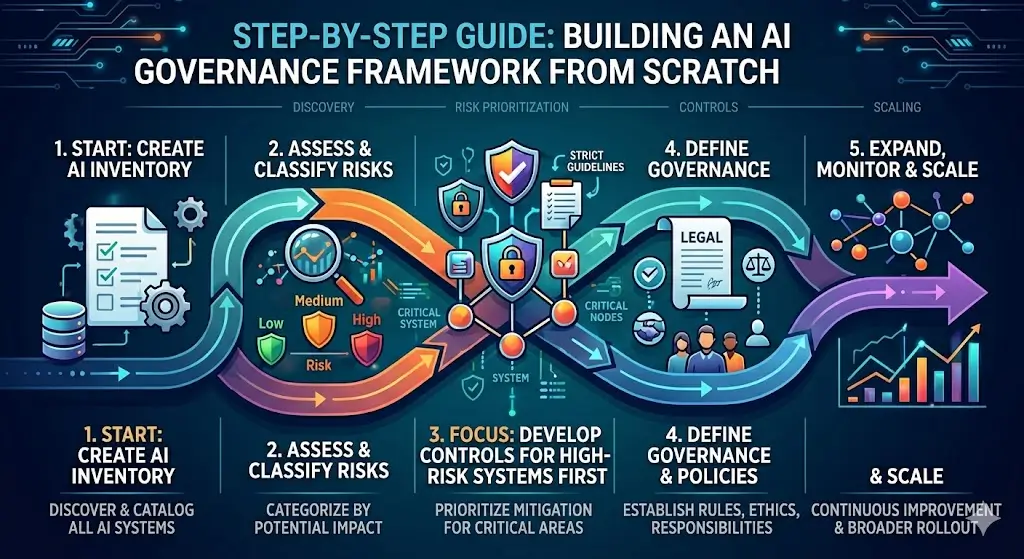
The mistake I see most often in governance program launches: organizations spend the first three months designing the complete governance framework before they know what AI they actually have. They commission a policy architecture, align on principles, choose a framework — and during all of that, their highest-risk AI systems continue running without controls.
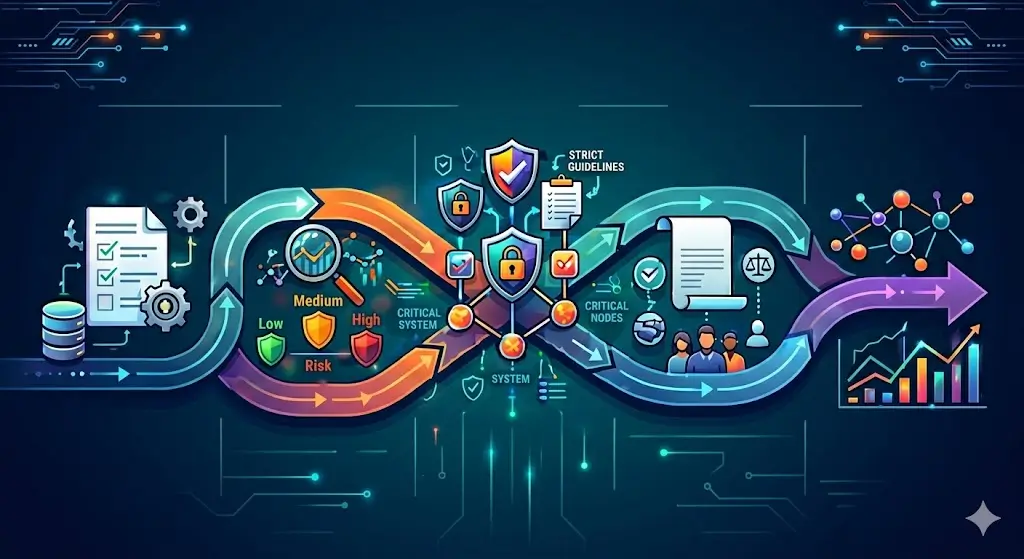
Governance programs that work flip that sequence. They start with the inventory. Then risk classification. Then controls for the systems that need them most urgently. The framework design happens in parallel, informed by reality rather than preceding it.
This guide is a practical, step-by-step reference for organizations building their first AI governance program or maturing an existing one. It covers every phase — from the AI inventory that everything depends on to the cultural practices that make governance self-sustaining at scale.
This article is part of our Complete Guide to AI Governance. For framework selection guidance, see our 7 AI Governance Frameworks guide. For the foundational concepts, see What Is AI Governance?
Before You Start: The Right Sequence
Three principles should govern how you sequence your governance program build. Getting these right means the difference between a program that produces real risk management and one that produces documentation that nobody uses.
Principle 1: Risk before policy. Understand what AI you have and what risks it creates before you design the governance framework to manage those risks. Policy designed in the abstract — without reference to actual AI inventory and actual risk profiles — produces generic controls that don’t fit any specific situation well.
Principle 2: Controls before coverage. Build solid controls for your highest-risk AI systems before extending lightweight governance to your full portfolio. An organization with 50 AI systems that has excellent governance for its 5 highest-risk systems is far better positioned than one with thin coverage across all 50.
Principle 3: Embed rather than bolt on. Governance that is bolted onto existing development and procurement processes as a review step gets treated as an obstacle and bypassed. Governance embedded into those processes as a standard stage — a model card requirement in the deployment pipeline, a risk classification step in procurement — becomes part of how work gets done rather than a separate compliance exercise.
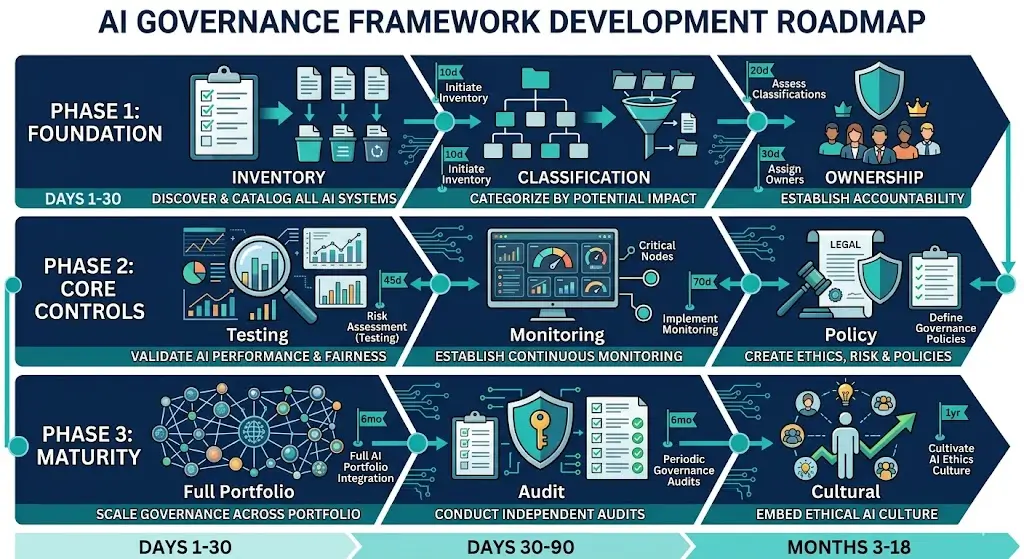
Phase 1: Foundation (Days 1–30)
Step 1: Build Your AI Inventory
Objective: a complete, documented list of every AI system your organization uses, builds, or plans to deploy — including shadow AI.
Start here. Not with policy. Not with framework selection. With the inventory. You cannot classify risk, establish oversight, or build controls for AI systems you don’t know you have.
An effective AI inventory uses multiple discovery methods simultaneously. Procurement and contracts: review all software contracts and SaaS subscriptions for AI capabilities, whether explicitly sold as AI or embedded in tools procured for other purposes. IT asset management: scan for AI-related software, libraries, APIs, and cloud services in use across the organization. Network monitoring: configure DLP and network monitoring tools to detect AI API calls, traffic to known AI services, and unauthorized SaaS connections. Department surveys: ask every business unit to self-report AI tools they’re using — both officially approved and personally adopted. Teams typically know what they’re using; they just haven’t been asked to report it systematically.
Most organizations discover significantly more AI than they anticipated. The gap between the initial mental inventory and the actual inventory is where your most urgent governance risks usually live — particularly shadow AI used in HR, legal, finance, and clinical functions.
For each AI system discovered, capture: system name and vendor, intended purpose and actual use cases, data types processed (including personal data), organizational function and team using it, current approval status (formally approved / informally adopted / unapproved), and a preliminary risk assessment.
Step 2: Classify AI Systems by Risk
Objective: assign each AI system in your inventory to a risk tier that determines the governance requirements that apply to it.
Not all AI requires the same governance intensity. A spell-checker doesn’t need Annex IV documentation. A system that makes loan decisions does. Risk classification determines which systems get which treatment — and prevents both governance gaps (high-risk AI without adequate controls) and governance waste (enterprise-grade oversight applied to minimal-risk tools).
Use a two-step classification process. First, apply the EU AI Act’s Annex III framework: does this system fall within one of the eight high-risk sectors (employment, credit, healthcare, education, housing, essential government services, law enforcement, critical infrastructure)? If yes, it requires comprehensive governance controls. Second, for systems that don’t clearly fall in those sectors, apply a risk scoring matrix that considers: consequence severity if the AI produces incorrect outputs, scale of affected population, reversibility of AI-influenced decisions, and level of human oversight currently in place.
This classification becomes the living backbone of your governance program — a document that gets updated as new systems are discovered, deployed, or retired.
Step 3: Establish Governance Ownership
Objective: assign named accountability for AI governance overall and for each high-risk AI system specifically, before any controls are built.
Governance without named owners doesn’t function. This is not a metaphysical claim — it’s an observation about organizational behavior. Controls that aren’t someone’s explicit responsibility don’t get monitored. Incidents without a named owner don’t get investigated. Bias testing without an assigned team doesn’t get run.
Assign two levels of ownership. First, an organization-level AI governance lead — typically the General Counsel, Chief Risk Officer, Chief Compliance Officer, or a dedicated Chief AI Officer — who owns the governance program overall, makes binding decisions on governance policies, and escalates AI risk issues to the board. Second, system-level owners for each high-risk AI system — named individuals accountable for the system’s performance, its governance compliance, and incident response if something goes wrong.
Form a cross-functional AI governance board within the first 30 days. This should include legal, compliance, engineering, data science, risk management, HR, and product representation — with clear decision authority over AI approvals, risk classifications, and significant governance decisions. Not an advisory committee that makes recommendations. A body with binding decision rights.[1]
Phase 2: Core Controls (Days 30–90)
With inventory, risk classification, and ownership in place, Phase 2 builds the actual controls for your highest-risk AI systems. This is where the governance program becomes operational rather than preparatory.
Step 4: Build the Risk Assessment for Each High-Risk System
Objective: a documented risk register for each high-risk AI system covering technical and sociotechnical risks, likelihood and severity, mitigations, and residual risk.
The risk assessment is the foundation of governance documentation. It creates the evidence trail that demonstrates you evaluated risks before deployment — the evidence that regulators, auditors, and courts will ask for first if something goes wrong.
For each high-risk AI system, document: a description of the system and its deployment context, the specific risks identified (covering both technical failure modes and sociotechnical risks like over-reliance and out-of-scope use), a likelihood and severity assessment for each risk with documented reasoning, the specific mitigations in place or planned, and the residual risk level after mitigation. This risk register should be treated as a living document — updated when the system changes, when new risks are identified through monitoring, or when deployment context shifts.
Step 5: Implement Bias Testing and Fairness Controls
Objective: documented bias testing with disaggregated performance metrics before deployment, and ongoing monitoring for emerging disparate impact after deployment.
For any AI system that makes or substantially influences decisions affecting individuals — employment, credit, healthcare, housing — bias testing is not optional. It is required by EU AI Act Annex IV, Colorado’s AI Act reasonable care standard, and US civil rights law enforcement expectations from the EEOC and FTC.
Effective bias testing requires three things: demographic data in your test dataset, the computational infrastructure to compute performance metrics by demographic group, and an organizational process that acts on findings before deployment. Run accuracy, false positive rate, and false negative rate separately for every demographic group the system will affect. Document the results honestly — including performance gaps you found and how you addressed them. Results that show perfect equity across all groups are treated with appropriate skepticism by regulators; honest documentation of gaps and mitigations is far more credible.
Step 6: Establish Human Oversight Protocols
Objective: documented workflows specifying how humans review, validate, and override AI outputs for consequential decisions — with genuine override authority.
Human oversight is required by the EU AI Act (Article 14), Colorado’s AI Act (right to human review for adverse decisions), and multiple US civil rights enforcement guidelines. It is also the primary defense against the “automation bias” risk — the well-documented tendency of human reviewers to default to AI recommendations without genuine independent evaluation.
Effective oversight protocols specify: who reviews AI outputs before consequential decisions are made (including minimum qualifications), what information reviewers have access to (the AI’s recommendation, its confidence level, the underlying inputs), what authority reviewers have to override AI recommendations (and whether that override is actually recorded), and how AI-assisted decisions are documented for audit purposes. “A manager approves AI decisions” is not an oversight protocol. A documented workflow with named reviewer roles, access requirements, override mechanisms, and logging is.
Step 7: Build Logging and Monitoring Infrastructure
Objective: operational logging that creates a continuous audit trail, and monitoring that detects performance degradation and bias drift before they cause harm.
Governance without monitoring is a controls-at-launch approach that degrades over time as AI systems drift from their documented performance profiles. Every high-risk AI system needs two monitoring functions operating continuously after deployment.
Operational logging captures what the system did, when, with what inputs, and with what outputs — the audit trail that enables incident investigation, regulatory compliance, and pattern detection. EU AI Act Article 12 specifies minimum logging requirements for high-risk AI. Design your logging to meet those requirements from day one.
Performance monitoring tracks whether the system continues to perform within acceptable parameters — accuracy, bias metrics, calibration — and alerts relevant owners when performance degrades below defined thresholds. The threshold decisions (what level of performance degradation triggers a review) should be made during governance design, not discovered in hindsight during an incident.
Phase 3: Maturity (Months 3–18)
Phase 3 expands governance from your highest-risk systems to your full AI portfolio, and builds the organizational practices that make governance sustainable without heroic individual effort.
Extend coverage to full AI portfolio. Using the risk classification from Phase 1, design proportional governance for each risk tier. High-risk systems get the full Phase 2 control set. Medium-risk systems get simplified risk assessments, basic bias testing, and monitoring. Minimal-risk systems get policy acknowledgment and basic documentation. The goal is governance that scales with your AI portfolio without requiring linear increases in compliance staffing.
Implement continuous monitoring infrastructure. Manual monitoring works at launch; it fails at scale. By month six, governance monitoring should be automated where possible — model performance dashboards with automated alerting, bias monitoring tools that flag emerging demographic performance gaps, and logging systems that surface anomalous behavior without requiring manual review of individual decisions.
Establish regular audit cycles. At minimum, conduct quarterly reviews of high-risk AI system performance against their documented governance specifications, and annual comprehensive governance audits that assess the entire program against your chosen framework (NIST AI RMF, ISO 42001, EU AI Act requirements). For systems where circumstances have changed — new data, new use cases, new deployment contexts — trigger out-of-cycle reviews.
Embed governance into development and procurement. Governance that lives outside the development pipeline gets bypassed under deadline pressure. The most sustainable approach: governance checkpoints built into the standard development and deployment workflow. A model card requirement before a model can be deployed to production. A risk classification check in the procurement process for AI-enabled software. A bias testing gate that must be passed before a high-risk AI update is approved for production. When governance is the path of least resistance, it gets done.
Consider ISO/IEC 42001 certification. If your commercial context requires demonstrated governance maturity — enterprise procurement qualifying, regulated industry partner requirements, international market expansion — pursue ISO 42001 certification in Phase 3. The governance infrastructure built in Phases 1 and 2 provides most of the substantive content; certification adds the management system structure, documentation, internal audit program, and external audit process that certification requires.[2]
Governance Structure: Ownership and Decision Rights
The organizational structure that supports AI governance is as important as the technical controls. Specifically: who can make which decisions, with what evidence, and with what consequences.
The AI governance board — established in Phase 1 — should own five categories of decisions: AI use case approvals (which AI systems can be deployed for which purposes), risk classification disputes (when teams disagree about whether a system is high-risk), policy exceptions (when an operational need requires deviation from standard governance requirements), incident response authorization (when an AI incident requires escalated response), and framework updates (when the governance program needs to evolve in response to new regulations or internal learning).
Below the board, system-level accountability owners carry day-to-day responsibility for their systems’ governance compliance. They are the people who receive monitoring alerts, commission bias testing, maintain risk registers, and appear in the documentation as the responsible party. When something goes wrong with a system, the system owner is the first accountability point — not the governance board.
A common structural question: should engineering or legal/compliance chair the governance function? The answer: the chair should have both sufficient organizational authority to enforce governance decisions and sufficient credibility across technical and legal/ethical dimensions. A Chief AI Officer or Chief Risk Officer working closely with legal and technical leadership typically provides the right combination. Pure technical leadership of governance tends to underweight legal and ethical dimensions; pure legal leadership tends to underweight implementation feasibility. Both perspectives need to be genuinely present in governance decisions.
Core Policy Framework: What You Actually Need
Organizations consistently over-engineer their AI policy frameworks at the expense of implementing actual controls. A 60-page AI policy document that nobody reads provides less governance value than a five-page policy that describes real processes that are actually followed.
The minimum viable AI policy framework requires four documents. AI Acceptable Use Policy: what AI can and cannot be used for by employees, including approved tools, prohibited use cases, data handling requirements, and disclosure obligations. Designed for all employees, written in plain language. AI Risk Classification Policy: the criteria and process for classifying AI systems by risk level, including who makes the classification decision and how it is documented. AI Development and Deployment Standards: the technical and process requirements for AI systems at each risk level — bias testing requirements, logging specifications, human oversight requirements, documentation standards. Designed for engineering and data science teams. AI Incident Response Procedures: what constitutes an AI incident, how incidents are detected and reported, who investigates, what remediation looks like, and when external disclosure is required.
These four documents, implemented and actually followed, provide more governance value than an elaborate framework that covers every contingency in theory but doesn’t reflect actual practice.
The 90-Day Action Plan
AI Governance 90-Day Action Plan
Days 1–10: AI Inventory Sprint
- Assign inventory project owner and team (minimum: IT, legal, one rep per major business unit)
- Audit all software contracts, SaaS subscriptions, and cloud services for AI capabilities
- Conduct department surveys for AI tools in use (approved and unapproved)
- Configure network monitoring to detect AI service connections
- Produce initial AI inventory document with preliminary risk flags
Days 10–20: Risk Classification
- Apply EU AI Act Annex III framework to all systems in inventory
- Apply risk scoring matrix to systems not clearly within Annex III sectors
- Produce tiered AI inventory: high-risk / medium-risk / minimal-risk
- Identify any currently deployed high-risk AI systems without existing governance controls
Days 20–30: Ownership and Structure
- Appoint AI governance lead at executive level
- Assign system-level owners for all high-risk AI systems
- Form AI governance board — define membership, meeting cadence, decision authority
- First governance board meeting: review inventory, confirm risk classifications, agree priority order for control implementation
Days 30–60: Core Controls for Priority Systems
- Complete risk assessment documentation for top-priority high-risk AI systems
- Conduct and document bias testing for all high-risk systems in employment, credit, or healthcare contexts
- Implement or verify human oversight protocols for systems making consequential decisions
- Verify logging infrastructure is in place and producing audit-ready records
- Draft AI Acceptable Use Policy — first review with governance board
Days 60–90: Documentation and Expansion
- Finalize and publish AI Acceptable Use Policy
- Draft AI Risk Classification Policy and AI Incident Response Procedures
- Begin EU AI Act Annex IV documentation for high-risk systems with EU market exposure
- Implement performance monitoring for priority systems with defined alerting thresholds
- Establish quarterly governance review cadence — schedule first review
- Brief board of directors / executive leadership on AI governance program status and roadmap
Use our AI Governance Checklist to assess your readiness at the end of each 30-day phase — 25 questions that surface whether governance is operational or just documented.
Frequently Asked Questions
What is the first step in building an AI governance framework?
Build the AI inventory — document every AI system your organization uses or plans to deploy. This is consistently the most underestimated step, and the most important. Most organizations discover 2–5x more AI systems than they initially estimated. Without a complete inventory, risk classification is incomplete, controls miss real risks, and governance programs are built on incorrect assumptions about what needs to be governed. Start with the inventory, not the policy framework.
How long does it take to build an AI governance program?
Minimum viable: 90 days. Mature program: 12–18 months. A 90-day sprint covering AI inventory, risk classification, basic policies, and controls for high-risk AI systems is achievable with dedicated resources. The 90-day program is a foundation, not a finished product — maturity requires extending coverage to the full portfolio, implementing continuous monitoring, establishing audit cycles, and embedding governance into development pipelines. Most organizations should plan for an 18-month full-maturity timeline.
Do you need a Chief AI Officer to build AI governance?
No, but you need named executive-level accountability. A CAIO is valuable for large organizations with complex AI portfolios. Smaller organizations can embed AI governance accountability in an existing executive role as long as that person has the authority to enforce governance decisions and the resources to build the program. The title doesn’t matter; the authority and accountability do.
Continue your governance program build:
- → 7 AI Governance Frameworks You Should Know in 2026Framework selection guidance — NIST AI RMF, ISO 42001, and when to layer the EU AI Act.
- → The 5 Core Pillars of AI GovernanceWhat each control in your governance program is designed to address — pillar by pillar.
- → AI Governance vs. AI EthicsWhy governance and ethics require different implementation approaches — and how to integrate both.
- → AI Governance Checklist: 25 QuestionsUse after each 30-day phase to assess whether governance is operational or just documented.
📚 References and Sources
- Ethyca, “AI Governance: Framework, Compliance & Operational Guide 2026.” Three-phase governance program development; governance ownership as prerequisite; operational vs. compliance-driven governance. ethyca.com
- SoftwareSeni, “EU AI Act NIST AI RMF and ISO 42001 Compared,” November 2025. ISO 42001 implementation timeline 9–18 months; enterprise sales certification requirements. softwareseni.com
- Quickway Info Systems, “AI Governance Framework for Enterprises: 2026 Blueprint.” AI inventory as first step; governance board structure; cross-functional ownership model. quickwayinfosystems.com
- NIST AI RMF 1.0 Playbook, January 2023. GOVERN-MAP-MEASURE-MANAGE functions; suggested actions for each function across the AI lifecycle. airc.nist.gov
- EU AI Act, Regulation (EU) 2024/1689. Article 9 (risk management system), Article 12 (logging), Article 14 (human oversight), Annex IV (technical documentation requirements). eur-lex.europa.eu
Sources verified March 2026. This article does not constitute legal advice.