Here is a thing that happens in organizations all the time. A company publishes a thoughtful AI ethics statement. It commits to fairness. It pledges transparency. It promises that AI will augment, not replace, human judgment. Leadership signs off. The comms team puts it on the website.
Six months later, the same company’s AI hiring tool is filtering out candidates from certain universities because those universities weren’t well-represented in historical hiring data. Nobody catches it because nobody is looking. The bias persists for months, affecting real hiring decisions, because the ethics statement had no operational infrastructure behind it. There was no bias testing requirement. There was no monitoring dashboard. There was no incident response process. There was ethics. But there was no governance.
This scenario plays out in organizations large and small, across industries, at companies that genuinely believe they care about AI ethics. The problem isn’t the values — those are usually sincere. The problem is that values without implementation infrastructure don’t change behavior.
This article is the precise treatment of that distinction — what AI ethics is, what AI governance is, why they are different, why both are necessary, and how organizations can build programs that genuinely integrate them rather than substituting one for the other.
This is part of our Complete Guide to AI Governance. For implementation guidance, see How to Build an AI Governance Framework from Scratch.
The Precise Distinction
The clearest way to understand the difference is through a single question and what happens when you try to answer it.
Imagine your company’s AI system produces discriminatory hiring outcomes tomorrow. A regulator calls and asks: “What evidence do you have that you evaluated this AI for discrimination risks before deployment, that controls were in place to prevent this, and that monitoring was running to catch it if controls failed?”
If your answer is: “We have an AI ethics policy that commits to non-discrimination” — you have AI ethics. You do not have AI governance.
If your answer is: “We have documented bias testing conducted before deployment, showing performance metrics disaggregated by demographic group, conducted by [named person or team] on [date], with findings and remediation documented in our risk register. We have a monitoring dashboard that tracks disparate outcome rates in real time, with alerting set to trigger when rates deviate beyond [defined threshold]. We have an incident response process owned by [named individual] that would have triggered investigation and reporting within [defined timeframe]” — then you have AI governance.
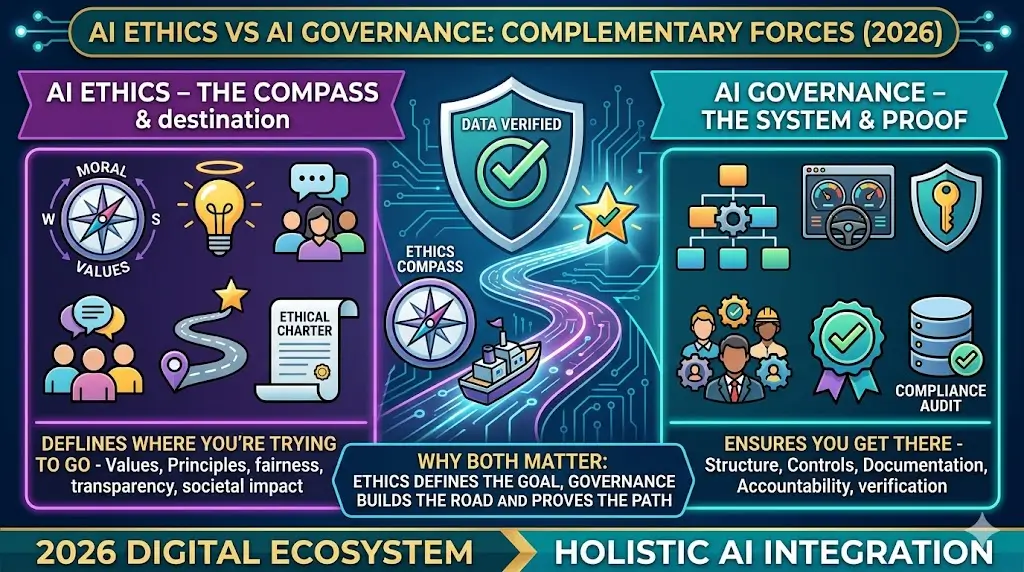
Ethics defines the destination. Governance is the map, the vehicle, and the accountability for arriving.
| Dimension | AI Ethics | AI Governance |
|---|---|---|
| Primary question | What is right? What should we aim for? | How do we ensure what’s right actually happens — and prove it? |
| Output | Principles, values, commitments | Policies, processes, controls, evidence |
| Enforceability | Moral and reputational pressure | Organizational authority, regulatory compliance, audit |
| Evidence type | Statements and commitments | Documentation, test results, audit trails |
| What happens when violated | Reputational damage if discovered | Regulatory fines, legal liability, operational consequences |
| Who produces it | Ethics teams, executive leadership, external advisors | Cross-functional teams: legal, engineering, compliance, risk |
| Time horizon | Ongoing aspiration — doesn’t “expire” | Continuous operational function — requires ongoing maintenance |
What AI Ethics Actually Is
AI ethics is a field concerned with the moral questions raised by AI: what values should guide AI development, what obligations developers and deployers have to affected individuals and society, and how AI should be designed to respect human rights, dignity, and autonomy.
The core principles that appear across most AI ethics frameworks are well-established by now. Fairness: AI should not produce discriminatory outcomes. Transparency: AI systems should be explainable and their use should be disclosed. Accountability: there should be clear responsibility for AI outcomes. Human autonomy: AI should augment rather than override human judgment for consequential decisions. Beneficence: AI should benefit people and society. Non-maleficence: AI should not cause harm.[1]
These principles are valuable. They represent hard-won consensus across philosophy, technology, law, and civil society about what responsible AI should look like. They are also — by design — abstract. They are intended to be broadly applicable across contexts, sectors, and technologies. That abstraction is a feature for establishing consensus; it becomes a problem when organizations mistake principles for programs.
The gap between principle and program is where most AI ethics failures occur. “We are committed to fairness” is a principle. “Before deployment, we test every AI system’s performance disaggregated by demographic group, with a documented fairness definition, and we refuse to deploy systems where we cannot demonstrate equitable performance within acceptable bounds” is a program. The principle is necessary but insufficient; the program is what actually prevents harm.
What AI Governance Actually Is
AI governance is the operational infrastructure that makes ethical principles a consistent organizational reality rather than an aspirational statement.
As Ethyca defines it: AI governance is “the operating framework for approving, monitoring, and controlling AI systems with continuous, audit-ready evidence. It defines who can make decisions about AI, what evidence those decisions must produce, and how controls are enforced across the full lifecycle.”[2]
Note what this definition contains that ethics definitions don’t: approving (who decides), monitoring (ongoing, not just at launch), controlling (mechanism for enforcement), and audit-ready evidence (proof, not assertion). These are operational requirements. They require people, processes, tools, and accountability structures — not just values.
The practical test is always the same: if someone asked you tomorrow to produce evidence that your AI system was governed responsibly, what would you hand them? Ethics provides the statement of intent. Governance provides the evidence of performance.
Five Ways Conflating Them Creates Real Harms
The distinction isn’t academic. Organizations that treat ethics and governance as synonymous consistently produce specific, predictable failures.
Failure 1: Ethics statements prevent accountability. Organizations sometimes cite their AI ethics commitments as evidence that they take AI risks seriously — in regulatory contexts, in response to incidents, in procurement qualifying. A well-written ethics statement can create a false sense of compliance that delays the building of actual governance infrastructure. The statement performs the function of governance without providing any of its protections.
Failure 2: Ethics without governance produces ethics-washing. “Ethics-washing” — making ethical-sounding commitments with no operational follow-through — is one of the most widely documented problems in responsible AI practice. It damages public trust, creates regulatory skepticism, and eventually produces the very incidents it was meant to prevent. Organizations that genuinely value AI ethics are best served by governance infrastructure that creates verifiable evidence of their commitments, not policy documents that can be deployed in response to criticism.
Failure 3: Governance without ethics produces compliance theater. The opposite failure is equally real. Organizations that build governance programs purely in response to regulatory requirements — designed to produce the required documentation without genuine engagement with the underlying values — produce systems that technically comply with the letter of requirements while missing their intent. Governance that is not grounded in genuine ethical commitment is brittle: it satisfies specific requirements while failing in novel situations that the regulatory framework didn’t anticipate.
Failure 4: Neither function gets resourced adequately. When ethics and governance are conflated, they often share a budget that adequately funds neither. The ethics function doesn’t have the legal and compliance expertise to translate principles into regulatory requirements. The compliance function doesn’t have the philosophical and social science expertise to identify ethical dimensions that aren’t in the legal requirements. Both suffer from being combined into a single underfunded hybrid function.
Failure 5: Accountability gaps emerge in novel situations. Ethics principles are designed to be timeless and universally applicable. Governance programs are designed for known risk scenarios. When a genuinely novel AI risk emerges — a new capability, a new deployment context, a new harm pattern — organizations with only ethics principles have no operational mechanism to respond. Organizations with governance infrastructure can invoke existing accountability structures, escalation processes, and incident response procedures even for situations those processes weren’t specifically designed for.
How Ethics and Governance Connect
The relationship is not adversarial or even parallel — it’s sequential and mutually reinforcing. Ethics provides the values that governance operationalizes. Governance provides the accountability and evidence that make ethical commitments credible.
Think of it architecturally: ethics is the foundation specification — what the building must achieve and why. Governance is the architectural and engineering system that translates that specification into a structure that actually stands up and does what it was designed to do, verifiably and continuously.
In practice, the sequence works like this. Start with ethical principles: what values should guide how your organization develops and uses AI? These principles should be developed with genuine engagement across the organization — not just by legal and compliance, but with input from the technical teams who will implement them, the business teams who will use the AI, and ideally some perspective from the communities affected by AI decisions.
Then translate each principle into operational requirements: what specific controls, processes, and governance mechanisms would ensure that this principle is respected in practice? “Commitment to fairness” becomes: bias testing before deployment, disaggregated monitoring after deployment, a defined remediation process when bias is detected, and clear accountability for the outcome.
Then build those requirements into your governance program. The governance program has explicit traceability back to the ethical principles that motivated it — so that governance doesn’t become a box-ticking exercise, and ethics doesn’t become mere aspiration.
The World Economic Forum describes this integration precisely: “Clear accountability, transparency, fairness and integrity must be built into everyday workflows, system design and decision-making rather than left as policy statements.”[3]
Building Programs That Integrate Both
Three practical principles for organizations building integrated ethics-and-governance programs.
Principle 1: Ethics informs, governance operationalizes. Every governance control should trace back to an ethical principle. Every ethical principle should have at least one operational governance control associated with it. When either side of that relationship is missing — governance controls without ethical grounding, or ethical principles without governance controls — you have a gap that creates either compliance theater or ethical aspiration without follow-through.
Principle 2: Involve different expertise for each function. AI ethics requires philosophical expertise, social science perspective, and community input — to identify what values matter and why. AI governance requires legal, compliance, engineering, and risk management expertise — to translate values into systems that work under organizational constraints and regulatory requirements. The people who do ethics well and the people who do governance well are often different people. Programs that try to locate both in a single function usually underfund both.
Principle 3: Treat failures in either direction as equally serious. Ethics-washing (ethics without governance) and compliance theater (governance without ethics) are different failure modes, but they’re equally damaging — to affected individuals, to organizational reputation, and to the broader project of developing trustworthy AI. Organizations serious about responsible AI have to be equally vigilant against both.
Related guides in this series:
- → The Complete Guide to AI GovernanceThe full pillar guide — frameworks, pillars, regulatory landscape, and implementation.
- → The 5 Core Pillars of AI GovernanceHow ethical principles map to specific governance pillars — and what implementing each pillar actually requires.
- → 7 AI Governance Frameworks You Should Know in 2026How NIST AI RMF, ISO 42001, and the EU AI Act operationalize ethical principles into governance requirements.
- → How to Build an AI Governance Framework from ScratchThe operational steps for translating ethical principles into governance infrastructure.
- → What Is AI Governance? Plain-English DefinitionThe foundational explainer for business leaders new to the governance concept.
- → AI Governance Checklist: 25 Questions Before Deploying AIA diagnostic for identifying whether your governance program actually operationalizes your ethics commitments.
Frequently Asked Questions
What is the difference between AI governance and AI ethics?
Ethics defines values; governance operationalizes them. AI ethics answers “what is right?” — producing principles and commitments about fairness, transparency, accountability, and human benefit. AI governance answers “how do we ensure what’s right actually happens?” — producing policies, processes, controls, monitoring systems, and accountability structures that translate principles into consistent practice. You need both: ethics without governance is aspiration; governance without ethics is compliance theater.
Is AI ethics part of AI governance?
Ethics is the foundation that governance operationalizes. The relationship is sequential: ethical principles define the values that governance programs implement. Governance programs should have explicit traceability back to the ethical principles that motivated them — so that governance doesn’t become a bureaucratic box-ticking exercise, and ethics doesn’t remain mere aspiration. Neither can fully substitute for the other.
Why is having an AI ethics policy not enough?
Because a policy defines intent, not behavior. An ethics policy that commits to “fairness” provides no protection against an AI system that discriminates against protected classes — because the policy contains no bias testing requirement, no monitoring system, no accountability structure, and no incident response process. The hiring algorithm scenario in this article’s introduction is precisely what happens when ethics policies exist without governance infrastructure behind them. Organizations that want AI ethics to actually prevent harm must translate ethics statements into operational governance controls.
What are examples of AI ethics principles?
The most widely cited: fairness and non-discrimination, transparency and explainability, accountability and responsibility, human autonomy (AI should augment, not replace, human judgment for consequential decisions), beneficence (AI should benefit people), and non-maleficence (AI should not cause harm).[1] These principles appear in the OECD AI Principles, the EU’s Ethics Guidelines for Trustworthy AI, and most major governance frameworks — evidence of the global consensus on what AI ethics requires at the values level.
📚 References and Sources
- OECD, “Recommendation of the Council on Artificial Intelligence,” 2019 (updated 2024); European Commission High-Level Expert Group on AI, “Ethics Guidelines for Trustworthy AI,” 2019; UNESCO, “Recommendation on the Ethics of Artificial Intelligence,” 2021. Core AI ethics principles: fairness, transparency, accountability, human autonomy, beneficence, non-maleficence. oecd.ai
- Ethyca, “AI Governance: Framework, Compliance & Operational Guide 2026.” Definition of AI governance as operational infrastructure producing audit-ready evidence. ethyca.com
- World Economic Forum, “Why effective AI governance is becoming a growth strategy,” January 2026. Ethics and governance integration: accountability, transparency, and fairness built into everyday workflows rather than policy statements. weforum.org
- Quickway Info Systems, “AI Governance Framework for Enterprises: 2026 Blueprint.” Governance vs ethics vs compliance distinction; ethics sets ideals; compliance monitors observance; governance provides oversight framework. quickwayinfosystems.com
Sources verified March 2026. This article does not constitute legal advice.