
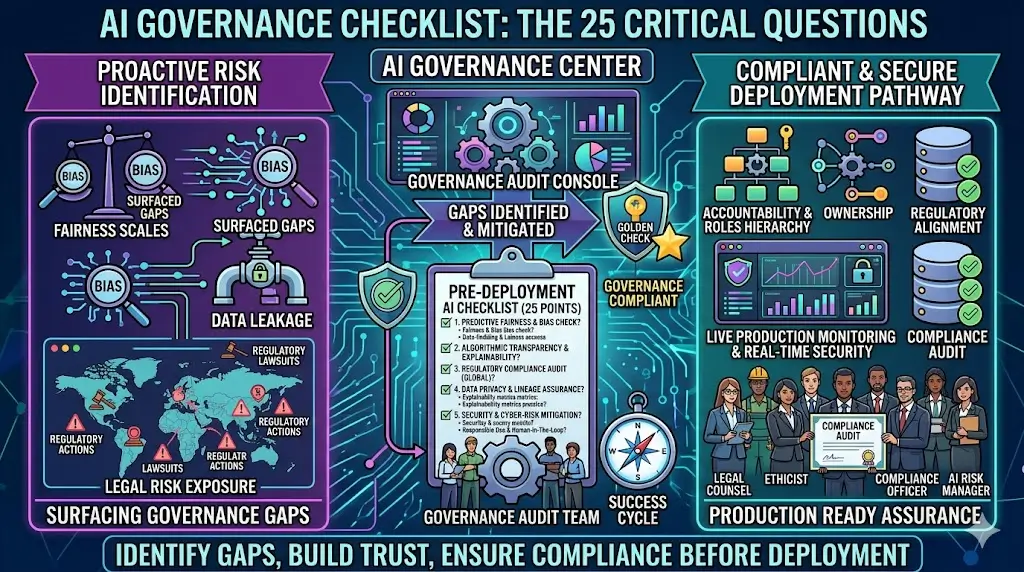
Every governance failure leaves a paper trail. Not in the form of a warning — in the form of an absence. The absence of bias testing documentation. The absence of a named owner for incident response. The absence of monitoring infrastructure. The absence of a human oversight protocol. When regulators investigate an AI incident or plaintiffs’ attorneys conduct discovery in an AI discrimination lawsuit, they’re looking for that absence — and finding it.
This checklist is designed to surface those absences before they become expensive. Twenty-five specific, binary questions across the five core governance pillars. If you can answer “yes — with documentation” to all twenty-five, your governance program is in strong shape. If you find yourself answering “yes but it’s not documented” or “we haven’t checked,” those are your gaps. If you answer “no,” those are your most urgent priorities.
Use this checklist: before deploying any new high-risk AI system; as an annual governance review for deployed high-risk AI systems; after significant changes to high-risk AI systems; and as a board or executive reporting tool to assess program status across your full AI portfolio.
This article is part of our Complete Guide to AI Governance. For framework guidance, see 7 AI Governance Frameworks. For implementation, see How to Build an AI Governance Framework from Scratch.
How to Use This Checklist
Each question has three possible answers: ✅ YES (documented) — the control exists and is documented with evidence; ⚠️ YES (undocumented) — the control exists in practice but documentation is absent or incomplete; ❌ NO or UNKNOWN — the control doesn’t exist, or you genuinely don’t know.
For governance purposes, only the first answer is satisfactory. “Yes but undocumented” is a compliance gap: if you cannot produce evidence of a control’s existence and operation, the control does not exist from a regulatory and litigation perspective. “Unknown” is a governance gap of a different kind — it suggests the AI system is not adequately monitored or documented.
For each “No” or “Unknown” answer, note: the gap, who should own remediating it, and a realistic target date for remediation. A checklist that produces only a score is less valuable than one that produces an action list.
Run this checklist per AI system, not across your portfolio as a whole. Governance is system-specific — a “yes” for System A does not mean System B is covered. High-risk AI systems each need their own checklist completion.
🕑 EU AI Act Note
For AI systems with EU market exposure, questions where a “No” answer creates direct EU AI Act compliance violations are marked with [EU AI Act]. These should be treated as the highest-priority gaps — they carry regulatory fine exposure, not just governance quality concerns.
Section A: Accountability (Questions 1–5)
Accountability questions identify whether clear ownership exists for this AI system’s governance and outcomes. These are the organizational structure questions — without strong accountability, every other section of this checklist will have implementation gaps.
🛡 Section A: Accountability
-
Is there a named individual accountable for this AI system’s governance compliance and performance outcomes?
Not a team or department — a named person who would appear in an enforcement action as the responsible party. Do they have the authority to stop or modify the system if problems arise?
Governance gap if No: no named owner = no incident response accountability = enforcement/litigation vulnerability [EU AI Act Articles 16–26] -
Has this AI system been formally approved for its current use case by an authorized person or governance body?
Is there a documented record of who approved this deployment, for what purpose, and when? Or was it deployed informally without formal approval? -
Is there a documented risk assessment for this AI system covering both technical and sociotechnical risks?
Does the risk register include failure modes, discrimination risks, over-reliance risks, and misuse scenarios — not just technical bugs? [EU AI Act Article 9] -
Does executive leadership receive regular reporting on this AI system’s risk profile and governance status?
Not a one-time briefing — ongoing reporting. Board-level visibility into AI risk is increasingly an expectation for regulated industry organizations. -
Is there a documented incident response process for this AI system specifying who investigates, who communicates externally, and within what timeframe?
For EU AI Act high-risk AI: serious incident reporting timelines are 15 days (general), 10 days (death involved), 2 days (critical infrastructure) under Article 73. Does this system have a process aligned with those timelines?
Section B: Transparency (Questions 6–10)
Transparency questions assess whether affected individuals and regulators can understand how this AI system works and how it influences decisions that affect them.
👁 Section B: Transparency
-
Is there comprehensive technical documentation for this AI system covering its design, training data, performance characteristics, and known limitations?
For EU AI Act high-risk AI: this is the Annex IV technical dossier requirement. For US organizations: this documentation is your primary defense in enforcement inquiries and litigation. [EU AI Act Article 11, Annex IV] -
Do deployers of this AI system have adequate Instructions for Use describing its capabilities, limitations, and required oversight measures?
A deployer who doesn’t understand an AI system’s limitations cannot provide meaningful human oversight. Does the IFU exist, and has it been provided to all deployers? [EU AI Act Article 13] -
Are consumers or individuals notified when this AI system influences consequential decisions about them?
Required by Colorado SB 24-205 for certain deployers. Required under GDPR Article 22 for automated decisions with significant effects. A standard governance expectation regardless of regulatory status. -
Can the AI system provide a meaningful explanation of why it produced a specific output for a specific input — at the case level, not just at the population level?
GDPR Article 22 and EU AI Act Article 14 both require that human reviewers can understand AI outputs well enough to evaluate them. Is this technically possible for your system? Is it operationally available to reviewers? -
If this AI system makes or influences decisions about individuals, do those individuals have a documented path to understanding and challenging those decisions?
Required by Colorado SB 24-205 (human review right), GDPR Article 22 (right to human review for automated decisions), and EU AI Act Article 14 (oversight mechanisms). Does an operational appeals process exist?
Section C: Fairness (Questions 11–15)
Fairness questions assess whether this AI system has been tested for bias and discrimination, and whether ongoing monitoring is in place to detect emerging disparate impact.
⚖ Section C: Fairness
-
Was this AI system tested for demographic performance disparities before deployment, with documented disaggregated performance metrics by relevant demographic groups?
Required by EU AI Act Annex IV Section 4; required under Colorado’s “reasonable care to prevent algorithmic discrimination” standard; expected by EEOC and FTC for employment and credit AI. Is the documentation available? [EU AI Act Annex IV §4] -
Were the training and test datasets reviewed for potential sources of historical bias before model training?
If training data reflects historical discrimination (e.g., historical hiring data from companies with discriminatory practices), the model will learn those patterns. Was this assessed before training? Is it documented? [EU AI Act Annex IV §3] -
Was a fairness definition explicitly chosen and documented — and is there reasoning for why that definition was appropriate for this specific use case?
Multiple valid mathematical fairness definitions exist and can conflict. Which one did you use, and why? The absence of an explicit choice is itself a governance gap — it means fairness wasn’t genuinely evaluated. -
Is there ongoing monitoring for emerging demographic performance disparities after deployment?
A model that was fair at deployment can become biased as population distributions shift, as economic conditions change, or as the model encounters new patterns. Is demographic performance monitored continuously — not just at launch? -
If algorithmic discrimination is discovered, is there a documented process for disclosing it to affected parties and regulators within required timeframes?
Colorado SB 24-205 requires disclosure to the AG within 90 days of discovering algorithmic discrimination. EU AI Act Article 73 requires serious incident reporting. Does a process exist — before an incident, not as an improvisation during one?
Section D: Security (Questions 16–20)
Security questions assess whether this AI system has been evaluated for AI-specific attack vectors — not just conventional cybersecurity threats.
🔒 Section D: Security
-
Was the training data for this AI system evaluated for potential data poisoning — deliberate corruption to manipulate model behavior?
Data poisoning is an AI-specific threat that doesn’t have a direct conventional cybersecurity analog. Particularly relevant for models trained on data from external or third-party sources. Was provenance and integrity verified? -
Has this AI system been evaluated for adversarial robustness — resistance to inputs specifically crafted to cause misclassification or harmful outputs?
Required under EU AI Act Article 15 for high-risk AI: “High-risk AI systems shall be resilient with regard to attempts by unauthorised third parties to alter their use, outputs or performance.” Has adversarial testing been conducted? [EU AI Act Article 15] -
For AI systems that process external text inputs (especially LLMs or AI agents): has prompt injection been assessed as a security risk, with mitigations in place?
Prompt injection — manipulating AI system behavior through crafted inputs — is an emerging production security risk particularly for agentic AI. For systems that can take actions, the consequences of successful prompt injection can extend beyond the AI system itself. -
Are there controls preventing model inversion — extraction of sensitive training data through repeated model queries?
Models trained on personal data may be vulnerable to model inversion attacks that reconstruct individual records from the training set. For AI trained on health records, financial data, or other sensitive personal information, has this risk been assessed and mitigated? -
Is there behavioral monitoring for the AI system that detects anomalous outputs suggesting adversarial interference or model compromise?
Beyond conventional system monitoring (uptime, errors), is there monitoring for behavioral anomalies that indicate the model is being manipulated or has been compromised? For high-stakes systems, this is a critical governance control.
Section E: Privacy (Questions 21–25)
Privacy questions assess whether personal data is handled responsibly throughout the AI lifecycle — including the AI-specific privacy risks that GDPR compliance alone doesn’t fully address.
👤 Section E: Privacy
-
Was a Data Protection Impact Assessment (DPIA) completed for this AI system before deployment, where required by GDPR Article 35?
Required when AI processing is “likely to result in a high risk to the rights and freedoms of natural persons.” For AI systems that make automated decisions about individuals, this threshold is typically met. Is the DPIA documented and up to date? -
For organizations subject to the EU AI Act’s FRIA requirement: has a Fundamental Rights Impact Assessment been completed before deployment?
Required for public bodies, banks, insurers, and certain other deployers under EU AI Act Article 27 before deploying high-risk AI. Has the FRIA been completed and has the market surveillance authority been notified? [EU AI Act Article 27] -
Has the training data been evaluated for AI-specific privacy risks — including inference of sensitive attributes from non-sensitive inputs?
AI systems can infer sensitive attributes (health conditions, political views, sexual orientation) from combinations of innocuous data. GDPR’s special category protections are hard to apply to inferred attributes. Has this specific risk been assessed? -
Are there mechanisms to honor data subject deletion requests (GDPR Article 17) despite data being encoded in model weights?
Personal data used for AI training can persist in model parameters even after the underlying data is deleted. Is there a machine unlearning process or equivalent mechanism? Has this been legally evaluated for your specific context? -
Is there a policy and technical control preventing employees from sending personal data to unauthorized AI tools or services?
Shadow AI creates GDPR Article 28 violations (unauthorized processing) every time employees send personal data to unapproved AI tools. Is there a shadow AI governance program, DLP controls for AI traffic, and a clear acceptable use policy?
Scoring and Prioritization
Count your answers in three categories:
| Answer Type | Meaning | Priority |
|---|---|---|
| ✅ YES (documented) | Control exists and is evidenced — genuinely compliant | Maintain: schedule for annual review |
| ⚠️ YES (undocumented) | Control may exist in practice but cannot be proven — governance gap | High priority: create documentation within 30 days |
| ❌ NO or UNKNOWN | Control doesn’t exist or you don’t know — regulatory and liability exposure | Immediate action: assign owner and remediation timeline |
For prioritization among your “No” answers: EU AI Act [marked] questions first — these carry regulatory fine exposure. Then Section A (Accountability) questions — these are structural foundations without which other controls cannot function. Then Section C (Fairness) — because bias and discrimination create simultaneous regulatory, civil rights litigation, and reputational exposure. Then Section E (Privacy) — for GDPR and shadow AI exposure. Then Sections B and D.
Interpretation by score range:
20–25 documented Yes: Strong governance posture — maintain cadence and monitor for changes.
15–19 documented Yes: Functional governance with specific gaps — prioritize remediation of No answers.
10–14 documented Yes: Significant governance gaps — build a structured remediation program.
Under 10 documented Yes: Governance program urgently needed — this AI system has serious unmitigated risk exposure.
Use our complete How to Build an AI Governance Framework guide to address the gaps this checklist surfaces. For framework selection to structure your remediation, see 7 AI Governance Frameworks You Should Know in 2026.
Frequently Asked Questions
What should an AI governance checklist include?
Five areas: accountability, transparency, fairness, security, and privacy. These correspond to the five core pillars of AI governance that appear consistently across NIST AI RMF, ISO 42001, the EU AI Act, and the OECD AI Principles. Each area should include questions about both whether controls exist and whether they are documented — because undocumented controls provide no regulatory protection. For organizations with EU market exposure, add EU AI Act-specific questions around Annex IV documentation, FRIA completion, and Article 73 incident response timelines. For a deeper treatment of each pillar, see our 5 Core Pillars of AI Governance guide.
How do you assess AI governance maturity?
Across five dimensions: inventory, risk classification, control coverage, monitoring, and accountability. A mature governance program can answer “yes, with documentation” to: Do you know all AI systems in use (including shadow AI)? Are all AI systems classified by risk level? Do high-risk systems have documented risk assessments, bias testing, human oversight, and monitoring? Are deployed systems continuously monitored for performance and bias? Is there named ownership for each system and a cross-functional governance board with real decision authority? Organizations that score “yes” across all five have mature governance; gaps in any of the five indicate specific program investment needs.
When should an AI governance checklist be completed?
Three occasions: pre-deployment, annually, and after significant changes. Running this checklist only at initial deployment misses the governance problem that matters most in practice: deployed AI systems that drift from their documented governance specifications over time. Annual reviews for all high-risk AI systems catch performance degradation, emerging bias issues, and governance processes that have become outdated as the system evolved. After any significant change — new training data, changed purpose, architectural update — re-run the checklist before redeployment.
Address your checklist gaps:
- → How to Build an AI Governance Framework from ScratchStep-by-step remediation roadmap with 90-day action plan.
- → The 5 Core Pillars of AI GovernanceWhat each checklist section is designed to address — pillar by pillar.
- → 7 AI Governance Frameworks You Should Know in 2026NIST AI RMF, ISO 42001, EU AI Act — which framework to use to structure your remediation.
- → AI Governance vs. AI EthicsWhy checklist gaps persist in organizations that believe they’re governing responsibly.
- → What Is AI Governance? Plain-English DefinitionShare with business leaders who need the business case for addressing these gaps.
📚 References and Sources
- EU AI Act, Regulation (EU) 2024/1689. Articles 9, 11, 13, 14, 15, 27, 47, 72, 73; Annex IV. All EU AI Act-marked questions reference specific articles. eur-lex.europa.eu
- NIST AI RMF 1.0, January 2023. GOVERN-MAP-MEASURE-MANAGE functions; suggested actions across the AI lifecycle. Fairness, accountability, transparency, security, privacy as characteristics of trustworthy AI. nist.gov
- Colorado SB 24-205, effective June 30, 2026. 90-day discrimination disclosure obligation; impact assessment requirements; safe harbor via NIST AI RMF. leg.colorado.gov
- GDPR, Regulation (EU) 2016/679. Articles 17 (deletion right), 22 (automated decision-making), 28 (processor agreements), 35 (DPIA requirement). eur-lex.europa.eu
- SecurePrivacy, “AI Governance: Enterprise Compliance & Risk Management Guide 2026.” Five pillar framework; regulatory mapping for each pillar; 99% of organizations have experienced AI-related losses averaging $4.4 million. secureprivacy.ai
Sources verified March 2026. This checklist does not constitute legal advice. Consult qualified legal counsel for jurisdiction-specific compliance assessment.