
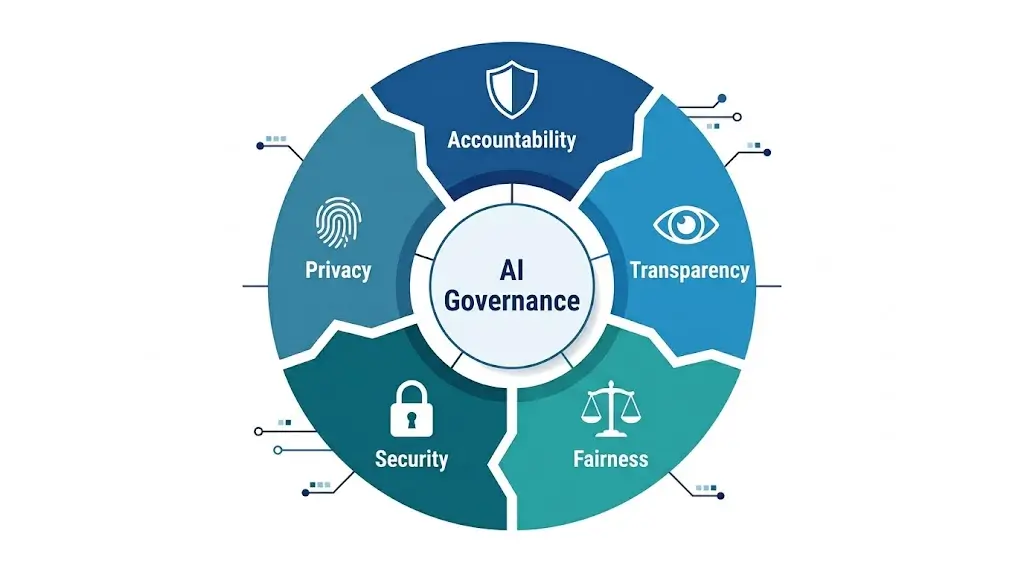
Pick up any AI governance framework — NIST AI RMF, ISO/IEC 42001, the EU AI Act, the OECD AI Principles, the World Economic Forum’s governance recommendations — and you’ll find the same five concepts appearing at the core of every one: accountability, transparency, fairness, security, and privacy.[1]
That convergence isn’t coincidence. These five pillars emerged from decades of thinking about how powerful, consequential systems should be governed — from financial regulation, medical device oversight, and data protection law — applied to the specific challenges of AI. They define what any AI governance program must address, regardless of which formal framework it adopts.
But knowing the five pillars as a list and understanding what they actually require in practice are very different things. Most governance programs can name all five. Far fewer have built concrete programs that make each pillar real in their specific organizational context.
This article goes beyond the list. For each pillar, I’ll explain what it means technically and operationally, where most organizations fail to implement it properly, and how it connects to specific legal requirements — because in 2026, these pillars are increasingly matters of law, not just aspiration.
This article is part of our Complete Guide to AI Governance. If you’re new to the topic, start with our plain-English introduction: What Is AI Governance?
The Five Pillars at a Glance
Before going deep on each pillar, here’s the overview — what each pillar covers and its core regulatory connection in 2026.
| Pillar | Core Question It Answers | Key Regulatory Connection | Primary Failure Mode |
|---|---|---|---|
| Accountability | Who is responsible when AI causes harm? | EU AI Act Article 9 (risk management system); Colorado SB 24-205 deployer obligations | Fragmented ownership across teams — everyone is “sort of” responsible, so no one actually is |
| Transparency | Do affected people understand how AI is influencing decisions about them? | EU AI Act Articles 13–14 (transparency and IFU); GDPR Article 22 (automated decision-making) | Technical documentation exists but affected individuals receive no meaningful explanation |
| Fairness | Does the AI produce equitable outcomes across demographic groups? | EU AI Act Annex IV (disaggregated performance); Colorado SB 24-205 (algorithmic discrimination); Title VII / ECOA (US) | Aggregate accuracy metrics look good; demographic subgroup performance never tested |
| Security | Is the AI protected against adversarial attacks and misuse? | EU AI Act Article 15 (accuracy and robustness); NIST AI RMF MEASURE 2.5–2.6; DORA (financial sector) | Standard IT security controls applied to AI without addressing AI-specific attack vectors |
| Privacy | Is personal data handled responsibly throughout the AI lifecycle? | GDPR Articles 5, 22, 35; EU AI Act Annex IV Section 3 (data governance); HIPAA (health AI) | GDPR compliance checked at data collection stage; AI-specific privacy risks during inference never assessed |
Pillar 1: Accountability
Core question: Who is responsible for this AI system’s outcomes — and does that person have the authority, information, and process to act when something goes wrong?
Regulatory drivers: EU AI Act Article 9 (risk management system ownership); EU AI Act Articles 16–26 (provider and deployer obligations); Colorado SB 24-205 (deployer risk management program); OMB M-24-10 (US federal agency AI accountability)
Accountability is the foundational pillar — not because it’s the most glamorous, but because without it, every other pillar degrades. When no one owns responsibility for an AI system’s fairness performance, bias testing gets skipped. When no one is accountable for monitoring, models drift undetected. When incident response has no owner, problems compound before anyone acts.
Only 15% of boards currently receive AI-related metrics, per SecurePrivacy’s 2026 enterprise governance analysis[2] — meaning accountability gaps exist at the highest organizational levels, not just in technical teams.
What Real Accountability Looks Like
Accountability in AI governance requires four concrete elements. Named ownership — specific individuals assigned responsibility for each AI system, with documented roles covering development oversight, deployment approval, performance monitoring, and incident response. Decision rights — documented authority over who can approve AI use cases, modify deployed systems, or retire them. Escalation paths — defined processes for what happens when AI performance degrades, bias is detected, or a serious incident occurs. Board-level visibility — regular reporting to executive leadership and the board on AI risk exposure and governance program status.
The most common failure pattern is what I call “distributed accountability” — the state where legal owns one part, engineering owns another, the business owns the outcomes, and data science owns the model, but nobody owns the whole picture. Accountability that is fragmented across functions is functionally equivalent to no accountability: when something goes wrong, every team can credibly point to what they were responsible for and what they weren’t.
The Regulatory Dimension
The EU AI Act’s provider and deployer obligations create legal accountability structures whether or not organizations have built them internally. Article 9 requires providers to establish a risk management system with named oversight. Articles 16–26 enumerate specific provider and deployer obligations with enforcement consequences. The Colorado AI Act’s requirement for a named risk management program with defined owners creates similar legal accountability structures. In both cases, the law is essentially forcing accountability into organizational structures that haven’t built it voluntarily.
Practical accountability measure: can you complete a RACI matrix for each high-risk AI system — naming who is Responsible, Accountable, Consulted, and Informed for each major governance activity? If you can’t complete it because the roles don’t exist, that’s your accountability gap identified.
Pillar 2: Transparency
Core question: Do the people affected by AI decisions understand how those decisions are being made — and can regulators verify that the AI is operating as claimed?
Regulatory drivers: EU AI Act Articles 13–14 (transparency obligations and IFU for high-risk AI); GDPR Article 22 (right to explanation for automated decisions); Colorado SB 24-205 (consumer notification requirements)
Transparency operates at two distinct levels that organizations frequently conflate — and conflating them creates compliance gaps in both directions.
Internal transparency means the organization genuinely understands how its AI systems work: what data they use, how they reach outputs, where they are reliable, and where they fail. This is primarily a documentation and organizational knowledge problem. Technical documentation, model cards, dataset cards, and performance reports are the instruments of internal transparency.
External transparency means affected individuals receive meaningful information about when and how AI is influencing decisions about them. This is both a communication design problem and a legal requirement. The EU AI Act Article 13 requires providers to supply Instructions for Use that describe the AI system’s capabilities, limitations, and performance characteristics in language deployers and operators can act on. GDPR Article 22 gives individuals the right to meaningful information about automated decision logic when AI makes significant decisions about them.
The Explainability Dimension
Explainability is a specific technical dimension of transparency: the ability to provide a comprehensible explanation of why an AI system produced a specific output for a specific input. Not a generic description of how the model works — but a specific answer to “why did this system recommend denying this person’s loan?”
This is technically hard for many modern AI systems, particularly deep learning models with high-dimensional feature spaces. But regulatory requirements don’t disappear because the technical challenge is difficult. The EU AI Act’s Article 14 human oversight requirements presuppose that human reviewers can understand AI outputs well enough to evaluate them. GDPR’s Article 22 requires explanations of automated decision logic in terms data subjects can understand.
The practical resolution: organizations should distinguish between systems where full mathematical explainability is achievable (traditional ML models, rule-based systems) and systems where it isn’t (deep neural networks, complex ensemble methods). For the latter, focus on behavioral explainability — documenting what inputs drive outputs, what the model’s known failure modes are, and what post-hoc explanation tools (LIME, SHAP) are in place to support case-level review.
The Most Common Transparency Failure
The gap I see most often: organizations invest in internal documentation — model cards, technical dossiers — but their external-facing transparency is nearly zero. Users interact with AI-influenced systems with no disclosure that AI is involved, no information about what that means for their decision, and no path to understanding or challenging the outcome. This is the transparency failure that regulators and plaintiffs’ attorneys find most easily.
Pillar 3: Fairness
Core question: Does this AI system treat people equitably, and is there documented evidence that it was tested for discriminatory outcomes before deployment and monitored for them after?
Regulatory drivers: EU AI Act Annex IV Section 4 (disaggregated performance metrics); Colorado SB 24-205 (algorithmic discrimination prevention); Illinois HB 3773 (employment AI non-discrimination); Title VII / ADA / ECOA / FHA (US civil rights laws applied to AI)
Fairness is simultaneously the most technically complex and most legally consequential of the five pillars in 2026. It’s technically complex because mathematical fairness has multiple valid definitions that can conflict. It’s legally consequential because algorithmic discrimination triggers civil rights liability, regulatory enforcement, and class action exposure simultaneously.
The Technical Complexity: Multiple Valid Definitions
There is no single universally agreed definition of “fair” for an AI system. At least four mathematically distinct fairness criteria are commonly used — and they cannot all be simultaneously satisfied when base rates differ across groups:[3]
Demographic parity: equal approval/selection rates across demographic groups. Equal opportunity: equal true positive rates (among qualified individuals, equal selection rates). Equalized odds: equal true positive and false positive rates. Calibration: predictions equally well-calibrated across groups.
The choice between these definitions is not purely technical — it’s a values decision that should involve legal, ethics, and affected stakeholder perspectives. Documenting which fairness definition you chose and why is as important as the technical implementation.
What Testing for Fairness Actually Requires
Effective fairness testing requires three things that most organizations don’t have simultaneously: demographic data in the test dataset, the analytical infrastructure to compute disaggregated performance metrics, and the organizational process to act on findings before deployment.
The most common failure is that aggregate performance metrics look excellent — 92% accuracy, strong AUC-ROC — while subgroup performance tells a different story that was never looked for. A credit scoring model that is 94% accurate overall but 81% accurate for applicants from certain zip codes has a fairness problem that the aggregate metric hides entirely.
The EU AI Act’s Annex IV requirement for disaggregated performance metrics is essentially a mandatory bias testing requirement. Colorado’s “reasonable care to prevent algorithmic discrimination” standard requires the same analysis from a different legal angle. The organizations that have built disaggregated testing into their development pipelines — rather than treating it as a compliance exercise to complete just before deployment — have a structural advantage in both regulatory compliance and litigation defense.
Pillar 4: Security
Core question: Is this AI system protected against the specific attack vectors that target AI systems — not just the general IT security threats that conventional cybersecurity addresses?
Regulatory drivers: EU AI Act Article 15 (accuracy, robustness, cybersecurity); NIST AI RMF MEASURE 2.5–2.6 (adversarial testing); DORA Article 6 (financial sector ICT risk management including AI)
AI security is a genuinely distinct discipline from conventional cybersecurity — not because conventional security doesn’t matter (it absolutely does), but because AI systems face attack vectors that didn’t exist before AI and that standard security controls don’t address.
AI-Specific Threat Vectors
Data poisoning is the injection of malicious data into training datasets to manipulate model behavior in predictable ways. An attacker who can influence training data can cause a fraud detection model to systematically miss certain fraud patterns, or a content moderation model to allow certain harmful content through. This threat exists during model training — a phase that most security programs don’t monitor.
Model inversion attacks extract sensitive information about training data by querying model outputs. When a model trained on private medical records can be queried thousands of times to reconstruct information about specific individuals in the training set, the model itself becomes a data breach vector. Differential privacy techniques and query rate limiting are among the technical mitigations.
Adversarial examples are inputs specifically crafted to cause misclassification. The classic example: slightly perturbing the pixels of a stop sign image causes an image classifier to label it as a speed limit sign. In production AI systems, adversarial examples can be used to systematically evade fraud detection, content filters, or identity verification systems.
Prompt injection is the AI-era version of SQL injection: manipulating a language model’s behavior through carefully crafted inputs. For organizations using LLMs in agentic workflows — where the LLM can take actions, send emails, or query databases — prompt injection from external content is a serious production security risk.[4]
What AI Security Governance Requires
Effective AI security governance adds four capabilities to conventional IT security: adversarial robustness testing before deployment (red-teaming AI systems with attack simulations); input validation and sanitization for AI systems that process external inputs; behavioral monitoring for anomalous model outputs that suggest adversarial interference; and supply chain security for training data provenance and third-party model components.
The EU AI Act’s Article 15 requires that high-risk AI systems be designed to be resilient against attempts by unauthorized third parties to alter their use, outputs, or performance. This is a binding robustness requirement that directly implies adversarial testing obligations.
Pillar 5: Privacy
Core question: Is personal data handled in ways that respect individuals’ privacy rights throughout the AI system’s lifecycle — including the inference-time use of personal data that most privacy programs don’t assess?
Regulatory drivers: GDPR Articles 5, 22, 35 (data protection principles, automated decision-making, DPIA); EU AI Act Annex IV Section 3 (training data governance); HIPAA (health AI data); CCPA/CPRA (California)
Privacy in AI governance sits at the intersection of data protection law and AI-specific risks — and the AI-specific risks extend significantly beyond what GDPR was primarily designed to address.
Beyond GDPR Compliance: AI-Specific Privacy Risks
GDPR’s Article 5 principles — data minimization, purpose limitation, storage limitation — provide a solid foundation for AI data governance. But three AI-specific privacy risks require additional attention that GDPR compliance alone doesn’t fully address.
Inference of sensitive attributes: AI systems can infer highly sensitive personal attributes — health conditions, sexual orientation, political beliefs, financial vulnerability — from combinations of innocuous-looking data. A model that predicts creditworthiness from purchasing patterns may effectively be inferring mental health status or relationship difficulties, even if no sensitive data was deliberately included in the inputs. GDPR’s special category protections are hard to apply to attributes that are inferred rather than directly collected.
Training data residue: personal data used to train AI models can “live on” in the model’s parameters in ways that make it extractable through model inversion attacks. Honoring deletion requests — a data subject’s right under GDPR Article 17 — becomes technically complex when the data has been encoded into model weights. Machine unlearning techniques exist but are computationally expensive and imperfect.
Purpose limitation at inference time: an AI model trained for one purpose can be deployed for a different, incompatible purpose without the personal data being “re-collected” — the model simply gets used differently. This creates purpose limitation violations that never trigger the collection-time consent mechanisms GDPR relies on. Governance requires tracking not just what data was collected for, but what each AI deployment actually does with its inference outputs.
Privacy by Design for AI
The most effective privacy governance for AI embeds privacy considerations into the AI development process rather than assessing them at deployment. Privacy-by-design for AI means: data minimization in training set construction, not just in user-facing data collection; Privacy Impact Assessment at the model design phase, before data collection begins; synthetic data or differential privacy techniques for models trained on sensitive data; and deployment scope restrictions that match the privacy profile of what was used for training.
How the Pillars Work Together
The five pillars are not independent — they reinforce each other when implemented properly and undermine each other when they’re siloed. Here’s how the dependencies flow.
Accountability enables everything else. Without named ownership, bias testing under Fairness doesn’t get done, monitoring for Privacy violations doesn’t get resourced, and Security red-teaming doesn’t get prioritized. Accountability is the organizational precondition for the other four pillars functioning.
Transparency requires Accountability. You cannot provide meaningful transparency to affected individuals if you don’t have internal accountability structures that understand how the system works. You cannot produce audit-ready documentation without someone who owns the documentation obligation.
Fairness and Privacy can conflict. Testing for demographic fairness requires demographic data — which can create privacy tension when demographic attributes are sensitive. The EU AI Act specifically addresses this: Article 10 allows processing of sensitive data for bias detection and correction purposes, providing a legal basis for fairness testing even when sensitive demographic data would otherwise require explicit consent.
Security enables Fairness and Privacy. A model whose training data has been poisoned cannot be trusted for fair outcomes. A model vulnerable to model inversion attacks cannot be trusted to protect privacy. Security is the technical foundation that makes fairness and privacy assessments meaningful rather than just theoretical.
The practical implication: governance programs that implement one or two pillars in isolation consistently underperform programs that treat the five pillars as an integrated system. Build the accountability structure first, then implement the other four pillars within it — with explicit attention to the dependencies and trade-offs between them.
Further reading in this governance series:
- → Complete Guide to AI GovernanceThe full pillar guide covering frameworks, regulatory landscape, and implementation.
- → 7 AI Governance Frameworks You Should Know in 2026How NIST AI RMF, ISO 42001, and the EU AI Act address each pillar in their specific requirements.
- → How to Build an AI Governance Framework from ScratchStep-by-step program development with templates for implementing all five pillars.
- → AI Governance vs. AI EthicsHow the five pillars connect to AI ethics principles — and why they require different implementation approaches.
- → AI Governance Checklist: 25 Questions Before Deploying AI25 questions organized by all five pillars — a diagnostic tool for identifying governance gaps.
Frequently Asked Questions
What are the 5 pillars of AI governance?
Accountability, Transparency, Fairness, Security, and Privacy — the five foundational pillars that appear consistently across every major AI governance framework.[1] Each pillar addresses a distinct category of risk: accountability governs who is responsible; transparency governs what affected people understand; fairness governs equitable treatment; security governs protection against AI-specific attacks; privacy governs responsible data handling. All five must be implemented — a program strong in three pillars but missing two is not adequate governance.
Why is accountability the most important pillar?
Because it’s the organizational precondition for every other pillar. Without named ownership, bias testing doesn’t get done, monitoring lapses, and incident response has no owner. Research confirms the gap: only 15% of boards receive AI-related metrics[2] — meaning accountability is absent at the highest organizational levels in most companies. Building accountability structures before the other four pillars is the sequence that works; building fairness testing without accountability produces testing that never triggers action.
What is the difference between AI transparency and explainability?
Transparency is the broader concept; explainability is a specific technical dimension. Transparency covers honest disclosure of how AI works, what its limitations are, and when it influences decisions about people. Explainability specifically refers to the ability to provide a comprehensible explanation of why a specific AI output was produced for a specific input. You can have organizational transparency without full technical explainability — but you can’t have genuine explainability without broader transparency as the foundation.
How do you measure fairness in an AI system?
Through disaggregated performance analysis — computing accuracy, error rates, and outcome rates separately for different demographic groups. The challenge is that multiple valid fairness definitions exist and can conflict with each other. The practical starting point: test your model’s performance across demographic groups using demographic data in your test set. For any high-risk AI system — employment, credit, healthcare, housing — EU AI Act Annex IV requires this as a documented compliance requirement. The absence of demographic disaggregation in your performance documentation is itself a compliance gap.
What AI-specific security threats exist beyond standard cybersecurity?
Four major categories: data poisoning, model inversion, adversarial examples, and prompt injection.[4] Standard IT security controls protect against unauthorized access and conventional attacks — they don’t address these AI-specific vectors. Effective AI security governance adds adversarial robustness testing, input validation for AI inputs, behavioral monitoring for anomalous outputs, and red-teaming exercises that simulate AI-specific attack scenarios.
📚 References and Sources
- Splunk, “AI Governance in 2026: A Full Perspective”; World Economic Forum, “Why effective AI governance is becoming a growth strategy,” January 2026; NIST AI RMF 1.0, January 2023. Five core pillars — accountability, transparency, fairness, privacy, security — as the consistent foundation across major AI governance frameworks. splunk.com | weforum.org
- SecurePrivacy, “AI Governance: Enterprise Compliance & Risk Management Guide 2026.” 15% of boards receive AI-related metrics; accountability gap at board level; five pillars with regulatory mappings. secureprivacy.ai
- Splunk, “AI Governance in 2026.” Fairness measurement approaches: bias auditing, sampling techniques, fairness metrics in model evaluation, ongoing monitoring for equitable outcomes. splunk.com
- SecurePrivacy, “AI Governance: Enterprise Compliance & Risk Management Guide 2026.” AI-specific security threats: data poisoning, model inversion, adversarial examples, prompt injection. secureprivacy.ai
- EU AI Act, Regulation (EU) 2024/1689. Articles 9–15 (risk management, transparency, human oversight, accuracy and robustness); Annex IV Section 3 (training data governance); Article 10 (legal basis for sensitive data processing for bias testing). eur-lex.europa.eu
- Databricks, “Introducing the Databricks AI Governance Framework.” Five-pillar enterprise AI governance framework; by 2026, organizations that operationalize AI transparency, trust, and security achieve 50% increase in adoption and business goals (Gartner). databricks.com
Sources verified March 2026. This article does not constitute legal advice.