📌 Key Takeaways
- AI SEO is the umbrella term for optimizing content across AI-powered search surfaces — it contains three sub-disciplines: GEO, AEO, and LLMO.
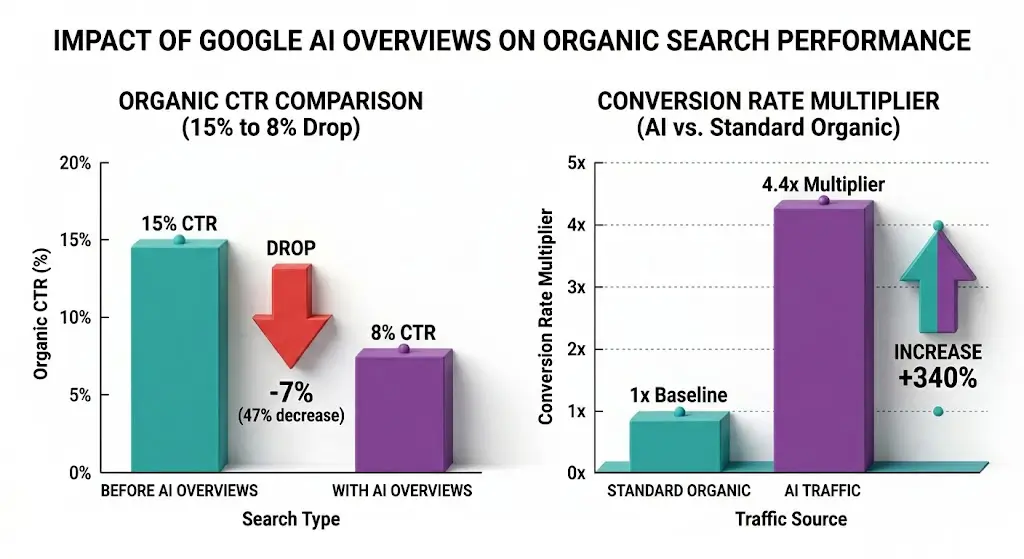
- Google AI Overviews now reach over 2 billion monthly users (BrightEdge, 2026), and organic CTR drops 34–61% when an AI Overview is present — making AI citation the primary mechanism for recovering lost visibility.
- AI-referred traffic converts at 4.4x the rate of standard organic search (Semrush, 2026) — and Ahrefs internal data shows AI visitors representing just 0.5% of traffic drove 12.1% of all signups.
- GEO, AEO, and LLMO share approximately 90% of their optimization tactics (Contently, 2026) — the differences are about where your content appears and which layer of AI systems you are targeting.
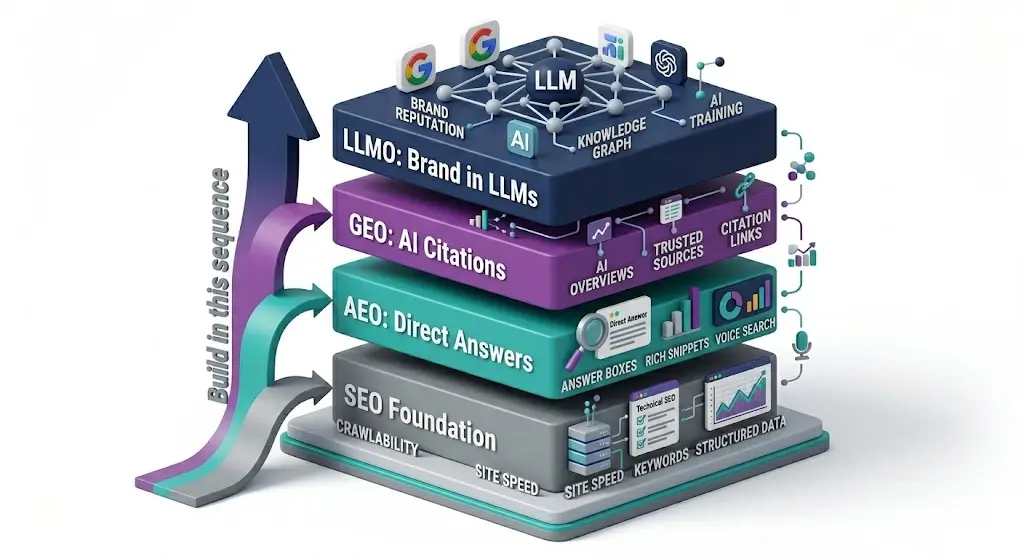
- The right sequence: SEO foundation first, then AEO for direct answers, then GEO for AI-generated citations, then LLMO for brand-level model awareness — one layered stack, not four separate strategies.
📋 Table of Contents
- What is AI SEO?~ 4 min
- Why AI SEO Matters in 2026: The Numbers~ 3 min
- The Four Layers: SEO → AEO → GEO → LLMO~ 5 min
- GEO, AEO, LLMO Compared: Full Breakdown~ 4 min
- Before & After: What Changes When You Implement AI SEO~ 3 min
- Case Study: 4,162% Organic Growth with AI SEO~ 3 min
- The AI SEO Implementation Checklist~ 4 min
- Common Mistakes and How to Avoid Them~ 3 min
- Frequently Asked Questions~ 3 min
- Conclusion~ 1 min
What is AI SEO?
AI SEO is the practice of optimizing your website and content to earn visibility across AI-powered search surfaces — not just traditional Google rankings. It is the umbrella strategy that contains three specific sub-disciplines: GEO (Generative Engine Optimization), AEO (Answer Engine Optimization), and LLMO (Large Language Model Optimization).
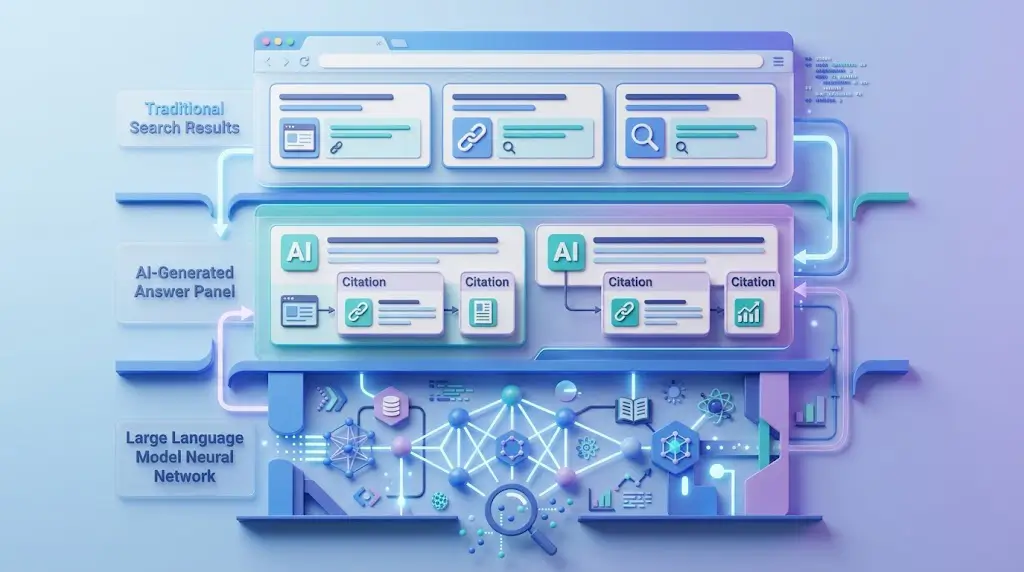
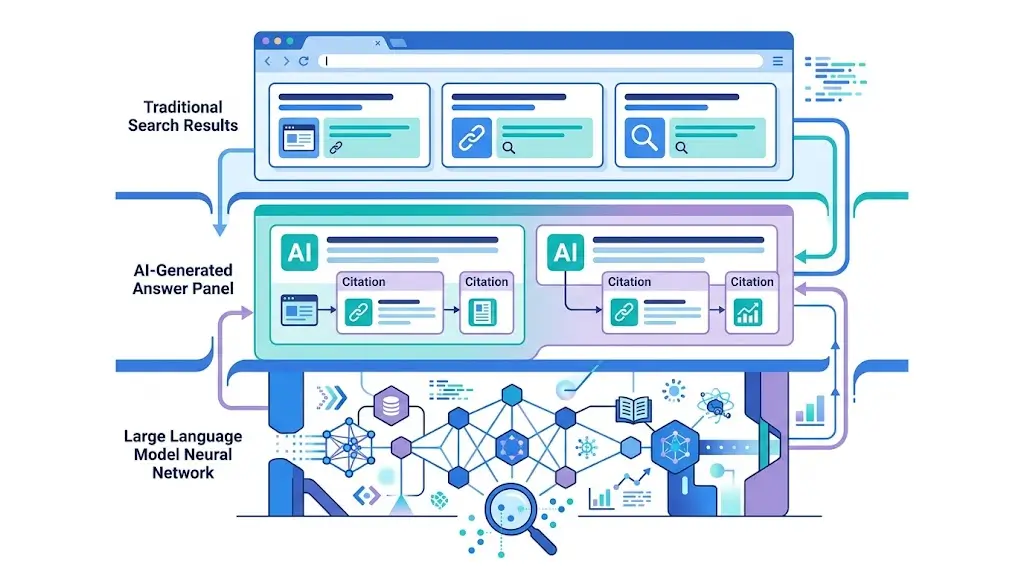
Here is why the distinction matters. When someone typed “best project management tool” into Google in 2022, they saw ten blue links and clicked one. When someone asks the same question in ChatGPT, Perplexity, or Google AI Mode in 2026, they receive a synthesized answer that cites two or three specific sources. Your content either gets cited — or it does not exist for that user.
Traditional SEO optimized for the first scenario. AI SEO optimizes for both.
The term itself is not yet fully standardized. Some practitioners use “AI SEO” to mean using AI tools to do SEO faster. Others use it to mean optimizing for AI search platforms. This guide focuses on the second definition — the one with real strategic implications for your content and business visibility.
“The practitioners who are struggling are those who still define SEO purely as keyword ranking. Those who have expanded their definition to include AI visibility and multi-surface presence are finding more opportunities, not fewer.”
— GoodFirms AI SEO Statistics Report, 2026[2]
💬 According to EverydayOnAI
The practical reading of the research cited throughout this guide is that the shift isn’t gradual — it’s binary at the page level. A page either has the self-contained, extractable structure that GEO and AEO reward, or it doesn’t, and the gap in citation rates between those two groups (documented in the ConvertMate and Princeton/KDD studies below) is widening faster than most editorial calendars adapt to. The implementation checklist in Section 7 isn’t a “nice to have” backlog item. Based on the citation-rate gaps the cited research documents, it’s closer to a pass/fail gate for whether a page exists to AI systems at all.
The Origin of Each Term
The sub-disciplines within AI SEO each have formal origins. GEO was formalized in a peer-reviewed paper by Princeton University, Georgia Tech, Allen Institute for AI, and IIT Delhi, published at ACM KDD 2024 — the first controlled experimental study measuring content visibility inside AI-generated responses across 10,000 queries.[1] AEO predates GEO, emerging from early voice search and featured snippet optimization practices around 2018 and has since expanded to cover AI answer surfaces. LLMO emerged from practitioner communities in 2023–2024, initially among SEO professionals experimenting with ChatGPT’s citation behavior.
The important thing to note: these are not competing strategies. They are three perspectives on the same goal — making sure AI systems select and surface your content when users ask questions in your domain.
📋 Section Summary
- AI SEO is the umbrella term for optimizing content across AI-powered search surfaces, containing three sub-disciplines: GEO, AEO, and LLMO.
- The term has two common meanings — using AI tools for SEO (workflow), and optimizing for AI search platforms (strategy). This guide covers the second, strategically significant definition.
- GEO was formalized at ACM KDD 2024 (Princeton/Georgia Tech/IIT Delhi); AEO originated in voice search optimization circa 2018; LLMO emerged from practitioner communities in 2023–2024.
Why AI SEO Matters in 2026: The Numbers
Before investing in any new strategy, you want evidence. The evidence for AI SEO is now substantial — from academic research, large-scale industry studies, and documented real-world results. Here is what the data actually says.
The Scale of the Shift
Google AI Overviews now reach over 2 billion monthly users globally — a platform larger than any individual social network — according to BrightEdge’s 2026 analysis.[3] Depending on query type and geography, AI Overviews appear on 25–48% of all Google searches.[4] ChatGPT processes over 1 billion queries per week. Perplexity generates approximately 20 million AI-synthesized answers per day.
Every one of those AI-generated answers cites specific sources. The question is not whether AI search matters for your content. It is whether your content appears in those citations.
2B
monthly users engage with Google AI Overviews globally[3]
61%
drop in organic CTR when AI Overviews appear — from 1.76% to 0.61% for affected queries[5]
4.4×
higher conversion rate from AI-referred traffic versus standard organic search visitors[6]
527%
growth in AI search sessions year-over-year comparing January–May 2024 to January–May 2025[7]
6.82%
of ChatGPT citations come from Google’s top 10 pages — meaning ranking #1 does not guarantee AI citation[8]
+91%
more paid clicks earned by brands cited in AI Overviews vs. non-cited brands on the same queries[9]
The Conversion Argument
The most important number above is not the traffic figure — it is the 4.4x conversion advantage from AI-referred visitors. Here is why this matters even though AI referral traffic is currently small in absolute volume.
Ahrefs’ internal data makes the math stark: AI visitors who represented just 0.5% of total traffic drove 12.1% of all signups — a 23x conversion multiplier.[6] As AI search adoption grows at 527% year-over-year, that multiplier compounds on an expanding base.
The window for early-mover advantage is real, but it is narrowing. Sites building AI citation authority now are establishing reference status with AI models while competition for those citations is still relatively low. By 2028, $750 billion of U.S. revenue is expected to run through AI-powered search[10] — the brands positioned for AI citation now are building toward that market.
▲ Why act now
83% of AI Overview citations come from outside Google’s organic top 10 (ConvertMate, 2026). The floor for citation eligibility is structural quality — not domain authority alone. A well-structured page on a mid-authority site can outperform a top-10 organic ranker in AI citation share, today, if it is optimized for extractability.
▼ The honest caveat
AI search referral traffic is still small in absolute volume for most sites. The 4.4x conversion advantage is real, but 4.4x of a small number is still a small number. AI SEO is a multi-quarter investment, not a quick traffic win. Measurement requires new setup — GA4 filters, manual citation testing — that takes time to build.
📋 Section Summary
- Google AI Overviews reach 2 billion monthly users (BrightEdge, 2026) and reduce organic CTR by 34–61% when present — making AI citation the primary mechanism for recovering lost click-through.
- AI search sessions grew 527% year-over-year (Previsible, 2025), while AI-referred visitors convert at 4.4x the rate of standard organic visitors (Semrush, 2026).
- Only 6.82% of ChatGPT citations come from Google’s top 10 pages (ConvertMate, 2026) — confirming that traditional SEO rank alone does not produce AI visibility.
The Four Layers: SEO → AEO → GEO → LLMO
The most useful mental model for AI SEO is a layered stack — not four competing strategies, but four levels of optimization that build on each other. Each layer assumes the previous one is already in place. Start from the bottom up.
Layer 1: Traditional SEO — The Non-Negotiable Foundation
Traditional SEO is not dead. Google still processes an estimated 8.5 billion searches per day and holds approximately 89% of the global search market.[11] Organic search drives roughly 53% of all website traffic across the web. You still need this.
More importantly for AI SEO: the AI platforms that power Overviews, ChatGPT Search, and Perplexity are all built on top of traditional web indexes. GPTBot crawls pages that are crawlable. Google AI Overviews draw from the same Knowledge Graph that powers regular search. A page blocked to AI crawlers cannot be cited regardless of content quality — it simply does not exist to the AI.
This means traditional SEO creates the floor. Everything above it depends on this foundation: clean crawlability, fast Core Web Vitals, correct canonicalization, and strong E-E-A-T signals. If your robots.txt blocks GPTBot, PerplexityBot, or Google-Extended — intentionally or accidentally — no other AI SEO investment will matter.
Layer 2: AEO — Optimizing for Direct Answers
AEO is the practice of structuring content to be directly extracted as a short, authoritative answer to a specific question — in featured snippets, voice search responses, People Also Ask boxes, and AI-powered answer cards. AEO optimizes for precision.
The content format AEO favors is concise: a direct definition or answer in the first sentence of each section, followed by structured supporting detail. The query type it targets is specific and question-based — “what is”, “how to”, “why does”, “what’s the difference between”. Importantly, AEO is the right starting point for most content teams because it improves clarity for human readers and extractability for AI systems simultaneously — one change, two payoffs.
As Neil Patel’s analysis of AEO confirms, content optimized for featured snippets is often the same content that earns AI-generated citations — the underlying mechanism is extractability, and both surfaces reward the same structural choices.[12]
Layer 3: GEO — Optimizing for AI-Generated Citations
GEO targets the longer, synthesized answers that AI platforms generate — the paragraphs of text that ChatGPT, Perplexity, or Google AI Overviews produce when a user asks a complex question. In these responses, the AI draws from multiple sources and cites them explicitly. GEO optimizes your content to be one of those cited sources.
GEO operates at a different scale than AEO: where AEO is about being the single direct answer to a specific question, GEO is about being one of the trusted sources that an AI weaves into a multi-paragraph synthesized response. GEO-optimized content is typically longer, more data-rich, and structured with strict heading hierarchies that allow AI crawlers to extract specific passages independently of their surrounding context.
The Princeton/KDD 2024 study found that content structure changes — adding authoritative citations, quotation-style formatting, and fluency optimizations — increased citation rates in AI responses by up to 30–40% in controlled experiments.[1] ConvertMate’s 2026 industry benchmark extended these findings: pages above 20,000 characters earn 4.3x more AI citations than shorter content across a sample of 10,000+ tracked pages.[8]
Layer 4: LLMO — Optimizing Brand Presence Inside LLMs
LLMO is the deepest layer and the hardest to control directly. It addresses how large language models — the underlying models powering ChatGPT, Claude, Gemini, and others — represent your brand and expertise in their parameters. This operates independently of live web retrieval.
The key practical distinction: GEO and AEO optimize for what happens when a user triggers a live web search and an AI cites your page. LLMO addresses what happens when a user prompts an AI in a context where no live web retrieval occurs — asking ChatGPT about your brand, or asking an AI agent which vendors to recommend in a specific category.
For most brands, LLMO influence comes from the same mechanisms that drive GEO: consistent, high-quality content with strong E-E-A-T signals, widely cited across authoritative third-party publications. You build LLMO authority as a side effect of doing GEO well. As Contently’s 2026 analysis notes, “the optimization tactics overlap by roughly 90 percent. Most teams will never encounter the rare cases where the difference is real.”[13]
📋 Section Summary
- The AI SEO stack has four layers: SEO foundation, AEO (direct answers), GEO (AI-generated citations), LLMO (brand in LLMs) — each layer assumes the previous one is solid before building on top.
- Traditional SEO remains non-negotiable because all AI search platforms are built on traditional web indexes — a page blocked to AI crawlers cannot be cited regardless of content quality.
- GEO, AEO, and LLMO share approximately 90% of their optimization tactics (Contently, 2026); the differences are about which layer of AI systems you are targeting, not which tactics to use.
GEO, AEO, LLMO Compared: Full Breakdown
The table below is organized by decision-making criteria — not just definitions. Use it to determine which layer to prioritize, which metric to track, and which schema to implement.
| Dimension | AEO | GEO | LLMO |
|---|---|---|---|
| What it targets | Featured snippets, voice search, answer boxes, PAA | AI-generated citations in ChatGPT, Perplexity, AI Overviews | Brand representation inside LLM parameters and AI agents |
| Primary platforms | Google (snippets), Siri, Alexa, Google AI Mode | ChatGPT Search, Perplexity, Google AI Overviews, Copilot | GPT-4o, Claude, Gemini (model-level), AI agents |
| Query type | Specific: “what is X”, “how to Y”, “define Z” | Exploratory: “explain X”, “compare A vs B”, “best way to do Y” | Conversational: open-ended prompts inside AI tools |
| Ideal content format | Concise Q&A, direct definitions, FAQ sections | Long-form, data-rich, structured headings, inline source citations | Comprehensive guides, consistent brand entity signals, third-party mentions |
| Primary schema | FAQPage, HowTo | Speakable, FAQPage, Article | Organization, Person, Product (entity clarity) |
| Measurable metric | Snippet appearance rate, voice answer rate | Citation rate, Response Inclusion Rate, AI referral traffic in GA4 | Brand mention rate in AI responses without web search prompt |
| Time to visibility | 2–8 weeks (pages with existing authority) | 4–12 weeks from structural optimization | Months to years (training cycle dependent) |
| Your degree of control | High — direct formatting changes | High — structural and schema changes | Low — indirect, through content + third-party mentions |
| Where to start | First — improves all content simultaneously | Second — builds on AEO foundation | Last — emerges from consistent GEO execution |
Where They Genuinely Overlap
In practice, a well-executed AEO content update — adding direct-answer sentences, FAQ sections, and proper heading structure — is simultaneously a GEO update. The content that gets selected for featured snippets (AEO) is often the same content that gets cited in AI-generated answers (GEO). The main reason to keep the terms distinct is measurement: the same optimization produces different signals in different tracking tools. Your featured snippet appearance is an AEO metric; your AI referral session in GA4 is a GEO metric. Both result from the same content change.
When the Distinction Actually Matters
There are three scenarios where the GEO/AEO/LLMO distinction becomes strategically relevant rather than academic:
Content length and depth: AEO favors concise, direct answers. GEO favors comprehensive long-form content — ConvertMate’s 2026 benchmark found pages above 20,000 characters earn 4.3x more AI citations.[8] A page optimized purely for featured snippets may be too short for competitive GEO performance on broad queries.
Schema selection: AEO uses FAQPage and HowTo schema. GEO adds Speakable schema targeting extractable content blocks. LLMO adds consistent entity markup (Organization, Person, Product schema) across all pages. You need all three layers of schema for full coverage — each layer adds something distinct.
Measurement and attribution: If you are demonstrating ROI to a leadership team, AEO performance (snippet appearance) and GEO performance (AI referral sessions and conversion rate) require different tracking setups and different proof points. Conflating them understates the value of each.
📋 Section Summary
- AEO, GEO, and LLMO differ primarily in the platform they target and the metric they produce — their optimization tactics overlap by approximately 90%, making them complementary rather than competing.
- The practical distinctions that matter operationally are content length (AEO = concise, GEO = comprehensive), schema selection (add Speakable for GEO; entity schema for LLMO), and measurement setup.
- Start with AEO because it improves all content simultaneously; then layer GEO for depth and citations; LLMO emerges as a side effect of executing GEO consistently well over time.
Before & After: What Changes When You Implement AI SEO
The most common question from content teams is not “what is AI SEO” but “what does it actually look like to change a page.” Here are three concrete before-and-after examples — the exact edits that move a page from invisible to cited.
Change 1: H3 Opening Sentences
✖ Before (traditional SEO approach)
“Before we explore the specifics of AI search optimization, it is worth understanding the historical context in which these platforms emerged. Over the past three years, the search landscape has fundamentally shifted in ways that demand a rethinking of how content teams approach…”
✔ After (AI SEO — answer-first)
“AI SEO is the practice of optimizing content for citation across AI-powered search surfaces including ChatGPT, Google AI Overviews, and Perplexity — in addition to traditional Google rankings.”
The first version is not bad SEO writing. It is simply invisible to AI extraction. AI systems extract the first sentence of each section at disproportionate rates. ConvertMate’s 2026 benchmark found that 44.2% of all AI citations come from a page’s first 30% of content — and within sections, from first sentences specifically.[8] The after version is extractable on its own, even without surrounding context.
Change 2: Statistics Without In-Text Source Attribution
✖ Before (hyperlink-only attribution)
“AI-referred traffic converts significantly better than organic search traffic, as this study shows.”
✔ After (self-contained, GEO-optimized)
“AI-referred traffic converts at 4.4 times the rate of standard organic search, according to Semrush’s 2026 analysis of cross-industry conversion data.”
A hyperlink is not enough. AI systems process text — they do not follow links to retrieve source information. A statistic without the source name and year in the sentence body cannot be correctly attributed by an AI reproducing the claim. The after version works whether a human reads it, an AI cites it, or a journalist quotes it. All three audiences understand the provenance without clicking anywhere.
Change 3: Section Endings
✖ Before (transition filler)
“Now that we have covered the basics of GEO, let’s move on to the next section where we’ll discuss implementation in more detail.”
✔ After (Section Summary Box — extractable bullets)
📋 Section Summary: GEO is the practice of structuring content for citation selection inside AI-generated responses, formalized at ACM KDD 2024. AI Overviews appear in 25–48% of Google searches as of Q1 2026 (Conductor / BrightEdge). Pages above 20,000 characters earn 4.3x more AI citations than shorter content (ConvertMate, 2026).
The summary box serves three purposes simultaneously: it gives AI systems explicitly formatted extractable content, it activates Speakable schema selectors, and it helps human readers retain the key points before moving to the next section. Every H2 section in an AI-SEO-optimized article should end this way.
📋 Section Summary
- The three highest-impact AI SEO content changes are: answer-first H3 opening sentences, self-contained statistical statements with inline source attribution, and Section Summary Boxes at the end of every H2.
- AI systems extract the first sentence of each section at disproportionate rates — 44.2% of all AI citations come from a page’s first 30% of content (ConvertMate, 2026).
- A hyperlink is not sufficient source attribution for AI extraction — the organization name and year must appear in the sentence body for a statistic to be correctly attributed when an AI reproduces the claim.
Case Study: 4,162% Organic Growth with AI SEO
Xponent21, a digital marketing agency, published a detailed case study of their own AI SEO implementation in December 2025 — one of the most granular real-world datasets available on what the strategy actually produces when executed consistently.[14]
📋 Case Study: AI SEO from Zero to Category Leader
Xponent21 — Digital Marketing Agency (Published December 2025)
Starting point (mid-2024): A newly relaunched site with minimal search presence. The team built a content strategy specifically designed around AI search citation principles from day one — not retrofitted after publication.
Strategy: What they called the “AI SEO Content Accelerator” methodology — content architecture optimized for AI extraction, consistent schema markup, multimedia integration, and engagement signal building. The core principle: give AI-generated content something it cannot invent on its own — original expertise, verifiable data, and genuine authority signals.[15]
Results by May 2025 (approximately 12 months):
- 10.5 million total search impressions accumulated
- 20,100 total clicks from search presence
- 4,162% organic traffic growth from launch baseline
- Top position for “Top AI SEO Agency” in both Google AI Overviews and Perplexity simultaneously — category leadership across two AI platforms for the same query
What made it replicable: Content was built around AI citation principles from the first draft. Schema markup was treated as a priority, not an afterthought. AI citation rate was tracked manually with a fixed query set across platforms. Topical authority was built within a cluster, not through isolated articles.
The 4,162% figure is exceptional. The methodology is not. These are the same principles documented in the Princeton/KDD 2024 academic study — the case study is a practitioner validation of research findings, not an outlier tactic. A separate case study by Digital Harvest documented a 144% increase in overall website traffic year-over-year using the same core principles — less dramatic, but more representative of what a mid-stage content operation can expect.[15]
The common thread across both: original expertise embedded in content that AI systems can extract cleanly. Generic AI-generated content that adds nothing new does not win in AI citation competition for the same reason it struggles in traditional SEO — the systems selecting content are optimizing for authoritative, distinctive signal.
📋 Section Summary
- Xponent21’s AI SEO case study (December 2025) documented 4,162% organic traffic growth in 12 months and simultaneous top-position citations in Google AI Overviews and Perplexity for the same target query.
- The methodology — answer-first content architecture, consistent schema, topical cluster structure, and manual citation tracking — is documented and replicable regardless of site size.
- Digital Harvest’s separate case study documented a more typical 144% year-over-year traffic increase using the same core principles, representing a realistic mid-stage content operation result.
The AI SEO Implementation Checklist
Use this checklist in sequence. Each section builds on the previous one. Items marked with a star (★) are the highest-priority actions if you are starting from scratch.
🎯 Interactive Tool
AI Citation Readiness Score
Before working through the full checklist below, get a quick directional read on where your page or website currently stands. Check every box that already applies to you, then click Calculate. Your weakest layer will be flagged with a direct link to the relevant checklist section.
Layer 1 — SEO Foundation
Layer 2 — AEO (Direct Answers)
Layer 3 — GEO (AI Citations)
Layer 4 — LLMO (Brand in Models)
This is a self-assessment tool for directional guidance only — it does not replace a full technical audit and does not guarantee AI citation, ranking, or traffic outcomes.
✓ Layer 1: Traditional SEO (Prerequisites — Complete Before Anything Else)
- ★ Verify GPTBot, PerplexityBot, Google-Extended, and ClaudeBot are not blocked in robots.txt
- ★ Check Cloudflare Bot Fight Mode — confirm AI crawlers are not blocked at CDN level
- All pages crawlable and indexed in Google Search Console
- Core Web Vitals passing: LCP < 2.5s, CLS < 0.1, INP < 200ms
- Clean H1 → H2 → H3 heading hierarchy on all priority pages
- Author bios with domain-relevant credentials on every article
- Canonical URLs set correctly — no duplicate content issues
- XML sitemap submitted to Google Search Console and Bing Webmaster Tools
✓ Layer 2: AEO — Direct Answer Optimization
- ★ Every H3 first sentence delivers a direct answer — no preamble, no “In this section we will…”
- ★ FAQ section present on every priority page (minimum 5 questions, minimum 2 sentences per answer)
- ★ FAQPage schema implemented and validated in Google’s Rich Results Test
- Each FAQ answer self-contained and readable without the question for full context
- HowTo schema on all step-by-step instructional content
- People Also Ask (PAA) boxes monitored in Search Console for new question opportunities
- Headings rewritten to be question-format or definition-format where applicable
✓ Layer 3: GEO — AI Citation Optimization
- ★ All statistics reformatted to self-contained structure: [Organization] [finding] ([Source, Year])
- ★ Speakable schema targeting
.key-takeaway,.section-summary, andblockquoteselectors - ★ Section Summary Boxes at the end of every H2 (3 self-contained bullets minimum)
- Key Takeaways box immediately after the introduction (5 bullets minimum)
- Named entities re-introduced at the start of each new H2 section — no pronoun-only references
- Content depth above 20,000 characters on pillar articles
- llms.txt file created and deployed in site root
- “Last Reviewed” date visible in article body — updated every time statistics are refreshed
- Comparison tables present in every pillar article
✓ Layer 4: LLMO — Brand Model Optimization
- Organization schema implemented sitewide with consistent name, URL, and social profiles
- Brand mentioned consistently by full official name across all pages — no informal abbreviations
- Author pages with Person schema linking to verifiable external profiles (LinkedIn minimum)
- Third-party brand mentions actively built: target 5–10 authoritative external publications
- Internal linking from all spoke articles back to relevant pillar pages (topical cluster structure)
- ★ AI citation baseline measured: manual query test across ChatGPT, Perplexity, Google AI Overviews using 15–20 fixed target prompts. Record results now as your baseline.
📋 Section Summary
- The AI SEO implementation checklist has four sequential layers — start with traditional SEO prerequisites (especially AI crawler access), then AEO direct-answer formatting, then GEO structural changes, then LLMO brand entity signals.
- The single highest-priority first action: verify that GPTBot, PerplexityBot, Google-Extended, and ClaudeBot are not blocked in your robots.txt. All other optimization is irrelevant if AI crawlers cannot access your content.
- Establish a manual citation baseline — testing 15–20 fixed prompts across ChatGPT, Perplexity, and Google AI Overviews — before implementing any changes, so you can measure actual improvement over time.
Common Mistakes and How to Avoid Them
These are the five errors content teams, SEO specialists, and growth marketers make most frequently when implementing AI SEO — and what to do instead.
Mistake 1: Treating AI SEO as a Replacement for Traditional SEO
The most common strategic error is framing AI SEO as an either/or choice. It is not. Traditional SEO creates the authority foundation that all AI platforms rely on. Domain traffic is the strongest single predictor of AI citation frequency, according to SE Ranking’s analysis of 2.3 million pages.[2] Sites with over 32,000 referring domains are 3.5x more likely to be cited by ChatGPT (Ahrefs, 2026).[6] SEO builds the floor. AI SEO builds the walls.
Mistake 2: Blocking AI Crawlers Without Knowing It
Many sites have inadvertently blocked GPTBot, PerplexityBot, or Google-Extended through blanket User-agent: * Disallow: / rules, aggressive Cloudflare Bot Fight Mode settings, or CDN configurations that reject unfamiliar user agents. Check your robots.txt and your Cloudflare dashboard before any other AI SEO work. Every other optimization in this guide is irrelevant if the crawlers cannot access your content.
Mistake 3: Treating AI SEO as a One-Time Project
Content freshness is weighted more aggressively in AI citation selection than in traditional SEO. AI citation rates drop sharply as content ages — faster than organic ranking decay. Pages with statistics that are 18+ months old lose citation share to fresher competitors. The AI SEO checklist above is not a project to complete; it is a quarterly maintenance cycle. The “Last Reviewed” date visible in your article body is not aesthetic — it is a ranking signal for AI systems that use freshness as a citation criterion.
Mistake 4: Optimizing Only New Content
Your highest-ROI AI SEO targets are your existing top-traffic pages — they already have the backlink authority and indexed history that AI platforms use when evaluating source credibility. Retroactive GEO and AEO optimization of your top 10 organic traffic pages will typically produce faster AI citation results than publishing new content from scratch. Update your most authoritative existing pages first; launch new content second.
Mistake 5: Confusing “Using AI Tools for SEO” with “Optimizing for AI Search”
A significant portion of content labeled “AI SEO” in 2026 describes using AI writing or keyword research tools to improve traditional SEO workflows — Semrush AI, Surfer, Clearscope, and so on. That is a legitimate workflow improvement, but it is not what this guide covers. Optimizing for AI search platforms — earning citations in ChatGPT, Perplexity, and Google AI Overviews — is a distinct strategy requiring different structural changes. If you are evaluating vendor content about “AI SEO,” clarify which definition they are using before acting on it.
📋 Section Summary
- The five most common AI SEO mistakes are: treating it as a replacement for traditional SEO, inadvertently blocking AI crawlers, treating it as a one-time project rather than a quarterly cycle, optimizing only new content instead of retrofitting top-traffic pages, and confusing AI tools for SEO with optimization for AI search.
- Retroactive optimization of existing top-traffic pages typically produces faster AI citation results than new content, because those pages already have the authority signals AI platforms use to evaluate source credibility.
- Check your robots.txt and Cloudflare Bot Fight Mode before implementing any other AI SEO change — blocked crawlers render all other optimizations irrelevant.
Frequently Asked Questions About AI SEO
These are the questions content strategists, SEO professionals, and business owners most commonly ask. Each answer is written to be directly extractable and structured to appear in Google’s People Also Ask, featured snippets, and AI-generated responses.
What is the difference between AI SEO, GEO, AEO, and LLMO?
AI SEO is the umbrella term; GEO, AEO, and LLMO are its three sub-disciplines. GEO (Generative Engine Optimization) targets citation selection inside AI-generated responses from platforms like ChatGPT and Perplexity. AEO (Answer Engine Optimization) targets direct-answer surfaces: featured snippets, voice search, and AI answer boxes. LLMO (Large Language Model Optimization) targets how large language models represent your brand in their parameters — independent of live web retrieval.
In practice, the optimization tactics for all three overlap by approximately 90% (Contently, 2026).[13] The differences are primarily about which surface you are targeting and which metric you are tracking — not which editorial or structural changes to make.
Does AI SEO replace traditional SEO?
No — traditional SEO is the non-negotiable foundation that AI search platforms are built on. Google AI Overviews draw from the same index and E-E-A-T signals as regular search. GPTBot crawls pages that are accessible and indexable. A page blocked to AI crawlers cannot be cited in AI responses regardless of content quality. SE Ranking’s analysis of 2.3 million pages found domain traffic as the strongest single predictor of AI citation frequency — making traditional SEO performance directly predictive of AI citation potential.[2] AI SEO is an additional optimization layer on top of traditional SEO, not a substitute for it.
How long does it take to see results from AI SEO?
AEO improvements typically produce results in 2–8 weeks; GEO results in 4–12 weeks; LLMO improvements take months to years. Adding FAQ sections, direct-answer sentences, and FAQPage schema can produce featured snippet appearances within 2–8 weeks for pages with existing authority. GEO structural optimization — self-contained statistics, Speakable schema, Section Summary Boxes — typically takes 4–12 weeks to show in AI referral traffic, with the fastest results on Perplexity and the slowest on Google AI Overviews. Pages with established backlink profiles see faster results than new pages building authority from scratch.
Is AI SEO relevant for small websites and blogs?
Yes — and the competitive window is more open for smaller sites in AI citation than in traditional SEO. ConvertMate’s 2026 benchmark found that 83% of AI Overview citations come from outside the organic top 10.[8] Only 6.82% of ChatGPT citations come from Google’s top 10 pages. Structural and content quality changes can produce AI citation results on smaller sites with moderate authority — something that would be nearly impossible in traditional SEO’s top-10 competition for broad terms. The authority ceiling is still real, but the floor is substantially lower than in traditional SEO.
Which AI platforms should I prioritize for optimization?
Start with Google AI Overviews, then ChatGPT Search, then Perplexity AI — in that order, based on user scale and traffic referral potential. Google AI Overviews reaches 2 billion monthly users (BrightEdge, 2026).[3] ChatGPT processes over 1 billion weekly queries (OpenAI, February 2026). Perplexity is smaller but has the highest citation transparency for users — inline source cards with excerpts — making its citation behavior measurable and its traffic quality demonstrably high. Universal GEO and AEO principles apply across all platforms and should be implemented as the baseline before any platform-specific work.
What are the most important AI SEO metrics to track?
The four primary AI SEO KPIs are: AI Citation Rate, Response Inclusion Rate, AI Referral Sessions in GA4, and AI Referral Conversion Rate. AI Citation Rate (pages cited ÷ pages tracked) measures how frequently AI platforms select your content as a citation source. Response Inclusion Rate (prompts where your brand appears ÷ total prompts tested) measures share of voice in AI responses. AI Referral Sessions in GA4 requires filtering for traffic from chat.openai.com, perplexity.ai, and gemini.google.com. AI Referral Conversion Rate should be compared against your organic baseline — the 4.4x advantage documented by Semrush (2026) is the benchmark to beat.[6]
Conclusion: The Window for AI Citation Authority Is Open — But It Is Closing
Five Actions to Take This Week
AI SEO is not a trend to monitor. It is the current operating environment for content that wants to earn visibility across the surfaces where people actually search in 2026. Google AI Overviews reduce organic CTR by 34–61% (Ahrefs, 2026) — but brands cited inside those Overviews earn 35% more organic clicks and 91% more paid clicks than non-cited brands (Seer Interactive, 2025).[9] The choice is not between AI SEO and traditional SEO. It is between appearing inside AI-generated answers — or having your traditional rankings cannibalized by AI Overviews that cite your competitors instead.
First, check AI crawler access — open your robots.txt right now and verify GPTBot, PerplexityBot, Google-Extended, and ClaudeBot are not blocked. This is the prerequisite nothing else can compensate for. Second, run a citation baseline test — prompt ChatGPT, Perplexity, and Google AI Mode with 15 queries relevant to your business and document where you appear versus where competitors appear. You cannot optimize what you have not measured.
Third, retrofit your top 10 organic traffic pages with AEO changes first — add direct-answer H3 opening sentences and FAQ sections with FAQPage schema. These are your highest-authority pages, and AEO changes on existing authority assets typically produce faster results than new content. Fourth, add Section Summary Boxes and reformatted statistics with inline source attribution to every retrofitted page. Fifth, create and deploy your llms.txt file in the site root — this takes 20 minutes and signals to AI systems exactly which pages you want them to prioritize.
💬 According to EverydayOnAI
Of the five actions above, the robots.txt and Cloudflare check is the one teams skip most often — precisely because it requires no creative or strategic thinking, just a five-minute technical check. It’s also the only item on this list that can silently invalidate every other investment in this guide. If a single AI crawler is blocked, the AEO formatting, the GEO statistics rewrite, the schema markup — none of it gets evaluated, because the content was never retrieved in the first place. If you do nothing else this week, do that.
Compliance as a Competitive Moat
The sites that will dominate AI search visibility in 2027 are building citation authority today — while competition for those citations is still relatively low. Early AI SEO is not just about traffic. It is about establishing reference status with AI models before those models calcify around incumbent citations the same way PageRank calcified around incumbent backlink profiles in the mid-2000s.
The methodology is clear, the evidence is solid, and the implementation is accessible to any content team willing to work through the checklist above systematically. The only question is whether you start this quarter or let competitors establish the citations you should own.
📚 References and Sources
- Princeton University, Georgia Tech, Allen Institute for AI, IIT Delhi — “GEO: Generative Engine Optimization,” ACM KDD 2024. First peer-reviewed controlled study measuring content visibility inside AI-generated responses; 30–40% citation rate increase from structural optimization in controlled experiments. arxiv.org
- GoodFirms / SE Ranking, “AI SEO Statistics 2026: 35+ Verified Stats,” 2026. Domain traffic as strongest predictor of AI citation frequency; external brand mentions correlated at 0.664 with AI Overview appearances; sites with 32,000+ referring domains 3.5x more likely to be cited by ChatGPT. goodfirms.co
- BrightEdge, AI SEO Statistics Report 2026. Google AI Overviews reach 2 billion monthly users globally; brands cited in AI Overviews earn 35% more organic clicks. brightedge.com
- Conductor, Q1 2026 analysis of 21.9 million queries. AI Overviews appear on approximately 25% of monitored Google searches; BrightEdge upper bound of 48% reflects specific query categories and US-centric sampling. conductor.com
- SEOmator, “30+ AI SEO Statistics for 2026: Data on AI Overviews, ChatGPT & GEO,” 2026. 61% CTR drop when AI Overviews appear (from 1.76% to 0.61%); 93% zero-click rate in AI Mode; 2 billion monthly AI Overview users. seomator.com
- Semrush / Ahrefs, 2025–2026. Semrush: AI-referred traffic converts at 4.4x the rate of standard organic search. Ahrefs internal: AI visitors = 0.5% of traffic, drove 12.1% of signups (23x conversion multiplier); sites with 32,000+ referring domains 3.5x more likely to be cited by ChatGPT. semrush.com / ahrefs.com
- Previsible, “AI Traffic Report 2025.” Tracked 19 GA4 properties; AI search sessions grew from approximately 17,000 to 107,000 comparing January–May 2024 with January–May 2025 — a 527% year-over-year increase. previsible.io
- ConvertMate, “GEO Benchmark Study 2026.” Pages above 20,000 characters earn 4.3x more AI citations; 44.2% of all AI citations come from a page’s first 30% of content; 83% of AI Overview citations come from outside Google’s organic top 10; only 6.82% of ChatGPT citations come from Google’s top 10 pages. convertmate.io
- Seer Interactive, “AI Overview Brand Visibility Study,” September 2025. Brands cited in AI Overviews earn 35% more organic clicks and 91% more paid clicks than non-cited brands on the same queries. seerinteractive.com
- Limelight Digital, “38+ AI SEO Statistics 2026,” April 2026. $750 billion of U.S. revenue expected to run through AI-powered search by 2028. limelightdigital.co.uk
- InstantPress, “SEO Statistics for 2026,” June 2026. Google holds approximately 89% of global search market; processes estimated 8.5 billion searches per day; organic search drives roughly 53% of all website traffic. instantpress.co
- Neil Patel Blog, “AEO vs GEO vs LLMO: Are They All SEO?,” December 2025. AEO-optimized content for featured snippets is often identical to GEO-optimized content for AI citations; extractability as shared underlying mechanism. neilpatel.com
- Contently, “AEO vs GEO vs LLMO: The Acronym Confusion, Settled,” April 2026. Optimization tactics across GEO, AEO, and LLMO overlap by approximately 90%; most teams will never encounter the rare cases where the distinction is practically relevant. contently.com
- Xponent21, “AI SEO Case Study: Engineering Top AI Ranks,” December 2025. 10.5 million impressions, 20,100 clicks, 4,162% organic traffic growth in 12 months; simultaneous top-position citation in Google AI Overviews and Perplexity for category query. xponent21.com
- Digital Harvest, “AI SEO Case Study: How We Grew Organic Traffic by 144% in One Year,” January 2026. 200+ blog posts in 2025 vs. 6 in 2024; AI content worked best when topics were made specific and niche; human expertise embedded in content as primary differentiator. digitalharvest.io
Sources verified June 14, 2026. AI search statistics are moving fast — specific figures (CTR, citation rates, user counts) should be reconfirmed quarterly before use in client reporting or executive presentations. This article does not constitute professional SEO or legal advice.
📚 Go Deeper: Complete AI SEO Hub on EverydayOnAI
This pillar guide covers the full AI SEO framework — GEO, AEO, and LLMO as one integrated strategy. Each article below goes deep on a specific discipline or platform, with checklists, templates, and step-by-step guidance your team can use directly.
📚 Sub-Pillar: GEO (Generative Engine Optimization)
-
→ GEO Complete Guide: How to Get Cited by ChatGPT, Perplexity & Google AI
The comprehensive GEO pillar — Princeton/KDD 2024 research, 6 content optimization techniques, platform-specific strategies, and the full 50-point GEO checklist. -
→ GEO vs SEO: Full Comparison Guide
Where GEO and traditional SEO diverge, where they reinforce each other, and how to build a dual-surface strategy without duplicating effort. -
→ How to Optimize Content for ChatGPT Citations
Platform-specific tactics for earning citations in ChatGPT Search — content depth, self-contained statistics, and entity clarity signals that ChatGPT’s citation algorithm favors. -
→ How to Get Cited in Perplexity AI
Perplexity’s citation behavior differs from Google and ChatGPT — this guide covers the specific patterns that earn inline citation cards in Perplexity responses. -
→ GEO Content Writing Guide: Sentence-Level Tactics
The sentence-by-sentence editing guide for GEO — how to rewrite existing content to maximize extractability without losing readability for human audiences. -
→ How to Track AI Search Visibility
GA4 filter setup for AI referral traffic, manual citation testing protocol, and the metrics dashboard that replaces keyword rank tracking for AI search measurement. -
→ GEO Audit Checklist: 50-Point Downloadable Guide
The complete GEO audit checklist covering crawler access, content structure, schema implementation, citation tracking, and quarterly maintenance tasks.
📚 Sub-Pillar: AEO (Answer Engine Optimization)
-
→ What is AEO? The Complete Answer Engine Optimization Guide
The AEO sub-pillar — featured snippet tactics, voice search optimization, AI answer box strategies, and how AEO differs from GEO in practice. -
→ GEO vs AEO: Key Differences Explained
The practical decision guide for choosing where to focus first — with a decision framework based on your content type, platform, and conversion goals. -
→ AEO vs SEO: What Changes and What Stays
A precise breakdown of which SEO investments still compound for AEO, and which traditional tactics actively work against answer engine performance. -
→ AEO Keyword Research: Finding Answer-Intent Queries
How to identify and prioritize question-intent queries with AEO potential — the research methodology, tools, and scoring framework for your keyword queue. -
→ AEO Checklist: Is Your Content Answer-Ready?
The 40-point AEO audit — structure, schema, formatting, and freshness signals that determine whether your content gets selected as a direct answer.
📚 Sub-Pillar: LLMO (Large Language Model Optimization)
-
→ What is LLMO? Who Needs It and Why
The honest LLMO guide — what it actually means, who needs it beyond GEO, and why most SMBs should treat it as a side effect of good GEO rather than a separate workstream. -
→ llms.txt: Complete Setup Guide
What llms.txt is, how to write it, where to deploy it, and which AI platforms actually read it — including a ready-to-use template for everydayonai.com-style content sites. -
→ AI Crawlers: GPTBot, ClaudeBot, PerplexityBot Explained
How each AI crawler works, what it accesses, how to verify your robots.txt is configured correctly, and how to use Cloudflare settings to ensure AI crawlers are not accidentally blocked.
📚 Sub-Pillar: Comparison & Terminology
-
→ GEO vs AEO vs LLMO vs AI SEO: The Complete Terminology Guide
The definitive terminology guide — where each acronym came from, where they overlap, and which one to use in which context for maximum clarity with clients and teams. -
→ GEO & AI SEO Statistics 2026: Data & Benchmarks
The most comprehensive collection of AI search statistics, organized by category — CTR, citation rates, conversion data, and platform-specific benchmarks — all with primary source attribution. -
→ Best AI SEO Tools 2026: Ranked & Reviewed
Honest reviews of the tools that actually help with AI citation tracking, citation gap analysis, schema generation, and AI referral measurement — versus tools that only use “AI SEO” as a marketing label. -
→ AI SEO for Beginners: Where to Start
If this pillar article is too advanced, start here — a plain-language, jargon-free introduction to AI search optimization for content creators, small business owners, and marketers new to the topic.
Start Your AI SEO Audit Today
Download our free AI SEO Implementation Checklist — the 50-point audit covering all four layers of the AI SEO stack, built for content teams, SEO professionals, and growth marketers who want to earn citations in ChatGPT, Perplexity, and Google AI Overviews.
Leave a Reply