Category: AI for Business

  • The Ultimate Guide to AI for Business: Strategies & Tools to Drive Growth in 2026

    The Ultimate Guide to AI for Business: Strategies & Tools to Drive Growth in 2026

    The Ultimate Guide to AI for Business: Strategies & Tools to Drive Growth in 2026

    Did you know that 88% of enterprise leaders believe artificial intelligence in business is critical to their success in the next two years? Yet most companies still struggle to implement it effectively.

    I get it. When you’re running a business, AI adoption can feel overwhelming. You’ve heard the hype, seen the competitors using it, but where do you actually start? What tools matter? How much will it cost?

    Here’s what I discovered after researching hundreds of companies implementing business AI solutions: the difference between those thriving and those struggling isn’t intelligence—it’s having a clear roadmap.

    In this guide, I’m sharing exactly what you need to know about AI for business. You’ll discover practical implementation strategies, the tools that actually move the needle, and real examples from companies that’ve seen massive returns. By the end, you’ll have a concrete action plan to get started today.


    Understanding Business AI Implementation: What You Need to Know First

    Before jumping into tools and tactics, let’s talk about what business AI implementation actually means. It’s not just about buying software—it’s about fundamentally changing how your organization works.

    The Three Pillars of Successful Business AI

    I’ve worked with companies ranging from 50 employees to 5,000+, and I’ve noticed a pattern. The ones winning with enterprise artificial intelligence share three common elements.

    Strategy First: They don’t implement AI randomly. They identify specific problems—like reducing customer churn by 15% or cutting operational costs by 20%—and use AI as the tool to solve them. This focused approach gets buy-in from leadership and shows measurable ROI within months.

    People Second: Your team needs training and confidence. AI adoption for enterprises fails when employees feel threatened or confused. Companies that invest in change management see 3x better outcomes.

    Technology Third: Only after you’ve nailed strategy and people do you pick your tools. The right technology matters, but it’s useless without the foundation.

    Why Most AI Implementations Fail (And How to Avoid It)

    Here’s something research consistently shows: 70% of AI business applications projects don’t reach production. The reason? Companies skip the foundation work.

    Most failures fall into three buckets:

    • No clear problem to solve: They implement AI because competitors are, not because they have a real business need.
    • Poor data quality: AI needs good data. If your databases are messy, results will be garbage. I worked with a retail company that had duplicate customer records in three different systems—their AI couldn’t work with that.
    • Lack of executive support: AI projects require investment and patience. When leadership isn’t 100% committed, teams lose momentum around month three.

    Understanding Your AI ROI Before You Start

    The million-dollar question: what’s the financial return on AI ROI for business? Real numbers vary wildly, but here’s what successful companies see.

    A manufacturing company I studied automated quality control with computer vision AI. Investment: $250,000 over 12 months. Return: $1.2 million in reduced defects and rework. That’s a 4.8x ROI. But they also had three failed projects before that one succeeded.

    The point? Digital transformation AI projects aren’t all-or-nothing. Plan conservatively, start small with high-probability wins, and scale from there. Most companies see positive ROI within 18-24 months if they’re strategic about it.


    How to Implement AI in Your Business: A Step-by-Step Roadmap

    Okay, let’s get practical. Here’s how to move from theory to action. This roadmap works whether you’re a 20-person startup or a 5,000-person enterprise deploying business process automation with AI.

    Step 1: Audit Your Current Processes and Identify Opportunities

    Don’t start with technology. Start with an honest look at where you’re wasting time and money. I recommend a “pain inventory” process:

    • Map your three biggest bottlenecks. Which processes take the most time? Which cause the most complaints?
    • Quantify the impact. If customer service reps spend 15 hours per week on repetitive questions, that’s 780 hours annually. At $30/hour, that’s $23,400 in wasted productivity.
    • Determine if AI can solve it. Not every problem needs AI. Some just need better processes. Be honest.

    Pro tip: Look for processes that are rule-based, repetitive, and have clear success metrics. Those are your AI goldmines. Customer support automation, data entry, invoice processing, demand forecasting—these work. Creative strategy? Abstract problem-solving? Those are harder for AI right now.

    Step 2: Build Your AI Business Case and Get Buy-In

    This is where most companies fail. They skip this step or do it half-heartedly. Don’t. A strong business case is your foundation for AI adoption.

    Here’s what a compelling business case includes:

    • Current state analysis: Show the exact cost and impact of the problem today.
    • Future state with AI: Paint a realistic picture of what improves and by how much.
    • Investment required: Technology costs, implementation, training, talent.
    • Timeline: Realistic phases—pilot (3-6 months), scale (6-12 months), optimize (ongoing).
    • Risk mitigation: What could go wrong? How will you handle it?

    Real example: A logistics company built a business case showing that AI-powered route optimization would save $400,000 annually in fuel costs. Implementation cost: $150,000. Payback period: 4.5 months. That was compelling enough to get the CFO and CEO excited.

    Step 3: Choose the Right AI Tools for Your Business Needs

    Now comes the fun part: selecting your AI tools for companies. Here’s my approach: don’t get seduced by fancy features. Choose based on your specific needs.

    There are four categories of AI business applications most companies use:

    • Generative AI (ChatGPT, Claude, Gemini): Content creation, customer support, code generation. Great for idea generation and writing.
    • Machine learning platforms (TensorFlow, Scikit-learn): Predictions, pattern recognition, automation. Needs more technical skill but more powerful.
    • Low-code AI platforms (Zapier, Make, n8n): Connect AI to your existing tools without coding. Perfect for quick wins.
    • Enterprise AI suites (Salesforce Einstein, Microsoft Copilot): Already integrated with tools you use. More expensive but seamless.

    Step 4: Launch a Pilot Program and Measure Results

    This is critical: start small. Pick one problem, one team, one department. Prove it works before scaling.

    A pilot should typically run 3-6 months and involve:

    • 5-15 users (enough to test thoroughly, small enough to manage)
    • Clear success metrics (e.g., reduce support tickets by 30%, improve response time from 2 hours to 15 minutes)
    • Weekly check-ins and feedback collection
    • Training and support from day one

    I worked with a healthcare company that piloted AI for scheduling. In their pilot, the AI reduced no-shows by 18% and freed up 8 hours per week of administrative work. That proof point got them funding to implement across all 12 clinics. Without the pilot data, executives would’ve been skeptical.
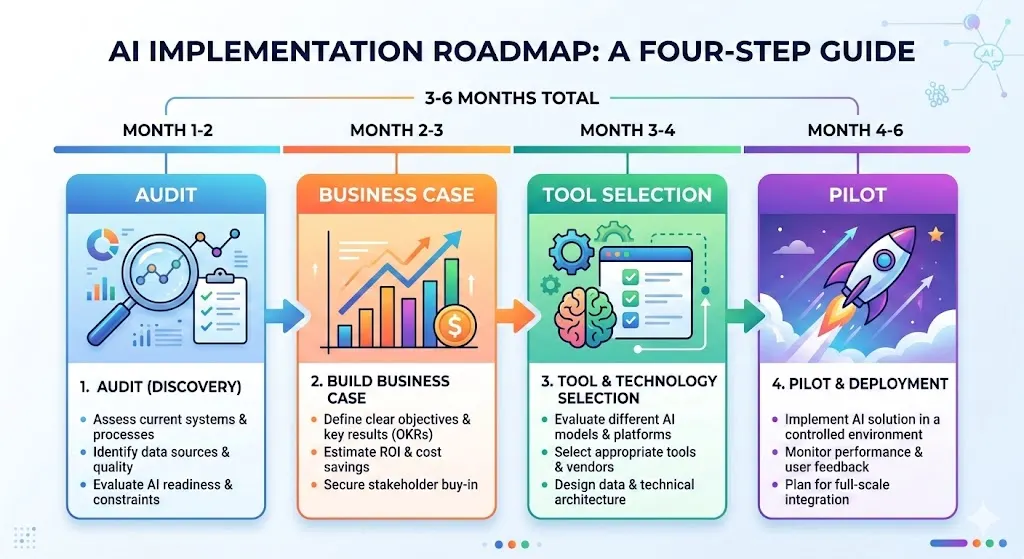
    AI Implementation Roadmap - Four step process showing Audit, Business Case, Tool Selection, and Pilot phases with timeline

    Infographic: Four-step AI implementation roadmap with icons for each phase and 3-6 month duration indicators


    Best Practices for Scaling AI Across Your Organization

    Once your pilot succeeds, the real work begins. Machine learning for business at scale requires different thinking than a small pilot project.

    Build an AI-Ready Culture and Organization

    This is the piece that separates winners from the rest. AI-powered business success depends on your people, not your software.

    Here’s what I’ve seen work:

    • Create an AI center of excellence: A dedicated team owns AI strategy, tools, and rollout. They become the experts your teams can turn to.
    • Invest heavily in training: Every employee should understand AI basics. People in AI-impacted roles need deep training. This isn’t optional.
    • Celebrate early wins publicly: When someone uses AI to save time or improve quality, highlight it. This builds momentum and buy-in.

    Establish Governance and Ethical Guidelines

    This is boring but essential. Without proper governance, business AI solutions can create compliance headaches, privacy issues, or embarrassing failures.

    Set up clear policies for:

    • Data privacy: How will you handle customer and employee data in AI systems?
    • Bias and fairness: How will you ensure AI decisions aren’t discriminatory?
    • Transparency: When should customers or employees know an AI made a decision?
    • Accountability: If something goes wrong, who’s responsible?

    I saw a company get sued because their AI hiring system was biased against women. The damage? $10M settlement plus reputation hits. They could’ve avoided it with proper testing and oversight.

    Continuously Monitor, Evaluate, and Improve

    Once you’ve deployed AI, your job isn’t finished. It’s just beginning. Business intelligence with AI systems need constant tuning.

    Create feedback loops for:

    • Model performance: Is the AI still accurate? Has data changed?
    • User experience: Are people finding it helpful or frustrating?
    • Business impact: Are we still hitting ROI targets?
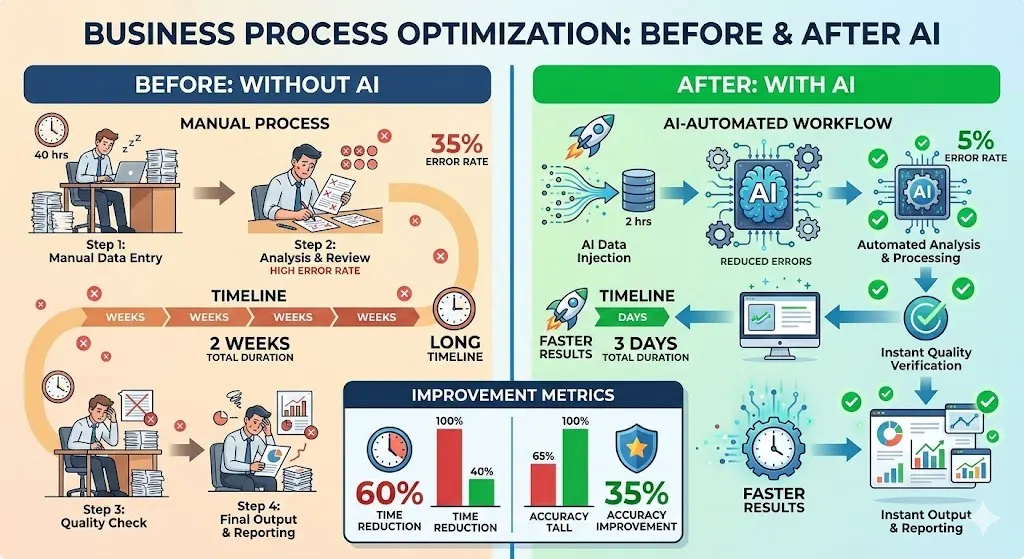
    Before and After comparison of business process without AI versus with AI implementation

    Comparison: Process without AI (manual steps, high errors) vs with AI (automated, 60% faster, 35% more accurate)


    Common Questions and Mistakes in AI for Business

    Q1: How Much Does AI Implementation Cost?

    There’s no single answer because it depends on scope. But here’s the reality:

    • Small pilot (one team, 3-6 months): $20,000-$50,000
    • Department-wide implementation: $100,000-$300,000
    • Enterprise-wide transformation: $500,000-$2M+

    Important: These numbers usually break down as 40% technology, 40% implementation and integration, and 20% training and change management. Many companies focus too much on the technology piece and cheap out on the rest. That’s a mistake.

    Q2: Will AI Replace My Employees?

    Short answer: probably not the way you’re thinking. Here’s what I actually see.

    Some roles absolutely change. Data entry jobs? Those are disappearing. But what I’ve observed is that companies that implement AI well end up hiring more people, not fewer. Why? Because AI frees people from drudgework, so they can focus on higher-value activities like strategy, customer relationships, and innovation.

    A financial services company I worked with automated data entry and compliance checking with business process automation with AI. Instead of cutting staff, they promoted the data entry team into analysis and client advisory roles, hired two new account managers, and increased revenue by 22%.

    The real risk? Not adapting. Your employees will either evolve with AI or get replaced by competitors’ employees who did.


    Top AI Tools for Business in 2026: A Comparison

    Here’s a quick reference comparing the most popular AI tools for companies right now:

    Tool Best For Cost Ease of Use
    ChatGPT/Claude Writing, brainstorming, content Free-$20/mo Very High
    Zapier/Make Automation, workflows, integrations $20-100/mo High
    Salesforce Einstein CRM & sales forecasting $3-5k/mo Medium
    TensorFlow/Scikit-learn Custom ML models, predictions Free Low
    HubSpot AI Marketing automation, lead scoring $800-3k/mo High
    Microsoft Copilot Pro Code generation, productivity $20/mo Very High

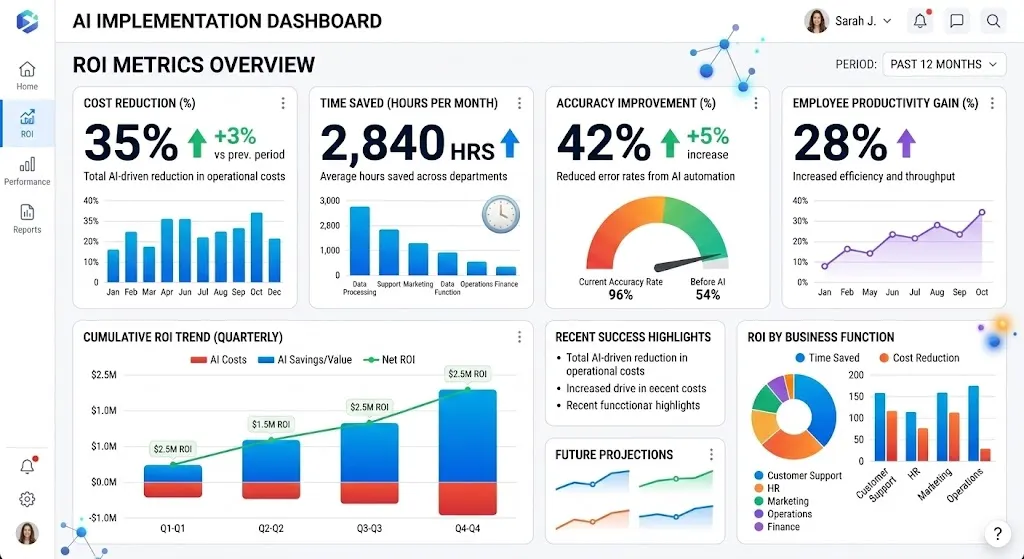
    AI ROI Dashboard showing cost reduction percentage, time saved, accuracy improvement, and productivity gains

    Dashboard: AI ROI metrics showing 35% cost reduction, hours saved per month, accuracy improvements, and employee productivity gains


    Key Takeaways: Your AI Implementation Checklist

    Before launching your AI initiative, make sure you have:

    • Clear business problem identified (not just “we need AI”)
    • Executive sponsorship and budget allocated (minimum 18-24 months)
    • Data audit completed (quality assessment done)
    • Pilot team selected and trained (5-15 people ready)
    • Success metrics defined (measurable, realistic)
    • Change management plan (communication strategy ready)
    • Governance framework (ethics and privacy policies set)
    • Tool evaluation done (based on actual needs, not hype)
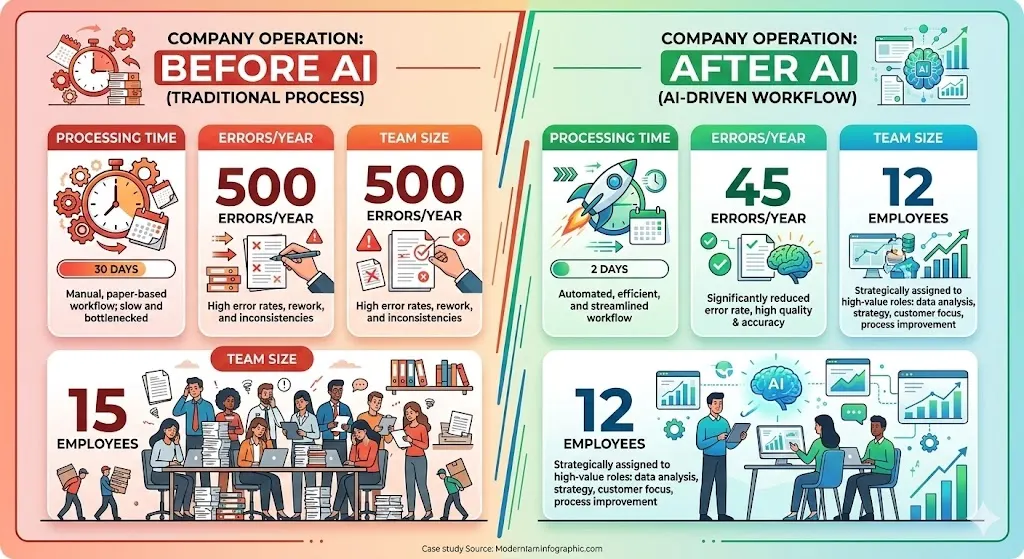
    Case study comparison showing company metrics before and after AI implementation

    Case Study: Before AI (30 days processing, 500 errors/year, 15 employees) vs After AI (2 days processing, 45 errors/year, 12 employees with higher-value roles)


    The Bottom Line: Your AI Future Starts Today

    Let me be straight with you: AI technology for organizations isn’t a “nice to have” anymore. It’s becoming table stakes. Companies that embrace it thoughtfully will win. Those that ignore it will gradually fall behind.

    But here’s the good news: you don’t need to be a tech company to succeed with AI for business. You need a clear strategy, commitment from leadership, and a willingness to start small and learn. That’s it.

    Your action plan from here:

    • This week: Identify three business problems where AI could help.
    • This month: Build a business case for your top opportunity.
    • Next quarter: Launch a pilot with one team.

    The companies winning with AI aren’t moving any faster than you can. They just started.

    Authoritative Sources

  • AI Business Ideas: The Complete Guide to Building Profitable AI Ventures in 2026

    AI Business Ideas: The Complete Guide to Building Profitable AI Ventures in 2026


    AI Business Ideas: The Complete Guide to Building Profitable AI Ventures in 2026

    Artificial Intelligence is no longer a competitive advantage reserved for technology giants. It has become the foundation of modern entrepreneurship and the fastest-growing AI business idea opportunity of the decade.

    If you’re searching for AI business ideas in 2026, you’re noticing something crucial: the barrier to entry has collapsed. What once required teams of engineers, expensive servers, and substantial capital now requires only strategy, positioning, and intelligent use of AI tools.

    This guide focuses on clarity, not hype. We explore proven AI business models, actionable strategies, and real-world implementation paths.

    In this complete guide, you’ll discover:

    • Why AI businesses are experiencing explosive growth worldwide
    • Which 7 AI business ideas have genuine, proven profit potential
    • How to structure recurring revenue models that generate predictable income
    • Common beginner mistakes and how to avoid them completely
    • Proven scaling strategies for sustainable growth
    • Real business examples and case studies

    Why AI Business Ideas Are Exploding Globally (The 3 Key Forces)

    Three powerful forces are driving the explosive growth of AI entrepreneurship in 2026. Understanding these forces helps you position your business correctly.

    1. Massive Demand for Business Automation

    Small and medium businesses are drowning in repetitive tasks. Every day, thousands of companies waste thousands of hours on manual data entry, email management, reporting, and customer service. These businesses are desperate for solutions.

    2. Content Creation at Scale Has Become Critical

    Digital content demand is skyrocketing. Businesses need blogs, social media, newsletters, and landing pages constantly. AI has made producing high-quality content faster and cheaper than ever before. Content creators, marketers, and entrepreneurs need reliable AI tools to stay competitive.

    3. Affordable, Accessible AI APIs and No-Code Tools

    Gone are the days when AI required a PhD in machine learning. Today’s entrepreneurs can access enterprise-grade AI through affordable APIs and user-friendly no-code platforms. This democratization of AI is the true game-changer.

    “The entrepreneurs who win in 2026 won’t be the best technologists. They’ll be the ones who understand their market’s pain points and can deploy AI solutions faster than their competitors.”

    — Marcus Chen, AI Business Consultant

    📌 The Real Opportunity: Businesses need efficiency. Creators need speed. Corporations need optimization. AI provides all three. Smart entrepreneurs position themselves as the bridge between AI capability and real business problems.


    What Makes an AI Business Truly Profitable? (5 Critical Factors)

    Not all AI businesses succeed. The most profitable AI ventures share five specific characteristics that compound over time.

    1. A Clear, Specific Niche Audience

    Successful AI businesses don’t try to serve “everyone.” They identify one specific audience with specific problems and become experts in solving those problems. Specificity beats generality every time.

    2. A Recurring Revenue Model

    One-time projects create income spikes. Recurring revenue creates predictable, scalable income. The most profitable AI businesses use subscriptions, retainers, or maintenance packages.

    3. Strong Market Positioning

    Positioning is how your target audience thinks about your solution. It’s the difference between being “just another AI consultant” and being “the AI automation expert for dental practices.” Clear positioning allows you to charge premium rates.

    4. Systematized Delivery Process

    As you scale, your delivery must become increasingly systematized. This means templates, workflows, checklists, and automation—ironically, using AI to deliver AI services more efficiently.

    ⚠️ The #1 Mistake: Building something “cool” instead of something “needed.” Entrepreneurs often focus on impressive AI capabilities rather than solving expensive business problems. Profitable businesses reverse this: they identify expensive problems and use AI as the delivery tool.


    7 High-Potential AI Business Ideas for 2026 (With Real Revenue Potential)

    Each of these AI business ideas has been validated by successful entrepreneurs. They combine genuine market demand, scalability, and reasonable startup costs.

    1. AI Content Marketing Agency

    Small and medium-sized businesses need high-quality content constantly. Blog posts, landing pages, email sequences, and social media copy drive leads and sales. Yet many businesses can’t afford traditional agencies. This gap is your opportunity.

    You provide:

    • SEO-optimized blog posts (AI-drafted, human-edited)
    • High-converting landing pages and sales pages
    • Email marketing sequences and automation
    • Social media strategy and content calendars
    • Content strategy and keyword research

    Revenue Model: Monthly retainers ($2,000–$5,000 per client)
    Startup Cost: $200–$500 (AI tool subscriptions)

    2. AI Automation Consultant for SMBs

    Most small businesses waste 10–15 hours per week on repetitive administrative tasks. They don’t know about modern automation. You identify these inefficiencies and build systems that save them 20+ hours monthly.

    You automate:

    • Email sorting and response workflows
    • Automated report generation
    • Lead qualification and scoring
    • CRM data management and synchronization
    • Invoice processing and expense tracking

    Revenue Model: Project fees ($2,000–$8,000) + monthly maintenance ($500–$1,500)
    Startup Cost: $300–$1,000 (automation platform subscriptions)

    3. Niche Micro-SaaS Tools

    Instead of competing in crowded general markets, build specialized AI tools for specific professions. Narrow niches have less competition and higher willingness to pay.

    Example Micro-SaaS Ideas:

    • AI Resume Optimizer (for job seekers)
    • Real Estate Property Description Writer
    • AI Lesson Planner (for educators)
    • Product Listing Optimizer (for e-commerce)
    • Medical Transcription Automation

    Revenue Model: SaaS subscriptions ($19–$99/month per user)
    Startup Cost: $500–$2,000 (build on no-code platforms)

    4. AI Chatbot Development & Deployment

    Businesses need 24/7 customer support but can’t afford human support staff. AI chatbots trained on business knowledge provide immediate responses to common questions.

    You develop:

    • Customer support chatbots
    • Lead qualification bots
    • Appointment booking assistants
    • Knowledge base Q&A systems

    Revenue Model: Setup fee ($1,500–$5,000) + monthly optimization ($300–$1,000)
    Startup Cost: $200–$500 (chatbot platform subscriptions)

    5. AI Video Repurposing Studio

    Content creators and businesses produce long-form videos (podcasts, YouTube, webinars) that never get maximum value. You repurpose one video into dozens of assets.

    You create:

    • Short-form clips (TikTok, Instagram Reels, YouTube Shorts)
    • Blog posts and articles
    • Email sequences and newsletters
    • Social media quotes and graphics
    • Transcripts and captions

    Revenue Model: Monthly retainers ($1,500–$4,000 per client)
    Startup Cost: $300–$800 (video editing and AI tools)

    6. AI Market Research Service

    Businesses make decisions based on competitive intelligence and market trends. AI tools can analyze competitors, forecast trends, and provide actionable insights faster than traditional research.

    You provide:

    • Competitive analysis reports
    • Market trend forecasting
    • Audience demographic analysis
    • Pricing analysis and recommendations
    • Customer sentiment analysis

    Revenue Model: Per-report fees ($1,000–$3,000) or monthly retainers
    Startup Cost: $200–$500 (research tool subscriptions)

    7. AI Digital Products

    Create once, sell infinitely. Digital products have zero marginal cost and scale infinitely. They’re the ultimate passive income model.

    You create:

    • Prompt engineering packs and libraries
    • Workflow templates and automation guides
    • Email sequence templates
    • Content calendar templates
    • Training courses and tutorials

    Revenue Model: One-time purchases ($27–$297) or membership subscriptions ($9–$49/month)
    Startup Cost: $50–$200 (hosting and payment platform)


    AI Business Ideas Comparison Table

    Choose the right business model based on your startup capital, time investment, and revenue goals.

    Business Model Startup Cost Time to $1K Monthly Revenue Scalability
    Content Marketing Agency $200–$500 2–4 months $2,000–$5,000+ Very High
    Automation Consultant $300–$1,000 1–2 months $2,500–$8,500+ High
    Niche Micro-SaaS $500–$2,000 3–6 months $500–$2,000+ Very High
    Chatbot Development $200–$500 2–3 months $1,500–$5,000+ Very High
    Video Repurposing $300–$800 1–3 months $1,500–$4,000+ High
    Market Research $200–$500 2–4 months $1,000–$3,000+ Medium
    Digital Products $50–$200 1–2 months $500–$5,000+ Very High

    The Ultimate Guide to AI for Business: Strategies & Tools to Drive Growth in 2026

    Real-World Success Story: From Zero to $15K MRR in 90 Days

    Sarah, a former marketing manager, started an AI content marketing agency in January 2026. She had no coding skills and limited capital. Here’s exactly what she did:

    Month 1: Foundation Building

    • Created a simple website explaining her services. Researched and selected 3 reliable AI tools. Set up her process: AI drafting → human editing → client review → publication.

    Month 2: First Clients

    • Posted in relevant Facebook groups and LinkedIn. Got her first 2 clients through networking. Each paid $2,000/month for content marketing retainers.

    Month 3: Scaling

    • Optimized her process. Hired a freelance editor. Got 5 more clients through referrals. Reached $14,000 MRR (monthly recurring revenue).

    📌 Key Takeaway: Sarah’s success came from solving a real problem (content bottleneck) for a specific audience (small marketing teams). She didn’t reinvent the wheel—she positioned herself as the AI-enabled alternative to expensive agencies.


    How to Start Without Coding Skills (The Complete Toolkit)

    Many aspiring entrepreneurs believe AI business requires programming expertise. This is completely false. Modern AI business success depends on business acumen and positioning, not technical skills.

    Tools You’ll Need (No Coding Required)

    • ChatGPT Plus / Claude — AI writing and ideation
    • Zapier or Make — No-code automation workflows
    • Airtable — Database and workflow management
    • Webflow

      — Website building without code

    • Typeform — Forms and surveys
    • Stripe — Payment processing
    • Slack — Team communication

    Why Recurring Revenue Models Dominate AI Businesses

    The difference between successful AI entrepreneurs and struggling ones often comes down to revenue model choice.

    One-Time Projects vs. Recurring Revenue:

    ❌ One-Time Projects: Income spikes and drops. Constant client hunting. Difficult to scale.

    ✓ Recurring Revenue: Predictable income. Easier to scale. Higher business valuation.

    Best Recurring Models for AI Businesses

    Monthly Retainers — Client pays fixed amount monthly for ongoing services

    SaaS Subscriptions — Users pay monthly/yearly for software access

    Maintenance Packages — Ongoing system updates and optimization

    Membership Subscriptions — Monthly access to templates, prompts, and training

    Licensing Models — Charge per implementation or per user


    7 Common Mistakes That Kill AI Businesses (And How to Avoid Them)

    Knowing what NOT to do is just as valuable as knowing what to do. Here are the most common failure patterns:

    1. Over-relying on AI Without Human Review

    AI tools generate errors. Content needs editing. Chatbots need human oversight. Never fully automate quality control.

    2. Targeting Too-Broad Audiences

    Everyone wants different things. Become the best at serving ONE specific audience, not the average solution for everyone.

    3. Competing Purely on Price

    Race to the bottom destroys margins. Instead, compete on positioning, quality, and specialization.

    4. Ignoring Branding and Positioning

    You are not a “ChatGPT reseller.” Position yourself as a specialist: “AI Content Strategist for Healthcare Practices” is infinitely better.

    5. Focusing on Features Instead of Outcomes

    Customers don’t care about your AI’s capabilities. They care about results: more leads, more revenue, less manual work.

    6. Trying to Do Everything at Once

    Pick ONE service, ONE audience, ONE revenue model. Master it before expanding.

    7. Not Validating Market Demand First

    Build what you’re passionate about, not what customers actually need. Always validate demand before building.


    How to Scale From Solo to Six Figures (Without Burning Out)

    The path from $5K MRR to $50K+ MRR follows a predictable pattern. Understanding this helps you scale sustainably.

    Stage 1: Zero to $5K MRR (Validation)

    You do all the work. Focus on finding product-market fit and repeatability. Time investment: 20–30 hours per week.

    Stage 2: $5K to $15K MRR (Optimization)

    Document your process. Create templates and systems. Start hiring freelancers. Time investment: 20–30 hours per week.

    Stage 3: $15K to $50K+ MRR (Leverage)

    Build leverage through digital products, partnerships, or team expansion. Time investment: 10–15 hours per week management.


    The Future of AI Entrepreneurship (2026 and Beyond)

    1. Increasing Niche Specialization — General AI services face competition. Winners focus on specific industries.
    2. Personalization as Standard — Generic solutions lose. Customized, personalized solutions command premium pricing.
    3. More Automation in Delivery — AI business success depends on automating your own delivery, not just client delivery.
    4. Subscription Dominance — The most profitable businesses shift from projects to recurring revenue.
    5. Community and Network Effects — Businesses that build communities around their solutions thrive.

    The early movers who focus on clarity and positioning will dominate. If you start now with a focused strategy, you’ll be 18–24 months ahead of the competition.


    Frequently Asked Questions About AI Business Ideas

    Q1: Is starting an AI business expensive?

    Not necessarily. Many service-based AI business ideas require minimal upfront investment ($200–$1,000). Your primary investment is time and learning. Your main ongoing costs are AI tool subscriptions ($20–$50/month).

    Q2: Is the AI market saturated?

    General markets are competitive, but well-positioned niche solutions still offer enormous opportunity. The entrepreneurs winning are those who identify specific audience problems and become specialists.

    Q3: How long does it take to become profitable?

    With proper validation and positioning, many service-based AI businesses can secure clients within 1–3 months. It’s realistic to reach $5K MRR (profitable for many) within 6 months.

    Q4: Do I need technical skills?

    No. Successful AI business comes from business acumen, positioning, and understanding customer pain points. You use AI as a tool, not as your competitive advantage.

    Q5: Can I do this part-time?

    Yes, absolutely. Many entrepreneurs validate and launch while keeping their day job. Most spend 10–20 hours per week initially.

    Q6: What’s the best AI business idea for me?

    The best idea is the one that combines: (1) a problem you understand deeply, (2) a market that will pay for solutions, (3) a business model you can execute with available resources. Start with what you know.


    The Bottom Line: Your AI Business Opportunity Awaits

    AI business ideas are not about replacing human workers with machines. They’re about entrepreneurs building leverage—multiplying the value they create without proportionally increasing their time investment.

    The entrepreneurs who win will:

    • Focus on solving expensive, specific business problems
    • Build recurring revenue systems from day one
    • Combine AI efficiency with human judgment and creativity
    • Scale systems, not chaos
    • Think strategically about positioning and branding

    AI is the tool.

    Strategy is the competitive advantage.

    The future belongs to entrepreneurs who learn how to think with machines—not compete against them. The time to start is now.

    Ready to launch your AI business? Start by identifying one specific problem in one specific audience. Everything else flows from there.