📌 Key Takeaways
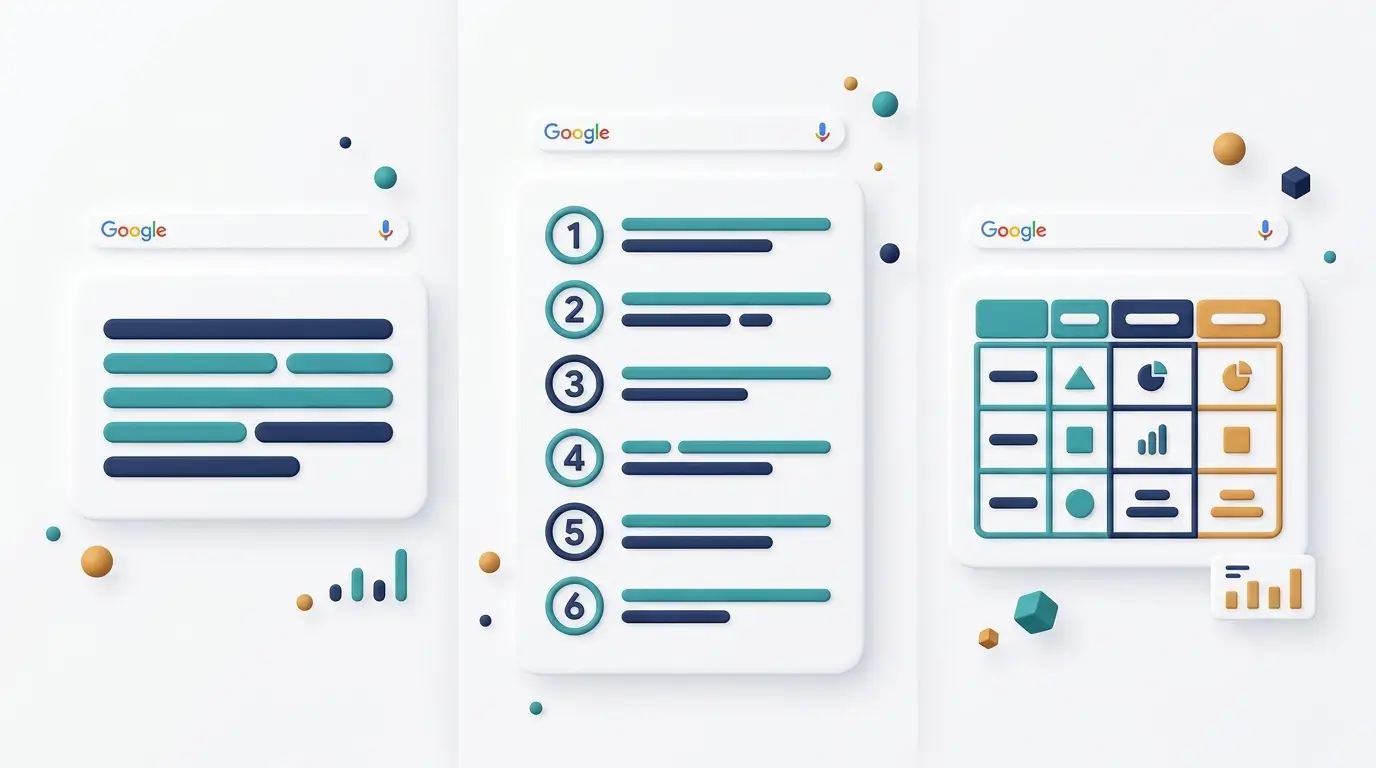
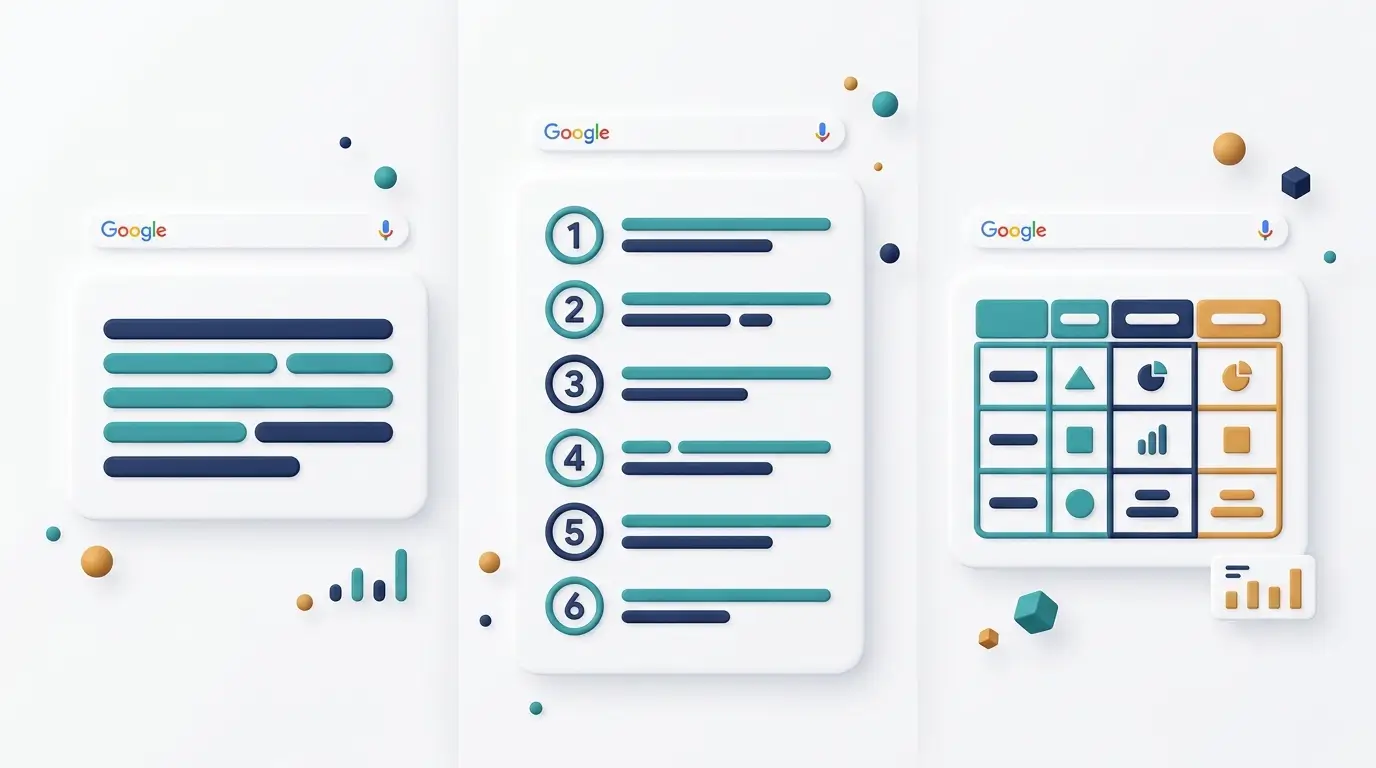
- There are three featured snippet formats, each with precise content specs: paragraph snippets (40-60 words, definition/explanation queries), list snippets (5-8 items in native HTML ol/ul, how-to/best-X queries), and table snippets (3-4 columns × 5-10 rows in native HTML table, comparison/pricing queries).
- Paragraph snippets make up approximately 55% of all featured snippets, lists approximately 30%, and tables approximately 12% — but list and table snippets generate higher CTR because they present actionable, scannable information.[1]
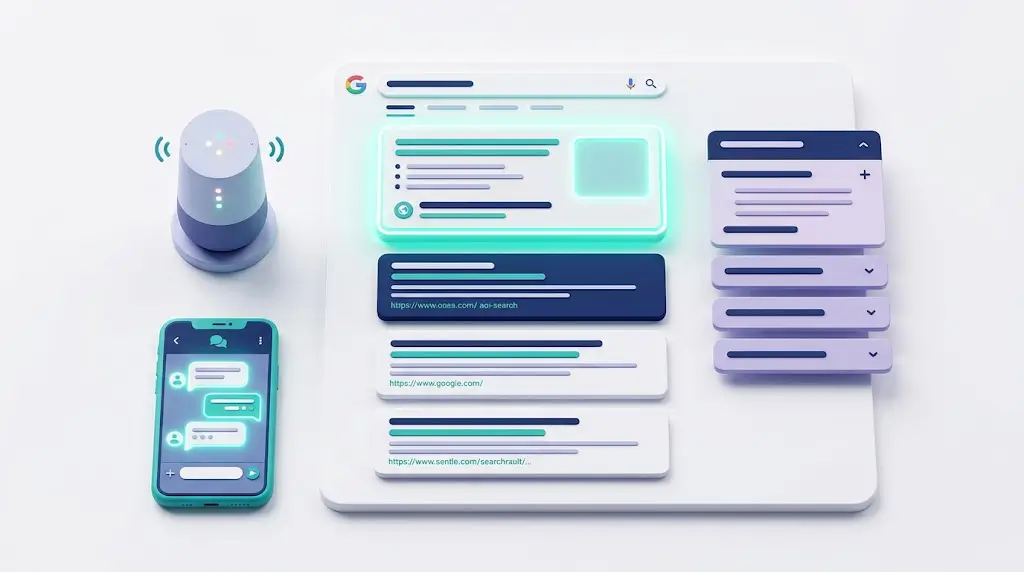
- Voice search and featured snippets are functionally the same target: approximately 40.7% of voice assistant answers come from existing featured snippets,[2] and assistants read aloud roughly the first 29 words of the snippet source — matching the paragraph snippet length spec almost exactly.
- Format mismatch is one of the most common snippet failure modes — using paragraph format for a query that expects a numbered list, or a list for a query that expects a table, reduces selection probability regardless of content quality.
- Inverted pyramid writing — lead with the direct answer first, support with context after — is the structural principle that converts good content into extractable snippet content without rewriting everything from scratch.
📋 Table of Contents
- The One Rule That Applies to All Three Formats~ 2 min
- Paragraph Snippets: The 40-60 Word Writing Spec~ 4 min
- List Snippets: The 5-8 Item Writing Spec~ 3 min
- Table Snippets: The 3-4 Column Writing Spec~ 3 min
- Voice Search: Why It’s the Same Optimization~ 2 min
- Format Matching: The Most Important Pre-Writing Step~ 2 min
- Before & After: Three Rewrites That Win Snippets~ 3 min
- Featured Snippet Writing Checklist~ 2 min
- Frequently Asked Questions~ 2 min
- Conclusion~ 1 min
The One Rule That Applies to All Three Formats
Before getting into format-specific specs, one principle applies identically to paragraph snippets, list snippets, and table snippets: the answer must appear immediately after the heading, with nothing in between.
Google’s extraction algorithm reads content top-to-bottom and selects the first substantive, extractable answer it finds after a relevant heading. A paragraph that spends two sentences establishing context before stating the definition will be passed over in favor of a competing page that leads with the definition. A list that opens with a narrative paragraph before the numbered items will lose to a page where the list starts on the line directly following the heading. A table buried after four paragraphs of explanation will not compete with a table that follows immediately after the heading it belongs to.
This is the inverted pyramid principle applied to snippet writing: the most important information — the direct answer — goes first. Supporting context, caveats, and elaboration follow it. This is the structural change responsible for the majority of snippet wins documented in AEO case studies, because most existing web content is written the other way: context first, answer second.
💬 According to EverydayOnAI
The inverted pyramid principle is genuinely counter to how most writers are trained. Academic writing, long-form journalism, and traditional blog posts all build toward the answer — you earn it through the setup. Featured snippet optimization reverses that: the reader (and the extraction algorithm) gets the answer in the first sentence, then chooses whether to read the setup. This feels wrong to write at first. The adjustment that usually helps: think of the heading as the question, and the opening sentence as the answer you’d give if someone stopped you in a hallway and asked that question. That’s the sentence Google extracts.
📋 Section Summary
- The universal snippet rule across all three formats: the answer must appear immediately after the heading, with no intervening context-setting, preamble, or introductory prose.
- Google’s extraction algorithm selects the first extractable answer after a relevant heading — content that buries the answer loses to competing pages that lead with it, regardless of overall content quality.
- Inverted pyramid writing — direct answer first, supporting context second — is the structural principle that converts well-written content into snippet-eligible content without requiring a full rewrite.
Paragraph Snippets: The 40-60 Word Writing Spec
Paragraph snippets are the most common format — approximately 55% of all featured snippets — and are triggered by definition and explanation queries: “what is”, “who is”, “why does”, “how does”.[1] They are also the primary voice search source, since voice assistants read aloud the first 29 words of a paragraph snippet — and a well-written 40-60 word snippet is, within those first 29 words, a complete standalone answer.
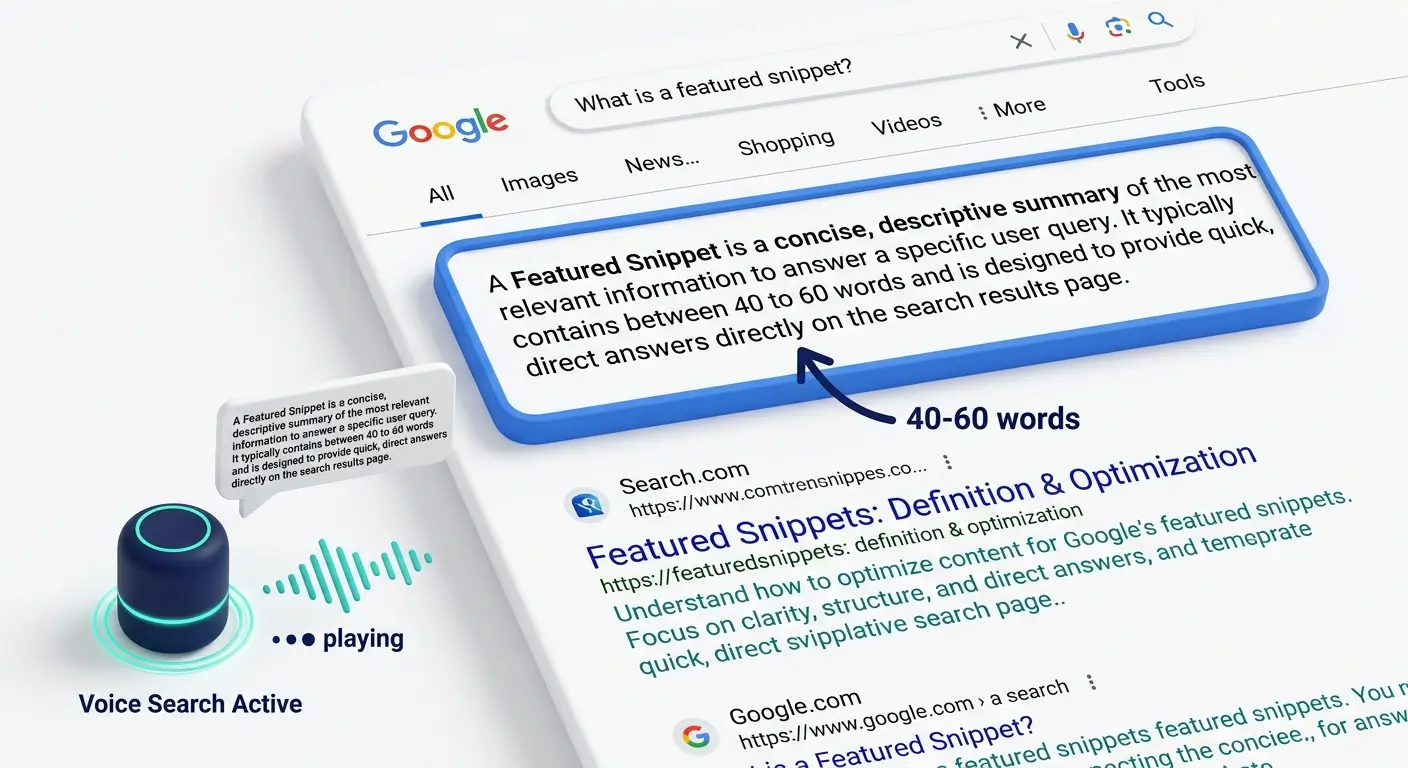
Paragraph Snippet Writing Spec
Triggered by: “what is”, “who is”, “why does”, “how does”, definition and explanation queries
| Element | Specification | Why It Matters |
|---|---|---|
| Total word count | 40-60 words | Under 40 appears incomplete; over 60 gets truncated with “…” |
| First sentence | Direct answer, 15-25 words | Google extracts from the top — the definition must be in sentence 1 |
| Average sentence length | Under 18 words per sentence | Shorter sentences reduce truncation risk and improve voice readability[5] |
| Heading match | Exact or near-exact query phrasing | Heading must mirror how the user typed the query |
| Placement | First sentence after heading — no introductory text | Extraction algorithm reads top-to-bottom, stops at first answer |
| Content type | Specific, factual claims — no vague generalities | Vague content is not selected for extraction[5] |
| Verb tense | Present tense for definitions | “X is…” not “X was…” — recency signal for evergreen definitions[5] |
| Voice reading window | First 29 words | What a voice assistant will read aloud from your snippet[6] |
📋 Section Summary
- Paragraph snippets (~55% of all snippets) have a tight writing spec: 40-60 words total, direct answer in sentence 1, average sentence length under 18 words, present tense for definitions, no introductory prose between heading and answer.
- Voice search reads the first 29 words aloud — a well-constructed 40-60 word paragraph snippet is effectively a pre-formatted voice answer within its first two sentences.
- Specific, factual claims are selected for extraction; vague generalities are not — this applies to the 40-60 word answer block specifically, not to supporting context further down the page.
List Snippets: The 5-8 Item Writing Spec
List snippets make up approximately 30% of featured snippets and are triggered by “how to” process queries, “best X” ranking queries, and “steps to” instructional queries.[1] They generate higher CTR than paragraph snippets for the queries that trigger them, because a list presents multiple actionable items that pull readers in — the “More items” link that Google appends to truncated lists is itself a click driver.
List Snippet Writing Spec
Triggered by: “how to”, “steps to”, “best X”, “top X”, “ways to” queries
| Element | Specification | Why It Matters |
|---|---|---|
| Item count | 5-8 items | Fewer than 5 appears incomplete; more than 8 gets truncated[4] |
| HTML markup | Native <ol> (steps) or <ul> (items), never <div> | Google’s extraction only targets native HTML list elements[4] |
| Item length | One sentence per list item, 10-20 words | Longer items get truncated; each item should be independently scannable[1] |
| Placement | Immediately after heading — no paragraph before list | Any text between heading and list reduces extraction probability |
| Item ordering | Most important items first (1-3) | Google truncates at ~7 items; if truncated, items 1-3 must stand alone |
| Elaboration | After the list, not inside list items | Elaboration inside <li> breaks the clean extraction pattern[4] |
| CSS | Do not hide list markers with CSS | Hidden markers can confuse crawlers evaluating list structure[1] |
| Heading format | H2 phrased as the question or process title | “How to optimize for featured snippets” not “Optimization tips” |
One alternative structure for longer processes: instead of one list with 5-8 items, use H3 subheadings as the list items. Write your H2 as the question, then use H3 tags for each step. Google synthesizes these subheadings into a list snippet — the H3 text becomes the list item, and the content under each H3 serves the human reader who clicks through. This approach works well when each step requires a full section of content rather than a single sentence.[4]
📋 Section Summary
- List snippets (~30% of snippets, higher CTR than paragraphs) require: 5-8 items in native HTML ol/ul markup, one sentence per item (10-20 words), no introductory paragraph between heading and list, and elaboration placed after the list rather than inside list items.
- CSS that hides list markers and div-based visual lists (not native HTML) are both extraction barriers — the content may look correct to humans but is invisible to Google’s list extraction system.
- H3-as-list-items is a valid alternative for longer processes: Google synthesizes H3 subheadings into list snippet format when the H2 heading matches a list-trigger query.
Table Snippets: The 3-4 Column Writing Spec
Table snippets make up approximately 12% of featured snippets but are consistently triggered for high-value commercial queries: comparisons (“X vs Y”), pricing (“how much does X cost”), and specifications (“what are the dimensions of X”).[1] For these query types, a well-structured table is often the highest-CTR content format — the tabular layout signals “this content has multiple dimensions” in a way that a paragraph cannot.
Table Snippet Writing Spec
Triggered by: “X vs Y”, “difference between”, pricing queries, specification queries, comparison queries
| Element | Specification | Why It Matters |
|---|---|---|
| Column count | 3-4 columns | More columns overflow the answer box; 3 is the optimal display size[3] |
| Row count | 5-10 rows | Under 5 rows appears thin; over 10 is truncated with “More rows” |
| HTML markup | Native <table> with <th> and <td> | Div-based grids cannot be extracted into table snippets[7] |
| Header row | <th> elements with descriptive column names | Google uses headers to understand the comparison logic[7] |
| Cell content | Short cells — no merged cells, no nested tables | Complex table structures confuse extraction[7] |
| Column logic | Clear comparison logic — Feature | Option A | Option B | Consistent column structure helps AI agents parse and cite the data |
| Placement | Immediately after heading, no pre-table paragraph | Same inverted pyramid rule — extraction starts at the first content element after the heading |
📋 Section Summary
- Table snippets (~12% of snippets, highest value for comparison/pricing queries) require: 3-4 columns, 5-10 rows, native HTML table markup with th and td elements, descriptive headers, short cells, no merged cells, and no nested tables.
- Div-based grids that look like tables visually cannot be extracted as table snippets — the markup, not the appearance, determines extractability.
- The same native HTML table that wins a table snippet is also more parseable by AI citation systems, making table markup a shared investment for AEO and GEO simultaneously.
Voice Search: Why It’s the Same Optimization
Voice search optimization is frequently treated as a separate workstream from featured snippet optimization — with separate keyword research, separate content reformatting, and separate schema requirements. The data does not support treating them as separate. Approximately 40.7% of all voice assistant answers come directly from existing featured snippets.[2]
Voice assistants — Google Assistant, Siri, and Alexa specifically — read aloud approximately the first 29-30 words of the source content they pull from.[6] A 40-60 word paragraph snippet is, within its first two sentences, a complete standalone answer. Those first two sentences are what gets read aloud. The remaining 20-30 words of the snippet are available to the listener if they ask a follow-up — but the primary “voice answer” is the first 29 words of the snippet source, which in a well-written paragraph snippet is the direct-answer sentence followed by one supporting clause.
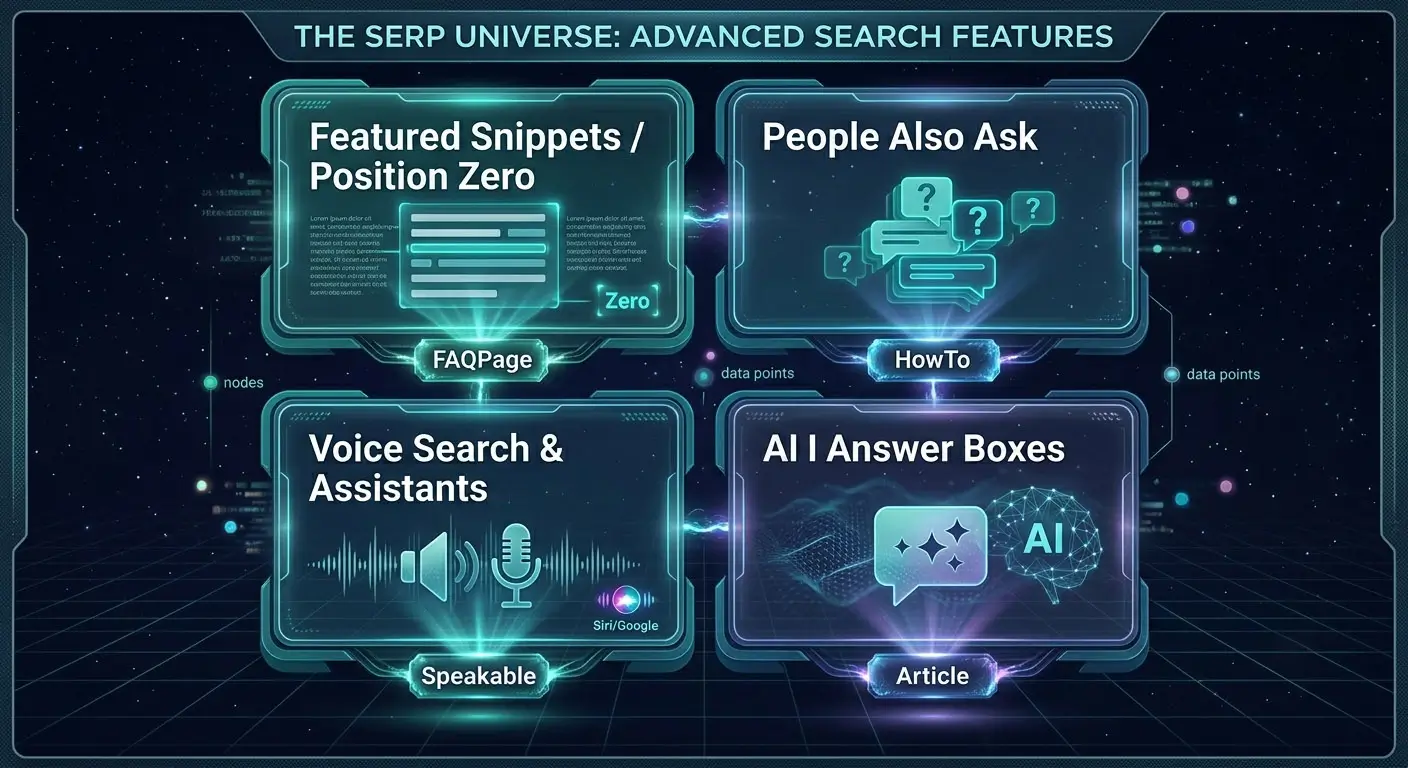
The practical implication: if you are already following the paragraph snippet writing spec (40-60 words, direct answer in sentence 1, under 18 words per sentence), you have already written a voice-search-ready answer. There is no additional reformatting needed. The only voice-specific addition is Speakable schema — the markup that signals to voice assistants which content blocks are appropriate to read aloud, which the AEO Guide covers in detail.
📋 Section Summary
- 40.7% of voice assistant answers come from existing featured snippets — voice search and snippet optimization are not two separate workstreams, they are one.
- Voice assistants read approximately the first 29 words of a snippet source — a paragraph snippet written to the 40-60 word spec delivers a complete, self-contained voice answer within its first two sentences by design.
- The only voice-specific addition beyond paragraph snippet optimization is Speakable schema markup — covered in the AEO Guide’s schema section.
Format Matching: The Most Important Pre-Writing Step
Format mismatch — using paragraph structure for a query that triggers list snippets, or building a list for a query that triggers tables — is one of the most common reasons technically correct content fails to earn a snippet.[8] Before writing a single word of snippet-optimized content, the pre-writing step is: search your target query and identify which format Google currently serves.
| Query Pattern | Expected Format | Example Query | Writing Action |
|---|---|---|---|
| “What is X”, “Who is X”, “Why does X” | Paragraph | “What is answer engine optimization?” | 40-60 word direct-answer paragraph |
| “How to X”, “Steps to X”, “Ways to X” | Ordered list | “How to optimize for featured snippets” | 5-8 item ol immediately after heading |
| “Best X”, “Top X”, “X recommendations” | Unordered list | “Best AEO tools 2026” | 5-8 item ul with item name + one-sentence description |
| “X vs Y”, “Difference between X and Y” | Table or paragraph | “AEO vs SEO difference” | 3-4 column HTML table OR 40-60 word direct comparison paragraph |
| Pricing, specifications, feature lists | Table | “How much does Semrush cost?” | 3-4 column HTML table, descriptive headers |
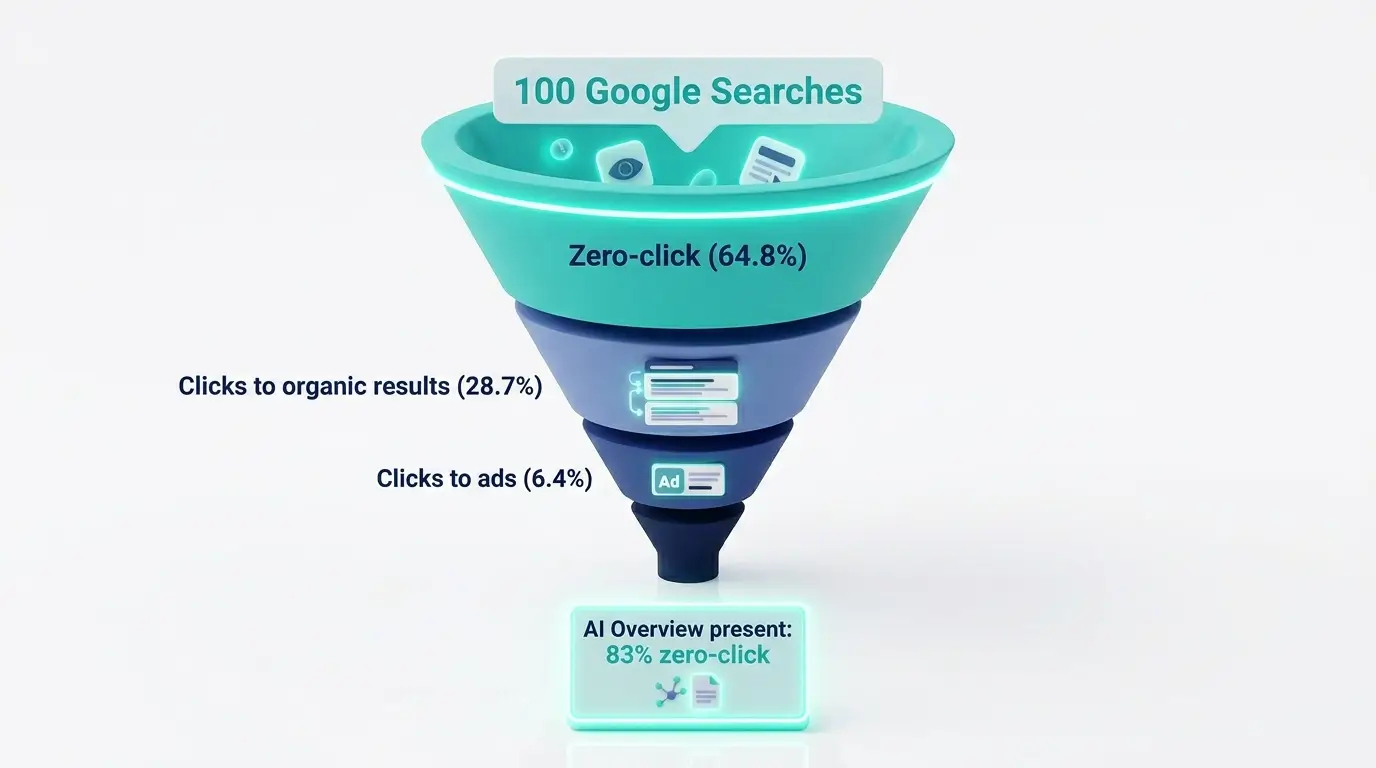
One additional format consideration for 2026 specifically: some queries that previously triggered featured snippets now trigger AI Overviews instead — particularly broad definition queries, as documented by DigitalApplied.[8] “How to” and “X vs Y” queries retain snippet presence more reliably than pure “what is” definitional queries, which AI Overviews have displaced in some topic areas. If your SERP check shows an AI Overview rather than a snippet for a broad definition query, apply GEO content structure (from the GEO Guide) rather than the snippet spec from this article — per the GEO vs AEO framework.
📋 Section Summary
- Format matching — searching the target query to identify which snippet format Google currently serves — is the required pre-writing step before any snippet optimization work.
- Query pattern reliably predicts format: “what is” → paragraph, “how to” → ordered list, “best X” → unordered list, “X vs Y” → table or comparison paragraph, pricing/specs → table.
- Broad “what is” definitional queries are the most likely to show AI Overviews instead of snippets in 2026 — if that’s what your SERP check shows, apply GEO structure rather than the paragraph snippet spec.
Before & After: Three Rewrites That Win Snippets
Rewrite 1: Paragraph Snippet — Definition Query
✖ Before — Context-first, buried definition
“In today’s rapidly changing digital landscape, understanding what AEO means for your content strategy has become increasingly important. AEO, which stands for Answer Engine Optimization, is something content teams should understand. It refers to the practice of making your content easily extractable…”
✔ After — 52 words, direct-answer first
“Answer Engine Optimization (AEO) is the practice of structuring content so it can be extracted as a standalone, direct answer in featured snippets, voice search results, and AI answer boxes. AEO targets becoming the answer itself — selected from a specific position on the page — rather than simply ranking in a list of results.”
The before version has the definition — it just doesn’t lead with it. The rewrite moves the definition to sentence 1, states it precisely, and uses the second sentence to add the key contrast (becoming the answer vs. ranking in results). Total word count: 52. Average sentence length: 17 and 20 words. Present tense. No preamble.
Rewrite 2: List Snippet — How-To Query
✖ Before — Narrative prose, no extractable list
“To optimize content for featured snippets, you’ll want to start by making sure your heading matches the query, and then you should write a clear answer, and it also helps to keep things concise while adding schema markup and monitoring your results over time with Search Console.”
✔ After — 6-item ordered list in native HTML
<ol> (1) Match your heading to the exact query phrasing. (2) Write a 40-60 word direct answer immediately after the heading. (3) Place the full list directly after the heading — no paragraph before it. (4) Add FAQPage or HowTo schema. (5) Submit to Google Search Console for indexing. (6) Monitor snippet appearance and refresh quarterly. </ol>
The same information, restructured. The before version contains all six steps but blends them into a single run-on sentence with coordinating conjunctions — Google cannot extract a list from this. The after version uses native ol/li markup, one action per item, all within the 10-20 word per item spec.
Rewrite 3: Table Snippet — Comparison Query
✖ Before — Comparison buried in prose
“Paragraph snippets are different from list snippets in several ways. While paragraphs work for definition queries and are 40-60 words, lists use 5-8 items and work for how-to queries. Tables are another format entirely, best for comparison data with 3-4 columns…”
✔ After — 3-column HTML table, immediately after heading
<table> [Format | Trigger | Spec] [Paragraph | “what is” queries | 40-60 words] [List | “how to” queries | 5-8 items in ol/ul] [Table | comparison queries | 3-4 columns, 5-10 rows] </table>
The prose comparison is readable and accurate but not extractable as a table snippet. The HTML table version takes exactly the same information and puts it in the format Google expects for comparison queries — three columns (Format, Trigger, Spec), three data rows plus header, native table markup.
Featured Snippet Writing Checklist
✓ Pre-Writing (Do This First)
- ★ Search target query and identify: does it trigger a snippet (paragraph, list, or table), an AI Overview, or neither?
- If AI Overview: apply GEO structure (not this checklist); if neither: SEO ranking work needed first
- If snippet: note the exact format (paragraph/list/table) and match content structure accordingly
- Review the current snippet holder — what’s their word count, structure, heading phrasing?
✓ Paragraph Snippet Writing
- ★ 40-60 total words in the answer block
- ★ Direct answer in sentence 1 — topic term defined immediately
- Average sentence length under 18 words
- Present tense for definitions (“X is…” not “X was…”)
- Specific, factual claims — no vague generalizations
- No introductory text between heading and answer paragraph
- ★ First 29 words standalone as a complete voice answer
✓ List Snippet Writing
- ★ 5-8 items only — not fewer, not more
- ★ Native <ol> (ordered/steps) or <ul> (unordered/items) markup — not styled divs
- ★ List placed immediately after heading — no paragraph before the list
- Each item: one sentence, 10-20 words
- Most important items in positions 1-3 (in case Google truncates)
- Elaboration in a paragraph after the list, not inside <li> elements
- CSS must not hide list markers
✓ Table Snippet Writing
- ★ Native <table> with <th> header row and <td> data cells — not div grids
- ★ 3-4 columns, 5-10 rows
- Descriptive column headers in <th> elements
- Short cell content — avoid merged cells and nested tables
- Clear comparison logic (Feature | Option A | Option B pattern)
- Table placed immediately after heading
✓ Post-Publication
- Search Console monitored monthly for average position anomalies below 1.0 (signals snippet win)
- Speakable schema implemented targeting the answer paragraph for voice surfaces
- Quarterly content refresh scheduled for any page holding a snippet — freshness is re-evaluated continuously
- Competitor snippet holders re-checked quarterly — they can reclaim lost snippets with reformatting
Frequently Asked Questions
How long should a featured snippet answer be?
Paragraph snippet answers should be 40-60 words. Under 40 words often appears incomplete to Google; over 60 words gets truncated with an ellipsis in the answer box. List snippets should contain 5-8 items with each item kept to one sentence (10-20 words). Table snippets perform best with 3-4 columns and 5-10 rows. These dimensions match Google’s answer box display constraints and the 15-20 second voice search reading window.[9]
What query types trigger each featured snippet format?
Paragraph snippets are triggered by “what is”, “who is”, “why does”, and “how does” queries. List snippets are triggered by “how to” process queries and “best X” or “top X” ranking queries. Table snippets are triggered by comparison queries (“X vs Y”), pricing queries, and specification queries. Matching your content format to the format Google currently serves for that query type is the highest-leverage pre-writing step — format mismatch reduces selection probability regardless of content quality.[8]
Does winning a featured snippet automatically win voice search?
Not automatically, but approximately 40.7% of voice assistant answers come directly from existing featured snippets.[2] Voice assistants read aloud roughly the first 29 words of a snippet source — meaning the same paragraph snippet spec (40-60 words, direct answer in sentence 1) produces a complete standalone voice answer within its first two sentences. The only voice-specific addition beyond paragraph snippet optimization is Speakable schema markup.
What is inverted pyramid writing and how does it help featured snippets?
Inverted pyramid writing means leading with the most important information first — the direct answer — and following with supporting detail, context, and caveats afterward. Google’s extraction algorithm identifies the first substantive passage after a relevant heading and lifts it as the snippet answer. A paragraph that buries the definition in sentence three fails snippet extraction even if the overall content quality is high, because the algorithm reads top-to-bottom and selects the first extractable answer it finds.
Should I use HTML lists or styled div elements for list snippets?
Always use semantic HTML lists — <ol> for ordered steps, <ul> for unordered items. Google’s list snippet extraction specifically targets native <ol> and <li> or <ul> and <li> elements.[4] Styled div elements that visually look like a list but lack proper HTML markup cannot be extracted into list snippets, regardless of how they appear to a human reader. Keep each <li> item to one sentence, place the list immediately after the heading, and avoid CSS that hides list markers.
Conclusion: Write for Extraction, Not Just for Reading
The sentence-level changes that win featured snippets are not about writing better — most content that fails to earn snippets is already well-written. They are about writing in a sequence that Google’s extraction algorithm can lift cleanly: direct answer first, format matched to query intent, markup that makes structure machine-readable.
The three-step workflow from this article: check the SERP to identify which format your target query triggers, use the corresponding writing spec (40-60 word paragraph, 5-8 item list, 3-4 column table), and place the answer immediately after the heading with nothing in between. That’s the entirety of the writing change — the rest is monitoring and quarterly freshness maintenance.
💬 According to EverydayOnAI
The most valuable insight from reviewing the specs above together is how narrow the actual optimization window is. Paragraph: 40-60 words. List: 5-8 items. Table: 3-4 columns. These are not wide ranges. Content that sits at 62 words may lose to a 55-word competitor. A list with 9 items may lose to one with 7. This precision is what makes snippet optimization feel mechanical — because it is, and intentionally so. The writer’s job is to make the extraction trivially easy for Google, which means respecting the dimensional constraints that match the answer box, not writing to express nuance or comprehensiveness within the snippet block itself. Save the nuance for the supporting paragraphs that follow.
📚 References and Sources
- EarnifyHub, “Featured Snippets for Bloggers in 2026: How to Capture Position Zero,” April 2026. Snippet format distribution: paragraph ~55%, lists ~30%, tables ~12%, video ~3%; list and table snippets generate higher CTR than paragraphs; each list item should be 10-20 words; avoid CSS hiding list markers. earnifyhub.com
- TurboAudit, “Answer Engine Optimization (AEO): 2026 Guide,” June 2026. 40.7% of voice assistant answers come from existing featured snippets. turboaudit.ai
- YoGrow Solutions, “How to Win the Featured Snippet: The 2026 SEO Formatting Guide,” January 2026. Three columns and five to six rows described as optimal table snippet size; AI agents find it easier to parse simple, data-rich table structures. yogrowsolutions.com
- AIOCopilot, “Featured Snippets Optimization Guide 2026: Position Zero Strategy,” April 2026. Process queries: use H2 with question, immediately follow with ol where each item is one concise step; H3-as-list-item alternative for longer processes; keep total items 5-8; elaboration in paragraph after list, not inside li; native HTML list elements required. aiocopilot.com
- MarGen, “Featured Snippets in 2026: How to Win Position Zero,” March 2026. Short sentences in definition paragraphs (under 18 words average); specific factual claims, not vague generalities; present tense for definitions; monthly review of 20 priority snippet queries. margen.net
- HubSpot, “Keyword Research for AEO,” June 2026, citing voice assistant data. Voice assistants typically read the first 29 words of a featured snippet source. blog.hubspot.com
- W3Era, “How to Optimize for Featured Snippets in 2026 (Complete Guide),” June 2026. Table snippet optimization requires native HTML table elements; descriptive headers; short cells; avoid merged cells, nested tables, vague column names, and image-based tables. w3era.com
- DigitalApplied, “Featured Snippets in the AI Overview Era: 2026 Guide,” March 2026. Format mismatch between content structure and query intent reduces snippet selection probability regardless of content quality; “how to” and comparison queries retain snippet presence more reliably than broad definition queries, which AI Overviews have displaced in some categories. digitalapplied.com
- DataEnriche, “How to Structure Content for Featured Snippets 2026,” April 2026. Featured snippet answer specs: 40-60 words paragraph (under 40 appears incomplete, over 60 truncated); 5-7 list items shown with “More items” for longer lists; 3-4 columns for table snippets; these lengths match Google’s answer box dimensions and voice search reading times of 15-20 seconds. dataenriche.com
Sources verified June 15, 2026. Featured snippet trigger rates and format distributions vary by industry and keyword type — these figures represent averages across broad query samples. Snippet presence for specific queries should always be confirmed via direct SERP check. This article does not constitute professional SEO advice.
📚 Go Deeper: Complete AI SEO Hub on EverydayOnAI
-
→ What is AI SEO? The Complete Guide to GEO, AEO & LLMO
The pillar guide — how featured snippet writing fits within the full AI SEO stack. -
→ What is AEO? The Complete Answer Engine Optimization Guide
The AEO sub-pillar — covers all four AEO surfaces including the Snippet-Readiness Checker tool and Speakable schema for voice search. -
→ AEO Keyword Research: Finding Answer-Intent Queries
How to identify the target queries that trigger featured snippets before you apply the writing specs in this article. -
→ GEO vs AEO: Key Differences Explained
If your SERP check shows an AI Overview instead of a featured snippet, this guide’s framework tells you which optimization to apply instead. -
→ AEO Checklist: Is Your Content Answer-Ready? (40-Point Audit)
The complete AEO audit — use this after applying the writing specs from this article to validate full coverage across all four AEO surfaces.
Audit Your Top Pages with the Snippet-Readiness Checker
Paste any paragraph into our free interactive Snippet-Readiness Checker — available in the AEO Guide — and get instant feedback on word count, direct-answer structure, specificity, and voice readability.