Tag: Featured Snippets

  • AEO Checklist 2026: Is Your Content Answer-Ready? (40-Point Audit)

    AEO Checklist 2026: Is Your Content Answer-Ready? (40-Point Audit)

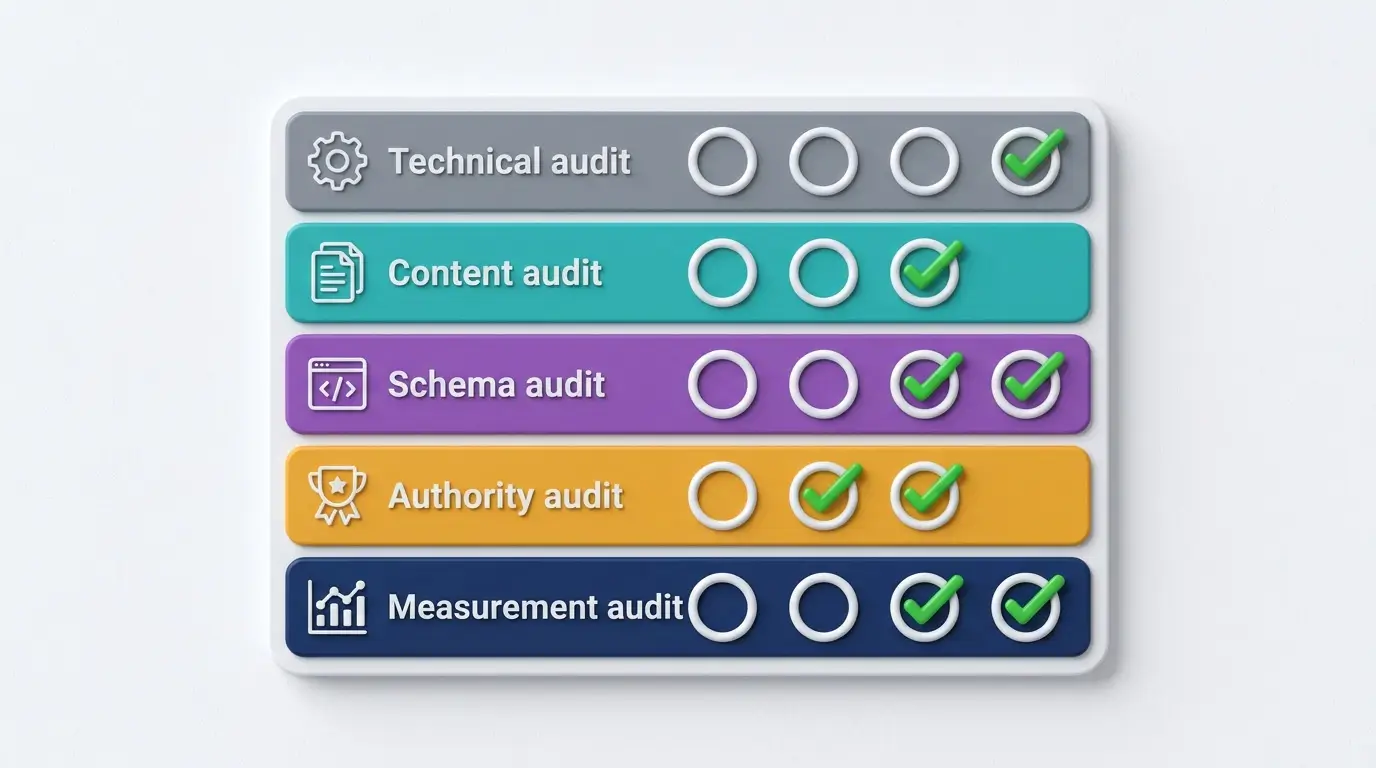
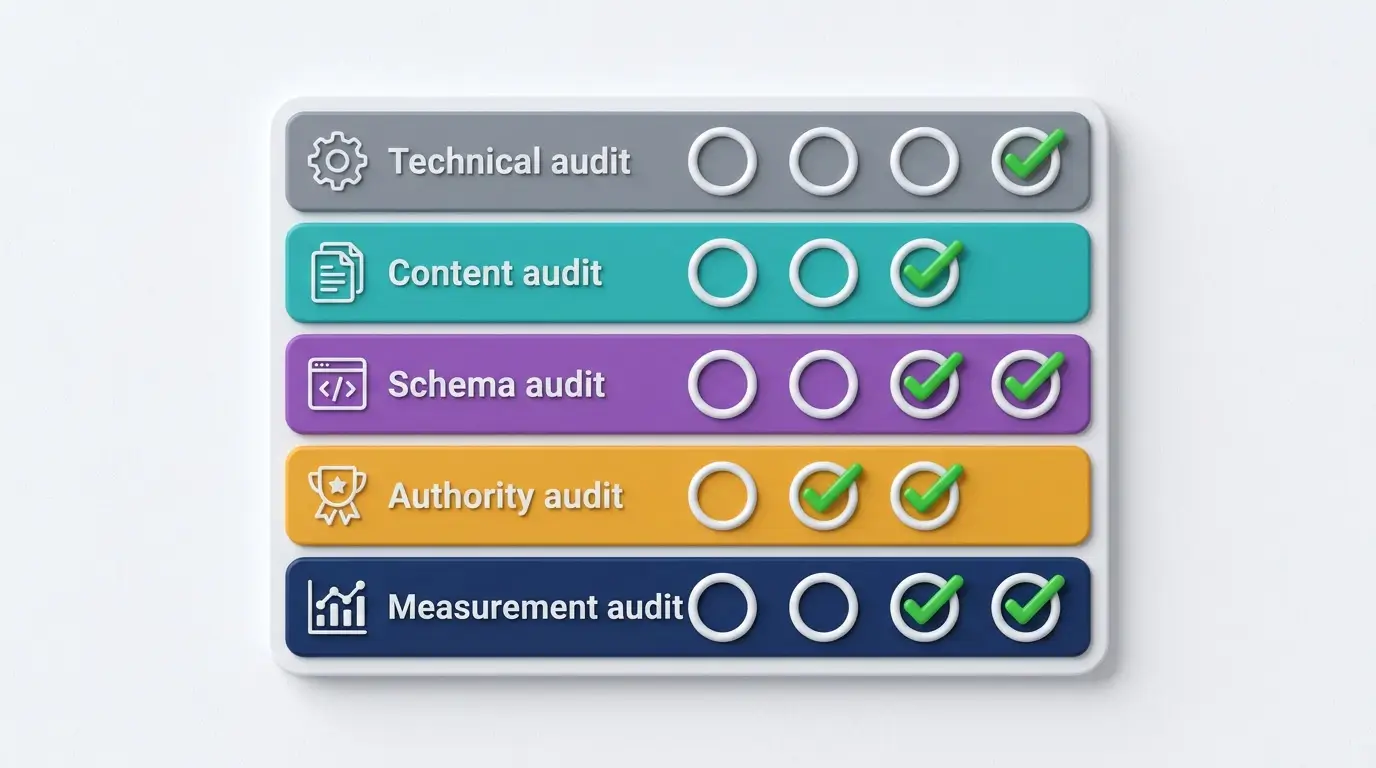
    Five-category AEO checklist board showing Technical, Content, Schema, Authority, and Measurement audit dimensions with checkbox indicators
    A complete AEO audit covers five distinct dimensions — each one a separate reason a well-written page might still be invisible to AI answer systems.

    📅 Last Reviewed: June 15, 2026. Final article in the AEO sub-pillar of the AI SEO Hub on EverydayOnAI. Use this checklist after reading the AEO Guide and the writing guides that precede it. Data from AirOps, lseo.com, Stackmatix, FirstAnswer, and BrightEdge cited inline.

    📌 Key Takeaways

    • A complete AEO audit covers five dimensions in sequence: Technical Access, Content Structure, Schema Markup, Authority Signals, and Measurement. Pages can fail one dimension while performing well in others — and a single failed dimension can make all other optimizations irrelevant.
    • Roughly 60% of AI Overview citations come from pages that do not rank in the top 20 organic results (AirOps research, 2026) — confirming that extractability and structure, not ranking position, are the primary determinants of AI citation eligibility.
    • Only 30% of brands remain visible from one AI answer to the next (AirOps research) — making quarterly audits and monthly monitoring essential, not optional.
    • Technical access issues are the most catastrophic single-point failures: a page blocked to GPTBot, PerplexityBot, or ClaudeBot makes all content and schema optimization irrelevant. Fix these first, always.
    • Target score: 70%+ (28 of 40 points) for meaningful AEO readiness. 85%+ (34 points) indicates strong answer-readiness — shift focus to maintenance and authority building rather than structural remediation.

    Why Most Pages That Rank Still Fail AEO Audits

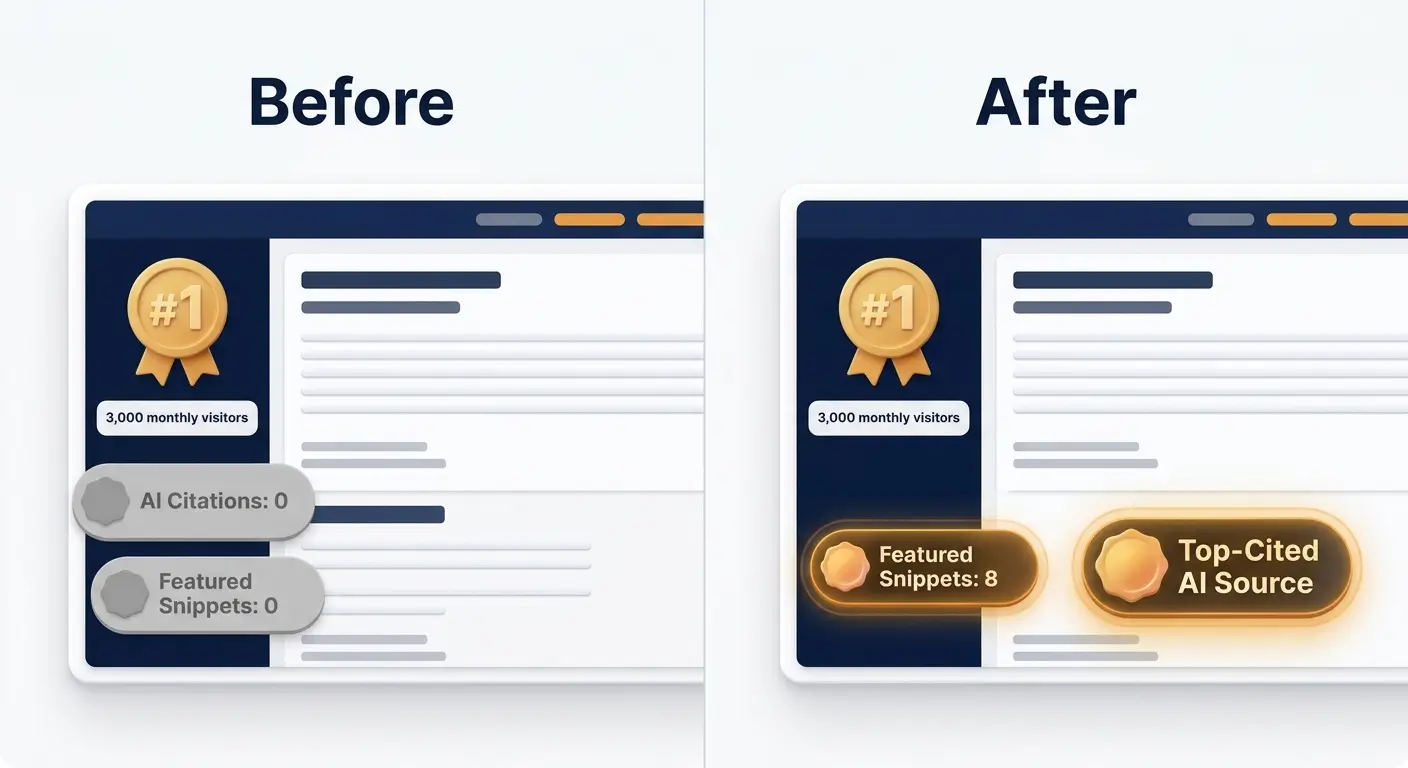
    The most counterintuitive finding in 2026 AI search research is this: roughly 60% of AI Overview citations come from pages that do not rank in the top 20 organic results.[1] Rankings and AI citations are not the same signal. A page can hold position #1 and receive zero AI citations. A page ranking at position #25 can be cited in every relevant AI Overview, if its content is extractable enough.

    This is why AEO audits are a separate exercise from traditional SEO audits. Traditional audits ask: Can Google rank this page? AEO audits ask: Can AI systems extract and reuse this page’s content as a cited source? The answers to those two questions are increasingly diverging — and only 30% of brands maintain consistent AI visibility from one answer generation to the next, according to AirOps research.[1]

    The five-dimension framework in this checklist reflects the actual reasons pages fail AEO audits, derived from the lseo.com 2026 AEO audit framework, AirOps’ 48-factor checklist, and FirstAnswer’s 100-point audit methodology — all published in 2026. The five dimensions are: Technical Access, Content Structure, Schema Markup, Authority Signals, and Measurement. Each is a separate way a well-written page can be completely invisible to AI answer systems.

    60%

    of AI Overview citations come from pages outside the organic top 20[1]

    30%

    of brands remain visible from one AI-generated answer to the next[1]

    78%

    of organizations now use AI in at least one business function[2]

    89%

    of B2B buyers use generative AI as a top information source at every buying stage[2]

    📋 Section Summary

    • 60% of AI Overview citations come from pages outside organic top 20 — ranking and AI citation are separate signals driven by separate optimization criteria.
    • Only 30% of brands maintain consistent AI visibility across consecutive answer generations — making the AEO audit a recurring governance function, not a one-time project.
    • The 5-dimension framework (Technical, Content, Schema, Authority, Measurement) covers the distinct ways a page can fail AI citation eligibility independently of its traditional SEO performance.

    How to Use This Checklist

    Run the checklist in dimension order — Technical Access first, Measurement last. Technical issues must be resolved before content changes have any effect; measurement must come last because you need a baseline before optimizations begin. Each item is scored as: Pass (1 point) or Fail / Not implemented (0 points). Total possible: 40 points.
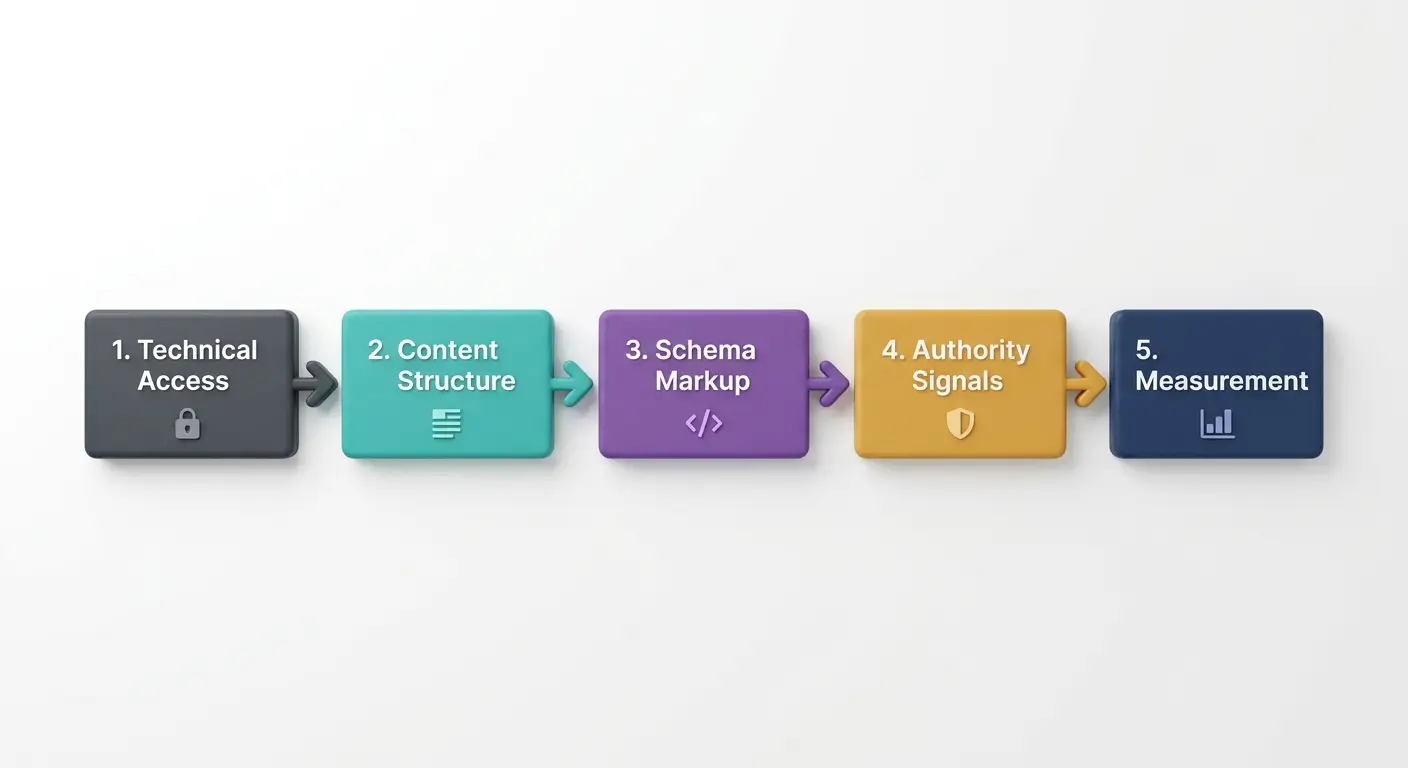
    Five-step AEO audit process flow: Technical Access, Content Structure, Schema Markup, Authority Signals, Measurement — run in this sequence
    Run the five dimensions in order. Technical issues block all downstream optimizations. Measurement comes last because you need a pre-optimization baseline to measure against.

    Two labels appear next to each item:

    • CRITICAL — A fail here makes all other optimizations in this dimension irrelevant. Fix before moving on.
    • HIGH — Most commonly responsible for AI citation failures in audited sites. High priority after Critical items.
    • MEDIUM — Meaningful improvement but not a blocker if Critical and High items are resolved.


    🎯 Interactive Tool

    AEO Audit Score Calculator

    Check off every item that’s already true for your page, then calculate your score. All 40 items from the checklist below are here — this just totals them and tells you where to focus first.

    🔒 1. Technical Access
    0 / 8

    📋 2. Content Structure
    0 / 12

    🔒 3. Schema Markup
    0 / 7

    ⚖️ 4. Authority Signals
    0 / 7

    📊 5. Measurement
    0 / 6

    0

    This is a self-assessment tool for directional guidance. Scoring 70%+ (28/40) indicates meaningful AEO readiness; 85%+ (34/40) indicates strong readiness. It does not replace a full technical audit and does not guarantee AI citation, ranking, or traffic outcomes.

    Dimension 1: Technical Access (8 items)

    Technical access failures are the only category where a single fail can make every other optimization completely irrelevant. If a page returns an empty div or loading shell when fetched with a bot user-agent, it is not crawlable by AI systems, and all other AEO work on that page has no effect.

    🔒 Technical Access

    8 items / 8 points

    01

    GPTBot not blocked in robots.txt — Search for “GPTBot” in your robots.txt file. “Disallow: /” against GPTBot blocks all ChatGPT citation eligibility.

    CRITICAL

    02

    PerplexityBot not blocked in robots.txt — Same check for PerplexityBot. Perplexity generates ~20 million AI answers per day; this bot must have access.

    CRITICAL

    03

    Google-Extended and ClaudeBot not blocked — Covers Google AI Overviews training and Claude AI respectively. Check for Disallow directives against both user-agents.

    CRITICAL

    04

    Cloudflare Bot Fight Mode not blocking AI crawlers — Cloudflare’s Bot Fight Mode can block GPTBot and PerplexityBot even when robots.txt allows them. Check Cloudflare Security → Bots → verify AI crawlers are not in a blocked category.

    CRITICAL

    05

    Page renders full content with bot user-agent — Fetch the URL using a bot user-agent emulator (e.g., Screaming Frog with a custom user-agent or Google’s Rich Results Test). If the response shows an empty div or loading shell, the page is not AI-crawlable regardless of robots.txt settings.

    CRITICAL

    06

    All priority pages in XML sitemap — Sitemap submitted to both Google Search Console and Bing Webmaster Tools. Pages absent from sitemap are discovered later and less reliably.

    HIGH

    07

    Canonical tags set correctly — no duplicate content issues — Canonical pointing to the wrong URL means AI systems may index the non-canonical version, splitting citation authority between two URLs for the same content.

    HIGH

    08

    llms.txt file created and deployed at site root — A text file at yoursite.com/llms.txt that explicitly lists priority content for AI crawlers. Not universally adopted yet, but a forward-looking signal with zero downside.[3]

    MEDIUM

    📋 Section Summary

    • Items 01-05 are CRITICAL — a fail on any one of these makes all content and schema optimization irrelevant for that page. Fix before proceeding.
    • Cloudflare Bot Fight Mode (item 04) is the most frequently missed technical blocker — it can block AI crawlers even when robots.txt explicitly allows them.
    • Page rendering with a bot user-agent (item 05) is the definitive test: what a bot actually receives when it fetches the page, regardless of what robots.txt says.

    Dimension 2: Content Structure (12 items)

    Content structure is the dimension most directly responsible for AEO citation failures — and the one most within your control without requiring technical changes. The most effective audit framework checks answer readiness: whether each page clearly resolves a specific user question, with a direct answer near the top, logical heading levels, and consistent formatting for facts, steps, lists, and supporting context.

    📋 Content Structure

    12 items / 12 points

    09

    Direct answer in first 1-2 sentences after each H2/H3 — The extraction algorithm reads top-to-bottom and selects the first extractable answer after a relevant heading. Content that builds context before stating the answer loses to pages that lead with the answer.[4]

    CRITICAL

    10

    Headings phrased as actual questions or direct topic statements — “How much does an AEO audit cost?” outperforms “Pricing” as an H2. Generative engines treat headings as semantic anchors — vague headings produce vague extraction.[4]

    HIGH

    11

    Paragraph snippet blocks: 40-60 words for definition/explanation queries — Under 40 words appears incomplete; over 60 words gets truncated. See the Featured Snippets Guide for the full spec.

    HIGH

    12

    List snippets use native <ol>/<ul> HTML with 5-8 items — Styled div elements cannot be extracted as list snippets. Native HTML list markup is required. Each <li> item: one sentence, 10-20 words.

    HIGH

    13

    Comparison content uses native HTML <table> with <th>/<td> markup — Div-based grids cannot be extracted as table snippets regardless of visual appearance. 3-4 columns, 5-10 rows, descriptive headers.

    HIGH

    14

    Statistics are self-contained: [Organization] [finding] ([Source, Year]) — AI systems process text, not hyperlinks. A statistic without inline source attribution cannot be correctly attributed when reproduced. Hyperlink-only attribution is insufficient for AI extraction.

    HIGH

    15

    FAQ section with minimum 5 Q&A pairs — each answer self-contained — Each FAQ answer must be readable without seeing the question. Q&A structure mirrors the prompt format generative engines optimize around.[4]

    HIGH

    16

    Section Summary boxes at the end of every H2 — 3 self-contained bullet points summarizing the section’s key claims. These are among the most consistently extracted content formats by AI platforms, per the Princeton/KDD 2024 study.

    MEDIUM

    17

    Key Takeaways box immediately after the introduction — 5 self-contained bullets at the top of the article. Signals to AI systems what the page’s core claims are before they read the full content.

    MEDIUM

    18

    Named entities re-introduced at start of each H2 section — No pronoun-only references (“it”, “they”, “the tool”) at the start of a new section. AI systems extract sections independently; self-contained sections are more reliably cited.

    MEDIUM

    19

    Content depth above 20,000 characters on pillar articles — ConvertMate’s 2026 benchmark: pages above 20,000 characters earn 4.3x more AI citations than shorter content. Does not apply to spoke articles where focused depth (8,000-15,000 chars) is appropriate.

    MEDIUM

    20

    “Last Reviewed” date visible in article body — updated when statistics refreshed — Content freshness is weighted more aggressively in AI citation selection than in traditional SEO. The visible date (not just schema metadata) is a signal to AI crawlers and human readers alike.

    MEDIUM

    📋 Section Summary

    • Item 09 (direct answer first) is the single highest-impact content change across AEO research — the extraction algorithm reads top-to-bottom and stops at the first extractable answer per section.
    • Items 12, 13 (native HTML list and table markup) are structural — visually correct but structurally wrong implementations (div-based) are extraction barriers regardless of content quality.
    • Item 14 (self-contained statistics) addresses the gap between hyperlink-only attribution (insufficient for AI) and inline source attribution (required for AI to correctly reproduce a cited claim).

    Dimension 3: Schema Markup (7 items)

    Schema markup is the most frequently misunderstood AEO dimension — with two important nuances. First, FAQPage, HowTo, and Speakable schema directly target AEO surfaces (snippets, PAA, voice). Second, per the Ahrefs May 2026 difference-in-differences study, schema markup showed no statistically significant effect on ChatGPT/AI Mode citations and was associated with a 4.6% decrease in Google AI Overview citations — meaning schema serves AEO surfaces but is not the lever for GEO/LLM citation specifically. See the AEO vs SEO guide for the full breakdown.

    🔒 Schema Markup

    7 items / 7 points

    21

    FAQPage schema implemented and validated — JSON-LD with @type: FAQPage, each Q&A pair as mainEntity. Validated in Google’s Rich Results Test. Directly targets People Also Ask and FAQ featured snippets.[7]

    HIGH

    22

    HowTo schema on all step-by-step instructional content — Targets list snippets for process queries. Each step as a HowToStep with name and text properties. Validated in Rich Results Test.

    HIGH

    23

    Speakable schema targeting direct-answer paragraphs and FAQ answers — cssSelector targeting .key-takeaway, .section-summary, blockquote, and .eoa-opinion selectors (or equivalent on your site). Signals to voice assistants which content is appropriate to read aloud.

    HIGH

    24

    Article schema with dateModified, author @id reference, and wordCount — dateModified signals freshness. Author @id links to the Person entity on the author page. wordCount provides a depth signal.

    MEDIUM

    25

    Person schema on author page with knowsAbout and sameAs arrays — Full entity markup enabling AI systems to resolve the author entity against Knowledge Graph records. sameAs should include LinkedIn URL at minimum.

    MEDIUM

    26

    Organization schema sitewide with consistent name, URL, and logo — Consistent entity data across all pages. Inconsistent name formatting (e.g., “EverydayOnAI” on some pages, “Everyday On AI” on others) creates entity disambiguation issues for AI systems.

    MEDIUM

    27

    All schema validated — no errors in Google Rich Results Test or Schema.org Validator — Invalid schema (malformed JSON-LD, missing required properties) produces no benefit and can suppress rich result eligibility entirely.

    HIGH

    📋 Section Summary

    • FAQPage, HowTo, and Speakable schema (items 21-23) directly target AEO surfaces — featured snippets, PAA, and voice search. These are confirmed high-value for AEO specifically.
    • Per Ahrefs’ May 2026 study, schema markup does not significantly affect ChatGPT or AI Overview citation frequency — it serves AEO surfaces, not GEO/LLM citation. Allocate schema effort accordingly.
    • Schema validation (item 27) is a prerequisite for any schema delivering its intended benefit — invalid JSON-LD is silently ignored by Google, producing zero effect despite appearing correct in the source code.

    Dimension 4: Authority Signals (7 items)

    Authority signals are the longest-lead dimension — they cannot be built overnight. But they are increasingly the differentiator between pages that pass all technical and content checks and still lose citations to higher-authority competitors covering the same topics.

    ⚖️ Authority Signals

    7 items / 7 points

    28

    Author bio with verifiable credentials on every article — Name, role, and domain-relevant expertise stated clearly. Links to LinkedIn or other verifiable external profiles. Anonymous or generic “Editorial Team” attribution is a direct E-E-A-T weakness.

    HIGH

    29

    Author page with full Person schema at a stable URL — A dedicated author page (not just a WordPress author archive) with the full Person entity markup. Links from article bylines to this page connect the Article schema author reference to the full entity.

    HIGH

    30

    Domain has meaningful backlink authority for the topic cluster — Backlink authority correlates with AI citation frequency (Semrush, 2026). Quality and topical relevance matter more than raw volume. Check domain authority in Ahrefs or Semrush against your top competitor in AI citations.

    HIGH

    31

    Brand actively mentioned in third-party publications (including unlinked mentions) — Unlinked brand mentions function as AI citation signals independently of backlinks. Track via Google Alerts or Semrush Brand Monitoring.[6]

    MEDIUM

    32

    Articles cite primary sources, not aggregator blogs — Chains of aggregator citations (blog citing blog citing blog) reduce source credibility for AI systems evaluating claim provenance. Trace statistics to named primary research.

    MEDIUM

    33

    Internal linking cluster connects all spoke articles back to their pillar — Topical cluster structure with consistent internal linking signals topic authority to both Google and AI platforms. Every spoke should link to the pillar; every pillar should link to all spokes.

    MEDIUM

    34

    Social media profiles with full URL on LinkedIn / Twitter linked from site — Active social presence with full profile URLs connected to the brand entity. Part of the entity consistency signals AI systems use to assess brand legitimacy.[5]

    MEDIUM

    📋 Section Summary

    • Author bio + author page with Person schema (items 28-29) are the most immediately actionable authority items — they can be implemented in hours and directly address Google’s E-E-A-T requirements.
    • Unlinked brand mentions (item 31) are an undertracked authority signal — AI platforms use them independently of backlinks to assess brand credibility within a topic area.
    • Primary source citations (item 32) affect both E-E-A-T trustworthiness signals and AI system confidence in reproducing your claims — aggregator citation chains weaken both simultaneously.

    Dimension 5: Measurement (6 items)

    Measurement is the dimension most sites skip — and the one that makes every other dimension’s improvements visible. Without a baseline, you cannot demonstrate that AEO work is producing results. An AEO audit should be treated as an ongoing governance function rather than an annual task — at minimum, a comprehensive audit quarterly, with lighter monthly reviews for critical pages.

    📊 Measurement

    6 items / 6 points

    35

    AI citation baseline documented: manual prompt test across ChatGPT, Perplexity, Google AI Overviews — Test 15-20 fixed target prompts across three platforms. Record which prompts cite your content, which cite competitors, and which produce no citation. This is your baseline — run before any other optimization.

    CRITICAL

    36

    GA4 configured to track AI referral sessions — Filter for referral traffic from chat.openai.com, perplexity.ai, gemini.google.com, bing.com/chat, and claude.ai. Create a GA4 segment or exploration to isolate and compare AI referral conversion rate vs organic baseline.

    HIGH

    37

    Google Search Console monitored for AI Overview impression data — GSC now surfaces AI Overview impressions separately. Monitor monthly for which pages and queries are triggering AI Overview appearances — this is the highest-signal free measurement tool available.

    HIGH

    38

    Featured snippet ownership tracked for priority queries in Search Console — Average position below 1.0 can indicate snippet ownership. Check monthly for newly won or lost snippets on tracked queries — snippet ownership changes without notification.

    MEDIUM

    39

    Quarterly re-check of manual prompt test results vs. baseline — Re-run the same 15-20 prompts from item 35 each quarter. Document changes in citation frequency, position within the answer, and competitor citation patterns.

    MEDIUM

    40

    Monthly lightweight check: AI referral traffic trend + top 5 priority prompts — Between full audits, a 30-minute monthly check of GA4 AI referral trend and 5 priority prompts catches significant changes before the next full quarterly audit.

    MEDIUM

    📋 Section Summary

    • Item 35 (baseline documentation) is CRITICAL — without a pre-optimization baseline, you cannot attribute any improvement to AEO work specifically, making the investment invisible to stakeholders.
    • GA4 AI referral filtering (item 36) captures the conversion rate advantage (4.4x vs organic, Semrush 2026) that makes AI SEO investment defensible to leadership — but only if the tracking is set up before traffic arrives.
    • Monthly lightweight checks (item 40) bridge the gap between quarterly full audits for high-velocity topics where AI coverage shifts faster than a quarterly cycle can track.

    Scoring & Priority Timeline

    Score Points Status Recommended Action
    85-100% 34-40 / 40 Strongly answer-ready Shift to maintenance: quarterly freshness cycle, monthly monitoring, authority building
    70-84% 28-33 / 40 Meaningfully AEO-ready Address remaining HIGH items; prioritize authority building for long-term citation gains
    50-69% 20-27 / 40 Foundation present, gaps remain Fix all CRITICAL and HIGH items before moving to MEDIUM; structure changes first
    Below 50% 0-19 / 40 Rebuild required Start with Dimension 1 (Technical Access); do not invest in content or schema until access is confirmed

    🕐 Recommended Remediation Timeline

    Days 0-7Fix all CRITICAL items (technical access, baseline measurement). Nothing else matters until these pass.
    Days 7-30Content structure: retrofit HIGH items on top 10 organic traffic pages. Answer-first paragraphs, native HTML lists/tables, self-contained statistics.
    Days 30-60Schema implementation: FAQPage, HowTo, Speakable, Article schema. Validate all in Rich Results Test.
    Days 60-90Authority signals: author page with Person schema, primary source audit, internal cluster linking.
    OngoingMonthly lightweight check (item 40). Quarterly full re-audit. Freshness cycle on pages holding snippets or AI citations.

    This timeline is directly aligned with the remediation priority sequence documented by AirOps’ 48-factor AEO audit framework: technical access issues block everything else, so fix those first; content structure improvements typically deliver faster results than authority-building efforts; schema implementation sits between the two in both timeline and impact.

    Case Study: From 0 to 2,600 Citations — What the Audit Showed

    TRM Agency’s 28-day case study (documented in our AEO Keyword Research guide) produced 2,600 AI citations from a site that already had page-one visibility. Running the 5-dimension framework against what they documented reveals exactly which checklist dimensions drove the result.

    📋 Case Study: 5-Dimension Audit Reconstruction

    TRM Agency — Own Site (28-Day Window, Early 2026)

    Dimension Pre-Campaign Status What They Did Citation Impact
    1. Technical Already passing — site had established page-one presence No changes needed Prerequisite confirmed ✅
    2. Content Organized around individual keywords; no question-chain structure Reorganized around query fan-out clusters — seed question + 3-4 follow-ups per page Primary driver — AI systems pulled from the full chain, multiplying citation count
    3. Schema Not documented in the case study Cited Google Search Central’s fan-out documentation as framework — implies structured approach Contributing factor
    4. Authority Already established — page-one visibility implies domain credibility No changes; existing authority was the prerequisite Prerequisite confirmed ✅
    5. Measurement GSC AI Overview impression tracking already active 28-day GSC window used to measure citation volume directly 2,600 citations documented ✅

    The case study demonstrates the checklist principle clearly: Dimensions 1 and 4 (Technical, Authority) were already passing — they were the prerequisite, not the intervention. Dimension 2 (Content Structure) was the primary intervention. Dimension 5 (Measurement) made the result visible and attributable.

    💬 According to EverydayOnAI

    The TRM case study is the clearest available demonstration that the checklist dimensions are genuinely independent variables. Technical access and authority were already solid — so all the citation gain came from one dimension: content restructuring around question chains. If those two dimensions had been failing, the same content restructuring would have produced zero results. This is why the audit sequence matters as much as the audit items themselves. Running content optimization before checking technical access is the most common way AEO work produces no measurable result despite being executed correctly.

    Frequently Asked Questions

    What does an AEO checklist audit?

    An AEO checklist audits five dimensions: technical access, content structure, schema markup, authority signals, and measurement. All five must pass before a page is genuinely answer-ready — a page can fail one dimension while performing well in the other four and still be completely invisible to AI answer systems. Traditional SEO audits focus on rankings, crawlability, and backlinks. AEO audits focus on whether AI systems can access, understand, extract, and confidently cite your content in generated answers.

    How often should I run an AEO audit?

    Comprehensive AEO audits quarterly; monthly lightweight checks between full audits. AI Overview coverage grew from 31% to 48% of queries in a single year (BrightEdge, 2026), and only 30% of brands remain visible from one AI answer to the next (AirOps).[1] The landscape shifts faster than annual or semi-annual cycles can track. Monthly: test 5-10 priority prompts and check GA4 AI referral trend. Quarterly: run the full 40-point audit and refresh any statistics older than one review cycle.

    What AEO audit score should I aim for?

    Target 70%+ (28 of 40 points) as a meaningful AEO readiness threshold; 85%+ (34 points) indicates strong answer-readiness. Pages scoring 50-70% have a workable foundation but need targeted improvements. Pages scoring below 50% typically have foundational issues in Technical Access or Content Structure that require remediation before AEO-specific optimizations produce results. The 70% threshold aligns with FirstAnswer’s research across their 100-point audit framework.[5]

    What is the most common reason pages fail AEO audits?

    Content structure — specifically, burying the direct answer mid-paragraph rather than leading with it immediately after the relevant heading. Technical access issues (AI crawlers blocked in robots.txt or Cloudflare) are less common but more catastrophic: they make all other optimizations irrelevant. AirOps research found roughly 60% of AI Overview citations come from pages outside the top 20 organic results[1] — confirming that structure and extractability, not ranking position, determine citation eligibility.

    Does passing an AEO checklist guarantee AI citation?

    No — a checklist removes barriers but does not guarantee selection. AI citation involves competition: even perfectly structured, technically accessible content may lose citations to a higher-authority domain covering the same topic. The checklist maximizes citation eligibility; citation frequency is also influenced by domain authority, content freshness, and consistency of brand mentions across third-party sources. Passing all 40 items puts your content in the eligible pool — how frequently it’s selected from that pool depends on competitive factors beyond any single page’s structure.

    Conclusion: Start with the Critical Items, Then Work Forward

    The 40-item checklist above consolidates five years of AEO research into a single, sequenced audit — from the technical prerequisites that make AI crawling possible to the measurement systems that make AEO investment visible to stakeholders. The sequence is not arbitrary: Technical Access failures make content and schema optimization irrelevant, while measurement failures make every improvement invisible.

    If you run only one thing from this article today, run item 35: the manual prompt baseline test. Search 15 target queries in ChatGPT, Perplexity, and Google AI Overviews. Document who is cited. That 20-minute exercise tells you more about your current AI search visibility than any analytics dashboard — and it gives you the before snapshot that makes every subsequent improvement measurable.

    💬 According to EverydayOnAI

    After reviewing multiple AEO audit frameworks published in 2026, the most consistent finding is that teams overinvest in schema and underinvest in content structure and measurement. Schema is visible, implementable, and feels like “doing something.” Content restructuring — reordering paragraphs, rebuilding headings as questions, cutting paragraphs from 80 words to 50 — feels unglamorous. And measurement setup (GA4 filters, prompt testing logs) feels administrative. But the case study evidence consistently points to content structure and measurement as the dimensions that produce documented results, while schema serves a narrower purpose than its prominence in vendor content suggests. Run the checklist in order. Fix what’s critical. Then measure whether it worked.

    📚 References and Sources

    1. AirOps, “AEO Audit Checklist: 48 Critical Factors for Answer Engine Optimization in 2026,” January 2026. Roughly 60% of AI Overview citations come from pages outside the organic top 20; only 30% of brands remain visible from one AI answer to the next; AEO audits measure citation readiness, not just traditional rankings. airops.com
    2. RevvGrowth, “AEO Audit Checklist to Assess Your AI Search Visibility,” May 2026. 78% of organizations use AI in at least one business function; 89% of B2B buyers rely on generative AI as a top information source at every buying stage. revvgrowth.com
    3. Stackmatix, “AEO Content Audit: 5-Step Checklist for AI Search Visibility (2026),” March 2026. llms.txt as forward-looking AEO technical signal; AI citation tracking tools (Otterly, Profound) for automated monitoring; monthly manual prompt testing recommended as baseline practice. stackmatix.com
    4. ailabsaudit.com, “AI Visibility Checklist 2026: 25 Actions, Every Statistic Sourced,” May 2026. Write answer in first two sentences after heading; headings as actual questions or sharp affirmations per Google May 2026 AI Optimization Guide; FAQ sections built from real questions mirror prompt formats; Princeton paper cited for heading-question alignment improving retrieval rank. ailabsaudit.com
    5. FirstAnswer, “The Complete AEO Audit Checklist for Small Businesses,” March 2026. 100-point AEO audit framework; 70+ points as meaningful AEO readiness threshold; 80+ indicates strong readiness; social media full profile URLs as entity authority signal. firstanswer.ca
    6. JDM Web Technologies, “AI SEO Ranking Factors 2026,” June 2026. Unlinked brand mentions cited as a top AI search visibility factor — functions independently of backlinks as an AI citation authority signal. jdmwebtechnologies.com
    7. AEO PRO Lab, “AEO Production Checklist for Client Service Pages,” March 2026. Five-stage AEO production checklist; FAQPage schema required for PAA and FAQ snippet eligibility; page rendering test with bot user-agent as definitive technical access check. aeoprolab.com
    8. lseo.com, “AEO Audit Checklist for 2026: Steps to Improve Trust,” April 2026. Three-discipline framework: answer readiness + governance (fact ownership, review workflows) + iteration; AEO audits should be treated as ongoing governance functions rather than annual tasks; comprehensive audit quarterly, lighter monthly reviews for critical pages. lseo.com

    Sources verified June 15, 2026. AEO audit criteria continue to evolve as AI platforms update their citation behavior — treat any specific scoring threshold or timeline as a 2026 benchmark requiring re-evaluation annually. This article does not constitute professional SEO advice and does not guarantee AI citation outcomes.

    📚 AEO Sub-Pillar — Complete

    This is the final article in the AEO sub-pillar of the AI SEO Hub. You have now covered the full AEO discipline — from definition to keyword research, writing specs, and this final audit checklist.

    Run Your First AEO Audit This Week

    Start with item 35 — the manual prompt baseline test. 15 queries in ChatGPT, Perplexity, and Google AI Overviews. 20 minutes. It tells you more about your current AI search visibility than any analytics dashboard.
    See the Full AI SEO Implementation Checklist →

  • How to Write for Featured Snippets & Voice Search (2026 Guide)

    How to Write for Featured Snippets & Voice Search (2026 Guide)

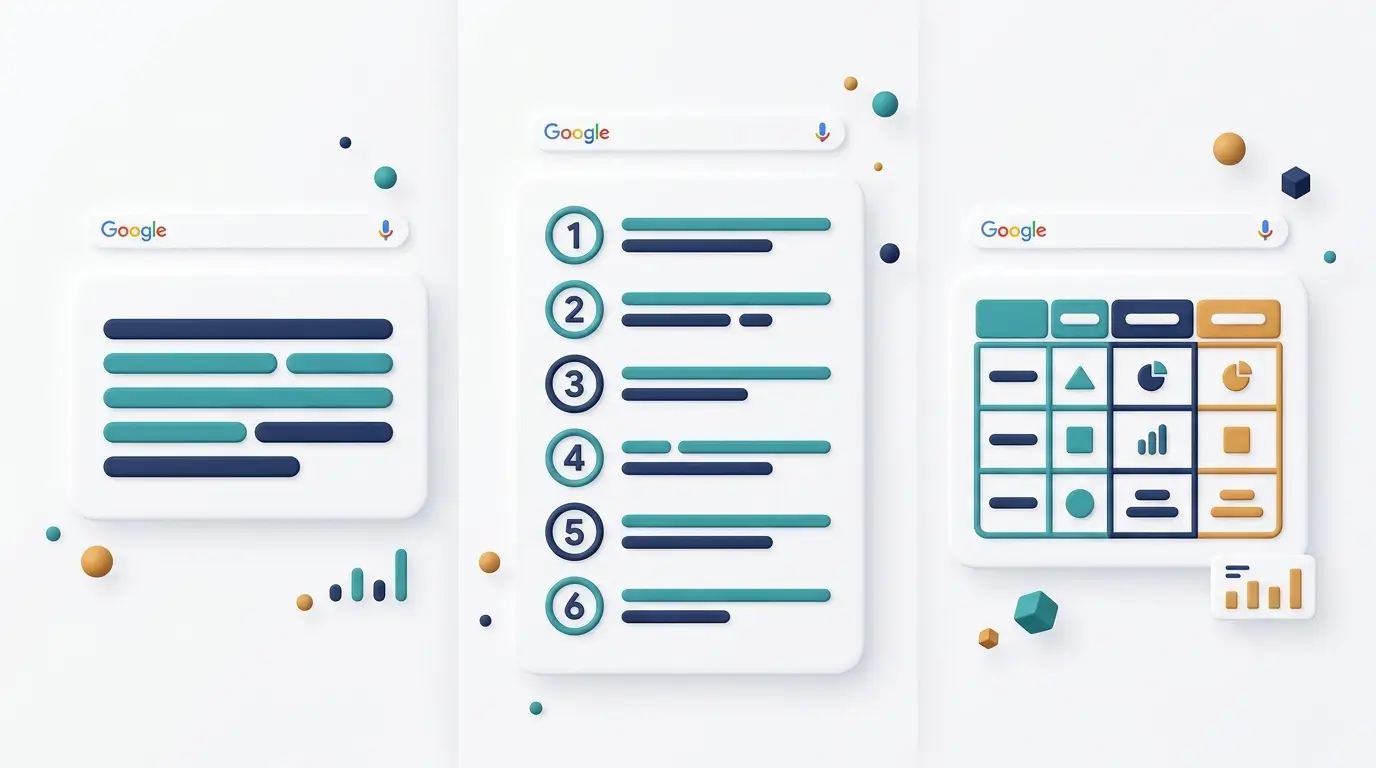
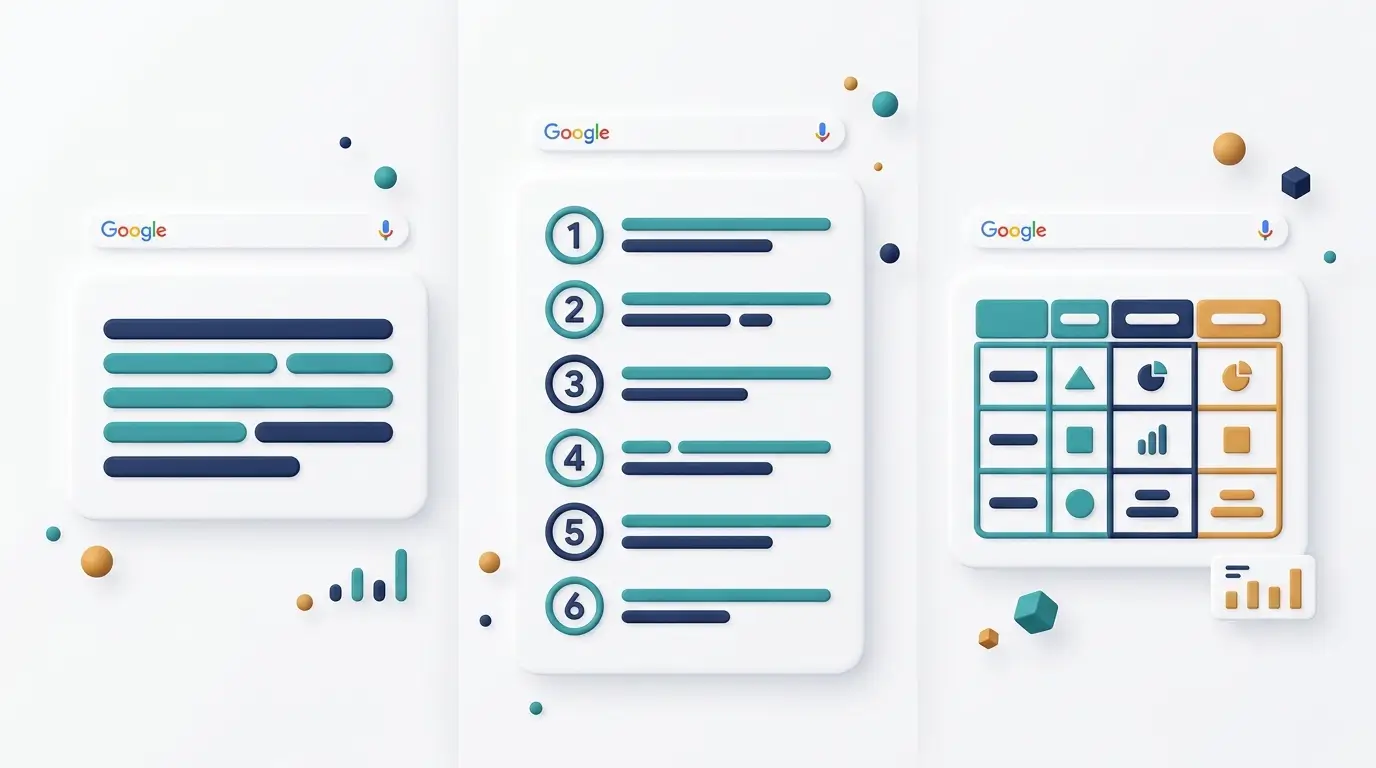
    Three-panel illustration showing the three featured snippet formats: paragraph snippet, list snippet, and table snippet, each with their corresponding Google search interface
    Each of the three featured snippet formats has different content structure requirements — match your writing to the format your target query typically triggers.
    📅 Last Reviewed: June 15, 2026. Part of the AI SEO Hub on EverydayOnAI. This is the sentence-level writing guide for the AEO formatting changes introduced in What is AEO? — read that first if you haven’t. Statistics from Semrush, EarnifyHub, DigitalApplied, and W3Era cited inline.

    📌 Key Takeaways

    • There are three featured snippet formats, each with precise content specs: paragraph snippets (40-60 words, definition/explanation queries), list snippets (5-8 items in native HTML ol/ul, how-to/best-X queries), and table snippets (3-4 columns × 5-10 rows in native HTML table, comparison/pricing queries).
    • Paragraph snippets make up approximately 55% of all featured snippets, lists approximately 30%, and tables approximately 12% — but list and table snippets generate higher CTR because they present actionable, scannable information.[1]
    • Voice search and featured snippets are functionally the same target: approximately 40.7% of voice assistant answers come from existing featured snippets,[2] and assistants read aloud roughly the first 29 words of the snippet source — matching the paragraph snippet length spec almost exactly.
    • Format mismatch is one of the most common snippet failure modes — using paragraph format for a query that expects a numbered list, or a list for a query that expects a table, reduces selection probability regardless of content quality.
    • Inverted pyramid writing — lead with the direct answer first, support with context after — is the structural principle that converts good content into extractable snippet content without rewriting everything from scratch.

    The One Rule That Applies to All Three Formats

    Before getting into format-specific specs, one principle applies identically to paragraph snippets, list snippets, and table snippets: the answer must appear immediately after the heading, with nothing in between.

    Google’s extraction algorithm reads content top-to-bottom and selects the first substantive, extractable answer it finds after a relevant heading. A paragraph that spends two sentences establishing context before stating the definition will be passed over in favor of a competing page that leads with the definition. A list that opens with a narrative paragraph before the numbered items will lose to a page where the list starts on the line directly following the heading. A table buried after four paragraphs of explanation will not compete with a table that follows immediately after the heading it belongs to.

    This is the inverted pyramid principle applied to snippet writing: the most important information — the direct answer — goes first. Supporting context, caveats, and elaboration follow it. This is the structural change responsible for the majority of snippet wins documented in AEO case studies, because most existing web content is written the other way: context first, answer second.

    💬 According to EverydayOnAI

    The inverted pyramid principle is genuinely counter to how most writers are trained. Academic writing, long-form journalism, and traditional blog posts all build toward the answer — you earn it through the setup. Featured snippet optimization reverses that: the reader (and the extraction algorithm) gets the answer in the first sentence, then chooses whether to read the setup. This feels wrong to write at first. The adjustment that usually helps: think of the heading as the question, and the opening sentence as the answer you’d give if someone stopped you in a hallway and asked that question. That’s the sentence Google extracts.

    📋 Section Summary

    • The universal snippet rule across all three formats: the answer must appear immediately after the heading, with no intervening context-setting, preamble, or introductory prose.
    • Google’s extraction algorithm selects the first extractable answer after a relevant heading — content that buries the answer loses to competing pages that lead with it, regardless of overall content quality.
    • Inverted pyramid writing — direct answer first, supporting context second — is the structural principle that converts well-written content into snippet-eligible content without requiring a full rewrite.

    Paragraph Snippets: The 40-60 Word Writing Spec

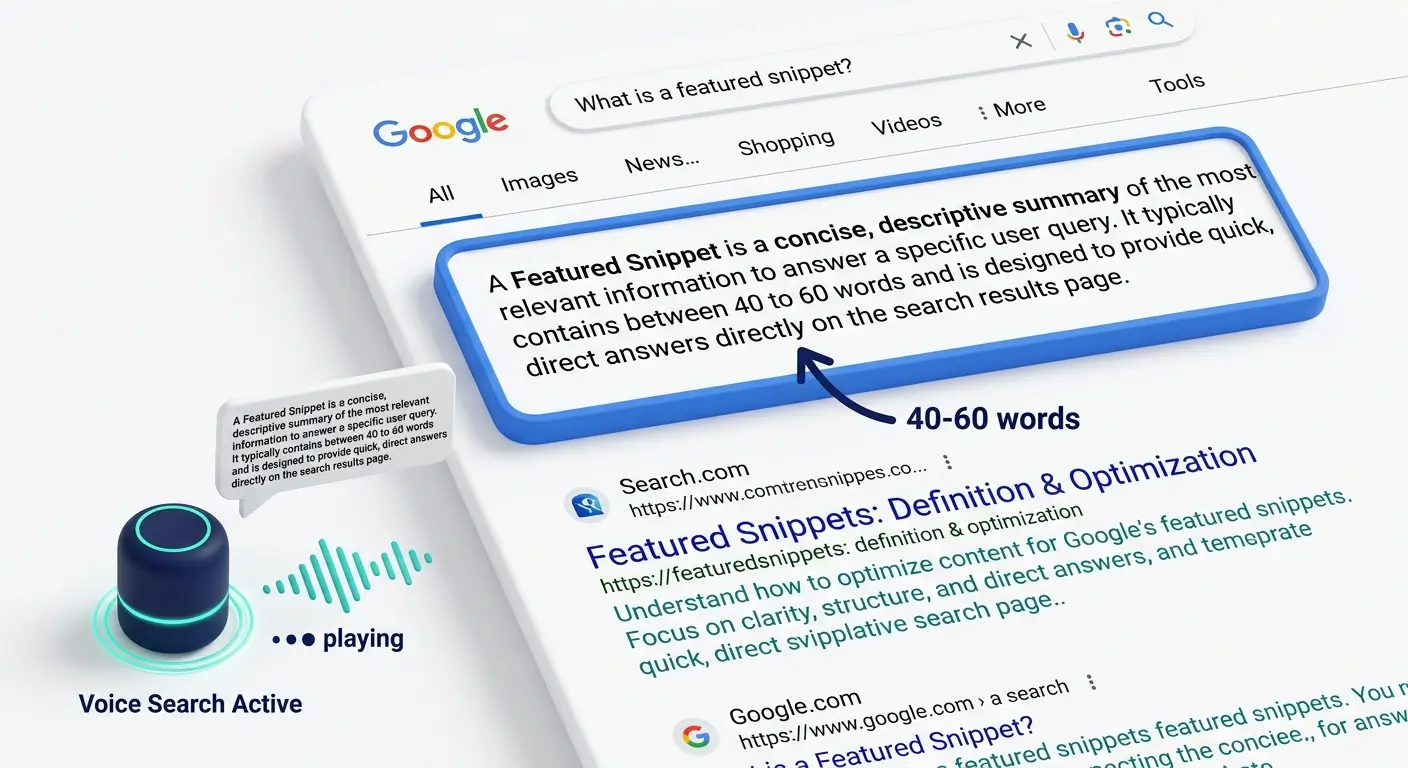
    Paragraph snippets are the most common format — approximately 55% of all featured snippets — and are triggered by definition and explanation queries: “what is”, “who is”, “why does”, “how does”.[1] They are also the primary voice search source, since voice assistants read aloud the first 29 words of a paragraph snippet — and a well-written 40-60 word snippet is, within those first 29 words, a complete standalone answer.

    Google search results page showing a paragraph featured snippet with a 40-60 word annotation, alongside a voice assistant speaker icon showing that the same content is read aloud
    The same 40-60 word paragraph snippet that wins position zero is what a voice assistant reads aloud — optimizing for one surface optimizes for both simultaneously.

    Paragraph Snippet Writing Spec

    Triggered by: “what is”, “who is”, “why does”, “how does”, definition and explanation queries

    Element Specification Why It Matters
    Total word count 40-60 words Under 40 appears incomplete; over 60 gets truncated with “…”
    First sentence Direct answer, 15-25 words Google extracts from the top — the definition must be in sentence 1
    Average sentence length Under 18 words per sentence Shorter sentences reduce truncation risk and improve voice readability[5]
    Heading match Exact or near-exact query phrasing Heading must mirror how the user typed the query
    Placement First sentence after heading — no introductory text Extraction algorithm reads top-to-bottom, stops at first answer
    Content type Specific, factual claims — no vague generalities Vague content is not selected for extraction[5]
    Verb tense Present tense for definitions “X is…” not “X was…” — recency signal for evergreen definitions[5]
    Voice reading window First 29 words What a voice assistant will read aloud from your snippet[6]

    📋 Section Summary

    • Paragraph snippets (~55% of all snippets) have a tight writing spec: 40-60 words total, direct answer in sentence 1, average sentence length under 18 words, present tense for definitions, no introductory prose between heading and answer.
    • Voice search reads the first 29 words aloud — a well-constructed 40-60 word paragraph snippet is effectively a pre-formatted voice answer within its first two sentences.
    • Specific, factual claims are selected for extraction; vague generalities are not — this applies to the 40-60 word answer block specifically, not to supporting context further down the page.

    List Snippets: The 5-8 Item Writing Spec

    List snippets make up approximately 30% of featured snippets and are triggered by “how to” process queries, “best X” ranking queries, and “steps to” instructional queries.[1] They generate higher CTR than paragraph snippets for the queries that trigger them, because a list presents multiple actionable items that pull readers in — the “More items” link that Google appends to truncated lists is itself a click driver.

    List Snippet Writing Spec

    Triggered by: “how to”, “steps to”, “best X”, “top X”, “ways to” queries

    Element Specification Why It Matters
    Item count 5-8 items Fewer than 5 appears incomplete; more than 8 gets truncated[4]
    HTML markup Native <ol> (steps) or <ul> (items), never <div> Google’s extraction only targets native HTML list elements[4]
    Item length One sentence per list item, 10-20 words Longer items get truncated; each item should be independently scannable[1]
    Placement Immediately after heading — no paragraph before list Any text between heading and list reduces extraction probability
    Item ordering Most important items first (1-3) Google truncates at ~7 items; if truncated, items 1-3 must stand alone
    Elaboration After the list, not inside list items Elaboration inside <li> breaks the clean extraction pattern[4]
    CSS Do not hide list markers with CSS Hidden markers can confuse crawlers evaluating list structure[1]
    Heading format H2 phrased as the question or process title “How to optimize for featured snippets” not “Optimization tips”

    One alternative structure for longer processes: instead of one list with 5-8 items, use H3 subheadings as the list items. Write your H2 as the question, then use H3 tags for each step. Google synthesizes these subheadings into a list snippet — the H3 text becomes the list item, and the content under each H3 serves the human reader who clicks through. This approach works well when each step requires a full section of content rather than a single sentence.[4]

    📋 Section Summary

    • List snippets (~30% of snippets, higher CTR than paragraphs) require: 5-8 items in native HTML ol/ul markup, one sentence per item (10-20 words), no introductory paragraph between heading and list, and elaboration placed after the list rather than inside list items.
    • CSS that hides list markers and div-based visual lists (not native HTML) are both extraction barriers — the content may look correct to humans but is invisible to Google’s list extraction system.
    • H3-as-list-items is a valid alternative for longer processes: Google synthesizes H3 subheadings into list snippet format when the H2 heading matches a list-trigger query.

    Table Snippets: The 3-4 Column Writing Spec

    Table snippets make up approximately 12% of featured snippets but are consistently triggered for high-value commercial queries: comparisons (“X vs Y”), pricing (“how much does X cost”), and specifications (“what are the dimensions of X”).[1] For these query types, a well-structured table is often the highest-CTR content format — the tabular layout signals “this content has multiple dimensions” in a way that a paragraph cannot.

    Table Snippet Writing Spec

    Triggered by: “X vs Y”, “difference between”, pricing queries, specification queries, comparison queries

    Element Specification Why It Matters
    Column count 3-4 columns More columns overflow the answer box; 3 is the optimal display size[3]
    Row count 5-10 rows Under 5 rows appears thin; over 10 is truncated with “More rows”
    HTML markup Native <table> with <th> and <td> Div-based grids cannot be extracted into table snippets[7]
    Header row <th> elements with descriptive column names Google uses headers to understand the comparison logic[7]
    Cell content Short cells — no merged cells, no nested tables Complex table structures confuse extraction[7]
    Column logic Clear comparison logic — Feature | Option A | Option B Consistent column structure helps AI agents parse and cite the data
    Placement Immediately after heading, no pre-table paragraph Same inverted pyramid rule — extraction starts at the first content element after the heading

    📋 Section Summary

    • Table snippets (~12% of snippets, highest value for comparison/pricing queries) require: 3-4 columns, 5-10 rows, native HTML table markup with th and td elements, descriptive headers, short cells, no merged cells, and no nested tables.
    • Div-based grids that look like tables visually cannot be extracted as table snippets — the markup, not the appearance, determines extractability.
    • The same native HTML table that wins a table snippet is also more parseable by AI citation systems, making table markup a shared investment for AEO and GEO simultaneously.

    Voice Search: Why It’s the Same Optimization

    Voice search optimization is frequently treated as a separate workstream from featured snippet optimization — with separate keyword research, separate content reformatting, and separate schema requirements. The data does not support treating them as separate. Approximately 40.7% of all voice assistant answers come directly from existing featured snippets.[2]

    Voice assistants — Google Assistant, Siri, and Alexa specifically — read aloud approximately the first 29-30 words of the source content they pull from.[6] A 40-60 word paragraph snippet is, within its first two sentences, a complete standalone answer. Those first two sentences are what gets read aloud. The remaining 20-30 words of the snippet are available to the listener if they ask a follow-up — but the primary “voice answer” is the first 29 words of the snippet source, which in a well-written paragraph snippet is the direct-answer sentence followed by one supporting clause.

    The practical implication: if you are already following the paragraph snippet writing spec (40-60 words, direct answer in sentence 1, under 18 words per sentence), you have already written a voice-search-ready answer. There is no additional reformatting needed. The only voice-specific addition is Speakable schema — the markup that signals to voice assistants which content blocks are appropriate to read aloud, which the AEO Guide covers in detail.

    📋 Section Summary

    • 40.7% of voice assistant answers come from existing featured snippets — voice search and snippet optimization are not two separate workstreams, they are one.
    • Voice assistants read approximately the first 29 words of a snippet source — a paragraph snippet written to the 40-60 word spec delivers a complete, self-contained voice answer within its first two sentences by design.
    • The only voice-specific addition beyond paragraph snippet optimization is Speakable schema markup — covered in the AEO Guide’s schema section.

    Format Matching: The Most Important Pre-Writing Step

    Format mismatch — using paragraph structure for a query that triggers list snippets, or building a list for a query that triggers tables — is one of the most common reasons technically correct content fails to earn a snippet.[8] Before writing a single word of snippet-optimized content, the pre-writing step is: search your target query and identify which format Google currently serves.

    Query Pattern Expected Format Example Query Writing Action
    “What is X”, “Who is X”, “Why does X” Paragraph “What is answer engine optimization?” 40-60 word direct-answer paragraph
    “How to X”, “Steps to X”, “Ways to X” Ordered list “How to optimize for featured snippets” 5-8 item ol immediately after heading
    “Best X”, “Top X”, “X recommendations” Unordered list “Best AEO tools 2026” 5-8 item ul with item name + one-sentence description
    “X vs Y”, “Difference between X and Y” Table or paragraph “AEO vs SEO difference” 3-4 column HTML table OR 40-60 word direct comparison paragraph
    Pricing, specifications, feature lists Table “How much does Semrush cost?” 3-4 column HTML table, descriptive headers

    One additional format consideration for 2026 specifically: some queries that previously triggered featured snippets now trigger AI Overviews instead — particularly broad definition queries, as documented by DigitalApplied.[8] “How to” and “X vs Y” queries retain snippet presence more reliably than pure “what is” definitional queries, which AI Overviews have displaced in some topic areas. If your SERP check shows an AI Overview rather than a snippet for a broad definition query, apply GEO content structure (from the GEO Guide) rather than the snippet spec from this article — per the GEO vs AEO framework.

    📋 Section Summary

    • Format matching — searching the target query to identify which snippet format Google currently serves — is the required pre-writing step before any snippet optimization work.
    • Query pattern reliably predicts format: “what is” → paragraph, “how to” → ordered list, “best X” → unordered list, “X vs Y” → table or comparison paragraph, pricing/specs → table.
    • Broad “what is” definitional queries are the most likely to show AI Overviews instead of snippets in 2026 — if that’s what your SERP check shows, apply GEO structure rather than the paragraph snippet spec.

    Before & After: Three Rewrites That Win Snippets

    Rewrite 1: Paragraph Snippet — Definition Query

    ✖ Before — Context-first, buried definition

    “In today’s rapidly changing digital landscape, understanding what AEO means for your content strategy has become increasingly important. AEO, which stands for Answer Engine Optimization, is something content teams should understand. It refers to the practice of making your content easily extractable…”

    ✔ After — 52 words, direct-answer first

    “Answer Engine Optimization (AEO) is the practice of structuring content so it can be extracted as a standalone, direct answer in featured snippets, voice search results, and AI answer boxes. AEO targets becoming the answer itself — selected from a specific position on the page — rather than simply ranking in a list of results.”

    The before version has the definition — it just doesn’t lead with it. The rewrite moves the definition to sentence 1, states it precisely, and uses the second sentence to add the key contrast (becoming the answer vs. ranking in results). Total word count: 52. Average sentence length: 17 and 20 words. Present tense. No preamble.

    Rewrite 2: List Snippet — How-To Query

    ✖ Before — Narrative prose, no extractable list

    “To optimize content for featured snippets, you’ll want to start by making sure your heading matches the query, and then you should write a clear answer, and it also helps to keep things concise while adding schema markup and monitoring your results over time with Search Console.”

    ✔ After — 6-item ordered list in native HTML

    <ol> (1) Match your heading to the exact query phrasing. (2) Write a 40-60 word direct answer immediately after the heading. (3) Place the full list directly after the heading — no paragraph before it. (4) Add FAQPage or HowTo schema. (5) Submit to Google Search Console for indexing. (6) Monitor snippet appearance and refresh quarterly. </ol>

    The same information, restructured. The before version contains all six steps but blends them into a single run-on sentence with coordinating conjunctions — Google cannot extract a list from this. The after version uses native ol/li markup, one action per item, all within the 10-20 word per item spec.

    Rewrite 3: Table Snippet — Comparison Query

    ✖ Before — Comparison buried in prose

    “Paragraph snippets are different from list snippets in several ways. While paragraphs work for definition queries and are 40-60 words, lists use 5-8 items and work for how-to queries. Tables are another format entirely, best for comparison data with 3-4 columns…”

    ✔ After — 3-column HTML table, immediately after heading

    <table> [Format | Trigger | Spec] [Paragraph | “what is” queries | 40-60 words] [List | “how to” queries | 5-8 items in ol/ul] [Table | comparison queries | 3-4 columns, 5-10 rows] </table>

    The prose comparison is readable and accurate but not extractable as a table snippet. The HTML table version takes exactly the same information and puts it in the format Google expects for comparison queries — three columns (Format, Trigger, Spec), three data rows plus header, native table markup.

    Featured Snippet Writing Checklist

    ✓ Pre-Writing (Do This First)

    • ★ Search target query and identify: does it trigger a snippet (paragraph, list, or table), an AI Overview, or neither?
    • If AI Overview: apply GEO structure (not this checklist); if neither: SEO ranking work needed first
    • If snippet: note the exact format (paragraph/list/table) and match content structure accordingly
    • Review the current snippet holder — what’s their word count, structure, heading phrasing?

    ✓ Paragraph Snippet Writing

    • ★ 40-60 total words in the answer block
    • ★ Direct answer in sentence 1 — topic term defined immediately
    • Average sentence length under 18 words
    • Present tense for definitions (“X is…” not “X was…”)
    • Specific, factual claims — no vague generalizations
    • No introductory text between heading and answer paragraph
    • ★ First 29 words standalone as a complete voice answer

    ✓ List Snippet Writing

    • ★ 5-8 items only — not fewer, not more
    • ★ Native <ol> (ordered/steps) or <ul> (unordered/items) markup — not styled divs
    • ★ List placed immediately after heading — no paragraph before the list
    • Each item: one sentence, 10-20 words
    • Most important items in positions 1-3 (in case Google truncates)
    • Elaboration in a paragraph after the list, not inside <li> elements
    • CSS must not hide list markers

    ✓ Table Snippet Writing

    • ★ Native <table> with <th> header row and <td> data cells — not div grids
    • ★ 3-4 columns, 5-10 rows
    • Descriptive column headers in <th> elements
    • Short cell content — avoid merged cells and nested tables
    • Clear comparison logic (Feature | Option A | Option B pattern)
    • Table placed immediately after heading

    ✓ Post-Publication

    • Search Console monitored monthly for average position anomalies below 1.0 (signals snippet win)
    • Speakable schema implemented targeting the answer paragraph for voice surfaces
    • Quarterly content refresh scheduled for any page holding a snippet — freshness is re-evaluated continuously
    • Competitor snippet holders re-checked quarterly — they can reclaim lost snippets with reformatting

    Frequently Asked Questions

    How long should a featured snippet answer be?

    Paragraph snippet answers should be 40-60 words. Under 40 words often appears incomplete to Google; over 60 words gets truncated with an ellipsis in the answer box. List snippets should contain 5-8 items with each item kept to one sentence (10-20 words). Table snippets perform best with 3-4 columns and 5-10 rows. These dimensions match Google’s answer box display constraints and the 15-20 second voice search reading window.[9]

    What query types trigger each featured snippet format?

    Paragraph snippets are triggered by “what is”, “who is”, “why does”, and “how does” queries. List snippets are triggered by “how to” process queries and “best X” or “top X” ranking queries. Table snippets are triggered by comparison queries (“X vs Y”), pricing queries, and specification queries. Matching your content format to the format Google currently serves for that query type is the highest-leverage pre-writing step — format mismatch reduces selection probability regardless of content quality.[8]

    Does winning a featured snippet automatically win voice search?

    Not automatically, but approximately 40.7% of voice assistant answers come directly from existing featured snippets.[2] Voice assistants read aloud roughly the first 29 words of a snippet source — meaning the same paragraph snippet spec (40-60 words, direct answer in sentence 1) produces a complete standalone voice answer within its first two sentences. The only voice-specific addition beyond paragraph snippet optimization is Speakable schema markup.

    What is inverted pyramid writing and how does it help featured snippets?

    Inverted pyramid writing means leading with the most important information first — the direct answer — and following with supporting detail, context, and caveats afterward. Google’s extraction algorithm identifies the first substantive passage after a relevant heading and lifts it as the snippet answer. A paragraph that buries the definition in sentence three fails snippet extraction even if the overall content quality is high, because the algorithm reads top-to-bottom and selects the first extractable answer it finds.

    Should I use HTML lists or styled div elements for list snippets?

    Always use semantic HTML lists — <ol> for ordered steps, <ul> for unordered items. Google’s list snippet extraction specifically targets native <ol> and <li> or <ul> and <li> elements.[4] Styled div elements that visually look like a list but lack proper HTML markup cannot be extracted into list snippets, regardless of how they appear to a human reader. Keep each <li> item to one sentence, place the list immediately after the heading, and avoid CSS that hides list markers.

    Conclusion: Write for Extraction, Not Just for Reading

    The sentence-level changes that win featured snippets are not about writing better — most content that fails to earn snippets is already well-written. They are about writing in a sequence that Google’s extraction algorithm can lift cleanly: direct answer first, format matched to query intent, markup that makes structure machine-readable.

    The three-step workflow from this article: check the SERP to identify which format your target query triggers, use the corresponding writing spec (40-60 word paragraph, 5-8 item list, 3-4 column table), and place the answer immediately after the heading with nothing in between. That’s the entirety of the writing change — the rest is monitoring and quarterly freshness maintenance.

    💬 According to EverydayOnAI

    The most valuable insight from reviewing the specs above together is how narrow the actual optimization window is. Paragraph: 40-60 words. List: 5-8 items. Table: 3-4 columns. These are not wide ranges. Content that sits at 62 words may lose to a 55-word competitor. A list with 9 items may lose to one with 7. This precision is what makes snippet optimization feel mechanical — because it is, and intentionally so. The writer’s job is to make the extraction trivially easy for Google, which means respecting the dimensional constraints that match the answer box, not writing to express nuance or comprehensiveness within the snippet block itself. Save the nuance for the supporting paragraphs that follow.

    📚 References and Sources

    1. EarnifyHub, “Featured Snippets for Bloggers in 2026: How to Capture Position Zero,” April 2026. Snippet format distribution: paragraph ~55%, lists ~30%, tables ~12%, video ~3%; list and table snippets generate higher CTR than paragraphs; each list item should be 10-20 words; avoid CSS hiding list markers. earnifyhub.com
    2. TurboAudit, “Answer Engine Optimization (AEO): 2026 Guide,” June 2026. 40.7% of voice assistant answers come from existing featured snippets. turboaudit.ai
    3. YoGrow Solutions, “How to Win the Featured Snippet: The 2026 SEO Formatting Guide,” January 2026. Three columns and five to six rows described as optimal table snippet size; AI agents find it easier to parse simple, data-rich table structures. yogrowsolutions.com
    4. AIOCopilot, “Featured Snippets Optimization Guide 2026: Position Zero Strategy,” April 2026. Process queries: use H2 with question, immediately follow with ol where each item is one concise step; H3-as-list-item alternative for longer processes; keep total items 5-8; elaboration in paragraph after list, not inside li; native HTML list elements required. aiocopilot.com
    5. MarGen, “Featured Snippets in 2026: How to Win Position Zero,” March 2026. Short sentences in definition paragraphs (under 18 words average); specific factual claims, not vague generalities; present tense for definitions; monthly review of 20 priority snippet queries. margen.net
    6. HubSpot, “Keyword Research for AEO,” June 2026, citing voice assistant data. Voice assistants typically read the first 29 words of a featured snippet source. blog.hubspot.com
    7. W3Era, “How to Optimize for Featured Snippets in 2026 (Complete Guide),” June 2026. Table snippet optimization requires native HTML table elements; descriptive headers; short cells; avoid merged cells, nested tables, vague column names, and image-based tables. w3era.com
    8. DigitalApplied, “Featured Snippets in the AI Overview Era: 2026 Guide,” March 2026. Format mismatch between content structure and query intent reduces snippet selection probability regardless of content quality; “how to” and comparison queries retain snippet presence more reliably than broad definition queries, which AI Overviews have displaced in some categories. digitalapplied.com
    9. DataEnriche, “How to Structure Content for Featured Snippets 2026,” April 2026. Featured snippet answer specs: 40-60 words paragraph (under 40 appears incomplete, over 60 truncated); 5-7 list items shown with “More items” for longer lists; 3-4 columns for table snippets; these lengths match Google’s answer box dimensions and voice search reading times of 15-20 seconds. dataenriche.com

    Sources verified June 15, 2026. Featured snippet trigger rates and format distributions vary by industry and keyword type — these figures represent averages across broad query samples. Snippet presence for specific queries should always be confirmed via direct SERP check. This article does not constitute professional SEO advice.

    📚 Go Deeper: Complete AI SEO Hub on EverydayOnAI

    Audit Your Top Pages with the Snippet-Readiness Checker

    Paste any paragraph into our free interactive Snippet-Readiness Checker — available in the AEO Guide — and get instant feedback on word count, direct-answer structure, specificity, and voice readability.

    Use the Free Checker →

  • AEO Keyword Research: Finding Answer-Intent Queries (2026 Guide)

    AEO Keyword Research: Finding Answer-Intent Queries (2026 Guide)


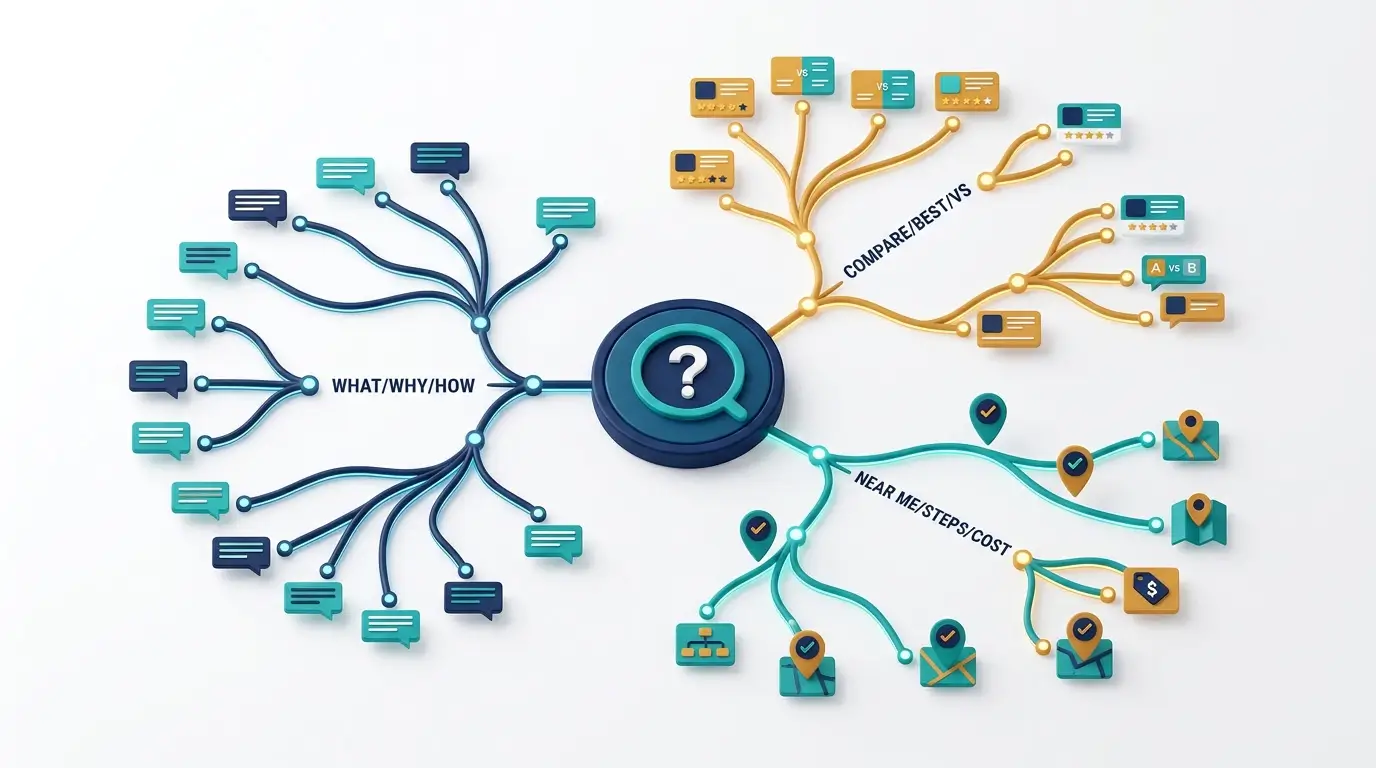
    Branching question tree diagram showing how a single seed keyword fans out into informational, consideration, and transactional AEO keyword clusters
    AEO keyword research starts with a seed keyword and fans out into the full question universe around it — organized by intent type, not search volume.
    📅 Last Reviewed: June 15, 2026. This article is part of the AI SEO Hub on EverydayOnAI. It builds directly on What is AEO? — read that first if you haven’t. Tool pricing verified as of June 2026; always check vendor sites before subscribing. Data from HubSpot, CheckThat.ai, Stackmatix, BrightEdge, and Semrush cited inline.

    📌 Key Takeaways

    • AEO keyword research prioritizes three criteria over search volume: whether the query triggers a direct-answer surface (snippet, AI Overview, PAA), whether you already have page-one ranking authority for it, and whether the query is phrased in the conversational, full-sentence format that AI systems process.
    • Query fan-out — Google’s internal technique of expanding a single user query into multiple related sub-queries — is the core principle driving AI Overview content selection, and the same principle should drive how you build your AEO keyword list: start with a seed question and map its natural follow-up chain, not just the head term alone.
    • Google Search Console is the highest-leverage free AEO keyword tool for most sites — it surfaces question-based queries your pages already nearly rank for, where AEO formatting changes (not more link building) are the remaining gap.
    • An effective AEO keyword tool stack for 2026: GSC (free, highest ROI) + AlsoAsked ($47/month) + AnswerThePublic for question mapping + Semrush for question-type filtering + direct AI platform testing as the validation layer.
    • TRM Agency documented 2,600 AI citations in a single 28-day window using a question-cluster content strategy built on query fan-out mapping — with the site already having meaningful page-one visibility as the starting prerequisite.

    How AEO Keyword Research Differs from SEO Keyword Research

    Traditional SEO keyword research is built around three metrics: search volume, keyword difficulty, and ranking potential. You find terms with high enough monthly searches to be worth targeting and low enough competition to be winnable, then you build content around them.

    AEO keyword research keeps those metrics as context but replaces them as the primary selection criteria. The three criteria that actually drive AEO prioritization are different:

    1. Does the query trigger a direct-answer surface? A keyword is an AEO keyword when searching it in Google produces a featured snippet, an AI Overview, or a People Also Ask box — not just a standard list of ranked pages. A query with 50 monthly searches that reliably triggers an AI Overview is a higher-value AEO target than a query with 5,000 monthly searches that returns only blue links.[1]

    2. Is the query phrased in conversational, full-sentence format? Traditional keyword research optimizes for short fragments (“best project management tool”). AEO keyword research targets the full-sentence phrasing that users apply when prompting AI systems — “what’s the best project management tool for remote teams in 2026?” — because that’s the format AI systems process, and the format that PAA boxes, voice assistants, and AI Overviews are built to answer.[2]

    3. Does your page already have ranking authority to be in contention? As established in our AEO vs SEO guide, AEO formatting only produces results for pages that already rank on page one. AEO keyword research should begin with queries where this authority already exists — not with building new authority from scratch.[1]

    📋 Section Summary

    • AEO keyword selection criteria: (1) query triggers a direct-answer surface, (2) query uses conversational/full-sentence phrasing, (3) your page already has page-one ranking authority for it.
    • Search volume is context, not the primary criterion — a low-volume question that triggers AI citations can outperform a high-volume head term that only returns blue links in AEO value.
    • Starting with existing ranking pages (via GSC) is more efficient than building AEO keyword lists from scratch, because authority is the prerequisite the other criteria build on.

    Query Fan-Out: The Framework Behind AI Keyword Selection

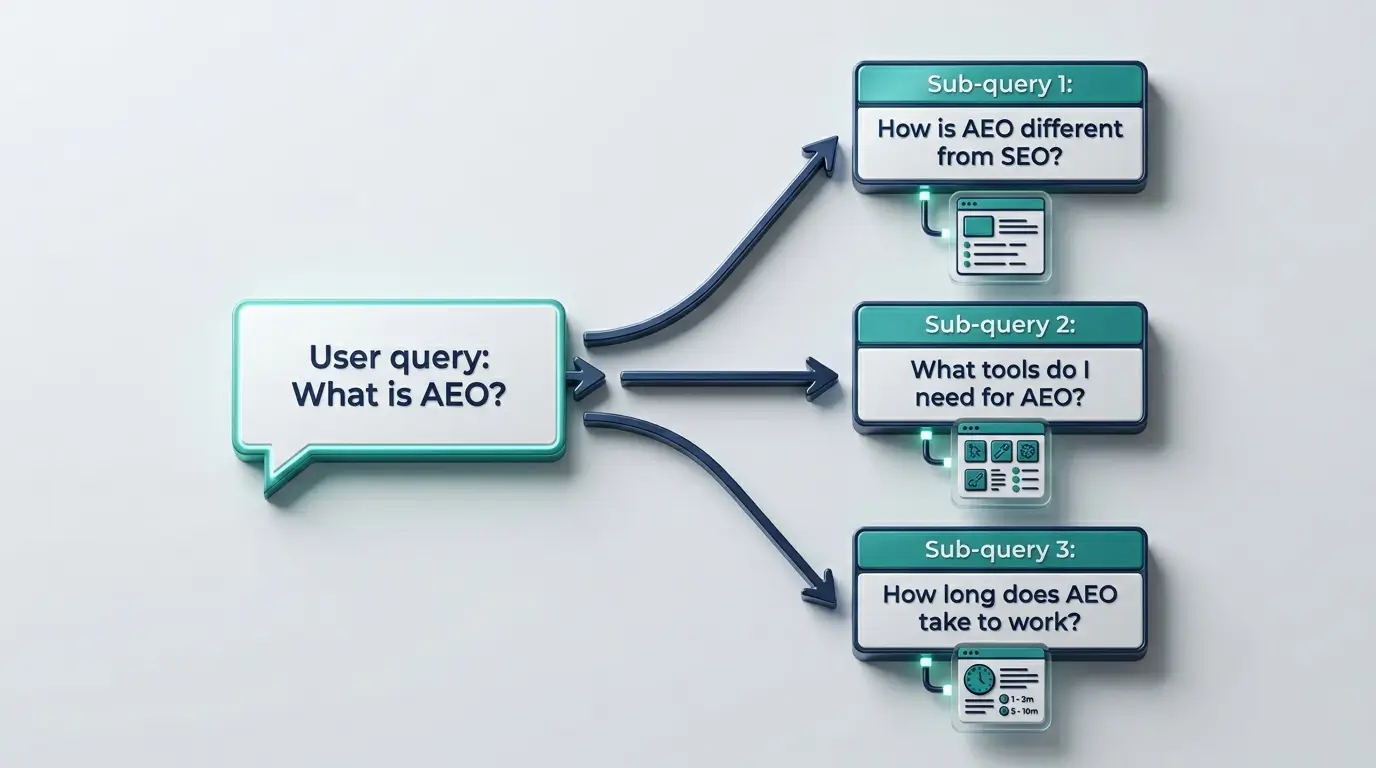
    Query fan-out is the name Google Search Central gives to the internal process AI systems use when generating answers: a single user query is expanded into multiple related sub-queries, and the system retrieves and synthesizes answers from pages that collectively address the full question chain.[3]

    Diagram showing how a single user query 'What is AEO?' fans out into three related sub-queries that AI systems retrieve answers for simultaneously
    When a user asks “What is AEO?”, AI systems internally expand that into a set of related sub-queries — and cite pages that collectively answer the full chain, not just the exact surface query.

    This has a direct implication for keyword research: a page that only answers its exact target keyword will be a weaker AEO candidate than a page that answers the target keyword and the three or four questions that logically follow from it. The high-performing AEO content is not the page that perfectly answers one question — it’s the page that AI systems can mine for an answer to the initial query and multiple follow-up sub-queries from the same source.

    The practical application is a “question chain” methodology: instead of researching individual AEO keywords in isolation, you map them in sequences. For any seed question, the research question is: what does a user who just got the answer to this typically ask next? That next question is your first fan-out node, and the question after that is the second — typically three to four levels deep before the chain becomes too specific to cover in a single piece.

    💬 According to EverydayOnAI

    The fan-out principle reshapes how we think about content planning for AI SEO. Traditional keyword research says: “Here are 20 keywords, each needs its own page.” Fan-out mapping says: “Here are 5 seed questions, each with a 3-4 question chain — build content that covers the chains, and you become the page AI systems mine for the whole topic, not just one query.” The difference in citation volume between these two approaches is roughly the difference between being one of many cited sources and being the primary cited source. The TRM Agency case study below shows what this looks like when executed with existing page-one authority as the starting point.

    📋 Section Summary

    • Query fan-out is Google’s documented internal technique for expanding a user query into related sub-queries during AI answer generation — directly explaining why pages covering full question chains outperform single-question pages in AI citation.
    • AEO keyword research built around fan-out mapping produces question chains (seed → follow-up 1 → follow-up 2 → follow-up 3) rather than isolated keyword lists.
    • The research question for each fan-out node: “What does a user who just got the answer to [current question] typically ask next?” — answerable directly with PAA chains from AlsoAsked and AnswerThePublic.

    Case Study: 2,600 AI Citations in 30 Days from Question-Cluster Strategy

    TRM Agency documented a 28-day content strategy execution in early 2026 that produced 2,600 AI citations — measured directly through Google Search Console’s AI Overview impression data.[3]

    📋 Case Study: Question-Cluster Strategy for AI Citation Volume

    TRM Agency — Own Site (28-Day Window, Early 2026)

    Starting point: The site already had meaningful page-one visibility across several target topics — establishing the prerequisite per the AEO vs SEO guide. The strategy was not about building new ranking authority but about maximizing AI citation capture from existing authority.[3]

    Methodology: Content was organized around question clusters aligned with the query fan-out principle — mapping the natural follow-up question chains from core topic queries and ensuring each cluster page answered both the seed question and its logical follow-up sub-queries. Google Search Central’s documentation on query fan-out was explicitly cited as a framework reference.[3]

    Results in 28 days:

    • 2,600 AI citations captured within a single GSC 28-day analysis window
    • Simultaneous growth in organic impressions alongside AI citation growth — confirming that optimizing for AI citation did not cannibalize traditional search visibility
    • GSC data showed AI Overviews and AI Mode surfacing supporting links from pages that had not previously been primary ranking targets — the fan-out mechanism pulling in adjacent content

    Why it worked: The existing page-one authority gave the content credibility eligibility. The question-cluster structure aligned with how AI systems fan out from user queries — giving AI Overview generation multiple adjacent questions it could pull from the same domain, compounding the citation count rather than spreading it across many unrelated sources.

    The 2,600 citation figure is notable, but the structural principle is more important: citation volume scales with question-chain coverage, not just individual page authority. A domain with five well-structured question-cluster pages covering complete fan-out chains can out-cite a domain with fifty isolated pages of equal individual quality, because AI systems are pulling from chains, not from a ranked list of pages.

    📋 Section Summary

    • TRM Agency’s 28-day case study produced 2,600 AI citations using a question-cluster strategy aligned with the query fan-out principle, starting from existing page-one authority.
    • AI citation growth occurred simultaneously with organic impression growth — no evidence of traditional search cannibalization.
    • Citation volume scales with question-chain coverage: AI systems pull from the full fan-out chain, rewarding pages that answer seed questions plus logical follow-ups over isolated single-question pages.

    The 5-Step AEO Keyword Research Process

    This process runs in sequence. Steps 1 and 2 identify quick-win existing opportunities; Steps 3-5 build out the full question-cluster map for new content.

    Step 1: Mine GSC for Existing Answer-Intent Queries

    Google Search Console is the highest-ROI starting point for AEO keyword research because it surfaces queries your pages already rank for — where the authority prerequisite is already met and AEO formatting changes alone can unlock snippet or AI citation wins.[1]

    The specific GSC filter for AEO opportunity: export all queries with average position between 2.0 and 15.0 (page one and close-to-page-one) and impressions above 100 over 90 days. Filter this list for queries containing question words — “what”, “how”, “why”, “when”, “which”, “can”, “does”, “is”, “are”. These are your highest-priority AEO targets: question-format queries where you have existing authority but haven’t yet structured the content for direct extraction.[4]

    Step 2: Check Which Queries Already Trigger Answer Surfaces

    For each question-format query identified in Step 1, run the SERP check from the GEO vs AEO decision framework — search the query in an incognito window and note whether it triggers a featured snippet, an AI Overview, or a PAA box. Queries that already trigger an answer surface are your confirmed AEO keywords. Queries that don’t trigger any answer surface are lower-priority for AEO formatting and better left to standard content improvement or SEO work first.

    Step 3: Build Fan-Out Chains with AlsoAsked

    For each confirmed AEO keyword from Step 2, run it through AlsoAsked to visualize the PAA chain. AlsoAsked provides real-time PAA data and semantic question clustering — showing not just the first-level PAA questions but the follow-up questions that appear when each PAA entry is clicked, giving you a two-to-three-level question tree per seed query.[5] This is the fan-out map for that keyword — the complete question chain your content should cover.

    Step 4: Expand Vocabulary with AnswerThePublic

    For each seed keyword, run AnswerThePublic to capture the full vocabulary range of how users phrase questions about that topic — organized by interrogative format (who, what, when, where, why, how), preposition-based phrasing, and comparison queries.[2] This step ensures your H3 headings mirror the exact natural-language phrasing users apply — not an SEO-cleaned version of it. A heading that reads exactly as a user would type or speak the question is more likely to match PAA extraction and voice search phrasing than one reworded for keyword optimization.

    Step 5: Validate with Direct AI Platform Testing

    For your highest-priority AEO keywords, search them directly in ChatGPT Search and Perplexity AI. Note which sources are currently being cited for each query.[6] This validation step answers three questions: Is an AI answer already being generated for this query? Who is currently cited, and why (what content structure do those pages use)? Is your domain present, and if not, what’s the structural gap between your page and the pages currently cited? This is your competitive benchmark and your content brief simultaneously.

    📋 Section Summary

    • The 5-step process runs: GSC mining for existing question queries → SERP check for answer surface triggers → AlsoAsked fan-out chain mapping → AnswerThePublic vocabulary expansion → AI platform validation testing.
    • Steps 1-2 identify quick wins from existing authority (AEO formatting changes only needed); Steps 3-5 build new content maps for topics not yet covered.
    • AI platform testing (Step 5) is both a competitive benchmark and a content brief — it shows who is currently cited, in what format, and what gap your page needs to close to be cited instead.

    Tool Stack: What to Use, When, and What It Costs

    No single tool covers all five steps above. The effective AEO keyword research stack in 2026 uses different tools for different stages of the process.

    Google Search Console

    Cost: Free  |  Best for: Step 1 (existing query discovery)  |  Data refresh: Daily

    The highest-ROI AEO keyword tool for most sites — it surfaces the question-based queries your pages already rank for, which are the highest-priority AEO targets (authority prerequisite already met). Filter queries by question words and position range 2-15 to find pages where AEO formatting changes alone can unlock answer-surface wins.

    💡 Pro tip: Export 90-day query data and add a column for “triggers answer surface?” — then run Step 2’s SERP check on the top 20 question queries by impression count. This two-column check is your entire quick-win AEO keyword list.

    AlsoAsked

    Cost: $47/month (unlimited users)  |  Best for: Steps 3-4 (fan-out chain mapping)  |  Data refresh: Real-time PAA data[5]

    The most purpose-built AEO keyword research tool in the stack. AlsoAsked visualizes the full PAA question chain — seed question → follow-up questions → follow-up follow-ups — giving you the fan-out map for any topic. The semantic question clustering helps identify which sub-questions belong in the same piece versus which warrant separate pages.

    💡 Pro tip: For each confirmed AEO keyword, export the full AlsoAsked tree and group questions into two categories — “answer in same section” (closely related) and “answer in separate H2” (distinct enough to need their own heading and direct-answer paragraph). This becomes the section outline for that page.

    AnswerThePublic

    Cost: Free tier (3 searches/day) / $199/month Expert (unlimited users)[5]  |  Best for: Step 4 (vocabulary expansion)  |  Data refresh: Monthly

    Best used for vocabulary — the exact natural-language phrasings users apply across interrogative formats (who, what, when, where, why, how), prepositions, and comparisons. The structured groupings mirror the content format AEO rewards: each question type maps directly to a heading format (how → numbered steps, what → definition, compare → table).

    💡 Pro tip: Use the free tier for initial research — three strategically planned searches cover your top three AEO topic clusters. Upgrade only if you need breadth across many topic areas with no search limits.

    Semrush Keyword Magic Tool

    Cost: $139.95/month (Pro) / Free tier (limited)  |  Best for: Steps 3-4 (question-type filtering, competitive gap)  |  Data refresh: Daily[5]

    Most useful for filtering your seed topic into question-type queries at scale and identifying competitive gaps — which questions competitors rank for that you don’t. The Topic Research feature surfaces semantically related questions and subtopics in a visual card format, useful for spotting AEO content gaps in your cluster.

    💡 Pro tip: Export Semrush’s “Questions” filter results for your top 5-10 seed keywords. Cross-reference this list against your AlsoAsked fan-out map to identify questions that have both PAA presence (high AEO value) and search volume (traditional SEO value).

    ChatGPT / Perplexity AI (Direct Testing)

    Cost: Free / ChatGPT Plus $20/month for full Search access  |  Best for: Step 5 (validation)  |  Data refresh: Live

    The validation layer that no keyword tool replicates — directly testing whether a query triggers an AI-generated answer and who currently gets cited. This is how you identify the content structural patterns that are actually winning citations for your specific keywords, not just patterns that theoretically should work.

    💡 Pro tip: After testing your query in ChatGPT and Perplexity, note the structure of every cited source — paragraph length, use of lists, presence of Section Summary-style blocks, inline source attribution. These are your specific content structure targets for that keyword, drawn from what’s actually working right now.

    📋 Section Summary

    • The 2026 AEO keyword tool stack: GSC (free) for existing query discovery → AlsoAsked ($47/month) for fan-out chain mapping → AnswerThePublic for vocabulary expansion → Semrush for question-type filtering → direct AI platform testing for citation validation.
    • The free tier of the stack (GSC + AnswerThePublic 3 searches/day + direct ChatGPT/Perplexity testing) covers the five-step process for most small and mid-size sites without any paid subscription.
    • AlsoAsked at $47/month with unlimited users is the highest-value paid addition for teams that need to map question chains at scale across multiple topic clusters.

    AEO Keyword Priority Scoring System

    Use this scoring system to prioritize your AEO keyword list when you have more targets than you can address immediately. Score each keyword on four criteria (0-3 per criterion), then sum for a total out of 12.

    Criterion 0 — Not present 1 — Partial 2 — Present 3 — Strong
    Answer surface trigger No snippet, PAA, or AI Overview PAA only (inconsistent) Consistent featured snippet or PAA AI Overview present
    Your current ranking authority Page 3+ or not indexed Page 2 (positions 11-20) Bottom of page 1 (positions 6-10) Top of page 1 (positions 1-5)
    Conversational phrasing fit Head term only (“AEO”) Short question (“what is AEO?”) Full question with context (“how is AEO different from SEO for B2B?”) Multi-turn prompt chain (seed + 3 follow-ups mapped)
    Your current answer-surface presence Not cited anywhere in AI or snippets Cited in one platform only Snippet held OR cited in 1+ AI platform Both snippet and AI citation held

    Scoring interpretation: 10-12 = immediately actionable (existing win to extend or defend); 7-9 = high priority (one or two gaps to close); 4-6 = medium priority (authority or content structure work needed first); 0-3 = deprioritize (either no answer surface exists yet or authority prerequisite not met).

    📋 Section Summary

    • The 4-criterion AEO priority scoring system (answer surface trigger + current ranking authority + conversational phrasing fit + current answer-surface presence) produces a 0-12 score per keyword.
    • Keywords scoring 10-12 are immediate wins (authority exists, answer surface exists, formatting changes are the remaining gap); keywords scoring 0-3 should be deprioritized until authority or answer surface prerequisites are met.
    • The scoring system replaces search-volume-based prioritization with a framework that reflects the actual preconditions for AEO success.

    Before & After: SEO Keyword List vs. AEO Keyword List

    The same topic — “answer engine optimization” — researched with a traditional SEO approach versus an AEO approach, for the same site.

    ✖ Traditional SEO Keyword List

    answer engine optimization (3,600/mo), aeo seo (1,200/mo), what is aeo (880/mo), aeo meaning (590/mo), answer engine optimization tools (320/mo), aeo vs seo (210/mo) — prioritized by volume, targeting one keyword per page.

    ✔ AEO Keyword Research Output

    Seed: “What is answer engine optimization?” → Chain: “How is AEO different from SEO?” → “Which AEO tools work best for small sites?” → “How long does AEO take to show results?” → “What schema markup does AEO require?” — one page covers the full chain, structured with H3s matching each question exactly, Answer-first paragraphs per section.

    The traditional list produces six separate page targets. The AEO approach produces one page that covers the full question chain — designed for AI systems to mine across multiple related sub-queries, and structured so a user who searches any question in the chain lands on content that answers not just that question but the next two they’re likely to ask.

    AEO Keyword Research Checklist

    ✓ Discovery Phase

    • ★ GSC query export filtered for question words + positions 2-15 + impressions 100+ over 90 days
    • ★ Each question query checked: does it trigger a featured snippet, AI Overview, or PAA box?
    • Queries that trigger answer surfaces marked as confirmed AEO keywords, scored 0-12 using the priority scoring system above
    • Queries that don’t trigger answer surfaces deprioritized or queued for future re-check as AI Overview coverage expands

    ✓ Fan-Out Mapping Phase

    • ★ AlsoAsked run on each confirmed AEO keyword to map PAA chain (2-3 levels deep)
    • AnswerThePublic run on each seed keyword to capture full vocabulary range across interrogative formats
    • Questions clustered into “same H2 section” vs. “separate H2” based on semantic proximity
    • Full question chain documented per target page: seed question + 3-4 fan-out follow-ups

    ✓ Validation Phase

    • ★ Each high-priority AEO keyword tested directly in ChatGPT Search and Perplexity
    • Currently cited sources documented: content structure, paragraph length, presence of lists/tables/summaries
    • Your content’s current presence noted: if absent, gap identified (authority, structure, or depth?)
    • Quarterly re-check scheduled: PAA chains, AI Overview coverage, and competitor citation status all shift

    Frequently Asked Questions

    What makes a keyword an ‘AEO keyword’ versus a regular SEO keyword?

    An AEO keyword is a query that triggers a direct-answer surface — a featured snippet, People Also Ask box, voice search result, or AI Overview — rather than only a standard ranked list of links. AEO keywords are typically phrased as full questions or comparisons and reflect how users prompt AI systems rather than how they type short keyword fragments into traditional search. High search volume is not a primary AEO keyword criterion — a low-volume question that consistently triggers a featured snippet is more valuable for AEO than a high-volume head term that only returns blue links.[1]

    What is query fan-out and why does it matter for AEO?

    Query fan-out is a technique, documented by Google Search Central, where a single user query is expanded into multiple related sub-queries to retrieve a more comprehensive AI-generated answer. For AEO keyword research, this means a page targeting “what is AEO” should also answer the follow-up questions users naturally ask after that — “how is AEO different from SEO”, “what tools do I need” — because AI systems are themselves fanning out from the user’s original query and pulling from pages that cover the full question chain.[3]

    Should I prioritize high-volume or low-volume keywords for AEO?

    Neither metric alone should drive AEO prioritization. The better criterion is whether the keyword consistently triggers a direct-answer surface and whether your page already has ranking authority to be in contention for it. A 50-monthly-search question that reliably triggers an AI Overview and converts AI-referred visitors at 4.4x the organic rate (Semrush, 2026) can outperform a 5,000-monthly-search head term that only returns blue links in AEO terms.

    Which tools are best for AEO keyword research in 2026?

    The most effective approach uses a tool stack: Google Search Console (free) + AlsoAsked ($47/month) + AnswerThePublic + Semrush for question-type filtering + direct AI platform testing. GSC identifies existing ranking queries where authority prerequisites are already met. AlsoAsked maps PAA chains for fan-out structuring. AnswerThePublic expands vocabulary range. Direct AI testing validates whether a query triggers AI-generated answers and who currently gets cited — no keyword tool replicates this last step.[5]

    How often should I refresh my AEO keyword research?

    Quarterly, at minimum — more frequently in fast-moving industries. AI Overview coverage grew from 31% to 48% of queries between February 2025 and February 2026 (BrightEdge), and PAA chains update as new content is indexed. A keyword that didn’t trigger an answer surface six months ago may trigger one today — and vice versa. Build this re-check into your existing quarterly content refresh cycle.

    Conclusion: Start with GSC, End with AI Platform Testing

    AEO keyword research is not a different version of SEO keyword research with question marks added. It’s a different process — starting from where authority already exists (GSC), mapping the question chains AI systems follow (fan-out via AlsoAsked), and validating against what AI systems are actually citing today (direct platform testing). Volume metrics come last, as context, not as the driver.

    The fastest path to an actionable AEO keyword list is: export your GSC queries for the last 90 days, filter for question words and positions 2-15, check each of the top 20 against your SERP to see which triggers an answer surface, then score those that do using the 0-12 priority system above. That’s one to two hours of work, and the resulting list is higher-value for AEO purposes than any keyword tool output built around volume-based prioritization.

    💬 According to EverydayOnAI

    The GSC-first approach is also the easiest to defend to a stakeholder who’s skeptical about “all this AEO stuff.” You’re not proposing new content, new link building, or new tooling investment to start — you’re proposing AEO formatting changes to pages that are already ranking and already generating impressions. That’s the lowest-friction, highest-credibility pitch for AEO work, and it happens to also be the highest-ROI starting point per the process above. Start there, document what moves, and the data you generate becomes the argument for the rest of the keyword research investment.

    📚 References and Sources

    1. Stackmatix, “AEO Keyword Research: Find Keywords for AI Search & Answer Engines,” 2026. AEO keyword research prioritizes question-based queries, conversational phrasing, and intent clusters over individual keyword volume; GSC described as most reliable free source for discovering AEO keyword opportunities. stackmatix.com
    2. HubSpot, “Keyword Research for AEO: A Guide for Winning Answer Engine Traffic in 2026,” June 2026. Conversational phrasing mirrors how users interact with AI systems; AnswerThePublic surfaces real conversational queries across interrogative formats; no single AEO keyword tool covers the full process. blog.hubspot.com
    3. TheRankMasters, “TRM AEO Case Study: 2.6K AI Citations in 30 Days,” Early 2026. 2,600 AI citations in a 28-day GSC window; content organized around query fan-out question clusters; Google Search Central’s query fan-out documentation cited as framework reference; AI citation growth occurred simultaneously with organic impression growth. therankmasters.com
    4. Stackmatix, “AEO Keyword Research” (same source), 2026. Specific GSC filter methodology: question-based queries, positions 2-15, impressions 100+ over 90 days for AEO opportunity identification. stackmatix.com
    5. CheckThat.ai, “Best AEO Keyword Research Tools 2026,” February 2026. Tool pricing and data refresh cadence: AlsoAsked $47/month unlimited users (real-time PAA data); AnswerThePublic $199/month Expert (unlimited users, monthly data refresh); Semrush daily updates; Frase, Clearscope, Surfer SEO integration capabilities. checkthat.ai
    6. Stackmatix, “Best Free AI Keyword Research Tools (2026): 15+ Compared,” March 2026. Direct AI platform testing in ChatGPT and Perplexity recommended to identify queries that trigger AI-generated answers and discover which content structures are being cited. stackmatix.com
    7. Google Search Central, Query Fan-Out Documentation (referenced via TheRankMasters 2026). AI Overviews and AI Mode use query fan-out to explore related subtopics and data sources when generating answers, surfacing supporting links from a wider and more diverse set of pages than classic web search. developers.google.com

    Sources verified June 15, 2026. Tool pricing changes frequently — verify current pricing at each vendor’s site before subscribing. AEO keyword research data (PAA chains, AI Overview triggers) is dynamic; treat any keyword classification as a current snapshot requiring quarterly re-validation. This article does not constitute professional SEO advice.

    📚 Go Deeper: Complete AI SEO Hub on EverydayOnAI

    Build Your AEO Keyword List This Week

    Download our free AEO Keyword Research Template — a spreadsheet version of the 5-step process and 0-12 priority scoring system from this article, with pre-built GSC export filters and question-chain mapping columns.

    Get the Free Template →

  • AEO vs SEO: What Changes and What Stays (2026)

    AEO vs SEO: What Changes and What Stays (2026)


    Illustration of a building with a solid ground floor representing unchanged SEO fundamentals and a new upper floor representing AEO additions
    AEO doesn’t replace the SEO foundation — it adds a new floor on top of it. Some of what’s on that new floor depends on the foundation; some of it doesn’t.
    📅 Last Reviewed: June 15, 2026. This article is part of the AI SEO Hub on EverydayOnAI, directly addressing Step 4 of the GEO vs AEO decision framework. All statistics verified against primary sources including Backlinko, Ahrefs, and Semrush.

    📌 Key Takeaways

    • Backlink authority, E-E-A-T, Core Web Vitals, and crawlability remain unchanged in importance — Backlinko’s analysis of 11.8 million search results found the #1 position has roughly 3.8x more backlinks than positions 2-10, and this advantage extends to AI citation frequency, not just rankings.
    • A documented 2026 case showed a page ranking #1 organically (3,000 monthly visitors) with zero featured snippets and zero AI citations — until AEO formatting changes produced 8 featured snippets and top-cited status in AI answers, with the underlying SEO ranking unchanged throughout.
    • Schema markup’s role bifurcates sharply: Ahrefs’ May 2026 difference-in-differences study (1,885 test pages vs. 4,000 controls) found schema produced no significant change in ChatGPT/AI Mode citations and a 4.6% decrease in Google AI Overview citations — yet schema remains essential for featured snippets, PAA, and voice answers.
    • The single new structural requirement AEO adds that SEO never had: answer-first content placement — a direct, extractable answer in a specific position and format, independent of overall topic comprehensiveness.
    • Brand mentions — even unlinked ones — are increasingly cited as a top AI visibility factor, a signal type traditional link-based SEO never weighted as heavily.


    The Core Question: New Game, or New Rules?

    Every “AEO vs SEO” discussion eventually runs into the same unresolved tension. One camp says SEO is dead — that ranking position no longer matters when AI answers the question before anyone clicks. The other camp says nothing has changed — that the same fundamentals (links, authority, content quality) that always drove rankings now drive AI citations too, so “AEO” is just SEO with extra branding.

    Both camps are half right, and the data points to a more useful framing: AEO is new rules layered on top of the old game, not a new game. The SEO foundation — the signals that determine whether a page is even in the running — has not changed in any way the data supports. What’s changed is what happens above that floor: a new set of structural and formatting requirements that determine whether an eligible page actually wins a featured snippet, a PAA answer, or an AI citation.

    This article works through that floor-and-new-layer model concretely — what specifically stays the same (with the evidence), what specifically changes (with a real before/after case), and one finding that surprises almost everyone who assumes schema markup is the bridge between the two.

    📋 Section Summary

    • “SEO is dead” and “nothing has changed” are both oversimplifications — the evidence supports a floor-and-new-layer model instead.
    • The SEO foundation (backlinks, E-E-A-T, technical health) determines eligibility; AEO formatting determines whether an eligible page wins the answer surface.
    • This article separates the two with evidence for each, plus one finding (on schema markup) that cuts across both.


    What Stays the Same: The SEO Foundation

    Three categories of SEO fundamentals show no meaningful change in 2026 — if anything, the data suggests they matter for a wider set of outcomes than before, because they now influence AI citation as well as traditional ranking.

    Backlinko’s analysis of 11.8 million Google search results found that the #1 ranking position has approximately 3.8 times more backlinks than positions 2 through 10 combined.[1] That correlation between link authority and top rankings is unchanged from the pre-AI-search era. What’s new is that the same authority signal now extends into AI visibility: a Semrush study examining backlinks and AI search found that domains with stronger backlink authority — measured by Semrush’s Authority Score — are mentioned more often in AI-generated answers, with quality and topical relevance mattering more than raw link volume in both contexts.[2]

    E-E-A-T, Core Web Vitals, and Crawlability

    E-E-A-T (Experience, Expertise, Authoritativeness, Trustworthiness) remains essential for content trust and long-term ranking stability, and Core Web Vitals — particularly LCP, INP, and CLS — continue to shape performance-based ranking outcomes.[4] Crawlability remains the absolute prerequisite underneath all of this — a page that cannot be crawled or interpreted does not rank, regardless of content quality, a point that applies identically to AI crawlers (GPTBot, PerplexityBot) as it does to Googlebot.[4]

    Google’s Own Evidence That Links Still Matter

    Perhaps the most concrete evidence comes from Google itself. According to industry reporting, when Google internally experimented with removing links from its ranking algorithm entirely, search quality became significantly worse — an experiment referenced in Google Search Central content and widely cited since.[3] Separately, Google’s spam policy documentation was updated in March 2024 to remove the word “important” from its description of links as a ranking factor — a subtle public-messaging shift that, notably, did not come with any corresponding algorithmic de-emphasis in observed ranking correlations.[3]

    3.8×

    more backlinks at position #1 vs. positions 2-10, across 11.8 million search results[1]

    Quality > Volume

    backlink authority (not raw count) correlates with AI-generated answer mention frequency[2]

    LCP / INP / CLS

    Core Web Vitals continue to directly shape performance-based ranking outcomes[4]

    Crawl First

    applies identically to Googlebot and AI crawlers (GPTBot, PerplexityBot) — uncrawlable pages don’t exist to either[4]

    📋 Section Summary

    • Backlink authority remains a top ranking factor (#1 position has 3.8x more backlinks than 2-10) and now also correlates with AI citation frequency — the same signal serves both purposes.
    • E-E-A-T, Core Web Vitals, and crawlability are unchanged in importance and apply identically to AI crawlers as to Googlebot.
    • Google’s own internal testing (links removed → search quality dropped significantly) is the strongest available evidence that link-based authority signals remain structurally load-bearing, despite softer public messaging since March 2024.


    Case Study: #1 Ranking, Zero AI Citations — Then 8 Snippets

    The clearest illustration of “what stays vs. what changes” isn’t a statistic — it’s a single documented before/after, reported in a 2026 AEO implementation guide.[5]

    Before and after comparison showing a page with #1 ranking and 3,000 monthly visitors but zero AI citations, then the same ranking and traffic but with 8 featured snippets and top-cited AI source status after AEO implementation
    The ranking and traffic didn’t move. What changed was an entirely separate visibility layer that traditional SEO metrics don’t capture.

    📋 Case Study: When #1 Isn’t Enough

    B2B Software Review Site — “Best Project Management Software” (2026)

    Before: The page held the #1 organic ranking for “best project management software,” generating approximately 3,000 monthly visitors. By every traditional SEO metric, the page was a success. But it appeared in zero AI search citations across ChatGPT and Perplexity, and held zero featured snippets — despite being, by the site’s own assessment, the most comprehensive guide on the topic.[5]

    What changed: The team implemented AEO-specific changes — conversational, question-and-answer-format content restructuring; schema markup targeting featured snippets; and content rewritten to align with how AI systems parse and extract direct answers (NLP-aligned phrasing).[5]

    After: The page captured 8 featured snippets and became a top-cited source in AI-generated answers for the topic.[5] Notably, the case is reported without any claimed change to the underlying #1 ranking or organic traffic — the SEO outcome stayed where it was; an entirely separate visibility layer was added on top of it.

    What makes this case study useful isn’t the headline number — it’s what didn’t change alongside it. The page didn’t need new backlinks, a content rewrite for “more comprehensiveness,” or a ranking improvement to unlock 8 featured snippets. The SEO foundation was already sufficient; what was missing was the answer-format layer this article’s “What Changes” section covers next.

    📋 Section Summary

    • A documented case shows a #1-ranked page with 3,000 monthly visitors and zero AI citations or featured snippets — a combination that is common, not exceptional, in 2026.
    • AEO-specific changes (Q&A restructuring, snippet-targeted schema, NLP-aligned phrasing) produced 8 featured snippets and top-cited AI status, with no reported change to the underlying ranking or traffic.
    • The SEO foundation (sufficient to hold #1) and the AEO layer (needed for snippet/citation visibility) operated as genuinely separate variables in this case — confirming the floor-and-new-layer model from Section 1.


    What Changes: The New Layer AEO Adds

    Three things make up the “new floor” that the case study above illustrates — requirements that traditional pre-2014 SEO had no real equivalent for.

    Answer-First Content Placement

    Traditional SEO rewarded comprehensive topic coverage, largely regardless of where in the page that coverage appeared — a thorough article could bury its best definition in paragraph six and still rank well if the overall page demonstrated topical depth. AEO specifically rewards content where a direct, self-contained answer to a likely query appears in a position and format — typically a 40-60 word paragraph, list, or table — that extraction systems can lift independently of surrounding context.[9] This is a genuinely new structural requirement, not a restatement of “write good content.”

    Brand Mentions as a Citation Signal

    One AI SEO ranking factor analysis goes as far as describing brand mentions on AI-trusted sources as the top factor for AI search visibility specifically — including unlinked mentions, which traditional link-based SEO never weighted as a primary signal.[8] Earned media, podcast mentions, and industry citations that never include a hyperlink were, for most of SEO’s history, treated as having limited direct ranking value. Under AEO/GEO, these mentions function as corroborating signals that an AI system can use to assess whether a brand is a credible source — independent of whether any individual mention links back.

    Content Characteristics, Independent of Links

    Analysis updated as of April 2026 found that articles covering more facts and running longer tend to earn more AI citations — a content-level finding that holds independent of the page’s backlink profile.[21] This aligns with the 20,000-character depth threshold covered in our GEO Guide — but the point worth isolating here is that this is a content lever, not a link-building or technical lever, and it’s one where a page with modest backlink authority can still compete on AI citation if the content itself meets the depth and density bar.

    📋 Section Summary

    • Answer-first content placement — a direct answer in a specific position and format immediately after a relevant heading — is the primary structural requirement AEO adds with no real pre-2014 SEO equivalent.
    • Brand mentions, including unlinked ones, function as AI citation signals in a way traditional link-based SEO never formally credited.
    • Content depth and factual density independently predict AI citation likelihood, separate from backlink authority — giving lower-authority sites a content-driven path to AI visibility that doesn’t exist in traditional competitive ranking for the same terms.


    The Schema Markup Paradox

    This is the finding most likely to contradict what you’ve read elsewhere — including, in part, our own AEO Guide and AI SEO Guide, which recommend schema markup as part of the AEO/GEO toolkit. The nuance matters enough to isolate here.

    Ahrefs ran a difference-in-differences study — a methodology that compares outcomes for a test group against a control group before and after an intervention — across 1,885 pages that added schema markup versus 4,000 control pages that didn’t, published May 11, 2026.[6] The result: schema markup produced no statistically significant change in ChatGPT or AI Mode citations — and was associated with a 4.6% decrease in Google AI Overview citations for the pages that added it.[6]

    ▲ Where Schema Still Works

    Schema markup remains directly useful for AEO surfaces — FAQPage and HowTo schema target featured snippets, PAA boxes, and voice answers, and Speakable schema helps voice assistants identify readable sections. A separate analysis confirms this split explicitly: schema helps for voice and featured snippet AEO surfaces, but not for direct LLM citation.[7]

    ▼ Where It Doesn’t Transfer

    For GEO — citation inside ChatGPT, AI Mode, and (per the Ahrefs data) even Google AI Overviews specifically — schema markup is not the lever. The -4.6% finding doesn’t mean schema is harmful broadly; it means the effort-to-outcome ratio for GEO citation is better spent on content structure (depth, self-contained statistics, section organization) than on expanding schema coverage.

    💬 According to EverydayOnAI

    This finding is the one most likely to be misread as “stop adding schema.” It shouldn’t be. FAQPage and HowTo schema remain genuinely useful for the AEO surfaces our sibling guide covers — featured snippets, PAA, and voice. What the Ahrefs data narrows is specifically the GEO claim: if your goal is ChatGPT or AI Overview citation, the -4.6% finding suggests that hours spent expanding schema coverage are better spent on the content structure changes in our GEO Guide. Same toolkit, two different goals, and now — for the first time — data showing they don’t pull the same lever.

    📋 Section Summary

    • Ahrefs’ May 2026 difference-in-differences study (1,885 vs. 4,000 pages) found schema markup produced no significant change in ChatGPT/AI Mode citations and a 4.6% decrease in Google AI Overview citations.
    • Schema markup remains directly useful for AEO surfaces (featured snippets, PAA, voice via FAQPage/HowTo/Speakable) — the finding is specific to GEO/LLM citation, not AEO broadly.
    • For GEO citation specifically, content structure and depth are the higher-leverage investment compared to schema expansion — a genuinely new piece of nuance for 2026 AI SEO planning.


    Side-by-Side: What’s Shared vs. What’s New

    Factor SEO Status AEO Status Verdict
    Backlink authority Top ranking factor (3.8x at #1) Correlates with AI mention frequency too Stays — and extends
    E-E-A-T Core trust/stability signal No evidence of reduced importance Stays
    Core Web Vitals / crawlability Prerequisite for ranking Prerequisite for AI crawler access too Stays
    Answer-first placement Not a formal ranking factor Primary structural requirement New
    FAQPage / HowTo / Speakable schema Minor rich-result benefit Directly targets snippets/PAA/voice New (AEO-specific)
    Schema for GEO/LLM citation N/A No significant effect (Ahrefs, 2026) Doesn’t transfer
    Unlinked brand mentions Minimal formal weight historically Cited as a top AI visibility factor New emphasis
    Content depth/density Supports topical authority Independently predicts AI citation Stays — and extends

    📋 Section Summary

    • Four factors stay unchanged or extend their relevance into AI visibility: backlink authority, E-E-A-T, Core Web Vitals/crawlability, and content depth.
    • Two factors are genuinely new with AEO: answer-first content placement and AEO-specific schema (FAQPage/HowTo/Speakable for snippets, PAA, voice).
    • One factor — schema markup for GEO/LLM citation specifically — does not transfer despite being part of the same general “schema markup” toolkit, per Ahrefs’ 2026 data.


    Two Checklists: Foundation Audit + New-Layer Audit

    Run the foundation audit first. If any item fails, prioritize it before the new-layer audit — per the case study above, the new layer only produces results once the foundation is sufficient.

    ✓ Foundation Audit (What Stays)

    • ★ Backlink profile reviewed for quality and topical relevance — not just raw count (Backlinko: #1 has 3.8x more backlinks than 2-10)
    • ★ Author bios and E-E-A-T signals present and verifiable on priority pages
    • Core Web Vitals passing: LCP < 2.5s, CLS < 0.1, INP < 200ms
    • ★ Crawlability verified for both Googlebot AND AI crawlers (GPTBot, PerplexityBot, ClaudeBot) — check robots.txt and Cloudflare settings
    • Page already demonstrates page-one-equivalent topical authority for its target query

    ✓ New-Layer Audit (What Changes)

    • ★ A 40-60 word direct-answer paragraph appears immediately after the primary heading — not buried mid-page
    • FAQPage and/or HowTo schema implemented, targeting featured snippets and PAA (not as a GEO citation tactic — see Section 5)
    • Brand actively pursuing unlinked mentions in industry publications, podcasts, and earned media — tracked separately from backlink-building
    • Content depth and factual density reviewed independently of backlink profile — does the content alone meet a citation-worthy density bar?
    • If GEO citation (ChatGPT, AI Mode, AI Overviews) is the goal, effort allocated to content structure (per the GEO Guide) rather than additional schema coverage

    📋 Section Summary

    • The foundation audit (backlinks, E-E-A-T, Core Web Vitals, crawlability, topical authority) should be run and passed before the new-layer audit — the case study shows the new layer is inert without it.
    • The new-layer audit separates AEO-surface schema (still valuable) from GEO citation effort (better spent on content structure per the Ahrefs finding).
    • Brand mention tracking and content depth review are treated as independent workstreams from backlink building — they are correlated but not interchangeable levers.


    Frequently Asked Questions

    Does AEO replace the need for traditional SEO?

    No — AEO adds a layer on top of SEO; it does not replace the foundation. Featured snippets, People Also Ask answers, and AI citations are still drawn primarily from pages that already demonstrate ranking authority. Backlinks, E-E-A-T signals, and technical health (crawlability, Core Web Vitals) remain prerequisites — AEO determines whether an already-eligible page wins the answer surface, not whether it’s eligible in the first place.

    Do backlinks still matter if I’m optimizing for AEO?

    Yes, and they matter for AI visibility too, not just rankings. Backlinko’s analysis of 11.8 million search results found the #1 position has roughly 3.8 times more backlinks than positions 2 through 10.[1] Separately, a Semrush study found that domains with stronger backlink authority (measured by Semrush Authority Score) are mentioned more often in AI-generated answers.[2] Quality and topical relevance matter more than raw volume in both cases.

    Does adding schema markup help me get cited by ChatGPT?

    Not directly, according to the best available data. Ahrefs ran a difference-in-differences study (1,885 test pages vs. 4,000 control pages, May 2026) and found schema markup produced no statistically significant change in ChatGPT or AI Mode citations, and was associated with a 4.6% decrease in Google AI Overview citations.[6] Schema remains valuable for AEO surfaces — FAQPage and HowTo schema directly target featured snippets, PAA, and voice answers — but for direct LLM citation, content structure and depth matter more than markup.

    What ranking factors stay exactly the same between SEO and AEO?

    Backlink authority, E-E-A-T signals, Core Web Vitals, and crawlability remain unchanged in importance. These function as the floor: a page needs to clear this bar to be considered for any visibility surface, traditional or AI-driven. What changes is what happens above that floor — AEO adds answer-format content structure and schema requirements that traditional SEO ranking alone never required.

    What’s the single biggest new requirement AEO adds that SEO never had?

    Answer-first content structure — placing a direct, self-contained answer immediately after a heading that mirrors the query’s phrasing. Traditional SEO rewarded comprehensive topic coverage regardless of where in the page that coverage appeared. AEO specifically rewards content where the answer to a likely query appears in a position and format (40-60 word paragraph, list, or table) that Google’s extraction systems can lift directly — a structural requirement with no real equivalent in pre-2014 SEO practice.


    Conclusion: Audit the Floor Before Building the New Layer

    The “AEO vs SEO” framing implies a choice. The evidence in this article doesn’t support one. Backlink authority, E-E-A-T, Core Web Vitals, and crawlability are exactly as important as they were — arguably more so, since they now influence AI citation alongside rankings. What’s genuinely new is a structural layer on top: answer-first placement, AEO-specific schema, and brand-mention signals that traditional SEO never formally counted.

    The case study in Section 3 is the article’s central evidence, and it’s worth restating plainly: a page can be a complete SEO success — #1 ranking, steady traffic — and simultaneously a complete AEO failure, with zero featured snippets and zero AI citations. Those aren’t two ends of the same spectrum. They’re two different audits, and the schema paradox in Section 5 shows that even within the “AEO toolkit,” not every tool serves both audits equally.

    💬 According to EverydayOnAI

    The DataEnriche case study is worth sitting with, because the situation it describes — #1 ranking, healthy traffic, zero AI presence — describes a large share of established content sites in 2026, not an edge case. SEO success and AEO/GEO visibility aren’t on the same axis, and a page can max out one while scoring zero on the other. The practical test takes two minutes: search your own #1-ranking pages’ topics in ChatGPT or Perplexity. If your brand doesn’t appear, that’s not a ranking problem — it’s a separate problem, with a separate fix, and the rest of this AI SEO Hub is built around exactly that fix.

    Run the Foundation Audit from Section 7 first. If it passes — and for most pages that already rank reasonably well, it will — move directly to the New-Layer Audit. That’s where the actual work, and the actual gap, usually is.

    📚 References and Sources

    1. Backlinko, analysis of 11.8 million Google search results, cited via ezmarketing/Clickrank 2026. The #1 ranking position has approximately 3.8 times more backlinks than positions 2 through 10. ezmarketing.com
    2. Semrush, “Do Backlinks Still Matter in AI Search? Insights from 1,000 Domains,” with Kevin Indig, October 2025. Domains with stronger backlink authority (Semrush Authority Score) are mentioned more often in AI-generated answers; quality and authority matter more than volume. semrush.com
    3. wpseoai, “Are Backlinks Still Important in 2026?,” May 2026, citing Ahrefs and Google Search Central. Google’s internal testing of removing links from its algorithm resulted in significantly worse search quality; March 2024 spam policy update removed “important” from the description of links as a ranking factor without corresponding algorithmic de-emphasis. wpseoai.com
    4. Clickrank, “Google SEO Ranking Factors 2026: The Ultimate Guide,” March 2026. E-E-A-T essential for content trust and long-term stability; Core Web Vitals (LCP, INP, CLS) shape performance rankings; crawlability is the absolute prerequisite for ranking, applying to AI crawlers as well as Googlebot. clickrank.ai
    5. DataEnriche, “Answer Engine Optimization (AEO): Complete Guide 2026,” April 2026. Case study: a client’s #1-ranked page for “best project management software” (3,000 monthly visitors) had zero AI search citations and zero featured snippets; after implementing AEO (conversational Q&A restructuring, snippet-targeted schema, NLP-aligned content), the page captured 8 featured snippets and became a top-cited AI source. dataenriche.com
    6. Ahrefs, difference-in-differences study (1,885 test pages vs. 4,000 control pages), cited via TurboAudit, May 11, 2026. Schema markup produced no statistically significant change in ChatGPT or AI Mode citations, and was associated with a 4.6% decrease in Google AI Overview citations. turboaudit.ai
    7. TurboAudit, “Answer Engine Optimization (AEO): 2026 Guide,” June 2026. Schema markup helps for voice and Featured Snippet AEO surfaces; does not help for direct LLM citation. turboaudit.ai
    8. JDM Web Technologies, “AI SEO Ranking Factors 2026,” June 2026. Brand mentions on AI-trusted sources — including unlinked mentions — described as the top ranking factor for AI search visibility specifically. jdmwebtechnologies.com
    9. Arc Intermedia, “SEO vs. AEO vs. GEO: The New Search Landscape for 2026,” April 2026. AEO requires concise, clear answers in the first 1-2 sentences after a question-format heading, distinct from general content comprehensiveness. arcintermedia.com
    10. wpseoai, “Are Backlinks Still Important in 2026?,” analysis updated April 2026. Articles covering more facts and running longer tend to earn more AI citations, a content-level finding independent of backlink profile. wpseoai.com

    Sources verified June 15, 2026. The Ahrefs schema markup finding is based on a single difference-in-differences study; further replication is expected as more AI citation data becomes available. This article does not constitute professional SEO advice and does not guarantee ranking, snippet, or AI citation outcomes.

    📚 Go Deeper: Complete AI SEO Hub on EverydayOnAI

    This article addresses Step 4 of the GEO vs AEO decision framework — what to do when neither AEO nor GEO formatting will move a keyword yet.

    Run the Two-Minute AI Visibility Test

    Download our free Foundation vs. New-Layer Audit checklist — a print-ready version of both checklists from this article, designed to be run on your top 10 ranking pages in under an hour.

    Get the Free Checklist →

  • GEO vs AEO: Key Differences Explained (2026 Decision Framework)

    GEO vs AEO: Key Differences Explained (2026 Decision Framework)


    Decision tree diagram showing how a search query branches toward a featured snippet, an AI Overview, or organic SEO depending on what Google currently serves
    GEO and AEO aren’t a strategy choice you make once — they’re a per-keyword decision based on what Google is currently serving for that specific query.
    📅 Last Reviewed: June 14, 2026. This article is part of the AI SEO Hub on EverydayOnAI, and a direct follow-up to What is AEO? and the GEO Complete Guide. All statistics verified against primary sources including SERPs.io, BrightEdge, SE Ranking, and Amsive.

    📌 Key Takeaways

    • GEO and AEO share approximately 90% of their content tactics (Contently, 2026) — but the SERP features they target, featured snippets and AI Overviews, coexist on only about 7.42% of queries (SERPs.io, 2026). These are two different kinds of overlap, and confusing them leads to misallocated effort.
    • When Google shows an AI Overview for a query, it typically does not also show a featured snippet — Google is making a binary choice per query, not layering both formats.
    • AI Overview coverage grew from 31% to 48% of tracked queries between February 2025 and February 2026 (BrightEdge) — a keyword that rewarded AEO a year ago may reward GEO today.
    • Industry coverage of AI Overviews varies sharply: healthcare queries trigger them at 88%, education at 83%, and B2B technology at 82% — meaning your industry alone is a strong signal for where to prioritize.
    • The practical fix is a per-keyword check, not a company-wide strategy choice: search your target keyword, see what Google currently serves, and apply the matching playbook.


    What’s Actually Different Between GEO and AEO

    If you’ve read our guides on GEO and AEO, the short version is familiar: AEO targets becoming the direct answer — a featured snippet, a voice search result, a People Also Ask entry — typically with one source cited. GEO targets being one of several sources an AI weaves into a longer synthesized answer, like a Google AI Overview or a ChatGPT response.

    That distinction is correct, but it leaves out the part that actually changes what you should do on a Tuesday morning when you’re deciding which page to optimize next. Here it is: the content structure that wins each overlaps by roughly 90%, but the SERP feature each appears in is largely mutually exclusive, query by query. A page that’s perfectly structured for both AEO and GEO can still only “win” one of them for any given search — because Google typically shows either a featured snippet or an AI Overview for a query, not both.

    This matters because most “AI SEO checklists” — including the ones in our own AI SEO Guide and AEO Guide — describe content-level changes that serve both disciplines simultaneously. That’s accurate and still the right starting point. But once those changes are made, the question of which result you should expect, and where to look for it, depends on something the content itself doesn’t control: what Google is currently serving for that specific keyword.

    💬 According to EverydayOnAI

    This is the single most common reporting mistake we see in AI SEO reviews: teams do the right structural work, then check the wrong dashboard for results. If Google is serving an AI Overview for a keyword, checking Search Console for a new featured snippet will show nothing — even if GEO citation rate for that exact page is climbing in ChatGPT and Perplexity. The fix isn’t more work. It’s running the 30-second check in Step 1 of the framework below before deciding where to look for the win, and before concluding the work “didn’t work.”

    📋 Section Summary

    • AEO and GEO target different SERP features (single-source snippet vs. multi-source AI synthesis) but are built using largely the same content structure — direct answers, clear headings, self-contained statistics.
    • Because Google typically serves either a featured snippet or an AI Overview for a given query — not both — the same well-structured content can only “win” one of these surfaces per keyword.
    • This means measurement and expectations need to be set per keyword, based on which SERP feature Google currently shows, not applied uniformly across a content backlog.


    The Data: Two Kinds of Overlap That Get Confused

    There are two genuinely different statistics floating around AI SEO content in 2026, and they get conflated constantly because they both involve the word “overlap.”

    Two comparison diagrams: one showing roughly 90% overlap between GEO and AEO content tactics, and another showing roughly 7.4% overlap between featured snippet and AI Overview SERP feature presence
    Two different statistics, often conflated: how much your content tactics overlap (high) versus how often the SERP features themselves co-occur for the same query (low).

    The first statistic — tactical overlap — is high. The content patterns that win featured snippets (direct first-sentence answers, clear question-format headings, properly structured lists and tables) are largely the same patterns that earn AI Overview citations.[a] Optimizing for featured snippet capture has been described as “the highest-leverage path to AI Overview citation, not a competing strategy.”[a]

    The second statistic — SERP feature co-occurrence — is low. Analysis from SERPs.io found that featured snippets and AI Overviews coexist on only about 7.42% of queries.[b] When an AI Overview appears, Google typically does not also show a featured snippet for that query — it’s a binary choice, not a stacking of features.[b] A separate SE Ranking study of AI Mode versus AI Overview — two different Google AI surfaces — found similarly low co-occurrence: 10.7% URL overlap and 16% domain overlap.[c]

    ~90%

    overlap in content tactics between GEO and AEO — same structural patterns serve both[shared]

    ~7.4%

    of queries show both a featured snippet and an AI Overview at the same time[b]

    31% → 48%

    growth in AI Overview query coverage, Feb 2025 to Feb 2026 (BrightEdge tracking)[c]

    88% / 82%

    of healthcare / B2B technology queries trigger an AI Overview — sharp industry variance[c]

    13.7%

    citation overlap between Google AI Overviews and Google AI Mode — two distinct surfaces[d]

    -37.04%

    CTR decline on queries where an AI Overview overlaps with a former featured snippet position[e]

    A First-Party Data Point Worth Noting

    One practitioner team tracking their own AI citation performance since mid-2025 found that FAQ sections — specifically, blocks with 40-60 word self-contained answer openers — were cited in AI-generated answers at roughly 3 times the rate of non-FAQ content sections on the same site.[d] They also found that posts with one hyperlinked statistic per 150-200 words consistently outperformed lower-density posts in AI citation frequency.[d] This is a useful real-world confirmation of the “90% tactical overlap” claim — the same FAQ structure that’s a textbook AEO move (targeting People Also Ask) is what produced their 3x GEO citation lift.

    📋 Section Summary

    • “GEO and AEO overlap ~90%” refers to content tactics (structure, formatting, schema). “Featured snippets and AI Overviews overlap ~7.4%” refers to which SERP feature appears for a given query. These are different measurements and both are true simultaneously.
    • AI Overview coverage nearly doubled in one year (31% → 48%, BrightEdge), with sharp industry variance — healthcare and education sites should expect AI Overview dominance more than e-commerce sites currently do.
    • A practitioner case found FAQ-formatted content (a core AEO tactic) earned roughly 3x more AI citations (a GEO outcome) than non-FAQ content on the same site — direct evidence of the tactical overlap in action.


    The 4-Step Per-Keyword Decision Framework

    This framework replaces “should we focus on GEO or AEO?” — a question with no single correct answer — with a per-keyword check that takes about 30 seconds per query.

    ✓ The 4-Step Framework

    • Step 1 — Check what Google currently serves. Search your target keyword (ideally in an incognito window, on both desktop and mobile). Note whether a featured snippet, an AI Overview, both, or neither appears above the organic results.
    • Step 2 — If a featured snippet appears: apply the AEO playbook from our AEO Guide — a 40-60 word direct-answer paragraph, FAQPage/HowTo schema, and the Snippet-Readiness Checker tool. Track success via Search Console snippet appearance.
    • Step 3 — If an AI Overview appears: apply the GEO playbook from our GEO Guide — self-contained statistics with inline source attribution, Section Summary boxes, and content depth above 20,000 characters. Track success via manual citation testing and AI referral sessions in GA4.
    • Step 4 — If neither appears and you’re not on page one: neither AEO nor GEO formatting will move this keyword yet. Prioritize traditional SEO — backlinks, on-page fundamentals, content depth — then re-run Step 1 once you reach page one.
    • Revisit quarterly. With AI Overview coverage nearly doubling in a year, a keyword’s classification can change. Build this check into your existing quarterly content refresh cycle rather than treating it as a one-time audit.

    One nuance worth flagging: Step 2 and Step 3 are not mutually exclusive at the content level — you should still make GEO-friendly structural changes even on a page targeting a featured snippet, because (a) the tactical overlap means this costs little extra effort, and (b) that same keyword’s classification may shift to AI Overview within months, per the 31% → 48% trend. The framework determines where you look for results and what you measure, not which structural changes you make.

    📋 Section Summary

    • The 4-step framework is: check what Google currently serves for the keyword, then apply the AEO playbook (if snippet), GEO playbook (if AI Overview), or SEO-first (if neither and not page one) — revisited quarterly.
    • This framework governs measurement and prioritization, not content structure — make GEO-friendly changes even on AEO-targeted pages, since the tactical overlap is high and keyword classifications shift over time.
    • The 30-second per-keyword check replaces an unanswerable strategic question (“GEO or AEO?”) with an operational one (“what does Google show right now, for this specific query?”).


    GEO vs AEO Side-by-Side

    A condensed, decision-focused comparison — see the full AI SEO Guide comparison table for the complete GEO/AEO/LLMO breakdown including LLMO.

    Dimension AEO GEO
    SERP feature targeted Featured snippet, PAA, voice answer AI Overview, ChatGPT/Perplexity citation
    Source pattern Single source, verbatim passage extracted Multiple sources, synthesized and paraphrased
    Ideal content unit One 40-60 word answer per heading Multiple question-specific sections per page
    Where to check results Search Console (snippet/PAA appearance) Manual prompt testing + GA4 AI referral filter
    Per-query co-occurrence ~7.4% — largely mutually exclusive per query[b]
    Content tactic overlap ~90% — same structural changes serve both[shared]

    📋 Section Summary

    • AEO and GEO differ primarily in source pattern (single verbatim source vs. multi-source synthesis) and ideal content unit (one tight answer vs. multiple question-specific sections).
    • Despite targeting different SERP features that rarely co-occur (~7.4%), the underlying content tactics overlap by ~90% — write for GEO’s multi-section depth, and AEO eligibility largely follows.


    Three Scenarios: The Framework in Practice

    Here’s how the 4-step framework plays out across three realistic situations — illustrating why “GEO vs AEO” is the wrong question to ask about a whole site, but the right question to ask about a specific keyword.

    Scenario A — “Before” Mindset

    A B2B SaaS content team applies the same AEO checklist (40-60 word direct answers, FAQPage schema) uniformly across their entire blog, then checks Search Console for snippet wins three months later. For their highest-traffic informational pages — in a vertical where 82% of queries now trigger an AI Overview — almost no new snippets appear, despite the formatting being textbook-correct.

    Scenario A — “After” Framework

    The same team runs Step 1 on those keywords and finds AI Overviews, not snippets, are what Google now serves for B2B technology queries at an 82% rate. They keep the same content structure (it’s ~90% the same work) but switch their measurement to manual AI citation testing and GA4 AI referral sessions — and immediately see the citations they’d been producing all along, just in the wrong dashboard.

    Scenario B — Local Service Query

    A local business optimizes its “emergency plumber [city]” page with GEO-style long-form content — 2,000+ words, multiple data sections, Section Summary boxes — expecting AI Overview citation.

    Scenario B — Framework-Correct Approach

    Step 1 reveals this query still shows a classic featured snippet with local pack results — a query type where AI Overviews remain less dominant. The AEO playbook (a tight, 40-60 word direct answer about emergency availability and hours, with Speakable schema) is the higher-leverage move here, not additional GEO-style depth the format won’t surface.

    Scenario C — New Content, Unranked

    A team publishes a new pillar article and immediately applies the full AEO + GEO checklist, expecting snippet or citation wins within weeks.

    Scenario C — Framework-Correct Approach

    Step 1 shows the page isn’t on page one yet for its target keyword — Step 4 applies. Neither AEO nor GEO formatting can produce results until the page earns enough ranking authority to be considered for snippet or citation eligibility at all. The team focuses on backlinks and topical authority first, with AEO/GEO structure already in place (so no rework is needed later) but expectations correctly set to “after page one,” not “within weeks.”

    📋 Section Summary

    • The same content structure can produce a featured snippet, an AI Overview citation, or neither, depending entirely on what Google currently serves for that specific query — not on how well the content is written.
    • Measurement misalignment (checking for snippets when Google now serves AI Overviews for that query type) can make successful GEO work look like a failure.
    • For unranked pages, AEO and GEO formatting is still worth doing upfront (it’s largely the same work either way) — but results should be expected only after the page reaches page one.


    Tool: Which Playbook Should You Use?

    Run Step 1 of the framework right now for one of your target keywords, then use this tool to get the matching next step.


    🎯 Interactive Tool

    GEO vs AEO Playbook Router

    Search your target keyword in an incognito window first. Then answer the question below based on what you see at the top of the results page.

    What appears at the top of Google for your target keyword?


    This tool provides directional guidance based on the per-keyword framework above. SERP features change over time — re-run this check quarterly, especially for keywords in industries with high AI Overview coverage (healthcare, education, B2B technology).


    Frequently Asked Questions

    What is the main difference between GEO and AEO?

    AEO targets becoming a single, directly-extracted answer; GEO targets being one of several sources synthesized into a longer AI-generated response. AEO (Answer Engine Optimization) wins featured snippets, voice search results, and People Also Ask entries — typically citing one source verbatim. GEO (Generative Engine Optimization) wins citations inside AI Overviews, ChatGPT responses, and Perplexity answers, where content from multiple sources is paraphrased and combined. The content structure that wins each overlaps by roughly 90%, but the SERP feature each appears in is largely mutually exclusive on a per-query basis.

    Can a page have both a featured snippet and be cited in an AI Overview?

    Rarely for the same query — research found featured snippets and AI Overviews coexist on only about 7.42% of queries.[b] When Google shows an AI Overview, it typically does not also show a featured snippet for that query — it’s a binary choice per query. However, a single page can hold a featured snippet for one query and be cited inside an AI Overview for a different, related query, since both formats draw on the same underlying content quality and structure.

    Which should I prioritize first, GEO or AEO?

    Check what Google currently serves for your target keyword, then apply the matching playbook. If a featured snippet appears, prioritize AEO formatting. If an AI Overview appears, prioritize GEO formatting. If neither appears and you’re not on page one, prioritize traditional SEO first. This per-keyword check matters more than choosing one discipline as a company-wide strategy.

    How often should I re-check which SERP feature my keywords trigger?

    Quarterly, at minimum — more often in high-AI-Overview-coverage industries. BrightEdge’s tracking found AI Overview coverage grew from 31% to 48% of queries between February 2025 and February 2026.[c] Healthcare (88%), education (83%), and B2B technology (82%) queries trigger AI Overviews at especially high rates[c] — sites in these verticals should check more frequently than the quarterly baseline.

    Do GEO and AEO require different content, or the same content formatted differently?

    The same underlying content, with different framing of the answer. AEO favors one tight 40-60 word answer immediately after a heading, optimized to stand alone as a single extracted passage. GEO favors multiple question-specific sections, each with its own direct answer, self-contained statistics, and inline source attribution. Content structured well for GEO is usually AEO-eligible as a byproduct — but the reverse requires adding more sections, not just perfecting one paragraph.


    Conclusion: Stop Choosing a Side

    “GEO vs AEO” sounds like a strategic fork in the road — pick one, build a roadmap around it, report on it quarterly. The data suggests that framing is the mistake. The content tactics overlap by roughly 90%, so the work itself is largely shared. What differs, and what genuinely requires a decision, is where you should expect to see the result of that work — and that’s determined per keyword, by what Google is currently serving, not by your overall content strategy.

    The action item from this article is small but high-leverage: take your top 10-20 target keywords, run Step 1 of the framework on each (search them, note what appears), and sort them into three buckets — snippet-classified, AI-Overview-classified, and neither. That sort takes under an hour and tells you exactly where to look for results from the AEO and GEO work you’re already doing, or about to do, from the AEO Guide and GEO Guide.

    💬 According to EverydayOnAI

    If you only do one thing from this article, do the hour-long keyword sort before touching any content. Every checklist in the AI SEO Hub — the AEO checklist, the GEO checklist, the AI Citation Readiness Score — assumes you already know which bucket each target keyword falls into. Skipping this step is how “we did everything right but saw no results” reports happen: the content work was correct, but it was being measured against the wrong SERP feature for that keyword. The sort is boring. It’s also the cheapest insurance against a wasted quarter that we know of.

    📚 References and Sources

    1. DigitalApplied, “Featured Snippets in the AI Overview Era: 2026 Guide,” March 2026. Strong correlation found between pages previously selected as featured snippets and pages cited as sources in AI Overviews; structured direct answers drive both snippet and AI Overview selection; optimizing for featured snippets described as the highest-leverage path to AI Overview citation. digitalapplied.com
    2. SERPs.io, “How to Win Featured Snippets in an AI Overview World,” March 2026. Featured snippets and AI Overviews coexist on approximately 7.42% of queries — Google makes a binary per-query choice between serving a snippet or an AI Overview, not both. serps.io
    3. Averi.ai, “How to Get Featured in Google AI Overviews (2026 Playbook),” citing BrightEdge tracking data, April 2026. AI Overview coverage grew from 31% to 48% of tracked queries, February 2025 to February 2026; industry variance — healthcare 88%, education 83%, B2B technology 82% of queries trigger AI Overviews; Google AI Mode reached 75 million daily users and over 1 billion monthly queries by late 2025. averi.ai
    4. Averi.ai, same source, first-party content library data. Only 13.7% citation overlap between AI Overviews and AI Mode; FAQ blocks with 40-60 word self-contained answers cited in AI-generated responses at approximately 3x the rate of non-FAQ content; statistics density of one hyperlinked stat per 150-200 words correlates with higher AI citation frequency. averi.ai
    5. Amsive, 700,000-keyword CTR study (2025), cited via The Digital Bloom, “2026 AI Citation Position & Revenue Report,” May 2026. Average CTR decline of 15.49% across the study; queries where an AI Overview overlapped with a former featured snippet position saw a steeper 37.04% CTR decline. thedigitalbloom.com
    6. Contently, “AEO vs GEO vs LLMO: The Acronym Confusion, Settled,” April 2026. Optimization tactics across AEO, GEO, and LLMO overlap by approximately 90% — full context in the AI SEO Guide pillar article. contently.com

    Sources verified June 14, 2026. SERP feature co-occurrence statistics vary by methodology (query sampling, geography, device) — figures here represent the most recent and methodologically transparent sources available. This article does not constitute professional SEO advice and does not guarantee snippet placement or AI citation outcomes.

    📚 Go Deeper: Complete AI SEO Hub on EverydayOnAI

    This article is part of the AI SEO Hub. Start with the pillar guide, then apply the playbook that matches what your target keywords are currently showing.

    Sort Your Keywords in Under an Hour

    Download our free Keyword SERP Classifier spreadsheet — log your top 20 target keywords, note what Google currently serves for each (snippet, AI Overview, or neither), and get an auto-generated priority list using the 4-step framework from this article.

    Get the Free Spreadsheet →

  • What is AEO? The Complete Answer Engine Optimization Guide (2026)

    What is AEO? The Complete Answer Engine Optimization Guide (2026)


    Diagram showing the four AEO surfaces — featured snippets, People Also Ask, voice search, and AI answer boxes — around a Google search results page
    AEO targets four distinct surfaces — featured snippets, People Also Ask, voice assistants, and AI answer boxes — each with its own format and schema requirements.
    📅 Last Reviewed: June 14, 2026. All statistics in this article have been verified against primary sources. This sub-pillar is part of the AI SEO Hub on EverydayOnAI — see the pillar guide for how AEO relates to GEO and LLMO. Data from Semrush, SparkToro/Datos, Similarweb, Bain & Company, and multiple AEO case study collections are cited inline with source and year throughout.

    📌 Key Takeaways

    • AEO (Answer Engine Optimization) is the practice of structuring content to be extracted as a standalone answer — in featured snippets, People Also Ask, voice search, and AI answer boxes — independent of organic ranking position.
    • 64.82% of Google searches now end without a click (SparkToro/Datos, 2026) — and that figure rises to 83% when an AI Overview is present (Bain & Company, 2025) — making “being the answer” more valuable than “being the click” for brand visibility.
    • Semrush’s 2026 SERP Features Report (23 million keywords, 14 countries) found paragraph snippets earn the highest CTR at 9.1%, and pages holding both the featured snippet and position #1 achieve a combined 52.3% CTR — nearly double position #1 alone.
    • Voice assistants pull approximately 41% of their answers directly from existing featured snippets, and read aloud roughly the first 29 words — meaning featured snippet optimization and voice search optimization are functionally the same exercise.
    • AEO does not replace SEO — content must already rank on page one before Google considers it for snippet extraction. AEO is the formatting and schema layer applied on top of competitive rankings.


    What is AEO?

    AEO (Answer Engine Optimization) is the practice of structuring content so it can be extracted as a standalone, direct answer — in Google’s featured snippets, People Also Ask boxes, voice assistant responses, and AI-generated answer cards. AEO optimizes for one specific outcome: becoming the answer itself, regardless of where your page ranks in the traditional list of ten blue links.

    This is the core distinction that separates AEO from traditional SEO. A page can rank #5 organically for a query and still hold the featured snippet for that exact same query — Google evaluates snippet eligibility through a separate process from ranking position. The page at #5 effectively jumps above #1 through #4 by winning the answer box. This is why AEO has become one of the highest-leverage optimizations available to sites that already have moderate ranking authority but have never structured their content for extraction.

    The discipline predates the current AI search boom by nearly a decade. Featured snippets — “position zero” — were introduced by Google in 2014.[1] Voice search optimization emerged as its own practice around 2018 as smart speaker adoption grew. What changed in 2024-2026 is the addition of a fourth surface — AI answer boxes inside ChatGPT, Perplexity, and Google AI Overviews — which draw on many of the same structural signals that the original three AEO surfaces have rewarded for a decade.

    💬 According to EverydayOnAI

    The most common strategic confusion we see is treating AEO as an alternative to SEO rather than a sequel to it. A page needs SEO authority to be eligible for AEO surfaces, and AEO formatting to actually win them once eligible — skipping either step leaves visibility on the table that, even at a 64.82% zero-click rate, the data later in this guide shows is increasingly worth claiming. The “AEO replaces SEO” framing tends to come from content explaining AEO in isolation; once you look at the prerequisite (page-one ranking) alongside the payoff (snippet eligibility), the sequential relationship becomes the only one that fits the data.

    How AEO Relates to GEO and LLMO

    If you’ve read our AI SEO Guide, you already know that AEO, GEO, and LLMO sit inside the same umbrella strategy and share roughly 90% of their optimization tactics.[shared] The practical distinction worth repeating here: AEO targets precision — a single short, direct answer to a specific question. GEO targets depth — being one of several sources an AI weaves into a longer synthesized response. The content changes that win AEO surfaces (direct-answer openings, FAQ structure, schema markup) are frequently the same changes that improve GEO citation rates — which is why AEO is the recommended starting point in the AI SEO stack.

    📋 Section Summary

    • AEO is the practice of structuring content to be extracted as a standalone answer in featured snippets, People Also Ask, voice search, and AI answer boxes — independent of organic ranking position.
    • Featured snippets (“position zero”) launched in 2014; voice search optimization emerged as a discipline around 2018; AI answer boxes are the newest AEO surface, added 2024-2026.
    • AEO requires existing SEO ranking authority as a prerequisite — it is a formatting and schema layer applied on top of competitive rankings, not a substitute for them.


    Why AEO Matters in 2026: The Numbers

    The case for AEO rests on one structural shift: search results pages increasingly answer the query directly, without requiring a click. Understanding the scale of this shift — and where the remaining clicks go — is the foundation for prioritizing AEO work.

    Funnel diagram showing that 64.8% of Google searches end without a click, rising to 83% when an AI Overview is present, with remaining clicks split between organic results and ads

    Out of every 100 Google searches, roughly 65 end on the results page itself — answered by a featured snippet, knowledge panel, People Also Ask box, or AI Overview (SparkToro/Datos, 2026).

    The Zero-Click Reality

    64.82% of all Google searches now end without a click to any organic or paid result, according to SparkToro’s analysis of Datos clickstream data — up from approximately 50% when Rand Fishkin first quantified the phenomenon in 2019.[2] Of the remaining searches, 28.7% result in a click to an organic result and 6.4% to a paid result.[2]

    The trend is significantly worse on mobile, where 77.2% of searches end without a click to any external site, compared to 46.5% on desktop.[3] And when a Google AI Overview appears for a query, 83% of those searches end without any click at all, according to Bain & Company’s December 2024 consumer survey.[4]

    64.82%

    of all Google searches end without any click to an external site[2]

    83%

    zero-click rate specifically when a Google AI Overview is present on the results page[4]

    9.1%

    CTR for paragraph-format featured snippets — the highest of the three snippet formats[5]

    52.3%

    combined CTR for pages holding both the featured snippet AND position #1 — nearly double #1 alone[5]

    2.1×

    higher brand recall rate when a domain name is clearly visible in a zero-click snippet citation[6]

    41%

    of voice assistant answers are pulled directly from existing featured snippets[7]

    Why “Zero-Click” Doesn’t Mean “Zero-Value”

    The instinctive reaction to a 64.82% zero-click rate is alarm. But the data tells a more nuanced story. Similarweb and the Baymard Institute’s 2026 study — analyzing clickstream data from 4.2 million tracked sessions alongside brand-awareness surveys of 11,800 participants across the US, UK, and Australia — found that users who saw a brand’s name in a zero-click featured snippet recalled that brand at a 38% higher rate than users who saw the same brand in a standard organic listing they also didn’t click.[6] When the domain name was clearly visible in the snippet citation, recall was 2.1 times higher.[6]

    This reframes the AEO value proposition. Winning a featured snippet for a high-volume informational query may not drive a click — but it drives a brand impression at scale, to an audience that traditional organic listings increasingly fail to reach. For brands building topical authority (the same authority that compounds into GEO and LLMO benefits per our AI SEO Guide), snippet visibility is a measurable top-of-funnel channel even when the raw click number looks unimpressive.

    ▲ The Case for AEO

    Pages holding both the featured snippet and position #1 see a combined 52.3% CTR — capturing nearly double the traffic of position #1 alone (Semrush, 2026). For competitive queries where you’re already on page one, AEO can be the highest-ROI optimization available, because it adds a second visibility surface to an asset you’ve already built.

    ▼ The Honest Caveat

    For many informational queries, winning the snippet means most users never click through — even with the 2.1x brand recall benefit, this is a brand-awareness play, not a traffic play. If your content strategy depends entirely on click-through traffic for revenue, AEO investment should prioritize commercial and transactional queries where users still need to visit your site to act.

    💬 According to EverydayOnAI

    The 2.1x brand recall figure deserves more attention than it usually gets in AEO discussions. Most teams measure snippet performance purely by click-through, then conclude “it isn’t working” when the click count doesn’t move — without checking whether branded search volume, direct traffic, or unaided brand recall moved instead. Those are the metrics zero-click visibility actually feeds, and they’re rarely set up as part of an AEO measurement plan. If you’ve recently won a featured snippet and your click-through looks flat, branded search volume for your company name over the same period is the number worth pulling next.

    📋 Section Summary

    • 64.82% of Google searches end without a click (SparkToro/Datos, 2026), rising to 83% when an AI Overview is present (Bain & Company, 2025) — and the trend is structurally worse on mobile (77.2%) than desktop (46.5%).
    • Paragraph-format featured snippets earn the highest CTR among snippet types at 9.1%, and holding both the snippet and position #1 produces a combined 52.3% CTR — nearly double position #1 alone (Semrush, 2026).
    • Zero-click snippet exposure is not zero-value: users recall brands shown in zero-click snippets at a 38% higher rate, rising to 2.1x when the domain is visible in the citation (Similarweb/Baymard Institute, 2026).


    The Four AEO Surfaces You Need to Win

    AEO is not one optimization target — it is four, each with distinct formatting requirements, schema needs, and measurement methods. Most content can realistically compete for all four simultaneously, because the underlying structural changes overlap heavily.

    2x2 grid diagram of the four AEO surfaces: featured snippets, People Also Ask, voice search and assistants, and AI answer boxes, each with their corresponding schema markup type
    Each AEO surface has a primary schema type — but the underlying content structure (direct answers, clear headings, self-contained paragraphs) serves all four simultaneously.

    Surface 1: Featured Snippets (Position Zero)

    Featured snippets appear in three formats, and Semrush’s 2026 analysis of 23 million keywords across 14 countries found meaningful CTR differences between them: paragraph snippets earn 9.1% CTR, list snippets 7.8%, and table snippets 6.4%.[5] The overall featured snippet CTR rose to 8.2% in 2026, up from 6.6% in 2025.[5]

    To target a paragraph snippet, place a 40-60 word direct-answer paragraph immediately after an H2 or H3 heading that mirrors the query’s phrasing. To target a list snippet, use a properly formatted <ol> or <ul> with 5-8 concise items for “how to” or “best X” queries. To target a table snippet, use a real HTML <table> element — Google extracts structured comparison data into table snippets without requiring special schema, but the table must use proper <th> and <td> markup, not styled <div> grids.

    Surface 2: People Also Ask (PAA)

    People Also Ask boxes show a list of related questions that expand to reveal a snippet-style answer when clicked, with each answer sourced from a different (or sometimes the same) ranking page. PAA prevalence has fluctuated significantly — Ahrefs documented PAA appearing on 40-60% of queries in early 2022, followed by a significant drop later that year as Google adjusted SERP layouts.[8] Despite this volatility, PAA remains one of the most direct windows into real user question phrasing available to content teams.

    The practical AEO tactic: search your target keyword, record every question that appears in the PAA box (including nested questions revealed by clicking), and ensure your content directly answers each one — ideally each as its own H3 with a direct-answer opening sentence, formatted with FAQPage schema.

    Surface 3: Voice Search and Assistants

    The scale of voice search is now substantial: there are an estimated 8.4 billion active voice assistants worldwide — a number that exceeds the global human population once multi-device usage is counted.[9] The average voice query is 29 words — roughly 7 times longer than a typed search, reflecting the conversational, full-sentence nature of spoken queries.[9]

    Critically, 41% of voice assistant answers are drawn directly from existing featured snippets, and assistants typically read aloud roughly the first 29-30 words of the source content.[7] This means voice search optimization is not a separate workstream from featured snippet optimization — the same 40-60 word direct-answer paragraph that targets a paragraph snippet is, almost word for word, what a voice assistant will read aloud. Despite this overlap and the scale of voice adoption, only an estimated 4% of businesses are considered voice-search ready based on analysis of nearly 75,000 companies.[10]

    Surface 4: AI Answer Boxes (ChatGPT, Perplexity, Google AI Overviews)

    The newest AEO surface overlaps significantly with GEO, covered in depth in our GEO Complete Guide. The AEO-specific angle: AI answer boxes frequently echo the exact phrasing and structure of featured snippets and FAQ answers when those formats exist for a query, because they represent pre-validated “this is a good direct answer to this question” signals that AI retrieval systems weight heavily. Content that already wins position zero has a structural head start for AI answer box inclusion — one more reason AEO is the recommended starting layer in the AI SEO stack.

    📋 Section Summary

    • The four AEO surfaces are featured snippets (paragraph, list, table formats), People Also Ask, voice search/assistants, and AI answer boxes — each with distinct formatting needs but heavily overlapping underlying structure.
    • Paragraph snippets (9.1% CTR) outperform list (7.8%) and table (6.4%) snippets, but list and table formats remain essential for “how to” and comparison queries respectively (Semrush, 2026).
    • Voice search and featured snippets are functionally the same optimization target — 41% of voice answers come from existing snippets, and assistants read approximately the same 29-30 word span that defines a paragraph snippet.


    AEO vs GEO vs SEO: Where AEO Fits

    The table below extends the comparison from our AI SEO Guide with an AEO-specific lens — focused on the practical question of where to allocate effort first.

    Dimension Traditional SEO AEO GEO
    Primary goal Rank in the top 10 organic results Become the direct answer (snippet, PAA, voice, AI box) Become a cited source in a synthesized AI response
    Prerequisite Domain authority, backlinks, on-page basics Page one ranking for target query Crawlable by AI bots; sufficient content depth
    Content format Comprehensive coverage of topic 40-60 word direct-answer paragraphs, lists, tables Long-form, data-rich, self-contained statistics
    Primary schema Organization, Article FAQPage, HowTo, Speakable Speakable, Article, FAQPage
    Measurable metric Organic rank position, organic traffic Snippet appearance rate, PAA appearance, voice answer share AI citation rate, Response Inclusion Rate
    Time to results Months (new pages); ongoing (established) 1-4 weeks for already-ranking pages 4-12 weeks from structural optimization
    Where to start Always first — the non-negotiable floor Second — fastest results on existing top-10 pages Third — builds on AEO formatting changes

    Why AEO Is the Highest-Leverage Second Step

    The “time to results” row above is the practical argument for sequencing AEO immediately after SEO fundamentals are solid. For a page that already ranks on page one — meaning the SEO investment has already been made and is already paying off in rankings — AEO formatting changes can produce a featured snippet or PAA appearance within 1-4 weeks, because Google re-evaluates snippet eligibility for established pages frequently. GEO changes on the same page typically take 4-12 weeks to show measurable AI citation impact. AEO is, in effect, the fastest return available on content you’ve already built.

    This is also why AEO and GEO should not be thought of as sequential investments requiring separate content — they are sequential checks applied to the same content. A page restructured with direct-answer H3 openings, FAQ sections, and FAQPage schema (AEO changes) is simultaneously more GEO-ready, because AI citation systems favor the same self-contained, extractable structure that snippet algorithms reward.

    📋 Section Summary

    • AEO sits between SEO and GEO in the AI SEO stack: it requires SEO ranking authority as a prerequisite, and its formatting changes overlap heavily with — and accelerate — GEO citation potential.
    • AEO produces the fastest measurable results (1-4 weeks) of the three layers when applied to pages that already rank on page one, making it the highest-leverage second step after SEO fundamentals.
    • AEO and GEO are not separate content tracks — they are complementary structural checks applied to the same pages, which is why retrofitting existing top-traffic content is more efficient than building separate AEO-only or GEO-only assets.


    Before & After: AEO Content Transformations

    Here are three concrete transformations — the exact structural changes that move a paragraph from “good content” to “snippet-eligible content,” across the three featured snippet formats.

    Transformation 1: Paragraph Snippet

    ✖ Before

    “There are many factors that go into answer engine optimization, and it can be a bit complicated to understand at first. Generally speaking, AEO involves making sure your content is structured in a way that search engines and AI tools can easily understand and extract information from, which is something that has become increasingly important…”

    ✔ After (40-60 word direct answer)

    “Answer Engine Optimization (AEO) is the practice of structuring content so it can be extracted as a standalone answer in featured snippets, voice search, People Also Ask, and AI answer boxes. Unlike traditional SEO, AEO targets becoming the direct answer rather than simply ranking in the results list.”

    The before version is 58 words but front-loads hedging language (“there are many factors,” “can be a bit complicated”) that delays the actual definition past the point where Google’s extraction algorithm looks for it. The after version is 50 words, opens with the term being defined, states what it is in the first clause, and contrasts it with the related concept — all within the 40-60 word range that Semrush’s data associates with the highest-performing paragraph snippets.

    Transformation 2: List Snippet

    ✖ Before (narrative paragraph)

    “To optimize for featured snippets, you should first do keyword research to find question-based queries, and then you’ll want to make sure your headings match those questions, and don’t forget to add schema markup, plus you should keep your answers concise and to the point.”

    ✔ After (structured ordered list)

    “How to optimize for featured snippets: (1) Research question-based queries using People Also Ask and AnswerThePublic. (2) Match headings to query phrasing exactly. (3) Place a direct answer immediately after each heading. (4) Add FAQPage or HowTo schema. (5) Keep answers to 40-60 words for paragraph snippets.”

    The same information, restructured as a numbered list with a question-format heading (“How to optimize for featured snippets:”) immediately preceding it, is now eligible for list-snippet extraction — which Semrush’s 2026 data shows earns a 7.8% average CTR, compared to effectively 0% for the narrative version, which Google’s extraction algorithm cannot parse into discrete steps.

    Transformation 3: Adding Speakable and FAQPage Schema

    ✖ Before (no schema)

    FAQ section exists on the page as plain HTML — visually identical to a user, but Google and voice assistants have no structured signal that this content block is a question-and-answer pair eligible for PAA or voice extraction.

    ✔ After (FAQPage + Speakable schema)

    Same visual FAQ section, now wrapped in FAQPage JSON-LD schema identifying each question/answer pair, plus a Speakable specification targeting the answer text — giving both Google’s PAA system and voice assistants an explicit, machine-readable signal for extraction.

    This transformation requires zero changes to what the user sees on the page — only the addition of structured data in the page’s <head> or via a schema plugin. It is consistently the highest-ROI AEO change per hour invested, because it requires no content rewriting at all on pages that already have well-structured FAQ sections.

    📋 Section Summary

    • The three highest-impact AEO transformations are: rewriting opening paragraphs to 40-60 word direct answers, restructuring step-based content into numbered lists with question-format headings, and adding FAQPage and Speakable schema to existing FAQ sections.
    • Schema-only changes (Transformation 3) require no visible content changes and are the fastest AEO win available on pages with existing FAQ sections.
    • List-format content that cannot be parsed into discrete steps is invisible to list-snippet extraction regardless of how useful the information is to a human reader — structure determines extractability independent of content quality.


    Case Study: 4,900% Revenue Growth from AEO

    The Optimist, a B2B content marketing agency, documented one of the most substantial AEO case studies published to date, covering a 14-month engagement with a B2B technology client.[11]

    📋 Case Study: AEO-Driven Revenue Growth, B2B Technology

    The Optimist — B2B Technology Client (14-Month Engagement, Published 2026)

    Methodology: Rather than repurposing existing industry data or commentary, the team built original research studies and proprietary datasets specifically designed to be cited as primary sources by both traditional search and AI systems. This was paired with structured “question research” — sometimes called AEO Topics — to identify the specific conversational queries decision-makers were asking that competitors weren’t directly answering.[11]

    Results over 14 months:

    • 4,900% increase in revenue attributed to LLM-referred traffic
    • 2,622% growth in traffic from LLM-referred sources specifically
    • Original research content became the most-cited source type across both Google featured snippets and AI-generated answers for the client’s target topic cluster

    Why it worked: Proprietary data cannot be replicated by competitors or generated by an AI from existing web content — it is, by definition, the kind of original source that both Google’s snippet algorithm and AI citation systems are designed to surface. The AEO Topics question research ensured this original data was packaged into the exact question formats (direct-answer paragraphs, FAQ structure) that both featured snippets and AI answers favor.

    This result sits at the extreme end of documented outcomes — most organizations should not anchor expectations to a 4,900% figure. A broader pattern across multiple AEO case studies aggregated by GreenBananaSEO, covering three B2B companies, found more representative results: a 300% average increase in qualified leads, AI-referred traffic converting at 25 times the rate of traditional search traffic, 27-40% of AI visitors becoming sales-qualified leads, results visible within a 90-120 day timeline, and 287-415% ROI in the first quarter post-implementation.[12]

    Independent of these case studies, HubSpot’s 2026 State of Marketing report found that 58% of marketers report visitors referred by AI tools convert at higher rates than traditional organic traffic — a directional signal consistent with both case study sets above, gathered across a much larger sample of organizations rather than individual case examples.[13]

    📋 Section Summary

    • The Optimist’s 14-month B2B case study documented 4,900% revenue growth and 2,622% traffic growth from LLM-referred sources, driven primarily by original research content packaged in AEO-friendly question/answer formats.
    • A broader 3-company aggregate from GreenBananaSEO found more typical results: 300% average lead increase, 25x AI traffic conversion advantage, and 287-415% first-quarter ROI within a 90-120 day timeline.
    • HubSpot’s 2026 State of Marketing report found 58% of marketers across a broad sample report AI-referred visitors convert at higher rates than traditional organic — corroborating the case study pattern at scale.


    The AEO Implementation Checklist

    Use this checklist on pages that already rank on page one for their target query — AEO formatting on non-ranking pages will not produce snippet results. Items marked with a star (★) are the highest-priority actions.


    🎯 Interactive Tool

    Snippet-Readiness Checker

    Paste the paragraph you want Google to pull into a featured snippet or read aloud as a voice search answer. This tool checks it against four structural patterns associated with snippet selection, then flags exactly what to fix.

    0

    This tool checks structural patterns only — direct-answer phrasing, sentence length, paragraph length, and presence of specific data. It does not check factual accuracy, and a high score does not guarantee Google will select your content for a featured snippet. Use it for directional formatting guidance.

    ✓ Featured Snippet Readiness

    • ★ Page already ranks on page one (top 10) for the target query — verify in Search Console
    • ★ Each H2/H3 heading mirrors a real query’s phrasing (use exact PAA or “People Also Ask” wording where possible)
    • ★ A 40-60 word direct-answer paragraph appears immediately after each heading, before any other content
    • Step-based content uses real <ol>/<ul> elements with 5-8 concise items, not narrative prose
    • Comparison data uses real HTML <table> markup with proper <th>/<td> tags
    • No single paragraph exceeds ~60 words before a paragraph break or sub-heading

    ✓ People Also Ask & FAQ Optimization

    • ★ All PAA questions for the target query (including nested/expanded questions) are documented and answered on-page
    • ★ FAQ section present with minimum 5 questions, each answer self-contained (readable without seeing the question)
    • ★ FAQPage schema implemented and validated in Google’s Rich Results Test
    • FAQ questions phrased exactly as users would type or speak them — not reworded into “marketing voice”
    • HowTo schema added to any numbered step-by-step process content

    ✓ Voice Search Optimization

    • ★ Speakable schema implemented, targeting direct-answer paragraphs and FAQ answers
    • Content includes conversational, full-sentence question phrasing matching the ~29-word average voice query length
    • Local business pages include hours, location, and service information in Speakable-tagged, snippet-eligible format for “near me” voice queries
    • Tested: does your content already hold a featured snippet for at least one target query? (41% of voice answers come from existing snippets — this is your fastest path to voice visibility)

    ✓ Measurement & Iteration

    • Baseline recorded: which target queries currently show a featured snippet, PAA box, or AI answer, and who holds each
    • Google Search Console monitored monthly for new “Average Position” anomalies that indicate snippet wins (positions below 1.0 can indicate snippet ownership)
    • ★ Manual voice query testing performed on Google Assistant, Siri, and Alexa for top 10 target queries — document which answers are read aloud and from which source
    • Quarterly content refresh scheduled for any page holding a featured snippet — snippets are re-evaluated frequently and can be lost to fresher competing content

    📋 Section Summary

    • The AEO checklist applies only to pages already ranking on page one — verify this in Search Console before investing in AEO formatting.
    • The four checklist categories are featured snippet readiness, PAA/FAQ optimization, voice search optimization, and measurement — with Speakable and FAQPage schema appearing across multiple categories as the connective tissue between surfaces.
    • Snippet ownership is not permanent — quarterly content refreshes are necessary to retain position zero as competing content is published and re-evaluated.


    Common Mistakes and How to Avoid Them

    These are the five errors content teams make most frequently when implementing AEO — and what to do instead.

    Mistake 1: Applying AEO Formatting to Pages That Don’t Rank

    AEO formatting on a page ranking at position #35 will not produce a featured snippet, regardless of how well-structured the direct-answer paragraph is. Google only evaluates snippet eligibility among pages that already demonstrate sufficient relevance and authority to rank competitively — generally page one. Audit your target page’s current ranking in Search Console before investing AEO effort; if it’s not on page one, that’s an SEO problem to solve first, not an AEO problem.

    Mistake 2: Writing the Direct Answer Buried Mid-Paragraph

    A common pattern: a paragraph that eventually contains a perfect 45-word direct answer — but it’s the third sentence, preceded by two sentences of context-setting. Google’s extraction algorithm strongly favors content where the direct answer is the first thing after the heading. If your paragraph has a great answer buried inside it, the fix is often as simple as reordering sentences — move the direct answer to the front, and relegate context to follow it.

    Mistake 3: Treating Snippet Wins as Permanent

    Featured snippets are re-evaluated by Google on an ongoing basis, and a snippet held today can be lost to a competitor’s fresher or better-structured content within weeks — with no notification. Pages holding valuable snippets need to be in a quarterly review cycle: checking whether the snippet is still held, whether competing content has improved, and whether the “Last Reviewed” date and any statistics need updating.

    Mistake 4: Ignoring Table Snippets for Comparison Content

    Comparison and “X vs Y” content is extremely common in AI SEO topics — yet many such articles present comparisons as prose or as styled <div> grids that Google cannot parse into table snippets. Even though table snippets have the lowest CTR of the three formats at 6.4% (versus 9.1% for paragraphs), for genuinely tabular data — pricing, specifications, feature comparisons — a real HTML <table> is both more useful to readers and the only format Google can extract into a table snippet at all.

    Mistake 5: Optimizing for Snippets While Ignoring AI Answer Boxes

    Because AEO and GEO overlap by approximately 90%, teams sometimes treat snippet optimization as the finish line — but AI answer boxes (the fourth AEO surface) have their own additional requirements covered in our GEO Complete Guide: self-contained statistics with inline source attribution, Section Summary boxes, and content depth beyond what a snippet requires. A page can hold a featured snippet and still be invisible in ChatGPT or Perplexity responses if it lacks these additional GEO-specific elements.

    📋 Section Summary

    • The five most common AEO mistakes are: formatting non-ranking pages, burying the direct answer mid-paragraph instead of placing it first, treating snippet wins as permanent, presenting tabular data in non-table formats, and stopping at snippet optimization without addressing AI-answer-box-specific GEO requirements.
    • Reordering sentences so the direct answer comes first is often a higher-impact, lower-effort fix than rewriting content from scratch.
    • Snippet ownership requires ongoing quarterly maintenance — it is not a one-time achievement.


    Frequently Asked Questions About AEO

    These are the questions content strategists and SEO professionals most commonly ask about AEO. Each answer is written to be directly extractable — appropriately, since this FAQ section is itself an AEO demonstration.

    What is AEO and how is it different from SEO?

    AEO (Answer Engine Optimization) is the practice of structuring content so it can be directly extracted as a standalone answer — in featured snippets, People Also Ask boxes, voice search results, and AI answer cards. Traditional SEO optimizes for ranking position in a list of results; AEO optimizes for being the answer itself, often regardless of organic rank. A page can rank #5 organically and still hold the featured snippet for the same query, because Google evaluates snippet eligibility separately from ranking position.

    What is a featured snippet and how do I get one?

    A featured snippet, also called “position zero,” is a highlighted answer block that appears above the first organic result on Google. To earn one, your content needs to already rank on page one for the target query, then provide a direct, self-contained answer immediately after a heading that matches the query’s phrasing — typically a 40-60 word paragraph for paragraph snippets, a numbered or bulleted list for list snippets, or a structured HTML table for table snippets. Semrush’s 2026 SERP Features Report found paragraph snippets earn the highest click-through rate among the three formats at 9.1%.[5]

    Does AEO replace traditional SEO?

    No — AEO is built on top of traditional SEO, not instead of it. A page must already have sufficient ranking authority to appear on page one before Google will consider it for a featured snippet, People Also Ask answer, or voice search result. AEO is the layer of formatting, structure, and schema markup applied to already-competitive content to win the extraction — it cannot substitute for the underlying ranking signals that traditional SEO builds.

    How does AEO relate to voice search?

    Voice search results are drawn predominantly from featured snippets. Analyses of voice assistant responses found that approximately 41% of voice answers come from existing featured snippets.[7] Voice assistants typically read aloud the first 29-30 words of a snippet, so content written to win a featured snippet is largely the same content that wins voice search. AEO treats these as one combined optimization target rather than two separate strategies.

    How long does AEO take to show results?

    For pages that already rank on page one, featured snippet and People Also Ask appearances can change within 1-4 weeks of restructuring content with direct-answer formatting and schema markup, since Google re-evaluates snippet eligibility frequently for established pages. For pages not yet on page one, AEO formatting alone will not produce snippet results — the underlying SEO ranking work must happen first, which typically takes longer.

    What schema markup is most important for AEO?

    FAQPage schema is the most broadly applicable for AEO, as it directly targets People Also Ask and FAQ-style featured snippets. HowTo schema is essential for step-by-step content targeting list snippets. Speakable schema helps voice assistants identify which sections of a page are appropriate to read aloud. Table-based content benefits from properly structured HTML tables, which Google can extract into table snippets even without dedicated schema.


    Conclusion: AEO Is Your Fastest Win in the AI SEO Stack

    Three Actions to Take This Week

    Of the four layers in the AI SEO stack — SEO, AEO, GEO, LLMO — AEO offers the fastest measurable return for the lowest effort, specifically because it applies to content you’ve already built and that already ranks. With 64.82% of searches ending without a click (SparkToro/Datos, 2026) and that figure climbing to 83% in the presence of an AI Overview (Bain & Company, 2025), the question is no longer whether your content will be “the answer” for some queries — it’s whether it will be your answer or a competitor’s.

    First, identify your AEO candidates — pull your top 20 organic pages from Search Console and check which currently lack a 40-60 word direct-answer paragraph immediately after their primary heading. These are your highest-probability snippet targets, because the hardest part (ranking) is already solved. Second, add FAQPage schema to every page with an existing FAQ section — this is a zero-content-change, pure-schema win that should take an afternoon for most sites. Third, run the Snippet-Readiness Checker above on your top candidate paragraphs and fix whatever it flags before moving to the next page.

    The Compounding Effect

    Every AEO improvement compounds into the layers above it. A page restructured for featured snippet eligibility is simultaneously better-positioned for GEO citation (covered in our GEO Complete Guide) and, over time, contributes to the brand-entity consistency that drives LLMO. AEO is not a side project — it is the connective tissue of the entire AI SEO stack, and it is the layer most teams can start on today, on content that already exists.

    📚 References and Sources

    1. SHNO, “Featured Snippet Statistics for 2026,” February 2026. Featured snippets (“position zero”) introduced by Google in 2014; remain among the highest-CTR SERP placements. shno.co
    2. SparkToro / Datos, Zero-Click Search Study, cited via Omnibound 2026. 64.82% of Google searches end without a click to an organic or paid result, up from 50.33% in 2019; 28.74% of clicks go to organic results, 6.44% to paid ads. omnibound.ai
    3. Omnibound, “Zero-Click Search Statistics (2026),” 2026. Mobile zero-click rate of 77.2% versus 46.5% on desktop — a structural device-level difference, not a minor variation. omnibound.ai
    4. Bain & Company / Dynata, Generative AI Consumer Survey, December 2024, cited via Omnibound 2026. 83% of searches that display a Google AI Overview end without any click. omnibound.ai
    5. Semrush, Annual SERP Features Report 2026 (23 million keywords, 14 countries), cited via Amra and Elma. Featured snippet CTR rose to 8.2% (from 6.6% in 2025); paragraph snippets 9.1% CTR, list snippets 7.8%, table snippets 6.4%; pages holding both featured snippet and position #1 achieve 52.3% combined CTR. amraandelma.com
    6. Similarweb / Baymard Institute, 2026 Zero-Click Brand Recall Study (4.2 million sessions, 11,800 survey participants across US/UK/Australia), cited via Amra and Elma. Zero-click featured snippet exposure produces 38% higher brand recall versus a standard organic listing; 2.1x higher recall when the domain name is visible in the snippet citation. amraandelma.com
    7. MonsterInsights, “Voice Search Optimization: How to Get More Traffic in 2026,” analysis of Google Home results. Approximately 41% of voice search answers come from existing featured snippets. monsterinsights.com
    8. Ahrefs, “People Also Ask” SEO Glossary entry. PAA boxes appeared on approximately 40-60% of Google queries in early 2022, followed by a significant drop in prevalence later that year. ahrefs.com
    9. DigitalApplied, “Voice Search Statistics 2026: 100+ Data Points and Trends,” April 2026. 8.4 billion active voice assistants worldwide; average voice query is 29 words, approximately 7x longer than a typed search; voice commerce projected to reach $164 billion by 2028. digitalapplied.com
    10. SearchEngineLand, cited via SEOProfy “72 Voice Search Statistics You Need to Know in 2026,” December 2025. Analysis of approximately 75,000 companies found only 4% are considered voice-search ready. seoprofy.com
    11. Stackmatix, “AEO & GEO Case Studies: Real Answer Engine Optimization Results, ROI & Proven Strategies (2026),” March 2026. The Optimist’s 14-month B2B technology client engagement: 4,900% revenue increase and 2,622% traffic growth from LLM-referred sources, driven by original research content and AEO Topics question research methodology. stackmatix.com
    12. GreenBananaSEO, “Answer Engine Optimization Case Studies: Real Companies, Real Results, Real ROI,” January 2026. Aggregate across three B2B companies: 300% average increase in qualified leads, 25x higher conversion rate from AI traffic vs. traditional search, 27-40% of AI visitors becoming sales-qualified leads, 90-120 day timeline to measurable results, 287-415% ROI in the first quarter post-implementation. greenbananaseo.com
    13. HubSpot, “State of Marketing 2026,” cited via 22i Digital and HubSpot Blog, April 2026. 58% of marketers report that visitors referred by AI tools (ChatGPT, Perplexity, Gemini) convert at higher rates than traditional organic traffic. blog.hubspot.com
    14. Contently, “AEO vs GEO vs LLMO: The Acronym Confusion, Settled,” April 2026. Optimization tactics across AEO, GEO, and LLMO overlap by approximately 90% — referenced in full in the AI SEO Guide pillar article. contently.com

    Sources verified June 14, 2026. Zero-click and featured snippet statistics vary meaningfully between sources depending on methodology (clickstream panels vs. survey data vs. SERP scraping) — figures here represent the most recent and methodologically transparent sources available. This article does not constitute professional SEO advice and does not guarantee snippet placement or traffic outcomes.

    📚 Go Deeper: Complete AI SEO Hub on EverydayOnAI

    This article is part of the AI SEO Hub — GEO, AEO, and LLMO as one integrated strategy. Start with the pillar guide, then explore the other AEO articles below.

    📚 Pillar & GEO Sub-Pillar

    📚 More in This AEO Sub-Pillar

    Check Your Top Pages for Snippet Opportunities

    Download our free AEO Audit Template — a spreadsheet to track your top 20 organic pages against featured snippet, PAA, and voice search opportunities, with a built-in priority score based on current ranking position.

    Get the Free Template →