Tag: Content Writing

  • How to Write for Featured Snippets & Voice Search (2026 Guide)

    How to Write for Featured Snippets & Voice Search (2026 Guide)

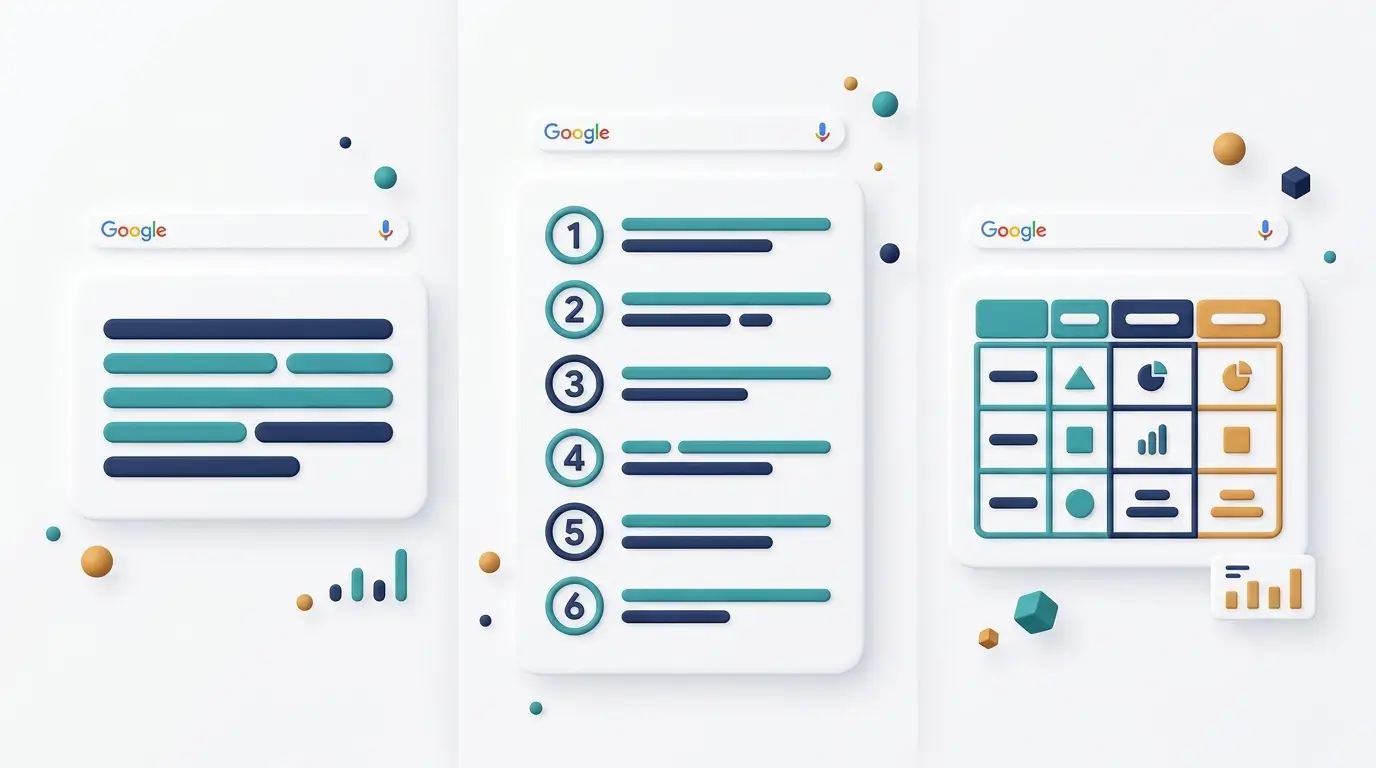
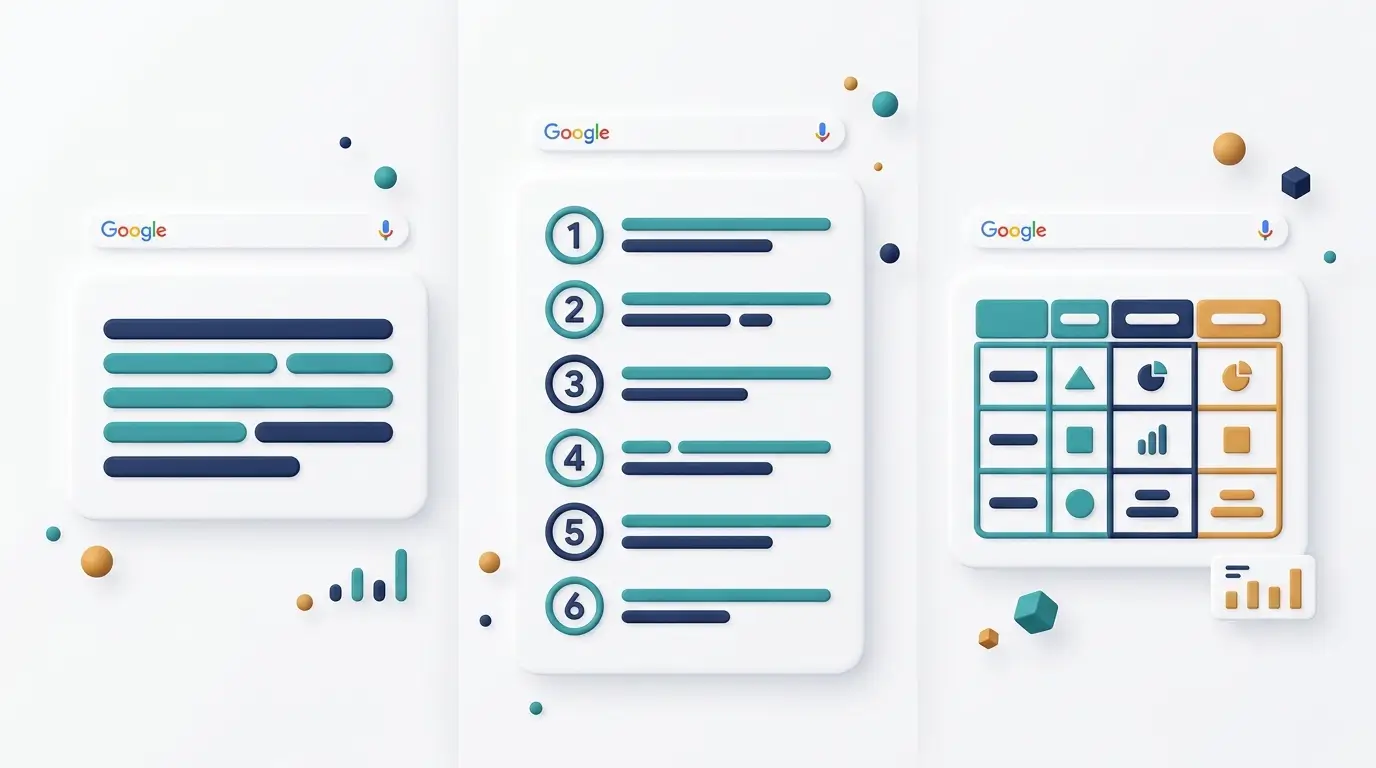
    Three-panel illustration showing the three featured snippet formats: paragraph snippet, list snippet, and table snippet, each with their corresponding Google search interface
    Each of the three featured snippet formats has different content structure requirements — match your writing to the format your target query typically triggers.
    📅 Last Reviewed: June 15, 2026. Part of the AI SEO Hub on EverydayOnAI. This is the sentence-level writing guide for the AEO formatting changes introduced in What is AEO? — read that first if you haven’t. Statistics from Semrush, EarnifyHub, DigitalApplied, and W3Era cited inline.

    📌 Key Takeaways

    • There are three featured snippet formats, each with precise content specs: paragraph snippets (40-60 words, definition/explanation queries), list snippets (5-8 items in native HTML ol/ul, how-to/best-X queries), and table snippets (3-4 columns × 5-10 rows in native HTML table, comparison/pricing queries).
    • Paragraph snippets make up approximately 55% of all featured snippets, lists approximately 30%, and tables approximately 12% — but list and table snippets generate higher CTR because they present actionable, scannable information.[1]
    • Voice search and featured snippets are functionally the same target: approximately 40.7% of voice assistant answers come from existing featured snippets,[2] and assistants read aloud roughly the first 29 words of the snippet source — matching the paragraph snippet length spec almost exactly.
    • Format mismatch is one of the most common snippet failure modes — using paragraph format for a query that expects a numbered list, or a list for a query that expects a table, reduces selection probability regardless of content quality.
    • Inverted pyramid writing — lead with the direct answer first, support with context after — is the structural principle that converts good content into extractable snippet content without rewriting everything from scratch.

    The One Rule That Applies to All Three Formats

    Before getting into format-specific specs, one principle applies identically to paragraph snippets, list snippets, and table snippets: the answer must appear immediately after the heading, with nothing in between.

    Google’s extraction algorithm reads content top-to-bottom and selects the first substantive, extractable answer it finds after a relevant heading. A paragraph that spends two sentences establishing context before stating the definition will be passed over in favor of a competing page that leads with the definition. A list that opens with a narrative paragraph before the numbered items will lose to a page where the list starts on the line directly following the heading. A table buried after four paragraphs of explanation will not compete with a table that follows immediately after the heading it belongs to.

    This is the inverted pyramid principle applied to snippet writing: the most important information — the direct answer — goes first. Supporting context, caveats, and elaboration follow it. This is the structural change responsible for the majority of snippet wins documented in AEO case studies, because most existing web content is written the other way: context first, answer second.

    💬 According to EverydayOnAI

    The inverted pyramid principle is genuinely counter to how most writers are trained. Academic writing, long-form journalism, and traditional blog posts all build toward the answer — you earn it through the setup. Featured snippet optimization reverses that: the reader (and the extraction algorithm) gets the answer in the first sentence, then chooses whether to read the setup. This feels wrong to write at first. The adjustment that usually helps: think of the heading as the question, and the opening sentence as the answer you’d give if someone stopped you in a hallway and asked that question. That’s the sentence Google extracts.

    📋 Section Summary

    • The universal snippet rule across all three formats: the answer must appear immediately after the heading, with no intervening context-setting, preamble, or introductory prose.
    • Google’s extraction algorithm selects the first extractable answer after a relevant heading — content that buries the answer loses to competing pages that lead with it, regardless of overall content quality.
    • Inverted pyramid writing — direct answer first, supporting context second — is the structural principle that converts well-written content into snippet-eligible content without requiring a full rewrite.

    Paragraph Snippets: The 40-60 Word Writing Spec

    Paragraph snippets are the most common format — approximately 55% of all featured snippets — and are triggered by definition and explanation queries: “what is”, “who is”, “why does”, “how does”.[1] They are also the primary voice search source, since voice assistants read aloud the first 29 words of a paragraph snippet — and a well-written 40-60 word snippet is, within those first 29 words, a complete standalone answer.
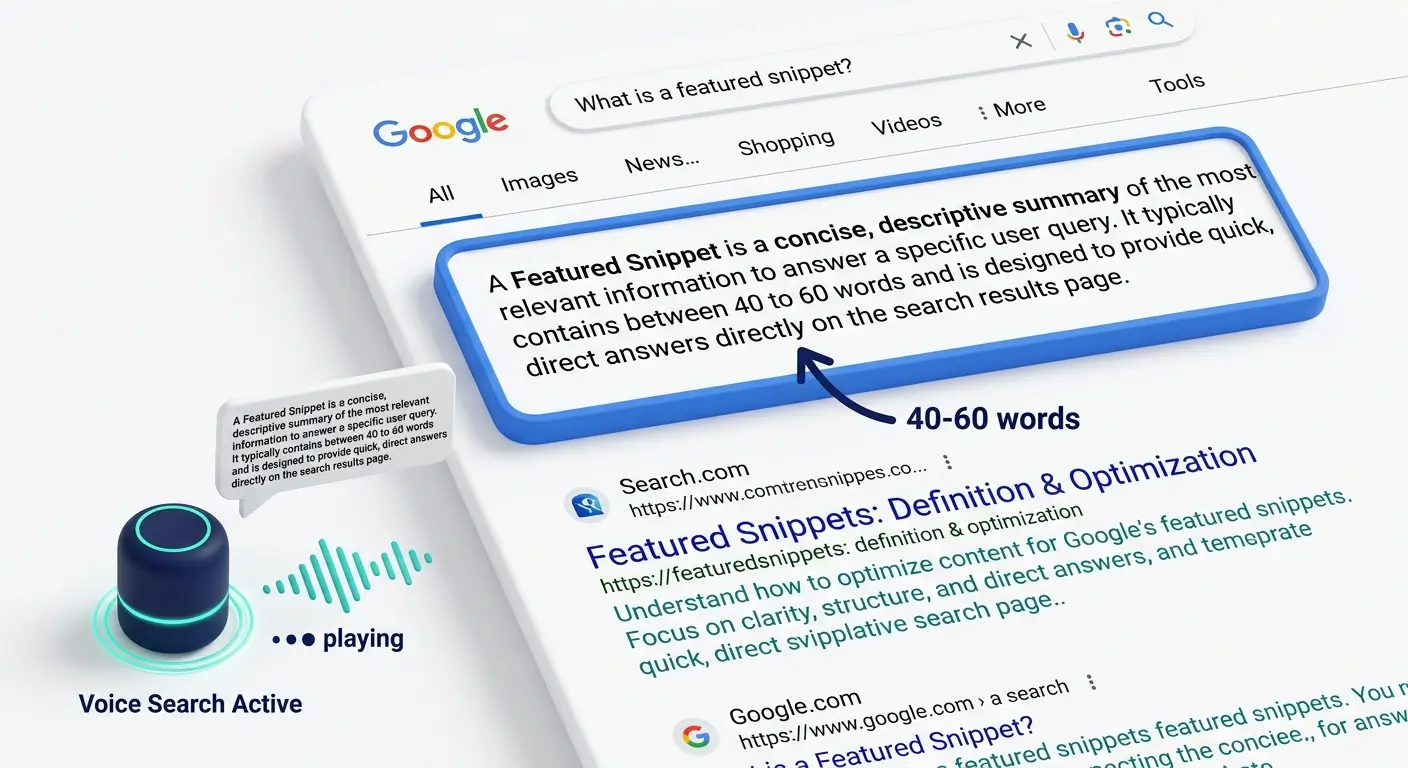
    Google search results page showing a paragraph featured snippet with a 40-60 word annotation, alongside a voice assistant speaker icon showing that the same content is read aloud
    The same 40-60 word paragraph snippet that wins position zero is what a voice assistant reads aloud — optimizing for one surface optimizes for both simultaneously.

    Paragraph Snippet Writing Spec

    Triggered by: “what is”, “who is”, “why does”, “how does”, definition and explanation queries

    Element Specification Why It Matters
    Total word count 40-60 words Under 40 appears incomplete; over 60 gets truncated with “…”
    First sentence Direct answer, 15-25 words Google extracts from the top — the definition must be in sentence 1
    Average sentence length Under 18 words per sentence Shorter sentences reduce truncation risk and improve voice readability[5]
    Heading match Exact or near-exact query phrasing Heading must mirror how the user typed the query
    Placement First sentence after heading — no introductory text Extraction algorithm reads top-to-bottom, stops at first answer
    Content type Specific, factual claims — no vague generalities Vague content is not selected for extraction[5]
    Verb tense Present tense for definitions “X is…” not “X was…” — recency signal for evergreen definitions[5]
    Voice reading window First 29 words What a voice assistant will read aloud from your snippet[6]

    📋 Section Summary

    • Paragraph snippets (~55% of all snippets) have a tight writing spec: 40-60 words total, direct answer in sentence 1, average sentence length under 18 words, present tense for definitions, no introductory prose between heading and answer.
    • Voice search reads the first 29 words aloud — a well-constructed 40-60 word paragraph snippet is effectively a pre-formatted voice answer within its first two sentences.
    • Specific, factual claims are selected for extraction; vague generalities are not — this applies to the 40-60 word answer block specifically, not to supporting context further down the page.

    List Snippets: The 5-8 Item Writing Spec

    List snippets make up approximately 30% of featured snippets and are triggered by “how to” process queries, “best X” ranking queries, and “steps to” instructional queries.[1] They generate higher CTR than paragraph snippets for the queries that trigger them, because a list presents multiple actionable items that pull readers in — the “More items” link that Google appends to truncated lists is itself a click driver.

    List Snippet Writing Spec

    Triggered by: “how to”, “steps to”, “best X”, “top X”, “ways to” queries

    Element Specification Why It Matters
    Item count 5-8 items Fewer than 5 appears incomplete; more than 8 gets truncated[4]
    HTML markup Native <ol> (steps) or <ul> (items), never <div> Google’s extraction only targets native HTML list elements[4]
    Item length One sentence per list item, 10-20 words Longer items get truncated; each item should be independently scannable[1]
    Placement Immediately after heading — no paragraph before list Any text between heading and list reduces extraction probability
    Item ordering Most important items first (1-3) Google truncates at ~7 items; if truncated, items 1-3 must stand alone
    Elaboration After the list, not inside list items Elaboration inside <li> breaks the clean extraction pattern[4]
    CSS Do not hide list markers with CSS Hidden markers can confuse crawlers evaluating list structure[1]
    Heading format H2 phrased as the question or process title “How to optimize for featured snippets” not “Optimization tips”

    One alternative structure for longer processes: instead of one list with 5-8 items, use H3 subheadings as the list items. Write your H2 as the question, then use H3 tags for each step. Google synthesizes these subheadings into a list snippet — the H3 text becomes the list item, and the content under each H3 serves the human reader who clicks through. This approach works well when each step requires a full section of content rather than a single sentence.[4]

    📋 Section Summary

    • List snippets (~30% of snippets, higher CTR than paragraphs) require: 5-8 items in native HTML ol/ul markup, one sentence per item (10-20 words), no introductory paragraph between heading and list, and elaboration placed after the list rather than inside list items.
    • CSS that hides list markers and div-based visual lists (not native HTML) are both extraction barriers — the content may look correct to humans but is invisible to Google’s list extraction system.
    • H3-as-list-items is a valid alternative for longer processes: Google synthesizes H3 subheadings into list snippet format when the H2 heading matches a list-trigger query.

    Table Snippets: The 3-4 Column Writing Spec

    Table snippets make up approximately 12% of featured snippets but are consistently triggered for high-value commercial queries: comparisons (“X vs Y”), pricing (“how much does X cost”), and specifications (“what are the dimensions of X”).[1] For these query types, a well-structured table is often the highest-CTR content format — the tabular layout signals “this content has multiple dimensions” in a way that a paragraph cannot.

    Table Snippet Writing Spec

    Triggered by: “X vs Y”, “difference between”, pricing queries, specification queries, comparison queries

    Element Specification Why It Matters
    Column count 3-4 columns More columns overflow the answer box; 3 is the optimal display size[3]
    Row count 5-10 rows Under 5 rows appears thin; over 10 is truncated with “More rows”
    HTML markup Native <table> with <th> and <td> Div-based grids cannot be extracted into table snippets[7]
    Header row <th> elements with descriptive column names Google uses headers to understand the comparison logic[7]
    Cell content Short cells — no merged cells, no nested tables Complex table structures confuse extraction[7]
    Column logic Clear comparison logic — Feature | Option A | Option B Consistent column structure helps AI agents parse and cite the data
    Placement Immediately after heading, no pre-table paragraph Same inverted pyramid rule — extraction starts at the first content element after the heading

    📋 Section Summary

    • Table snippets (~12% of snippets, highest value for comparison/pricing queries) require: 3-4 columns, 5-10 rows, native HTML table markup with th and td elements, descriptive headers, short cells, no merged cells, and no nested tables.
    • Div-based grids that look like tables visually cannot be extracted as table snippets — the markup, not the appearance, determines extractability.
    • The same native HTML table that wins a table snippet is also more parseable by AI citation systems, making table markup a shared investment for AEO and GEO simultaneously.

    Voice Search: Why It’s the Same Optimization

    Voice search optimization is frequently treated as a separate workstream from featured snippet optimization — with separate keyword research, separate content reformatting, and separate schema requirements. The data does not support treating them as separate. Approximately 40.7% of all voice assistant answers come directly from existing featured snippets.[2]

    Voice assistants — Google Assistant, Siri, and Alexa specifically — read aloud approximately the first 29-30 words of the source content they pull from.[6] A 40-60 word paragraph snippet is, within its first two sentences, a complete standalone answer. Those first two sentences are what gets read aloud. The remaining 20-30 words of the snippet are available to the listener if they ask a follow-up — but the primary “voice answer” is the first 29 words of the snippet source, which in a well-written paragraph snippet is the direct-answer sentence followed by one supporting clause.

    The practical implication: if you are already following the paragraph snippet writing spec (40-60 words, direct answer in sentence 1, under 18 words per sentence), you have already written a voice-search-ready answer. There is no additional reformatting needed. The only voice-specific addition is Speakable schema — the markup that signals to voice assistants which content blocks are appropriate to read aloud, which the AEO Guide covers in detail.

    📋 Section Summary

    • 40.7% of voice assistant answers come from existing featured snippets — voice search and snippet optimization are not two separate workstreams, they are one.
    • Voice assistants read approximately the first 29 words of a snippet source — a paragraph snippet written to the 40-60 word spec delivers a complete, self-contained voice answer within its first two sentences by design.
    • The only voice-specific addition beyond paragraph snippet optimization is Speakable schema markup — covered in the AEO Guide’s schema section.

    Format Matching: The Most Important Pre-Writing Step

    Format mismatch — using paragraph structure for a query that triggers list snippets, or building a list for a query that triggers tables — is one of the most common reasons technically correct content fails to earn a snippet.[8] Before writing a single word of snippet-optimized content, the pre-writing step is: search your target query and identify which format Google currently serves.

    Query Pattern Expected Format Example Query Writing Action
    “What is X”, “Who is X”, “Why does X” Paragraph “What is answer engine optimization?” 40-60 word direct-answer paragraph
    “How to X”, “Steps to X”, “Ways to X” Ordered list “How to optimize for featured snippets” 5-8 item ol immediately after heading
    “Best X”, “Top X”, “X recommendations” Unordered list “Best AEO tools 2026” 5-8 item ul with item name + one-sentence description
    “X vs Y”, “Difference between X and Y” Table or paragraph “AEO vs SEO difference” 3-4 column HTML table OR 40-60 word direct comparison paragraph
    Pricing, specifications, feature lists Table “How much does Semrush cost?” 3-4 column HTML table, descriptive headers

    One additional format consideration for 2026 specifically: some queries that previously triggered featured snippets now trigger AI Overviews instead — particularly broad definition queries, as documented by DigitalApplied.[8] “How to” and “X vs Y” queries retain snippet presence more reliably than pure “what is” definitional queries, which AI Overviews have displaced in some topic areas. If your SERP check shows an AI Overview rather than a snippet for a broad definition query, apply GEO content structure (from the GEO Guide) rather than the snippet spec from this article — per the GEO vs AEO framework.

    📋 Section Summary

    • Format matching — searching the target query to identify which snippet format Google currently serves — is the required pre-writing step before any snippet optimization work.
    • Query pattern reliably predicts format: “what is” → paragraph, “how to” → ordered list, “best X” → unordered list, “X vs Y” → table or comparison paragraph, pricing/specs → table.
    • Broad “what is” definitional queries are the most likely to show AI Overviews instead of snippets in 2026 — if that’s what your SERP check shows, apply GEO structure rather than the paragraph snippet spec.

    Before & After: Three Rewrites That Win Snippets

    Rewrite 1: Paragraph Snippet — Definition Query

    ✖ Before — Context-first, buried definition

    “In today’s rapidly changing digital landscape, understanding what AEO means for your content strategy has become increasingly important. AEO, which stands for Answer Engine Optimization, is something content teams should understand. It refers to the practice of making your content easily extractable…”

    ✔ After — 52 words, direct-answer first

    “Answer Engine Optimization (AEO) is the practice of structuring content so it can be extracted as a standalone, direct answer in featured snippets, voice search results, and AI answer boxes. AEO targets becoming the answer itself — selected from a specific position on the page — rather than simply ranking in a list of results.”

    The before version has the definition — it just doesn’t lead with it. The rewrite moves the definition to sentence 1, states it precisely, and uses the second sentence to add the key contrast (becoming the answer vs. ranking in results). Total word count: 52. Average sentence length: 17 and 20 words. Present tense. No preamble.

    Rewrite 2: List Snippet — How-To Query

    ✖ Before — Narrative prose, no extractable list

    “To optimize content for featured snippets, you’ll want to start by making sure your heading matches the query, and then you should write a clear answer, and it also helps to keep things concise while adding schema markup and monitoring your results over time with Search Console.”

    ✔ After — 6-item ordered list in native HTML

    <ol> (1) Match your heading to the exact query phrasing. (2) Write a 40-60 word direct answer immediately after the heading. (3) Place the full list directly after the heading — no paragraph before it. (4) Add FAQPage or HowTo schema. (5) Submit to Google Search Console for indexing. (6) Monitor snippet appearance and refresh quarterly. </ol>

    The same information, restructured. The before version contains all six steps but blends them into a single run-on sentence with coordinating conjunctions — Google cannot extract a list from this. The after version uses native ol/li markup, one action per item, all within the 10-20 word per item spec.

    Rewrite 3: Table Snippet — Comparison Query

    ✖ Before — Comparison buried in prose

    “Paragraph snippets are different from list snippets in several ways. While paragraphs work for definition queries and are 40-60 words, lists use 5-8 items and work for how-to queries. Tables are another format entirely, best for comparison data with 3-4 columns…”

    ✔ After — 3-column HTML table, immediately after heading

    <table> [Format | Trigger | Spec] [Paragraph | “what is” queries | 40-60 words] [List | “how to” queries | 5-8 items in ol/ul] [Table | comparison queries | 3-4 columns, 5-10 rows] </table>

    The prose comparison is readable and accurate but not extractable as a table snippet. The HTML table version takes exactly the same information and puts it in the format Google expects for comparison queries — three columns (Format, Trigger, Spec), three data rows plus header, native table markup.

    Featured Snippet Writing Checklist

    ✓ Pre-Writing (Do This First)

    • ★ Search target query and identify: does it trigger a snippet (paragraph, list, or table), an AI Overview, or neither?
    • If AI Overview: apply GEO structure (not this checklist); if neither: SEO ranking work needed first
    • If snippet: note the exact format (paragraph/list/table) and match content structure accordingly
    • Review the current snippet holder — what’s their word count, structure, heading phrasing?

    ✓ Paragraph Snippet Writing

    • ★ 40-60 total words in the answer block
    • ★ Direct answer in sentence 1 — topic term defined immediately
    • Average sentence length under 18 words
    • Present tense for definitions (“X is…” not “X was…”)
    • Specific, factual claims — no vague generalizations
    • No introductory text between heading and answer paragraph
    • ★ First 29 words standalone as a complete voice answer

    ✓ List Snippet Writing

    • ★ 5-8 items only — not fewer, not more
    • ★ Native <ol> (ordered/steps) or <ul> (unordered/items) markup — not styled divs
    • ★ List placed immediately after heading — no paragraph before the list
    • Each item: one sentence, 10-20 words
    • Most important items in positions 1-3 (in case Google truncates)
    • Elaboration in a paragraph after the list, not inside <li> elements
    • CSS must not hide list markers

    ✓ Table Snippet Writing

    • ★ Native <table> with <th> header row and <td> data cells — not div grids
    • ★ 3-4 columns, 5-10 rows
    • Descriptive column headers in <th> elements
    • Short cell content — avoid merged cells and nested tables
    • Clear comparison logic (Feature | Option A | Option B pattern)
    • Table placed immediately after heading

    ✓ Post-Publication

    • Search Console monitored monthly for average position anomalies below 1.0 (signals snippet win)
    • Speakable schema implemented targeting the answer paragraph for voice surfaces
    • Quarterly content refresh scheduled for any page holding a snippet — freshness is re-evaluated continuously
    • Competitor snippet holders re-checked quarterly — they can reclaim lost snippets with reformatting

    Frequently Asked Questions

    How long should a featured snippet answer be?

    Paragraph snippet answers should be 40-60 words. Under 40 words often appears incomplete to Google; over 60 words gets truncated with an ellipsis in the answer box. List snippets should contain 5-8 items with each item kept to one sentence (10-20 words). Table snippets perform best with 3-4 columns and 5-10 rows. These dimensions match Google’s answer box display constraints and the 15-20 second voice search reading window.[9]

    What query types trigger each featured snippet format?

    Paragraph snippets are triggered by “what is”, “who is”, “why does”, and “how does” queries. List snippets are triggered by “how to” process queries and “best X” or “top X” ranking queries. Table snippets are triggered by comparison queries (“X vs Y”), pricing queries, and specification queries. Matching your content format to the format Google currently serves for that query type is the highest-leverage pre-writing step — format mismatch reduces selection probability regardless of content quality.[8]

    Does winning a featured snippet automatically win voice search?

    Not automatically, but approximately 40.7% of voice assistant answers come directly from existing featured snippets.[2] Voice assistants read aloud roughly the first 29 words of a snippet source — meaning the same paragraph snippet spec (40-60 words, direct answer in sentence 1) produces a complete standalone voice answer within its first two sentences. The only voice-specific addition beyond paragraph snippet optimization is Speakable schema markup.

    What is inverted pyramid writing and how does it help featured snippets?

    Inverted pyramid writing means leading with the most important information first — the direct answer — and following with supporting detail, context, and caveats afterward. Google’s extraction algorithm identifies the first substantive passage after a relevant heading and lifts it as the snippet answer. A paragraph that buries the definition in sentence three fails snippet extraction even if the overall content quality is high, because the algorithm reads top-to-bottom and selects the first extractable answer it finds.

    Should I use HTML lists or styled div elements for list snippets?

    Always use semantic HTML lists — <ol> for ordered steps, <ul> for unordered items. Google’s list snippet extraction specifically targets native <ol> and <li> or <ul> and <li> elements.[4] Styled div elements that visually look like a list but lack proper HTML markup cannot be extracted into list snippets, regardless of how they appear to a human reader. Keep each <li> item to one sentence, place the list immediately after the heading, and avoid CSS that hides list markers.

    Conclusion: Write for Extraction, Not Just for Reading

    The sentence-level changes that win featured snippets are not about writing better — most content that fails to earn snippets is already well-written. They are about writing in a sequence that Google’s extraction algorithm can lift cleanly: direct answer first, format matched to query intent, markup that makes structure machine-readable.

    The three-step workflow from this article: check the SERP to identify which format your target query triggers, use the corresponding writing spec (40-60 word paragraph, 5-8 item list, 3-4 column table), and place the answer immediately after the heading with nothing in between. That’s the entirety of the writing change — the rest is monitoring and quarterly freshness maintenance.

    💬 According to EverydayOnAI

    The most valuable insight from reviewing the specs above together is how narrow the actual optimization window is. Paragraph: 40-60 words. List: 5-8 items. Table: 3-4 columns. These are not wide ranges. Content that sits at 62 words may lose to a 55-word competitor. A list with 9 items may lose to one with 7. This precision is what makes snippet optimization feel mechanical — because it is, and intentionally so. The writer’s job is to make the extraction trivially easy for Google, which means respecting the dimensional constraints that match the answer box, not writing to express nuance or comprehensiveness within the snippet block itself. Save the nuance for the supporting paragraphs that follow.

    📚 References and Sources

    1. EarnifyHub, “Featured Snippets for Bloggers in 2026: How to Capture Position Zero,” April 2026. Snippet format distribution: paragraph ~55%, lists ~30%, tables ~12%, video ~3%; list and table snippets generate higher CTR than paragraphs; each list item should be 10-20 words; avoid CSS hiding list markers. earnifyhub.com
    2. TurboAudit, “Answer Engine Optimization (AEO): 2026 Guide,” June 2026. 40.7% of voice assistant answers come from existing featured snippets. turboaudit.ai
    3. YoGrow Solutions, “How to Win the Featured Snippet: The 2026 SEO Formatting Guide,” January 2026. Three columns and five to six rows described as optimal table snippet size; AI agents find it easier to parse simple, data-rich table structures. yogrowsolutions.com
    4. AIOCopilot, “Featured Snippets Optimization Guide 2026: Position Zero Strategy,” April 2026. Process queries: use H2 with question, immediately follow with ol where each item is one concise step; H3-as-list-item alternative for longer processes; keep total items 5-8; elaboration in paragraph after list, not inside li; native HTML list elements required. aiocopilot.com
    5. MarGen, “Featured Snippets in 2026: How to Win Position Zero,” March 2026. Short sentences in definition paragraphs (under 18 words average); specific factual claims, not vague generalities; present tense for definitions; monthly review of 20 priority snippet queries. margen.net
    6. HubSpot, “Keyword Research for AEO,” June 2026, citing voice assistant data. Voice assistants typically read the first 29 words of a featured snippet source. blog.hubspot.com
    7. W3Era, “How to Optimize for Featured Snippets in 2026 (Complete Guide),” June 2026. Table snippet optimization requires native HTML table elements; descriptive headers; short cells; avoid merged cells, nested tables, vague column names, and image-based tables. w3era.com
    8. DigitalApplied, “Featured Snippets in the AI Overview Era: 2026 Guide,” March 2026. Format mismatch between content structure and query intent reduces snippet selection probability regardless of content quality; “how to” and comparison queries retain snippet presence more reliably than broad definition queries, which AI Overviews have displaced in some categories. digitalapplied.com
    9. DataEnriche, “How to Structure Content for Featured Snippets 2026,” April 2026. Featured snippet answer specs: 40-60 words paragraph (under 40 appears incomplete, over 60 truncated); 5-7 list items shown with “More items” for longer lists; 3-4 columns for table snippets; these lengths match Google’s answer box dimensions and voice search reading times of 15-20 seconds. dataenriche.com

    Sources verified June 15, 2026. Featured snippet trigger rates and format distributions vary by industry and keyword type — these figures represent averages across broad query samples. Snippet presence for specific queries should always be confirmed via direct SERP check. This article does not constitute professional SEO advice.

    📚 Go Deeper: Complete AI SEO Hub on EverydayOnAI

    Audit Your Top Pages with the Snippet-Readiness Checker

    Paste any paragraph into our free interactive Snippet-Readiness Checker — available in the AEO Guide — and get instant feedback on word count, direct-answer structure, specificity, and voice readability.
    Use the Free Checker →

  • GEO Content Writing: How to Write for AI Extraction

    GEO Content Writing: How to Write for AI Extraction

    Pages with answer-first headlines are cited by ChatGPT 41% of the time — versus only 29% for pages with loosely related headlines. That 12-percentage-point gap comes from a single writing choice: where the answer appears in the first sentence. Kevin Indig’s AirOps study of 16,851 ChatGPT queries and 353,799 pages (April 2026) identified this as the highest-leverage structural difference between cited and non-cited content.

    GEO content writing is not a new genre — it is a constraint layer applied on top of standard content writing. The substance stays the same. The sentence structure changes. AI platforms do not read your articles the way humans do. They extract individual passages, evaluate each one for clarity and verifiability, and reproduce the ones that score highest. Content optimized for sequential human reading fails this extraction test at the sentence level — even when the ideas it contains are strong.

    “Citation winners are almost 2x more likely to contain definitive language — ‘is defined as’, ‘refers to’ — at 36.2% versus 20.2% for non-cited content. ChatGPT seeks the sentence with the highest information gain, regardless of whether it appears first, second, or fifth.”
    — Kevin Indig, Growth Memo, “The Science of How AI Pays Attention,” February 2026 (analysis of 1.2 million ChatGPT responses, 18,012 verified citations)

    This guide covers exactly what changes at the sentence and paragraph level to make content extraction-ready — with formulas, before/after rewrites, and a pre-publish checklist that takes under 20 minutes to run.

    📌 KEY TAKEAWAYS

    • Pages with answer-first headlines are cited by ChatGPT 41% of the time versus 29% for pages with loosely related headlines — a finding from Kevin Indig’s AirOps study of 16,851 ChatGPT queries (April 2026).
    • 44.2% of all AI citations come from the first 30% of a page’s content, with a “ski ramp” distribution pattern confirmed across 1.2 million ChatGPT responses and 18,012 verified citations (Kevin Indig / Growth Memo, February 2026).
    • Citation winners are almost 2x more likely to contain definitive language — “is defined as,” “refers to” — at 36.2% versus 20.2% for non-cited content (Kevin Indig / Growth Memo, February 2026), making authoritative tone a functional citation requirement, not a stylistic preference.
    • Structured content earns approximately 2.5x more AI citations than unstructured prose of equivalent length (Resollm analysis, 2025), with comprehensive guides achieving 67% citation rates versus 18% for opinion pieces (Presence AI, 2,000+ cited pages, February 2026).
    • Gartner predicts traditional search engine volume will drop 25% by 2026 as AI chatbots become substitute answer engines (Gartner, February 2024), making extraction-ready writing a primary content skill, not a supplementary one.

    1. How AI Models Read and Extract Content

    This section covers how AI-powered search platforms actually process web content — establishing the technical foundation that explains why every GEO writing technique works the way it does.

    AI Models Extract, They Do Not Read

    AI search platforms process web content through extraction and synthesis, not sequential reading. When Google AI Overviews or ChatGPT Search generates an answer, the underlying system breaks web pages into chunks — typically at the paragraph or section level — evaluates each chunk for relevance and information density, and selects specific passages to incorporate into a synthesized response. The human experience of reading from top to bottom, building context as you go, does not apply to how AI models consume your content.

    This extraction behavior has a measurable structural preference backed by large-scale data. Kevin Indig’s analysis of 1.2 million ChatGPT responses and 18,012 verified citations (Growth Memo, February 2026) found what Indig calls a “ski ramp” distribution pattern: 44.2% of all citations come from the first 30% of a page, 31.1% from the middle 30–70%, and 24.7% from the final third. The AI model reads the beginning of a page with the attention of a journalist looking for the “who, what, where” — and extracts disproportionately from that opening section.

    What AI Models Look For in a Passage

    AI models evaluate extracted passages against three criteria simultaneously: relevance to the query, clarity of the claim, and verifiability of the source. The Growth Memo February 2026 analysis quantified this: citation winners contain definitive language — “is defined as,” “refers to” — at 36.2% versus 20.2% for non-cited content, almost a 2x gap. Passages that express clear, specific relationships between named concepts are extracted at significantly higher rates than passages that hedge claims or rely on surrounding context for meaning.

    A second critical finding from the same study: ChatGPT seeks “the sentence with the highest information gain” — the most complete use of relevant named entities with additive, specific information — regardless of whether that sentence is first, second, or fifth in a paragraph. This means sentence-level clarity and information density are the primary extraction variables, not position alone. Position matters because high-information-gain sentences are more likely to appear at the start of well-structured content — but the underlying selector is information density, not location.

    41%
    ChatGPT citation rate for answer-first headlines vs 29% for loosely related (Indig/AirOps, Apr 2026)
    44.2%
    of all ChatGPT citations come from the first 30% of content (Growth Memo, Feb 2026)
    2x
    More likely to be cited when content uses definitive language — 36.2% vs 20.2% (Growth Memo, Feb 2026)
    2.5x
    More AI citations for structured vs unstructured prose of equivalent length (Resollm, 2025)

    📋 SECTION SUMMARY — How AI Reads Content

    • AI search platforms extract content at the paragraph and section level rather than reading sequentially — Kevin Indig’s analysis of 1.2 million ChatGPT responses (18,012 verified citations, Growth Memo, February 2026) confirmed a “ski ramp” distribution where 44.2% of all citations originate from the first 30% of content.
    • ChatGPT selects the sentence with the highest “information gain” — the most complete use of named entities and specific, additive claims — making sentence-level information density the primary extraction variable, independent of position alone.
    • Citation winners contain definitive language at 36.2% versus 20.2% for non-cited content — a nearly 2x gap — confirming that authoritative, specific claims are a functional citation requirement, not a stylistic preference (Growth Memo, February 2026).

    2. GEO Writing vs. Traditional Content Writing

    This section maps the specific structural differences between GEO-optimized content and traditional content writing — establishing what changes and what stays the same.

    GEO writing and traditional content writing differ primarily at the sentence level, not the idea level. The same information can be written in a way that AI models extract at high rates or skip entirely — depending on where the answer appears, how statistics are attributed, and whether each sentence carries its full meaning independently. The goal is content that reads naturally to humans and extracts cleanly for AI simultaneously.

    Dimension Traditional Content Writing GEO Writing (Added Requirement)
    H3 first sentence Context-building, framing, or question restatement acceptable Direct answer or definition required — no preamble, no exceptions
    Statistics format Hyperlinked source sufficient Self-contained: org name + number + context + year in plain text
    Sentence structure Context can be distributed across multiple sentences Each key claim readable as standalone — full meaning in one sentence
    Named entities Pronouns acceptable after first mention Full official name re-introduced at start of each new H2 section
    Paragraph length Variable — narrative flow determines length 3–4 sentences max; one idea per paragraph, independently readable
    Section endings Transition sentence to next section Summary Box with 3 self-contained bullets + transition
    Promotional language Acceptable in moderation Eliminated — AI models filter promotional content at the passage level
    Tone Hedged or conditional language acceptable for nuance Definitive statements preferred — hedged language reduces citation probability
    💡 KEY POINT
    GEO writing is not a replacement for good writing — it is a constraint layer applied on top. The answer-first rule applies to sentence one. Traditional narrative flow continues from sentence two onward. The constraint is narrow and specific; it does not require rewriting every sentence, only restructuring where answers appear.

    📋 SECTION SUMMARY — GEO vs Traditional Writing

    • The primary structural difference between GEO and traditional content writing is sentence-level: GEO writing leads with the answer, traditional writing builds toward it — a reversal that directly affects AI extraction probability because 44.2% of citations come from a page’s first 30% (Growth Memo, February 2026).
    • Promotional language is filtered by AI models at the passage evaluation stage — not just ignored — making its removal a functional GEO requirement rather than a stylistic guideline.
    • GEO writing serves both human readers and AI extraction simultaneously when applied correctly: the answer-first rule improves human scannability and AI extractability for the same reason — it puts the most valuable information first.

    3. The 7 GEO Writing Techniques

    This section covers the seven specific writing techniques that directly improve AI citation rates — ordered by implementation impact, with the formula and before/after example for each.

    1 Answer-First H3 Sentences

    Answer-first formatting means the first sentence after every H3 heading delivers the direct answer or definition — not a transition, not context, not a question restatement. Kevin Indig’s AirOps study of 16,851 ChatGPT queries and 353,799 pages (April 2026) found that pages with headlines that directly answer the question are cited 41% of the time, versus 29% for pages with loosely related headlines — a 12-percentage-point gap from a single structural choice.

    Formula
    [Subject — full named entity] is / does / requires / means [direct answer or definition.]
    ❌ Traditional (context-first)

    “Before understanding how GEO works, it’s important to consider the context in which AI platforms were developed and why they process content differently from traditional search engines…”

    ✅ GEO (answer-first)

    “Generative Engine Optimization (GEO) works by structuring content so that AI platforms can extract, understand, and cite specific sentences without needing surrounding context to interpret them correctly.”

    The answer-first rule applies without exception. There is no topic complexity, no stylistic rationale, and no query type that justifies opening an H3 sub-section with context before the answer. Context belongs in sentences two and beyond — never in sentence one. This single change, applied systematically across all H3 headings on a page, is the highest-ROI structural edit in the GEO writing workflow.

    2 Self-Contained Statistics

    Self-contained statistics are data points that include every element needed to understand and verify them in a single sentence — the organization, the specific number, the full context, and the source name and year in plain text. A hyperlink alone is insufficient for GEO because AI models read the text surrounding links; they do not follow links to retrieve source information.

    Formula
    [Organization / Study name] [verb] [specific number] [full context] ([Source, Year]).
    ❌ Not self-contained

    “Studies show the fine can reach up to €35 million for violations.”
    (Missing: which study, which regulation, which violation category, year)

    ✅ Self-contained

    “The EU AI Act imposes fines of up to €35 million or 7% of global annual turnover — whichever is higher — for companies deploying prohibited AI practices (EU AI Act, Article 99, 2024).”

    Precision directly increases citability. Katarina Dahlin’s analysis of AI optimization practices, citing Princeton research (March 2026), confirms that content with verifiable statistics achieves 30–40% higher visibility in AI-generated responses compared to unoptimized content. A specific number (“15%”) is cited more frequently than an approximate one (“about 15%”) — the difference is that a precise number signals a verifiable claim, while an approximation signals uncertainty that reduces AI confidence in the citation.

    3 Quotable Standalone Sentences

    Quotable sentences are complete standalone thoughts — sentences that communicate their full meaning without any surrounding context, making them directly reproducible by AI models in synthesized answers. The Growth Memo February 2026 study found that citation winners contain definitive language at 36.2% versus 20.2% for non-cited content — almost a 2x gap — confirming that a sentence’s standalone clarity and confidence are the primary citation selectors at the sentence level.

    ✅ QUOTABILITY TEST
    Read each key claim sentence in complete isolation — without the sentence before or after it. If the meaning is clear and complete, it is quotable. If it requires context to make sense, rewrite it until it does not. Apply this test to every sentence that contains a claim, a statistic, or a definition.
    ❌ Context-dependent

    “As we discussed earlier, this can significantly help improve the results you’re seeing across all the platforms mentioned above.”

    ✅ Quotable standalone

    “Applying answer-first H3 formatting and self-contained statistics improves AI citation visibility by 30–40%, according to Princeton University and Georgia Tech research published at ACM KDD 2024.”

    4 Named Entity Clarity

    Named entity clarity means using full official names rather than pronouns or abbreviations as the subject of any sentence that opens a new section or introduces a concept. AI models use named entities as primary anchors for determining what a passage is about and who it should be attributed to — a paragraph that begins “It requires…” or “They found…” without re-stating the subject forces the AI to infer attribution from context, which reduces extraction accuracy and citation probability.

    Rule
    First mention in every new H2 section → full official name.
    Subsequent sentences in same section → abbreviation acceptable.
    New H2 section begins → full official name again.
    ❌ Pronoun as subject

    “It requires companies to complete seven compliance steps before the 2026 deadline.”
    (Which regulation? Which companies? Requires the reader to have read the previous section.)

    ✅ Named entity as subject

    “The EU AI Act requires high-risk AI system providers to complete seven conformity assessment steps before August 2, 2026.”

    5 Authoritative Tone

    Authoritative tone in GEO writing means choosing definitive statements over hedged or conditional language — because the data shows that citation winners express clear, confident relationships between concepts at nearly twice the rate of non-cited content. This is not a stylistic preference; it is a functional citation requirement. A sentence that reads “this approach might help improve AI visibility in certain contexts” signals uncertainty that reduces an AI model’s confidence in reproducing the claim.

    ❌ Hedged (lower citation probability)

    “This approach might help improve your AI visibility results in certain contexts depending on your content type and industry.”

    ✅ Authoritative (higher citation probability)

    “Applying answer-first H3 formatting improves AI citation visibility by eliminating the extraction window lost when context precedes the answer — a structural change that applies across all AI search platforms regardless of content type.”

    Authoritative tone does not mean overstating or omitting caveats. It means choosing active over passive voice, specific mechanisms over vague benefits, and named evidence over implied authority. The distinction between “this can help” and “this does X by doing Y” is the difference between a sentence that hedges and a sentence that explains — and AI models consistently prefer the latter.

    6 Single-Idea Paragraphs

    Single-idea paragraphs contain one concept each, written in 3–4 sentences maximum, and are understandable in isolation without surrounding paragraphs. AI models extract content at the paragraph level — a paragraph that introduces two topics or transitions between concepts mid-way forces the extraction system to either take more than it needs or cut the passage short at the topic boundary.

    The practical paragraph structure for GEO: topic sentence in sentence 1 (the named claim), supporting evidence or mechanism in sentences 2–3, and optionally a concrete example in sentence 4. When a paragraph requires a fifth sentence, the additional content belongs in a new paragraph. When a paragraph contains a “furthermore” or “additionally” that introduces a genuinely new concept, that new concept belongs in a new H3 sub-section.

    ⚠️ WATCH FOR
    Transition sentences that connect two different topics within a single paragraph — “Furthermore, this also applies to…” — are the most common paragraph-level GEO mistake. Each connector that introduces a new idea should become the first sentence of a new paragraph or H3 section, not a continuation of the current one.

    7 Section Summary Boxes

    Section Summary Boxes are structured blocks at the end of each H2 section containing 3 self-contained bullet points — each bullet independently readable without the section content. These blocks are among the highest-density extraction targets on a GEO-optimized page because they concentrate factual claims in a clean, structured format that AI models can parse and reproduce with minimal inference.

    Formula — Each Summary Bullet
    [Named entity] + [definitive claim] + [specific number or date] + ([source if applicable]). Self-contained.

    Speakable schema targeting the .section-summary CSS class provides an explicit structural signal to AI platforms that these blocks are designed for extraction — removing the inference burden from AI crawlers and directly increasing the probability that these high-density passages are selected as citation sources. This is a 5-minute schema addition with a disproportionate GEO impact.

    📋 SECTION SUMMARY — The 7 GEO Writing Techniques

    • Answer-first H3 formatting is the single highest-leverage writing change in GEO — pages with answer-first headlines are cited by ChatGPT 41% of the time versus 29% for loosely related headlines, based on Kevin Indig’s AirOps study of 16,851 ChatGPT queries (April 2026).
    • Self-contained statistics — including organization, number, full context, and year in plain text — are directly tied to the 30–40% higher AI visibility from verified statistics found in Princeton/KDD 2024 research; hyperlinks alone fail this standard because AI models read text, not link destinations.
    • Citation winners contain definitive language at 36.2% versus 20.2% for non-cited content (Growth Memo, February 2026) — making authoritative tone, quotable standalone sentences, and single-idea paragraphs functional citation requirements rather than stylistic preferences.

    4. Before & After: Real Rewrites

    This section shows complete paragraph-level rewrites applying all seven GEO techniques simultaneously — demonstrating how the same information is restructured for AI extraction without losing substance or readability.

    Rewrite 1: Definition Paragraph

    ❌ Before — Traditional

    “When we talk about AI search, it’s important to understand how it differs from what most of us are used to. These systems work in a fundamentally different way. Rather than returning a list of links, they synthesize information from multiple sources and present a unified answer. This has big implications for how content needs to be written.”

    ✅ After — GEO

    “AI search platforms synthesize content from multiple sources into a single unified answer rather than returning a ranked list of links — a structural difference that requires content to be written for extraction rather than sequential reading. Platforms including ChatGPT Search, Google AI Overviews, and Perplexity AI all operate on this synthesis model. Content designed for traditional link-ranking fails at the extraction stage even when it ranks well in conventional Google search.”

    Changes applied: Answer-first opening (synthesis vs. list), named entities introduced (ChatGPT Search, Google AI Overviews, Perplexity AI), final sentence is a standalone quotable claim, removed “when we talk about” preamble entirely.

    Rewrite 2: Statistics Paragraph

    ❌ Before — Traditional

    “Recent research shows that a large percentage of searches now end without any clicks at all. This is sometimes called zero-click search and it’s becoming more and more common. The rise of AI Overviews is the main reason for this shift.”

    ✅ After — GEO

    “59.7% of Google searches now end without a single click to any website, according to SparkToro and Datos’ 2024 analysis of real-world search behavior. Google AI Overviews, which appeared on approximately 48% of searches as of April 2026 (Averi.ai, State of AI Content Marketing), are the primary driver of this zero-click shift. For content teams, this means AI citation visibility — not just ranking position — is now required for content to reach its intended audience.”

    Changes applied: Vague “large percentage” replaced with specific “59.7%”, source attribution added in plain text for both statistics, final sentence is a standalone actionable conclusion, named entities (SparkToro, Datos, Google AI Overviews, Averi.ai) introduced in full.

    Rewrite 3: How-To Introduction Paragraph

    ❌ Before — Traditional

    “There are several things you can do to improve your chances of being cited by AI. In this section, we’ll look at the most important steps you should take. Some of these might be familiar from your SEO work, while others will be new.”

    ✅ After — GEO

    “Improving AI citation rates requires four specific changes to existing content: rewriting H3 first sentences to answer-first format, reformatting all statistics to include in-text source attribution, adding Section Summary Boxes to each H2 section, and verifying that AI crawlers are not blocked in robots.txt or at the CDN level. Each change can be applied to existing content without creating new pages — the GEO layer is a structural edit, not a content overhaul.”

    Changes applied: “Several things” replaced with the specific four changes named explicitly, “in this section, we’ll look at” preamble removed entirely, second sentence is a standalone quotable claim that completes the meaning of the first.

    📋 SECTION SUMMARY — Before & After Rewrites

    • Every GEO rewrite makes three changes simultaneously: removes preamble from sentence 1, adds named entities and specific numbers to replace vague language, and ensures the final sentence of each paragraph is a standalone quotable conclusion.
    • GEO rewrites do not change the substance of content — they restructure where information appears, how statistics are attributed, and whether each sentence carries independent meaning, without altering the underlying argument or factual claims.
    • The most common traditional writing patterns that fail GEO — “when we talk about,” “in this section we’ll look at,” “recent research shows” without specifics — are all preamble or vagueness patterns that delay or obscure the extractable claim.

    5. Best Content Formats for AI Citation

    This section covers which content formats earn the highest AI citation rates — with the specific data behind each format’s performance and the structural reasons it performs the way it does.

    Format Citation Rate Source Why It Works for GEO
    Comprehensive Guides with Data Tables 67% across all platforms Presence AI, 2,000+ cited pages, Feb 2026 Data tables are self-contained extraction units; comprehensive depth satisfies multiple sub-queries simultaneously
    Comparison / “Top N” Lists 61% citation rate; 21.9% of all AI citations Presence AI (Feb 2026); Wix (Mar 2026) Each item is inherently self-contained with a named entity as subject; rows are independently extractable
    FAQ Sections with Schema 58% citation rate Presence AI, Feb 2026 Q&A structure mirrors how users query AI; FAQPage schema explicitly signals extractability to AI crawlers
    Step-by-Step How-To Guides 54% citation rate Presence AI, Feb 2026 Numbered steps are individually extractable units; HowTo schema amplifies with machine-readable step structure
    Statistics and Research Pages +30–40% visibility lift from statistics Princeton/KDD 2024 Verifiable data points are high-confidence extraction targets; each statistic is a complete standalone claim
    Opinion / Analysis Pieces 18% citation rate Presence AI, Feb 2026 Subjective analysis is harder to verify; lower extraction confidence unless backed by named data sources

    “Q&A is the best format for AI search. Structured content — headings and lists — is almost as effective for non-question queries, while dense paragraphs perform worst.”
    — Chris Green, AI content format analysis, June 2025, cited in position.digital, 2026

    The structural reason comparison and list formats dominate AI citations is directly traceable to GEO writing principles: each item in a “Top N” format is inherently self-contained, has its own named entity as subject, and presents its claim in isolation from surrounding items. This is exactly the extraction structure all seven GEO writing techniques aim to produce at the sentence and paragraph level. Applying GEO writing techniques inside comparison and list formats creates compounding citation advantage — the format is already preferred, and the writing within it is additionally optimized.

    A note on freshness: content updated within the last 30 days receives 3.2 times more citations than content older than 90 days, according to SE Ranking’s analysis of ChatGPT citation factors. For high-performing formats like comprehensive guides and comparison articles, scheduled quarterly updates with new statistics and examples maintain citation rates that would otherwise decay as fresher competing content appears.

    📋 SECTION SUMMARY — Content Formats

    • Comprehensive guides with data tables achieve 67% citation rates across AI platforms, while comparison matrices achieve 61% and FAQ sections with schema markup achieve 58%, according to Presence AI’s analysis of 2,000+ cited pages (February 2026) — all three formats outperform unstructured narrative content because each section or item is inherently self-contained.
    • Listicles account for 21.9% of all AI citations in AI Mode, ChatGPT, and Perplexity combined (Wix, March 2026), while structured content overall earns approximately 2.5x more AI citations than unstructured prose of equivalent length (Resollm analysis, 2025).
    • Content updated within the last 30 days receives 3.2x more citations than content older than 90 days (SE Ranking ChatGPT citation factors analysis), making quarterly freshness updates a citation maintenance requirement for high-performing formats.

    6. Pre-Publish GEO Writing Checklist

    This section provides the complete pre-publish verification checklist for GEO content writing — a 20-minute audit that catches the most common extraction-blocking mistakes before content goes live.

    Run This Before Every Publish

    • H3 first sentence audit — read every H3 first sentence in isolation. If it does not directly answer or define the H3 topic without surrounding context, rewrite it. No exceptions for introductory context, historical framing, or build-up language.
    • Statistics self-contained check — find every data point using Ctrl+F for “%” and for years in parentheses. Verify each includes: specific number + full context + source organization name + year in plain text. Hyperlink-only attribution fails this check.
    • Named entity audit — confirm the primary subject is introduced by its full official name at the start of each H2 section. Remove any pronoun or abbreviation that stands in for a named entity at an H3 opening.
    • Quotability test — read each key claim sentence in complete isolation. If it requires the surrounding paragraph to make sense, rewrite it. Target: every sentence containing a statistic, a definition, or a process claim must be independently readable.
    • Paragraph length check — flag any paragraph over 4 sentences. Split it. Verify each resulting paragraph covers exactly one idea and has a topic sentence as sentence 1.
    • Promotional language scan — search for: “best in class,” “industry-leading,” “we offer,” “our solution,” “revolutionary,” “game-changing.” Remove or rewrite each as a specific factual claim with a named mechanism.
    • Section Summary Boxes — verify every H2 section ends with a Summary Box containing 3 self-contained bullets. Check each bullet: named entity present? specific claim? number or date where applicable?
    • Key Takeaway Box — confirm 5 self-contained bullets appear before the TOC. Verify each bullet is readable without surrounding article context.
    • Speakable schema — confirm .key-takeaway, .section-summary, and blockquote selectors appear in Speakable schema markup targeting extractable blocks.
    • Last Reviewed date — confirm the date is visible in the article body, not only in schema metadata.
    💡 WORKFLOW TIP
    Run this checklist as a final pass after all content editing is complete — not during drafting. Applying GEO constraints during the drafting process slows production significantly. Write naturally first, then apply the GEO layer as a structured 15–20 minute review pass before publishing. This separation of drafting and GEO review maintains writing speed while ensuring structural compliance.

    📋 SECTION SUMMARY — Pre-Publish Checklist

    • The 10-item pre-publish GEO checklist covers: H3 first sentences, statistics self-contained check, named entity audit, quotability test, paragraph length, promotional language removal, Section Summary Boxes, Key Takeaway Box, Speakable schema, and Last Reviewed date — running it takes under 20 minutes for a standard article.
    • The three highest-impact checklist items are the H3 first sentence audit (directly tied to the 41% vs 29% citation rate gap), the statistics self-contained check (tied to 30–40% visibility lift from verified statistics), and the Section Summary Box verification (targets the highest-density extraction blocks on the page).
    • Running the GEO checklist as a separate final pass after drafting — rather than applying constraints during writing — maintains production speed while ensuring structural compliance with all seven GEO writing techniques.

    7. Frequently Asked Questions About GEO Content Writing

    Each answer below is written as a self-contained response — complete and accurate without requiring the question for context.

    What is GEO content writing?

    GEO content writing is the practice of crafting articles, guides, and pages so that AI-powered platforms — including ChatGPT, Google AI Overviews, Perplexity, and Gemini — can extract, understand, and cite specific sentences and passages without needing surrounding context. It differs from traditional content writing in three specific ways: sentences are designed to be self-contained standalone thoughts, statistics always include full in-text source attribution in plain text rather than just hyperlinks, and every H3 sub-section begins with a direct answer or definition rather than contextual framing. The goal is content that reads naturally to humans and extracts cleanly for AI simultaneously.

    What is the answer-first format in GEO writing?

    The answer-first format means placing the direct answer or definition in the very first sentence of every H3 sub-section, before any contextual explanation, in the structure: “[Subject — full named entity] is/does/requires [direct answer].” Kevin Indig’s AirOps study of 16,851 ChatGPT queries and 353,799 pages (April 2026) found that pages with headlines directly answering the question are cited 41% of the time versus 29% for loosely related headlines — a 12-percentage-point gap from this single structural change. All context, elaboration, and nuance belong in sentences two and beyond, never in sentence one.

    How do I write statistics for GEO?

    Statistics in GEO-optimized content must follow this formula: [Organization or Study name] [verb] [specific number] [full context] ([source, Year]). A hyperlink is insufficient because AI models read surrounding text rather than following links to retrieve source information. Precision matters: a specific number (“15%”) is cited more frequently than an approximation (“about 15%”), and Princeton/KDD 2024 researchers found that content with verifiable statistics achieves 30–40% higher visibility in AI-generated responses compared to content without verified data. Every statistic must be self-contained — readable as a complete verifiable claim without surrounding context.

    What makes a sentence quotable for AI?

    A sentence is quotable for AI when it functions as a complete standalone thought containing: a clear named subject (not a pronoun), a definitive claim rather than hedged language, and optionally a specific number or source attribution — all within a single sentence. Kevin Indig’s analysis of 1.2 million ChatGPT responses and 18,012 verified citations (Growth Memo, February 2026) found that citation winners contain definitive language — “is defined as,” “refers to” — at 36.2% versus 20.2% for non-cited content. The quotability test is simple: read the sentence in complete isolation. If the meaning is clear without surrounding context, it is quotable. If it requires context, rewrite it.

    How long should paragraphs be in GEO content?

    Paragraphs in GEO-optimized content should be 3–4 sentences maximum, covering exactly one idea each, with a topic sentence as sentence 1. AI models extract content at the paragraph level — a paragraph that introduces two topics or transitions between concepts reduces both extraction accuracy and citation probability. The practical paragraph structure is: topic sentence (sentence 1), supporting evidence or mechanism (sentences 2–3), and optionally a concrete example (sentence 4). When a paragraph requires a fifth sentence, the additional content belongs in a new paragraph with its own topic sentence.

    What content format gets cited most by AI platforms?

    Comprehensive guides with data tables achieve the highest citation rates at 67% across AI platforms, followed by comparison matrices and product reviews at 61%, FAQ sections with schema markup at 58%, and step-by-step how-to guides at 54%, according to Presence AI’s analysis of 2,000+ cited pages (February 2026). Listicles account for 21.9% of all AI citations across AI Mode, ChatGPT, and Perplexity combined (Wix, March 2026). Structured content overall earns approximately 2.5x more AI citations than unstructured prose of equivalent length (Resollm analysis, 2025). Opinion and analysis pieces show the lowest citation rates at 18% (Presence AI, February 2026).

    Conclusion: Write for the Sentence, Win the Citation

    AI platforms do not read your articles. They read your sentences — extracting, evaluating, and synthesizing individual passages into new answers for new queries. The 44.2% of citations that come from the first 30% of content (Growth Memo, February 2026) are not there because that section is longer or better optimized in aggregate. They are there because well-structured content front-loads its highest-information-gain sentences — and those are the ones AI models select.

    Four writing changes to make today, ordered by impact:

    1. Rewrite every H3 first sentence in your top 10 pages using the answer-first rule — this is the single highest-ROI editing task in the GEO workflow. Pages with answer-first headlines are cited 41% of the time versus 29% without. No new content required, only sentence restructuring.
    2. Make every statistic self-contained — run Ctrl+F for “%” and check each result. Add organization name, full context, and year in plain text next to every data point. Eliminate any statistic cited only through a hyperlink.
    3. Add Section Summary Boxes to every H2 section — three bullets, each following: named entity + claim + number. Target with Speakable schema. These are the highest-density extraction blocks on the page.
    4. Run the pre-publish checklist before every future publish — make it the last step before hitting publish, not an afterthought after traffic has already been measured without GEO compliance. After 2–3 articles, the checks become automatic.

    Gartner predicts traditional search volume will drop 25% by 2026 as AI chatbots become substitute answer engines (Gartner, February 2024). The brands building citation authority now — through sentence-level writing discipline applied consistently, not just page-level optimization — will hold that authority as the landscape continues shifting. The window where GEO writing is a competitive advantage is open. The techniques are specific, the evidence is published, and the changes are structural edits, not content overhauls.

    🔗 CONTINUE READING — GEO CLUSTER

    Download the GEO Writing Checklist (PDF)

    The 10-point pre-publish GEO writing checklist as a printable PDF — keep it next to your editor and run it before every publish.

    DOWNLOAD FREE CHECKLIST →

    EA

    everydayonai.com Editorial Team

    The everydayonai.com team covers AI strategy, content marketing, and the practical application of generative AI for business. This article was reviewed for factual accuracy and full GEO compliance in June 2026. About the team →