Blog

  • EU AI Act Compliance Guide: What Every Business Must Know Before the August 2026 Deadline

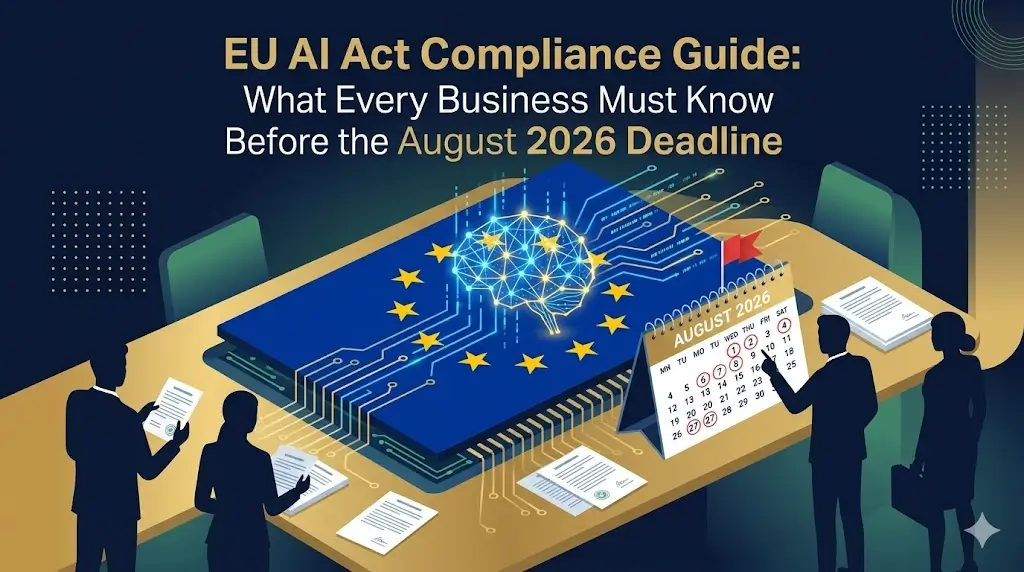
    EU AI Act Compliance Guide: What Every Business Must Know Before the August 2026 Deadline

    The countdown has begun. Businesses around the world now have fewer than five months to comply with the EU AI Act — the world’s first comprehensive, legally binding AI framework. The August 2026 deadline is fast approaching, and the stakes are higher than ever.

    Non-compliance carries serious financial consequences. Companies in violation face fines of up to €35 million or 7% of global annual turnover — whichever is greater. That penalty structure is even more severe than GDPR. Moreover, regulators are not waiting years to act.

    Yet many businesses remain underprepared. Some organizations still don’t know which risk category their AI systems fall into. Others assume the Act doesn’t apply to them because they operate outside Europe. Furthermore, some teams have started compliance programs but lack clarity on the seven specific technical requirements they must meet.

    “The EU AI Act is not just a European issue. Any company in the world that develops or deploys AI systems touching EU citizens must comply. The extraterritorial reach of this law is broader than most legal teams currently appreciate.”

    — Dr. Kilian Gross, Head of AI Policy, European Commission (2025)

    This guide is designed for business leaders, compliance officers, legal teams, CTOs, and product managers who need a clear, actionable roadmap. Whether your company builds AI products, deploys third-party AI tools, or simply uses AI in daily operations — this is everything you need to know.

    By the end of this article, you will understand the risk classification system, the seven core compliance requirements, industry-specific obligations, the real cost of non-compliance, and a practical 90-day action plan. You will also find answers to the most common questions teams are asking right now.

    Let’s start with the foundation.


    What Is the EU AI Act? The World’s First Comprehensive AI Law


    A Brief History and Why It Matters

    The European Union formally adopted the EU Artificial Intelligence Act in May 2024. The legislative process began in April 2021, when the European Commission published its initial proposal. On August 1, 2024, the Act entered into force — making the EU the first jurisdiction in the world to establish a legally binding AI framework across sectors.

    Importantly, this is not a voluntary code of conduct. It is hard law, backed by defined penalties and designated enforcement authorities. Think of the EU AI Act as the GDPR of artificial intelligence. Just as GDPR set a global baseline for data protection, the AI Act sets a global baseline for responsible AI development and deployment.

    The regulation takes a risk-based approach. Consequently, your compliance burden depends directly on how much potential harm your AI system could cause. Most AI use cases — entertainment recommendations, predictive maintenance tools, and content optimization software — face minimal obligations. However, AI systems that make consequential decisions about people face strict requirements.

    Who Does the EU AI Act Apply To?

    The Act applies to providers (organizations that develop or place AI systems on the market), deployers (organizations that use AI professionally), importers, and distributors operating within or serving the EU. Critically, your company’s location does not exempt you from these obligations.

    The extraterritorial scope is one of the most misunderstood features of the Act. If your company operates from the United States, United Kingdom, Singapore, or anywhere outside Europe, but your AI system affects individuals in EU member states, you must comply. This is the same jurisdictional logic that made GDPR a global compliance requirement.

    However, there are limited exceptions. AI developed solely for military purposes, pure scientific research, and personal non-professional use falls outside the Act’s scope. For any commercial AI deployment touching the EU, though, compliance is mandatory.

    The Complete EU AI Act Implementation Timeline

    The EU AI Act rolls out in phases. Understanding this timeline is essential for planning your compliance program. Missing an earlier deadline can compound your exposure as later deadlines arrive.

    Deadline What Takes Effect Who Is Primarily Affected
    August 1, 2024 EU AI Act enters into force. Awareness and preparation phase begins. All businesses with AI exposure in the EU
    February 2, 2025 Prohibited AI practices become illegal and enforceable. All providers and deployers globally
    August 2, 2025 GPAI model obligations, AI literacy requirements, and governance rules take effect. GPAI providers; all businesses using AI
    August 2, 2026 ⚠ High-risk AI systems (Annex III) must be fully compliant. All providers and deployers of Annex III high-risk AI
    August 2, 2027 High-risk AI embedded in regulated products (Annex I) must comply. Medical devices, machinery, vehicles with AI components

    The August 2, 2026 deadline affects the broadest range of businesses. AI systems in hiring, education, credit decisions, healthcare, and critical infrastructure must all achieve full compliance by this date. Five months is tight — but achievable if you start immediately.


    The Risk Classification System: Where Does Your AI System Fall?

    Before investing in compliance activities, every business must answer one foundational question: What risk tier does my AI system belong to? Your answer determines your compliance obligations, your timeline, and your penalty exposure. Therefore, getting this classification right is the single most important first step.


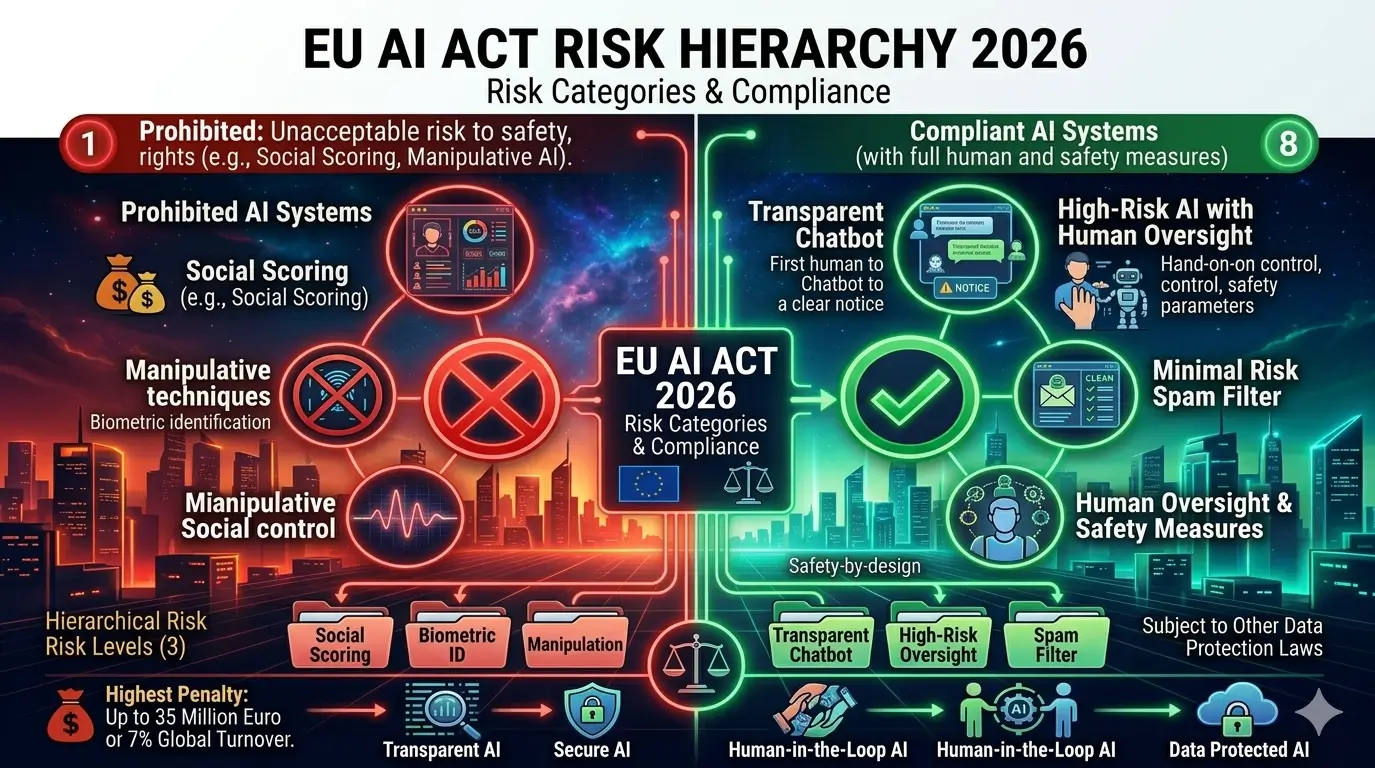
    Tier 1: Unacceptable Risk — AI Practices That Are Now Banned

    The highest tier covers AI applications the EU considers inherently unacceptable. These practices were banned as of February 2, 2025. If your organization uses any of the following, you must stop immediately.

    Specifically, prohibited practices include AI that manipulates people through subliminal techniques or exploits psychological vulnerabilities. Additionally, social scoring systems used by public authorities are banned outright. Real-time facial recognition in public spaces is also prohibited, with only narrow law enforcement exceptions under strict judicial oversight.

    Furthermore, predictive policing AI that profiles individuals based on protected characteristics is illegal. AI systems that scrape facial images from the internet to build recognition databases without consent are also banned. Violations carry the highest penalty: up to €35 million or 7% of global annual turnover.

    Tier 2: High-Risk AI — The Core of the August 2026 Deadline

    High-risk AI systems pose significant risks to health, safety, or fundamental rights. However, their benefits — when properly governed — outweigh those risks. Consequently, they are not banned. Instead, they face strict regulation. This tier represents the central compliance challenge for most businesses before August 2026.

    High-risk AI systems fall into two groups. First, Annex I covers AI embedded in products already regulated under EU safety law — such as medical devices, machinery, and automotive systems. Second, and more broadly, Annex III covers eight application sectors driving the August 2026 deadline:

    1. Biometric identification and categorization of natural persons
    2. Critical infrastructure management (electricity grids, water systems, traffic management)
    3. Education and vocational training (AI that determines access or evaluates students)
    4. Employment and workforce management (CV screening, performance monitoring, promotion decisions)
    5. Access to essential private and public services (credit scoring, insurance, social benefits)
    6. Law enforcement (risk assessment tools, polygraph-like technologies)
    7. Migration, asylum, and border management
    8. Administration of justice and democratic processes

    Importantly, not every AI system in these sectors automatically qualifies as high-risk. The Act targets AI that makes or influences consequential decisions about individuals. For example, a scheduling tool in a hospital is likely minimal risk. By contrast, an AI assisting in clinical diagnosis is almost certainly high-risk.

    Tier 3: Limited Risk — Transparency Is the Key Obligation

    Limited-risk AI systems face lighter requirements. The focus here is on transparency — ensuring users know when AI is involved in interactions or decisions affecting them.

    Specifically, chatbots and virtual assistants must disclose their AI nature to users. AI that generates synthetic content — including deepfakes — must clearly label that content as AI-generated. Moreover, emotion recognition systems used commercially must inform individuals when their emotions are being assessed. Many marketing, customer service, and content creation tools fall into this tier.

    Tier 4: Minimal Risk — The Majority of AI Use Cases

    Most AI systems in commercial use today fall here and face no mandatory compliance obligations. AI-powered spam filters, entertainment recommendations, inventory optimization tools, and predictive maintenance software all belong in this category. Additionally, most enterprise analytics AI features fall here as well.

    Voluntary adherence to EU codes of conduct is encouraged but not legally required. Therefore, if your AI clearly falls into this tier, you can focus resources on any systems that do carry compliance obligations.

    General Purpose AI (GPAI): The New Category for Foundation Models

    The EU AI Act introduces a distinct category for General Purpose AI models — systems trained on broad data that handle a wide range of tasks. This includes large language models (LLMs) and multimodal foundation models. GPAI obligations have been in effect since August 2025.

    All GPAI providers must produce technical documentation and comply with EU copyright law on training data. Additionally, providers of models with systemic risk — defined as those trained using more than 10²⁵ FLOPs — face further obligations. These include mandatory adversarial testing (red-teaming), real-time incident reporting to the European AI Office, and energy consumption reporting.

    Risk Tier Common Examples Primary Obligations Max Penalty
    Unacceptable Social scoring, real-time biometrics in public, subliminal manipulation Complete prohibition — stop immediately €35M / 7% global turnover
    High Risk CV screening AI, credit scoring, medical diagnostic AI, student assessment tools Full 7-requirement framework, conformity assessment, CE marking, EU database registration €15M / 3% global turnover
    Limited Risk AI chatbots, deepfake generators, emotion recognition in marketing Transparency and disclosure obligations €7.5M / 1.5% global turnover
    Minimal Risk Spam filters, recommendation engines, process automation AI Voluntary codes of conduct No mandatory penalty
    GPAI (Systemic Risk) Large language models (GPT-class, Gemini-class), multimodal foundation models Technical documentation, red-teaming, incident reporting, copyright compliance €15M / 3% global turnover


    The 7 Core Compliance Requirements for High-Risk AI Systems

    If your AI system qualifies as high-risk under Annex III, you must satisfy seven distinct compliance requirements before August 2, 2026. Each requirement demands genuine organizational investment — in documentation, process design, technical testing, and governance. There is no shortcut. Here is what each requirement means in practice.


    Requirement 1: Risk Management System

    Every high-risk AI system must operate under a documented, continuous risk management process. This process covers the entire lifecycle — from initial development through active deployment, ongoing monitoring, and eventual decommissioning. Importantly, this is not a one-time compliance event. You must update it whenever the AI system changes or new risks emerge.

    In practice, your risk management system must identify and catalogue all known and foreseeable risks, estimate their likelihood and severity, document mitigation measures, and track residual risks in real-world conditions. Consequently, you will need a formal AI Risk Register with named accountability for risk ownership and a quarterly review schedule for active systems.

    Additionally, your risk assessment must specifically address vulnerable groups. If children, people with disabilities, or minority communities may disproportionately interact with your AI system, you need explicit risk assessments for those populations.

    Requirement 2: Data Governance and Data Quality

    Your training, validation, and testing data must meet rigorous quality standards. Specifically, your data governance practices must address the origin and provenance of all data sources, potential biases in training data, and whether the data suits the intended deployment context.

    In concrete terms, you must document where your training data came from, how you collected it, and what preprocessing you applied. Furthermore, you must show how representative the data is of the real-world population your AI will serve.

    Bias assessments are a requirement, not an optional best practice. You must test whether your model performs differently across gender, age, ethnicity, nationality, and other protected characteristics. Tools such as Weights & Biases, MLflow, or DVC support this process and align well with EU AI Act data governance requirements.

    Requirement 3: Technical Documentation

    Before placing a high-risk AI system on the EU market, you must prepare comprehensive technical documentation in line with Annex IV of the Act. Think of this as your AI system’s complete regulatory dossier — the record an enforcement authority could request at any time.

    Required elements include a full system description and intended purpose, design specifications and architecture, training methodology and datasets, validation and testing results across demographic groups, monitoring and logging procedures, cybersecurity measures, and deployer instructions for use.

    Treat this as a living document, not a static report. Every significant model update — fine-tuning, dataset changes, architectural revisions — requires updating the documentation. Many compliance teams manage these as versioned records in platforms like Confluence or dedicated GRC tools, linked directly to deployment pipelines.

    Requirement 4: Record-Keeping and Automatic Logging

    High-risk AI systems must automatically log events and operational data throughout their lifetime. These logs must support post-hoc auditing — especially in the event of an incident, a regulatory investigation, or a legal dispute.

    At minimum, logs must capture the time of each operation, the input data or a secure identifier, the system’s output, and the identity of human operators who reviewed or acted on results. Log retention periods typically align with the system’s operational lifespan. For high-risk applications with long-term consequences, a minimum of 10 years is generally expected.

    Requirement 5: Transparency and Information for Deployers

    As a provider of a high-risk AI system, you must supply deployers with clear instructions for use. These instructions must specifically address the system’s intended purpose and scope, known performance limitations and error rates, demographic subgroups where accuracy may vary, and circumstances in which users should not rely on the system.

    Additionally, instructions must enable deployers to meet their own human oversight obligations and guide them in monitoring for unexpected behavior. This requirement creates a supply chain of accountability. As a deployer, you bear responsibility for using AI within its documented purpose.

    Therefore, if a provider has not given you adequate instructions, formally request them and document that request. Regulators assess deployer compliance partly on whether you had sufficient information — and whether you acted on it.

    Requirement 6: Human Oversight Measures

    This requirement carries the most significant operational implications. High-risk AI systems must enable effective, meaningful human oversight. Humans must understand what the system does, monitor it in real time, intervene and override outputs, and consciously decide not to act on AI results in specific cases.

    In practice, consequential decisions — hiring, credit approvals, medical diagnoses, educational assessments — cannot be fully automated when driven by high-risk AI. You must design a documented human review step with real decision-making authority. “Human in the loop” must be genuinely meaningful, not a rubber stamp.

    This has direct product design implications. Systems that route high-stakes decisions through AI without a human review point need redesigning before August 2026. The investment is real. However, the cost of regulatory action for eliminating meaningful human oversight is significantly higher.

    Requirement 7: Accuracy, Robustness, and Cybersecurity

    High-risk AI systems must achieve appropriate accuracy for their intended purpose, demonstrate robustness against adversarial manipulation, and maintain strong cybersecurity throughout their lifecycle. You must document, test, and actively maintain all three properties.

    Specifically, accuracy metrics must appear in technical documentation alongside honest acknowledgment of their limitations. Robustness testing means deliberately feeding the system manipulated inputs to verify it resists incorrect outputs. Furthermore, cybersecurity measures must address AI-specific attack vectors: data poisoning, model evasion, and model extraction.

    “The combination of accuracy benchmarks, adversarial robustness testing, and cybersecurity requirements means that EU AI Act compliance is not just a legal exercise — it is a rigorous engineering quality standard.”

    — European AI Office Technical Guidance, 2025


    Industry-Specific Compliance: What Your Sector Must Do Before August 2026

    The EU AI Act applies consistently across sectors. However, the practical compliance path looks very different depending on your industry. Regulatory overlaps, existing frameworks, and sector-specific risk profiles all shape what “compliant” means in practice. Here is what each major sector needs to prioritize.


    Healthcare and MedTech: The Dual Compliance Challenge

    AI systems in clinical contexts — diagnostic imaging algorithms, clinical decision support tools, drug interaction checkers, and patient risk stratification systems — almost universally qualify as high-risk. Moreover, many also fall under the EU Medical Device Regulation (MDR) or In Vitro Diagnostic Regulation (IVDR), creating a dual compliance obligation.

    Fortunately, the EU AI Act deliberately aligns with these frameworks. AI systems that already passed conformity assessment under MDR or IVDR satisfy several AI Act requirements automatically. However, meaningful gaps remain. Specifically, the AI Act adds data governance documentation requirements and expanded human oversight provisions not covered by MDR or IVDR.

    As a priority action, map every AI clinical tool against both frameworks. Then identify the gap between MDR/IVDR compliance and AI Act requirements. Finally, close those gaps — particularly on training data bias documentation and human override protocol design.

    HR Technology and Recruitment: The Highest-Scrutiny Sector

    AI used in employment decisions is explicitly listed as high-risk in Annex III. This covers CV screening, interview analysis, performance monitoring, promotion recommendations, and termination risk scoring. Additionally, enforcement authorities in Germany, France, and the Netherlands have indicated HR AI will be among the first sectors targeted post-August 2026.

    Case Study: Early Compliance as a Competitive Advantage

    A European HR-Tech SaaS Company (Illustrative Scenario)

    A 150-person HR technology company serving enterprise clients across Germany, France, and the Netherlands recognized in mid-2025 that their AI-powered performance review tool qualified as high-risk under Annex III. Rather than waiting, they launched a structured compliance initiative in Q3 2025.

    The program took eight months and cost approximately €180,000 in legal, technical, and consultancy resources. As a result, they achieved full compliance certification by March 2026. Consequently, two major enterprise clients that had paused contract renewals signed 3-year agreements within weeks of receiving the compliance certificate.

    Key takeaway: For B2B AI companies, early compliance generates revenue — it is not just a cost center. Enterprise procurement teams now require EU AI Act compliance documentation as a vendor selection condition.

    If you provide HR AI tools, your enterprise clients will increasingly require compliance certificates as a contract prerequisite. Therefore, building your program now protects existing revenue while creating a competitive differentiator in sales cycles.

    Fintech and Banking: Navigating Overlapping Regulatory Frameworks

    Credit scoring AI, loan processing tools, fraud detection models, and anti-money laundering systems all qualify as high-risk. Furthermore, the compliance picture for fintech is complex because of regulatory overlap with DORA (Digital Operational Resilience Act), the Capital Requirements Regulation, and EBA model risk guidelines.

    Financial institutions with mature model governance frameworks have a significant head start. The frameworks share conceptual overlap: both EBA guidelines and the EU AI Act emphasize documentation, validation, bias testing, and independent review. However, the requirements are not identical. A structured gap analysis is essential before assuming your existing framework satisfies AI Act obligations.

    EdTech and Educational Institutions

    AI systems that determine access to educational programs, assess or grade students, monitor student behavior, or make progression decisions are all high-risk. Consequently, EdTech companies and universities serving EU institutions must act now.

    Specifically, the most critical requirement in education is meaningful transparency. Students must understand when AI influences their assessment outcomes. Furthermore, they must have a genuine right to human review of any AI-generated decision affecting their educational path.

    Therefore, any student-facing AI that generates grades or progression recommendations without a documented human review step represents a clear compliance gap you must close before August 2026.

    SaaS Providers and B2B AI Tools: Understanding the Provider vs. Deployer Divide

    The EU AI Act draws a clear legal line between providers and deployers. As a SaaS provider building AI into your platform, you carry provider obligations: technical documentation, conformity assessment, and instructions for use to your customers. Your customers — the deployers — carry their own obligations: using the AI within its documented purpose and maintaining human oversight.

    However, there is an important nuance. If your deployer customers use your AI tools in a high-risk context you did not design for, high-risk obligations can still apply. For example, if a healthcare company uses your general-purpose document analysis AI for clinical documentation, the deployer may trigger high-risk obligations. Both parties share responsibility in that scenario.

    As a result, contractual clarity about permitted and prohibited use cases is essential. Review and update your vendor agreements to define the provider-deployer responsibility split explicitly before August 2026.


    Penalties and Enforcement: The Real Cost of Non-Compliance

    Building an internal business case for compliance investment requires quantifying the risk of inaction. Consequently, this section covers not only the financial penalty structure but also the broader consequences that penalty tables alone do not capture.

    The Three-Tier Penalty Structure

    Violation Category Maximum Fine Illustrative Scenarios
    Prohibited AI practices €35 million OR 7% of global annual turnover Deploying real-time biometric surveillance; using social scoring AI; running manipulative AI targeting psychological vulnerabilities
    High-risk AI non-compliance €15 million OR 3% of global annual turnover Missing technical documentation; no conformity assessment; absent human oversight; non-registration in EU AI database
    Incorrect or misleading information €7.5 million OR 1.5% of global annual turnover Providing false compliance documentation to notified bodies or market surveillance authorities

    For all company sizes, the percentage-of-turnover calculation makes penalties scale with commercial impact. For instance, a startup with €8 million in annual revenue faces a maximum of €560,000 for a Tier 1 violation. By contrast, an enterprise with €2 billion in global revenue faces up to €140 million for the same violation. Therefore, large organizations with significant EU exposure face the most acute urgency.

    How Enforcement Works: National and EU-Level Authorities

    Enforcement operates at two levels. The European AI Office, within the European Commission, oversees GPAI model compliance and coordinates cross-border enforcement. Additionally, each EU member state must designate one or more National Competent Authorities (NCAs) for market surveillance within their territory.

    Several NCAs are already operational. Germany designated the Federal Network Agency (Bundesnetzagentur) as its primary AI authority. France’s CNIL expanded its mandate to cover AI regulation. Spain established AESIA in 2024 — the EU’s first dedicated AI regulator. As a result, enforcement capacity across the EU is growing significantly ahead of the August 2026 deadline.

    Enforcement priorities in the initial post-deadline period focus on the highest-impact sectors first: HR AI, credit scoring systems, and healthcare AI. These sectors touch the most EU citizens, so regulators will pursue them before others.

    Beyond Fines: The Hidden Costs That Matter Most

    Financial penalties are only part of the non-compliance risk. Several additional consequences can prove more operationally damaging than the fines themselves.

    Market withdrawal orders represent the most severe operational outcome. Regulators can require a non-compliant AI system to leave the EU market entirely, stopping EU-derived revenue with immediate effect. For software businesses with 20–40% EU revenue, this outcome could be existential.

    Furthermore, commercial procurement barriers are already materializing before August 2026. Enterprise procurement teams in banking, insurance, healthcare, and government now include EU AI Act compliance in RFP processes and vendor due diligence checklists. Being identified as non-compliant creates commercial headwinds that far outlast any regulatory action.

    Moreover, civil liability adds a third dimension. The AI Liability Directive — a companion regulation under finalization — creates clearer legal pathways for individuals harmed by non-compliant AI to seek civil compensation. This creates tort litigation exposure entirely separate from regulatory fines, and potentially far more costly for systems that caused widespread harm.


    Your 90-Day EU AI Act Compliance Action Plan

    If your organization has not yet launched a structured EU AI Act compliance program, start today. An imperfect program launched now is categorically more valuable — legally and commercially — than a perfect one that begins after the deadline. Here is a practical three-phase sprint to get your business into a defensible compliance position.


    Phase 1 (Days 1–30): AI Inventory and Risk Classification

    You cannot comply with obligations you have not mapped. Therefore, your first 30 days must focus entirely on building a complete, accurate picture of your AI landscape. This inventory is the foundation of everything else — rushing it creates compounding problems downstream.

    First, assemble a cross-functional AI Inventory Team. Include Legal, Engineering, Product, HR, Finance, and Business Operations. Then systematically catalogue every AI system your organization develops, deploys, licenses from a third party, or uses operationally.

    For each system, answer these key questions: What decisions does it influence? Who does it affect? Does it fall into any Annex III category? Does it touch EU citizens? Where classification is genuinely uncertain, default to the higher tier. Regulators treat good-faith over-classification far more sympathetically than deliberate under-classification.

    ✓ Phase 1 Compliance Checklist (Days 1–30)

    • Complete AI systems inventory across all departments and business units
    • Document the purpose, data inputs, decision outputs, and affected users of each system
    • Classify every system: Unacceptable / High-Risk / Limited / Minimal / GPAI
    • Identify EU market exposure — which systems affect EU citizens or EU-based deployers
    • Flag any prohibited AI practices for immediate remediation action
    • Prioritize high-risk systems for the compliance program based on impact and timeline
    • Appoint a named AI Compliance Lead or establish an AI Governance Committee
    • Brief senior leadership on scope and resource requirements

    Phase 2 (Days 31–60): Documentation, Governance, and Gap Analysis

    With your inventory and classification complete, Phase 2 focuses on building compliance infrastructure. This includes technical documentation, governance structures, data quality assessments, and a systematic gap analysis against each of the seven high-risk requirements. Expect this phase to demand significant time from Engineering, Legal, and Product leadership simultaneously.

    For each high-risk AI system, begin drafting the Annex IV technical documentation. In parallel, conduct a structured gap analysis. For each of the seven requirements, honestly assess your current state and the gap to full compliance. Document this formally — it becomes both your roadmap and evidence of good-faith effort if regulators audit you.

    Additionally, commission a data governance review for each high-risk system’s training data. Review provenance, document quality issues, and initiate bias assessment across protected demographic characteristics. If significant bias issues emerge, address them now — before conformity assessment. Attempting to pass a conformity assessment with known unaddressed bias is both a regulatory risk and an ethical failure.

    Finally, engage external EU AI Act legal counsel to review your gap analysis and advise on your conformity assessment pathway. Determine whether your systems qualify for self-assessment or require a notified body.

    ✓ Phase 2 Compliance Checklist (Days 31–60)

    • Draft Annex IV technical documentation for each high-risk system
    • Complete formal gap analysis against all 7 compliance requirements
    • Initiate training data provenance review and bias assessment
    • Establish data lineage documentation for all high-risk AI training datasets
    • Draft AI Risk Management System documentation
    • Design and document human oversight protocols for each high-risk workflow
    • Engage qualified external EU AI Act legal / compliance advisor
    • Determine conformity assessment pathway: self-assessment vs. notified body
    • Review and update AI-related vendor contracts for deployer/provider clarity
    • Begin ISO/IEC 42001 AI Management System alignment if pursuing certification

    Phase 3 (Days 61–90): Testing, Conformity Assessment, and Registration

    The final phase moves from documentation to validation. Here you test systems against the Act’s technical requirements, complete conformity assessment, and finish regulatory registration. This phase also includes the internal training that makes compliance sustainable after the deadline.

    Start by executing comprehensive technical testing. Specifically, run accuracy benchmarking across demographic subgroups, robustness testing against adversarial inputs, and cybersecurity vulnerability assessment. Document all results — these form part of your Annex IV dossier. Remediate any failures before proceeding to conformity assessment.

    Next, complete your conformity assessment. For most Annex III systems, self-assessment is permitted — you assess compliance internally and sign a Declaration of Conformity. However, AI embedded in Annex I regulated products may require third-party assessment by an accredited notified body. Apply CE marking where applicable and register your system in the EU AI database.

    Finally, train your operational teams. The compliance program only succeeds if deployers and monitors understand their obligations — how to exercise meaningful oversight, what constitutes a reportable incident, and how to document unusual behavior. Ongoing compliance is a process, not a one-time event.

    ✓ Phase 3 Compliance Checklist (Days 61–90)

    • Complete accuracy, robustness, and cybersecurity technical testing
    • Document all test results and any remediation actions taken
    • Complete conformity assessment (self-assessment or notified body)
    • Sign EU Declaration of Conformity for each compliant high-risk system
    • Apply CE marking where applicable to products
    • Register high-risk AI systems in the EU AI database (where required)
    • Deploy logging and automated monitoring infrastructure
    • Train operational and deployment teams on human oversight requirements
    • Establish ongoing compliance review schedule (quarterly recommended)
    • Communicate compliance status formally to key customers and partners
    • Set up incident reporting process to the relevant National Competent Authority


    Frequently Asked Questions About EU AI Act Compliance

    These are the questions compliance teams, business leaders, and legal departments most commonly ask. Each answer is written to be directly actionable and structured to appear prominently in Google’s People Also Ask and featured snippet results.

    Does the EU AI Act apply to companies outside the European Union?

    Yes — the EU AI Act has broad extraterritorial scope. Any company, regardless of where it operates, must comply if its AI systems are used by people in EU member states. This applies to businesses based in the United States, United Kingdom, Canada, Japan, and every other non-EU country.

    Specifically, if you have EU customers — business or consumer — who interact with or are affected by your AI systems, you are in scope. The jurisdictional principle is identical to GDPR: access to the European market requires compliance with European law.

    What is the penalty for not complying with the EU AI Act?

    Penalties follow a three-tier structure based on violation severity. First, deploying prohibited AI systems results in fines up to €35 million or 7% of global annual turnover, whichever is higher. Second, non-compliance with high-risk AI requirements — such as missing documentation or absent human oversight — carries fines up to €15 million or 3% of global annual turnover.

    Third, providing incorrect or misleading information to regulatory authorities is subject to fines up to €7.5 million or 1.5% of global annual turnover. Furthermore, beyond financial penalties, regulators can order the complete withdrawal of non-compliant AI systems from the EU market.

    What exactly does the August 2026 deadline require businesses to do?

    By August 2, 2026, all providers and deployers of high-risk AI systems listed in Annex III must achieve full compliance. Specifically, this means completing your risk management system and documenting it, finalizing all Annex IV technical documentation, and completing conformity assessment with a signed Declaration of Conformity.

    Additionally, you must register your system in the EU AI database where required, apply CE marking where applicable, and deploy logging and monitoring capabilities. Human oversight protocols must be in place, and your staff must be trained on them. Systems that enter the EU market after August 2, 2026 without meeting these requirements are non-compliant from day one.

    What is the difference between the EU AI Act and GDPR?

    GDPR and the EU AI Act are distinct but complementary regulations. GDPR governs the collection, processing, storage, and protection of personal data. The EU AI Act governs the development, deployment, and operation of AI systems. Both frequently apply to the same product simultaneously.

    The EU AI Act does not replace GDPR. Rather, it adds AI-specific obligations on top of the existing data protection framework. Consequently, companies should treat both as overlapping compliance domains requiring separate but coordinated programs.

    Do startups and small businesses need to comply with the EU AI Act?

    Yes — but the Act includes specific support measures for smaller businesses. Micro-enterprises (fewer than 10 employees, under €2 million turnover) and small enterprises (fewer than 50 employees, under €10 million turnover) benefit from simplified conformity assessment procedures. Additionally, EU member states must provide regulatory sandboxes to help SMEs test compliance approaches.

    However, the substantive requirements — risk management, technical documentation, human oversight, and conformity assessment — apply in full regardless of company size. Being small provides procedural accommodations for meeting the obligations. It does not exempt you from them.

    Is my company required to register AI systems with the EU AI database?

    Providers of high-risk AI systems listed in Annex III must register before placing systems on the EU market. Registration requires submitting the system’s identifying information, a summary of its intended purpose, the conformity assessment procedure completed, and contact information for the provider or authorized EU representative.

    Importantly, the EU AI database is publicly accessible for most registrations. As a result, competitors, customers, and the general public can verify whether your system is registered and compliant. Deployers of high-risk AI in sensitive public-sector contexts also carry their own registration obligations, separate from those of providers.


    Conclusion: The Businesses That Act Now Will Lead — The Rest Will Scramble

    Five Priorities You Must Act On Today

    The EU AI Act is the most consequential technology regulation since GDPR. Its August 2026 deadline is a hard legal line, not a soft target. Consequently, businesses that move now will be far better positioned than those still waiting.

    First, conduct your AI inventory and risk classification — you cannot address obligations you have not mapped. Second, immediately stop any AI practices that fall into the prohibited category, since every additional day of use compounds your legal exposure. Third, for every high-risk AI system, launch your compliance program against the seven requirements now.

    Additionally, review your AI vendor relationships to ensure your deployer-provider responsibility split is contractually clear. Finally, assign formal ownership of AI compliance to a named leader in your organization. This cannot be treated as a background IT project.

    Compliance as a Competitive Advantage

    The EU AI Act is genuinely complex. However, it is also structured, specific, and navigable. The compliance path is clear for any business that engages with it seriously.

    Furthermore, organizations that achieve compliance before August 2026 do not simply avoid penalties. They become the AI partners that regulated industry customers trust, that sophisticated enterprise buyers prefer, and that regulators cite as the standard others should meet. As a result, early compliance is not just a legal obligation — it is a strategic investment.

    Your compliance journey begins with a single step: open a spreadsheet and start your AI inventory today.

    Start Your EU AI Act Compliance Journey Today

    Download our free 50-point EU AI Act Compliance Checklist — a practical audit tool covering all seven requirements for high-risk AI systems, built for compliance teams, CTOs, and legal departments.
    Get the Free Checklist →

  • EU AI Act Explained: Risk Categories, Prohibited AI & What’s Changing in 2026

    EU AI Act Explained: Risk Categories, Prohibited AI & What’s Changing in 2026

    EU AI Act Explained: Risk Categories, Prohibited AI & What’s Changing in 2026

    The European Union’s Artificial Intelligence Act represents the world’s first comprehensive legal framework governing artificial intelligence. With enforcement deadlines rapidly approaching, organizations must understand how this groundbreaking regulation affects their AI operations. This guide breaks down the EU AI Act’s risk categories, prohibited practices, and critical 2026 compliance requirements.

    Understanding the EU AI Act: A Regulatory Game-Changer

    The EU AI Act, formally known as the Artificial Intelligence Act (AIA), is groundbreaking legislation that establishes a risk-based framework for artificial intelligence systems. Adopted in December 2023 and beginning enforcement in February 2025, this regulation represents Europe’s bold move to balance innovation with consumer protection and fundamental rights.

    Unlike traditional regulatory approaches that apply uniform rules, the EU AI Act employs a tiered risk classification system. This means your compliance obligations depend entirely on your AI system’s risk level. A recommendation algorithm faces different requirements than an AI system making decisions about loan approvals or criminal risk assessment.

    💡 Key Insight: The EU AI Act applies extraterritorially. If your AI system operates in or affects the EU market—even if you’re based in the United States, Asia, or elsewhere—you must comply. This makes it the world’s de facto AI regulation standard.

    Why This Matters for Your Organization

    The EU represents approximately 15% of global GDP and 450 million people. Organizations ignoring EU AI compliance face maximum penalties reaching €35 million or 7% of global annual revenue. Beyond financial penalties, non-compliance creates reputational damage, market access restrictions, and operational disruptions.

    The regulation fundamentally shifts responsibility from regulators to organizations. Companies deploying AI systems must conduct impact assessments, implement safeguards, document decisions, and maintain human oversight mechanisms. This represents a significant operational change affecting product development, deployment, and ongoing monitoring processes. Official EU AI Act text

    EU AI Act implementation timeline 2023-2027 with key compliance deadlines

    The Four Risk Categories: A Complete Breakdown

    The EU AI Act’s most innovative feature is its risk-based classification system. Rather than regulating all AI equally, the regulation creates four categories based on potential harm to fundamental rights, safety, and democratic processes. Understanding where your AI system falls within this framework is essential for compliance planning.

    1. Unacceptable Risk (Prohibited Tier)

    This highest risk category contains AI systems so dangerous or rights-violating that they are banned outright. Organizations cannot legally deploy these systems in the EU market under any circumstances. No licensing, approval, or exemption exists for unacceptable risk AI systems.

    Unacceptable risk systems include those that manipulate human behavior through subliminal techniques, those that exploit vulnerabilities in specific populations, and those that fundamentally contradict EU values regarding human dignity, freedom, and equality. The regulation recognizes certain applications as incompatible with democratic societies.

    ⚠️ Critical Warning: Unacceptable risk violations carry the harshest penalties: up to €35 million or 7% of global annual revenue. These are treated like fraud or corruption—with criminal-level consequences.

    2. High-Risk AI Systems

    High-risk systems represent the most heavily regulated category of permitted AI. These systems can legally operate in the EU, but organizations must implement comprehensive safeguards, conduct detailed compliance assessments, and maintain ongoing monitoring. High-risk classification applies to AI systems that significantly impact fundamental rights or public safety.

    High-risk applications include: AI used in hiring decisions, credit scoring, immigration processing, law enforcement, educational assessment, and autonomous vehicle decision-making. These systems affect consequential outcomes in people’s lives, justifying intensive regulatory oversight.

    High-Risk Requirements Before Deployment:

    • Complete impact assessment documenting rights risks and mitigation strategies
    • Technical documentation including training data, testing protocols, and safety measures
    • Data governance policies ensuring high-quality, bias-free training data
    • Human oversight mechanisms ensuring human review of AI decisions
    • Transparency documentation and labeling requirements
    • Conformity assessment by qualified third parties (notified bodies)
    • EU database registration before market deployment
    High-Risk AI Examples Key Compliance Requirement Oversight Mechanism
    Recruitment AI systems Non-discrimination testing Human review of decisions
    Credit scoring/lending Financial impact assessment Appeal process for decisions
    Law enforcement facial recognition Accuracy benchmarking Judicial oversight required
    Immigration processing Fundamental rights impact assessment Human final decision authority
    Educational grading systems Bias testing across demographics Teacher review and override

    3. Limited Risk AI Systems

    Limited risk systems interact directly with users but don’t significantly threaten fundamental rights. These systems face minimal substantive requirements but must meet transparency standards. Users interacting with limited-risk AI must know they’re engaging with an AI system rather than a human.

    Examples include chatbots, deepfake detection systems, content recommendation algorithms, and interactive AI assistants. The core requirement is disclosure: users must understand they’re interacting with AI, enabling informed decision-making about information reliability and appropriateness.

    Limited Risk Requirements:

    • Clear disclosure that users are interacting with an AI system
    • Transparency about system capabilities and limitations
    • Information about how the AI makes decisions
    • User controls to decline AI-generated content (for deepfakes)

    4. Minimal/No Risk AI Systems

    The vast majority of AI systems deployed today fall into this lowest-risk category. Minimal-risk AI includes spam filters, recommendation engines in video games, basic chatbots for customer service, and predictive analytics for internal business operations. These systems face virtually no regulatory requirements.

    Organizations deploying minimal-risk AI can proceed without compliance assessments, documentation, or third-party review. However, the regulation encourages voluntary adoption of best practices including human oversight, fairness testing, and ethical guidelines. This soft-touch approach recognizes that most AI applications pose minimal societal risk.

    ✅ Best Practice: Even for minimal-risk systems, organizations should adopt voluntary governance practices. This demonstrates regulatory commitment, builds consumer trust, and simplifies future compliance audits.

    EU AI Act four risk categories pyramid from unacceptable to minimal risk

    Eight Prohibited AI Practices: What’s Banned

    The EU AI Act’s prohibited practices section represents perhaps the most important and immediately enforceable component. Beginning February 2, 2025, eight specific AI applications became illegal in the EU, with no exemptions or conditional approvals available. Organizations deploying these systems face immediate legal and financial consequences.

    Comprehensive List of Eight Prohibited Practices

    1. Government Social Credit Scoring Systems

    AI systems used by public authorities to assess or rank citizens’ social behavior, trustworthiness, or compliance are prohibited. These systems threaten fundamental freedom and dignity. While private sector credit scoring based on financial metrics remains legal, government-operated social monitoring systems are banned completely.

    2. Subliminal Manipulation Techniques

    AI systems designed to manipulate human behavior by operating below conscious awareness are banned. This includes systems using psychological techniques, emotional triggers, or persuasion methods that circumvent rational decision-making. The prohibition recognizes that manipulation through hidden techniques undermines human autonomy and informed consent.

    3. Untargeted Facial Image Scraping

    Indiscriminate collection of facial images from public sources (internet, CCTV footage) to create biometric databases is prohibited. Law enforcement and targeted applications may scrape faces under strict conditions, but mass, untargeted biometric collection violates privacy and data protection principles.

    4. Emotion Recognition in Workplace and Education

    AI systems designed to recognize and categorize emotions of employees or students are banned. These systems infringe on psychological privacy and could enable exploitative or discriminatory workplace practices. The regulation recognizes emotion recognition as uniquely invasive technology lacking sufficient scientific validation.

    5. Biometric Categorization Based on Sensitive Attributes

    Using biometric data (facial features, gait, voice) to infer sensitive characteristics like race, ethnicity, gender, age, or political beliefs is prohibited. While biometric authentication remains legal, inferring personal characteristics from biometric data violates fundamental rights and dignity protections.

    6. Manipulative Emotional Targeting of Vulnerable Populations

    AI systems designed to emotionally manipulate children, elderly people, people with disabilities, or socially disadvantaged individuals are banned. This prohibition recognizes that certain populations require additional protection from AI-enabled exploitation and manipulation techniques.

    7. Unreliable AI Evidence Evaluation Systems

    Using AI systems to evaluate the reliability of evidence in legal proceedings without human oversight is prohibited. AI cannot autonomously determine evidence reliability; human judges must assess all evidence evaluation, even when AI provides analytical support.

    8. Voice Assistants in Toys Enabling Manipulation

    Toys equipped with voice assistants designed to manipulate child behavior are banned. While educational toys with AI remain permitted, systems specifically engineered to encourage spending, bypass parental controls, or manipulate children’s decision-making violate child protection principles.

    Prohibited Practice Enforcement Date Severity Level Penalty Range
    Government social scoring February 2, 2025 Critical €5-35 million
    Subliminal manipulation February 2, 2025 Critical €5-35 million
    Untargeted facial scraping February 2, 2025 Critical €5-35 million
    Workplace emotion recognition February 2, 2025 Critical €5-35 million
    Biometric categorization February 2, 2025 Critical €5-35 million
    Vulnerable population manipulation February 2, 2025 Critical €5-35 million
    Unreliable evidence evaluation February 2, 2025 Critical €5-35 million
    Manipulative toy voice assistants February 2, 2025 Critical €5-35 million
    💡 Compliance Insight: If you deployed any of these eight practices before February 2025, you must immediately cease deployment and remove systems from the EU market. Continued operation after the enforcement date constitutes an ongoing violation with compounding penalties.

    2026 Compliance Timeline: Critical Deadlines Approaching

    The EU AI Act’s phased implementation creates a crucial deadline in August 2026. While prohibited practices became enforceable February 2025 and general-purpose AI rules took effect August 2025, the most significant compliance obligation—high-risk AI system requirements—takes effect August 2, 2026. Organizations must complete substantial preparations in the next months.

    Complete Timeline of Key Dates

    Already Passed: Prohibited Practices Enforcement (February 2, 2025)

    The eight prohibited AI practices became immediately enforceable. Organizations that deployed these systems must cease operations and remove systems from EU markets without delay. This phase required no preparation time but demands immediate remediation for violating organizations.

    General-Purpose AI Rules (August 2, 2025)

    Requirements for foundation models and large language models became effective. Organizations deploying general-purpose AI systems must now provide technical documentation, maintain usage logs, and implement safety measures. This includes transparency about training data sources and capabilities/limitations disclosure.

    🔴 CRITICAL: High-Risk AI System Deadline (August 2, 2026)

    This is the primary compliance deadline requiring substantial preparation. All high-risk AI systems must meet rigorous requirements by this date. Organizations cannot request extensions or exemptions. Deployment without compliance triggers maximum penalties.

    High-Risk Requirements Becoming Mandatory August 2, 2026:
    • Impact Assessment: Documented evaluation of fundamental rights risks and mitigation strategies
    • Data Governance: Quality assurance for training and testing data ensuring representativeness and non-discrimination
    • Technical Documentation: Detailed specifications of system architecture, decision logic, and performance benchmarks
    • Human Oversight Mechanisms: Processes ensuring human review of AI decisions before deployment
    • Performance Monitoring: Ongoing testing for accuracy, reliability, and absence of discriminatory bias
    • Transparency Measures: Clear communication to users about AI system capabilities and limitations
    • Conformity Assessment: Third-party review and certification by notified bodies
    • EU Database Registration: Listing of all high-risk systems in the official EU AI system registry
    • CE Marking: Compliance certification applied to high-risk systems
    ⚠️ Timeline Warning: August 2026 is only 17 months away. Organizations with high-risk AI systems should begin compliance assessments immediately. Delays in starting the process significantly increase risks of missing the deadline and facing non-compliance penalties. European Commission AI Guidance

    Product-Integrated AI (August 2, 2027)

    High-risk AI integrated into regulated products (medical devices, machinery, aviation equipment) must comply by August 2027. This later deadline recognizes that product-integrated AI requires regulatory coordination with existing product safety frameworks.

    Creating Your Compliance Timeline

    Organizations should work backward from August 2, 2026. Allocate time for: conducting risk assessments (4-8 weeks), documentation preparation (6-10 weeks), impact assessment development (8-12 weeks), notified body selection and engagement (2-4 weeks), and conformity assessment completion (4-8 weeks). This totals 24-42 weeks of preparation time.

    EU AI Act compliance timeline Gantt chart showing 17-month preparation through August 2026 deadline

    Penalties for Non-Compliance: Understanding Financial and Legal Consequences

    The EU AI Act enforces compliance through an escalating penalty structure that increases with violation severity. Understanding potential consequences helps organizations prioritize compliance efforts and assess compliance costs against penalty risks.

    Penalty Structure by Violation Type

    Tier 1: Prohibited AI Practice Violations

    Deploying any of the eight prohibited AI practices triggers penalties of up to €5 million or 1% of global annual revenue, whichever is higher. These are treated as fundamental violations reflecting core values incompatibility.

    Example: A European financial services company deploys an AI emotion recognition system in its call centers starting March 2025. The company faces €5 million minimum penalties regardless of profitability or company size.

    Tier 2: High-Risk System Non-Compliance

    Organizations failing to implement required safeguards for high-risk AI systems face penalties up to €15 million or 3% of global annual revenue. This applies to systems deployed without proper impact assessments, human oversight, or third-party conformity assessment.

    Example: A recruitment firm deploys an AI hiring system August 2026 without bias testing or human oversight. The firm faces penalties up to €15 million or 3% of revenue, whichever is greater.

    Tier 3: Maximum Penalties

    The most severe violations—including systematic violations, deliberate circumvention of requirements, or repeated violations—trigger penalties up to €35 million or 7% of global annual revenue, whichever is greater. These penalties treat AI regulation violations at corporate fraud severity levels.

    Example: A multinational technology company knowingly deploys prohibited emotion recognition systems across multiple EU member states over an 18-month period. The company faces €35 million penalties or 7% of revenue, plus remediation costs and reputational damage.

    Additional Consequences Beyond Financial Penalties

    • Market Access Restrictions: EU authorities can ban organizations from deploying AI systems in the EU until compliance is achieved
    • Product Recalls: Organizations may be required to remove non-compliant AI systems from the market
    • Operational Disruption: Correcting violations requires system redesign, retraining, and redeployment costs often exceeding financial penalties
    • Reputational Damage: Public enforcement actions damage customer trust and investor confidence
    • Criminal Liability: Individual executives may face criminal charges for violations involving fraud or intentional deception
    • Mandatory Audits: Organizations may face court-ordered compliance audits for extended periods
    Violation Category Minimum Penalty Maximum Penalty Likelihood of Enforcement
    Prohibited AI practice €5 million 1% of global revenue Very High
    High-risk system violation €15 million 3% of global revenue High
    Limited disclosure failure €10 million 2% of global revenue Medium
    Non-cooperation with regulators €15 million 3% of global revenue High
    Systematic non-compliance €35 million 7% of global revenue Very High
    💡 Financial Perspective: For a €1 billion company, 7% of revenue equals €70 million in penalties. This exceeds annual compliance budgets for most technology organizations. Compliance investment now prevents penalties far exceeding implementation costs.

    Case Studies: Real-World Impact and Compliance Examples

    Case Study 1: European Recruitment Software Company (High-Risk AI Compliance)

    Background

    A Berlin-based HR technology company developed AI recruitment screening software analyzing thousands of applications daily. The system ranked candidates based on predicted job performance using historical hiring data as training material.

    Compliance Challenge

    The recruitment AI fell into the high-risk category under EU AI Act Annex III (employment and hiring decisions). The software required full compliance by August 2026, including bias testing, impact assessment, and human oversight mechanisms.

    Implementation Approach

    • Conducted fundamental rights impact assessment identifying potential gender and age discrimination risks
    • Tested system performance across demographic groups, discovering 15% accuracy variance between gender categories
    • Retrained models using balanced datasets and fairness constraints
    • Implemented human review processes requiring HR specialists to examine all AI scores above 80th percentile
    • Created transparency mechanisms disclosing AI decision factors to candidates
    • Engaged with notified body (third-party assessor) for conformity assessment
    • Registered system in EU AI system database

    Outcomes

    The company successfully achieved compliance by August 2026, gaining competitive advantage as early complier. Market analysis showed 23% increase in customer trust and 15% revenue growth from European markets in the following year. Compliance costs totaled €400,000 but prevented potential €105 million in penalties (3% of €3.5B revenue) and market access restrictions.

    Case Study 2: US Technology Company (Prohibited Practice Violation Prevention)

    Background

    A Silicon Valley AI company developed emotion recognition technology for workplace wellness monitoring. The system analyzed video feeds from employee computers to detect stress, engagement, and emotional state during work.

    Compliance Challenge

    In November 2024, the company planned European market expansion. Regulatory analysis discovered that emotion recognition in workplace contexts is explicitly prohibited under the EU AI Act effective February 2025.

    Implementation Approach

    • Immediately ceased European sales and deployment of emotion recognition product
    • Refocused European product strategy on permitted wellness features (activity tracking, break reminders)
    • Removed emotion recognition capabilities from EU-deployed systems
    • Invested in alternative technology not involving emotional state detection
    • Implemented geographic compliance controls preventing EU users from accessing prohibited features

    Outcomes

    By pivoting quickly, the company avoided deployment violations and €5 million minimum penalties. The company maintained European market presence while developing compliant products. This case demonstrates the importance of regulatory scanning and proactive compliance planning before violations occur. EU AI Conformity Assessment

    ❓ Frequently Asked Questions About EU AI Act

    Q: What is the EU AI Act and why does it matter for my organization?

    A: The EU AI Act is Europe’s comprehensive artificial intelligence regulation establishing a risk-based framework for AI systems. It matters because it affects any organization deploying AI in or affecting the EU market, regardless of company location or size. The regulation imposes compliance obligations, documentation requirements, and potential penalties up to €35 million or 7% of global revenue for violations. Since the EU represents approximately 450 million people and 15% of global GDP, ignoring these requirements significantly restricts market access and creates legal exposure.

    Q: When do organizations need to comply with the EU AI Act?

    A: Compliance deadlines are staggered. Prohibited AI practices became enforceable February 2, 2025. General-purpose AI requirements took effect August 2, 2025. The critical deadline is August 2, 2026, when all high-risk AI system requirements become mandatory. Organizations with high-risk systems should begin compliance assessments immediately to meet this deadline. Delayed starts significantly increase risks of missing requirements and facing violations.

    Q: How are AI systems classified under the EU AI Act?

    A: The EU AI Act classifies AI into four risk categories: (1) Unacceptable Risk—systems banned outright including government social scoring and subliminal manipulation; (2) High-Risk—heavily regulated systems affecting fundamental rights or public safety, requiring impact assessments and human oversight; (3) Limited Risk—systems requiring transparency disclosure that users are interacting with AI; (4) Minimal/No Risk—systems facing virtually no requirements, including most recommendation algorithms and spam filters. Classification depends on the system’s potential impact on rights, safety, and democratic processes rather than technology type or deployment context.

    Q: What eight AI practices are prohibited under the EU AI Act?

    A: Eight practices are completely banned: (1) Government social credit scoring systems ranking citizen behavior; (2) Subliminal manipulation using techniques operating below conscious awareness; (3) Untargeted facial image scraping creating biometric databases; (4) Emotion recognition systems in workplace or educational settings; (5) Biometric categorization inferring race, ethnicity, gender, age, or political beliefs; (6) Emotional manipulation targeting vulnerable populations including children; (7) Unreliable AI systems evaluating evidence reliability in legal proceedings; (8) Manipulative voice assistants in children’s toys. These practices became enforceable February 2, 2025, with no exemptions available.

    Q: What are the specific penalties for non-compliance?

    A: Penalties scale by violation severity. Prohibited AI practice violations trigger €5 million or 1% of global revenue, whichever is greater. High-risk system non-compliance incurs €15 million or 3% of global revenue. The most severe violations reach €35 million or 7% of global revenue. For a €10 billion company, the 7% penalty equals €700 million. Beyond financial penalties, organizations face market access restrictions, product recalls, mandatory compliance audits, and significant reputational damage.

    Q: Do smaller companies need to comply with the EU AI Act?

    A: Yes. The EU AI Act applies extraterritorially to any organization deploying AI systems in or affecting the EU market, regardless of company size or location. However, compliance obligations scale with system risk classification. A small company deploying minimal-risk AI faces minimal requirements. A small company deploying high-risk systems must implement full compliance regardless of size. Additionally, compliance requirements may be proportionate to organizational capacity, but this proportionality doesn’t eliminate core obligations for high-risk systems.

    ✅ Your Action Plan for EU AI Act Compliance

    Immediate Actions (This Month)

    Organizations should begin compliance planning immediately. The August 2026 deadline arrives in less than 17 months, requiring rapid action to avoid violations.

    1. AI System Inventory: Document all AI systems deployed or planned, including model names, functions, data sources, and deployment locations
    2. Risk Classification: Categorize each system into risk levels using EU AI Act definitions and Annex III high-risk categories
    3. Compliance Assessment: For high-risk systems, identify specific requirements not currently met
    4. Regulatory Scanning: Subscribe to EU AI Act guidance updates and member state implementation guidelines
    5. Budget Allocation: Estimate compliance costs including documentation, assessment, and third-party review

    Short-Term Actions (Next 3 Months)

    1. Designate Compliance Owner: Assign accountability for EU AI Act compliance to specific executive or team
    2. Establish Compliance Team: Assemble cross-functional team including legal, product, data science, and operations
    3. Prohibited Practice Remediation: If any prohibited practices are deployed, immediately plan removal and market exit
    4. Notified Body Identification: Research and contact qualified third parties capable of conducting conformity assessments
    5. Policy Development: Begin drafting data governance, human oversight, and transparency policies

    Medium-Term Actions (4-8 Months)

    1. Impact Assessment Completion: Conduct fundamental rights impact assessments for high-risk systems
    2. Technical Documentation: Prepare comprehensive system documentation including architecture, decision logic, and performance metrics
    3. Bias Testing: Conduct fairness and accuracy testing across demographic groups
    4. Human Oversight Implementation: Establish processes ensuring human review of high-risk AI decisions
    5. Transparency Mechanisms: Develop user-facing documentation about system capabilities and limitations

    Final Preparation (9-17 Months)

    1. Conformity Assessment: Engage notified bodies for third-party system review and certification
    2. EU Database Registration: Prepare documentation for official EU AI system registry listing
    3. CE Marking: Apply compliance certification to high-risk systems
    4. Final Testing: Conduct comprehensive compliance verification across all requirements
    5. Staff Training: Ensure teams understand compliance requirements and ongoing monitoring obligations
    ✅ Success Indicator: By August 2026, organizations should have: completed impact assessments, engaged notified bodies, registered high-risk systems, implemented human oversight, and deployed conformity certifications. This demonstrates full compliance readiness.

    Conclusion: The AI Regulation Era Begins

    The EU AI Act represents a historic shift in how societies regulate powerful technologies. By establishing a risk-based framework distinguishing between minimal-risk and unacceptable-risk AI, Europe has created a pragmatic but rigorous regulatory model likely to influence global AI governance standards.

    Organizations deploying AI systems in or affecting EU markets must understand their compliance obligations. The August 2026 deadline for high-risk systems approaches rapidly. Delaying compliance preparation significantly increases risks of violations, penalties, and market access restrictions. Early compliance investment protects market access, builds customer trust, and demonstrates commitment to responsible AI development.

    The future of artificial intelligence will not be determined by developers alone but by the societies hosting these powerful systems. The EU AI Act reflects societal commitment to ensuring AI advances serve human flourishing while protecting fundamental rights. Organizations embracing this vision gain competitive advantage as responsible AI leaders.

    About This Article

    Accuracy Note: This article reflects EU AI Act provisions as of March 2026. Regulations evolve as member states implement guidance and enforcement begins. Organizations should verify all compliance requirements with official EU sources and consult legal counsel before making compliance decisions.

    Update Schedule: This guide will be updated quarterly as enforcement guidance and member state regulations develop. Subscribe to receive compliance updates.


  • The Complete AI Prompts Library: 100+ Templates for ChatGPT, Midjourney & More [2026]

    The Complete AI Prompts Library: 100+ Templates for ChatGPT, Midjourney & More [2026]

    The Complete AI Prompts Library: 100+ Templates for ChatGPT, Midjourney & More [2026]

    In 2026, the ability to write effective AI prompts has become a superpower. Whether you’re a content creator, marketing professional, developer, designer, or entrepreneur, the quality of your prompts directly determines the quality of your results.

    The difference between an average AI output and an exceptional one often comes down to one simple thing: how you ask the question. Yet most people are still using vague, generic prompts that produce mediocre results. This library changes that.

    Inside this comprehensive guide, you’ll discover 80+ battle-tested, production-ready prompts that have been refined for real-world use. These aren’t theoretical examples—they’re practical templates you can copy, paste, customize, and immediately use with ChatGPT, Claude, Google Gemini, Midjourney, DALL-E, Stable Diffusion, and virtually every AI tool available today.

    This isn’t just a collection of prompts. It’s a masterclass in prompt engineering, organized by use case, complete with explanations for why each prompt works and how to adapt it for your specific needs.

    Table of Contents

    Jump to any section (15 total)

    💡 Tip: Click any section to jump directly to that part. Use keyboard shortcut Ctrl+F to search for specific prompts.

    Introduction to the AI Prompts Library

    If you’ve ever received an AI output that missed the mark, you know the frustration. The AI can do incredible things—but only if you know how to ask correctly. This gap between potential and reality is exactly what this library addresses.

    The prompts in this library are organized by professional use case. Whether you’re:

    • A content creator struggling to generate article ideas faster than ever before
    • A marketing professional needing to scale your content production without sacrificing quality
    • A developer looking to accelerate coding tasks and debugging
    • A designer or artist wanting to generate concepts and variations at scale
    • A business owner seeking to automate analysis, strategy, and decision-making
    • An entrepreneur trying to wear 10 hats more effectively

    …you’ll find prompts specifically designed for your workflow. Each prompt is field-tested and includes guidance on how to customize it for maximum effectiveness.

    Why This Library Matters Right Now

    Here’s what makes 2026 different from 2024: AI tools have matured. The breakthrough phase is over. Now it’s about optimization and specialization. The people winning right now aren’t just using AI—they’re using it strategically with purpose-built prompts that deliver consistent, high-quality results.

    The best prompts are:

    • Specific, not vague – They provide clear context and desired outcomes
    • Structured – They follow proven frameworks that work reliably
    • Flexible – They can be adapted to different situations while maintaining effectiveness
    • Field-tested – They’ve been refined through real-world use, not just theory

    Everything in this library meets all four criteria.

    How to Use This AI Prompts Library

    Before you dive into the 80+ prompts ahead, understanding how to leverage this resource will maximize your results. This section shows you the mechanics of effective prompting.

    Understanding Prompt Structure: The Anatomy of an Effective Prompt

    Not all prompts are created equal. The best prompts follow a predictable structure that makes AI outputs far more reliable and useful. When you understand this structure, you can adapt any prompt in this library to your specific needs.

    Every effective prompt contains these elements:

    📊 IMAGE 1: PROMPT STRUCTURE DIAGRAM
    Recommended: 1200x675px | Alternative: 1000x1000px

    Description: 5-component circle diagram showing Role/Context, Task, Context, Format/Requirements, and Quality Standards connected to central “Effective Prompt”
    Colors: Blue (#1F4E78, #4472C4, #2E5C8A)
    Tool: DALL-E 3 or Midjourney

    The 5 Components of a Powerful Prompt

    1. Role/Context – Who should the AI be? (e.g., “You are a marketing strategist with 15 years of experience”)
    2. Task – What specifically should they do? (Clear, specific action)
    3. Context – What’s the background? (Situation, constraints, goals)
    4. Format/Requirements – How should the output be structured? (Format, length, style)
    5. Quality Standards – What makes output good? (Tone, perspective, examples to match)

    Example: Before vs. After

    📊 IMAGE 2: BEFORE & AFTER PROMPT COMPARISON
    Recommended: 1200x675px

    Description: Side-by-side comparison with weak prompt (red background, X mark) vs strong prompt (green background, checkmark). Arrow showing transformation in middle.
    Colors: Red (#FFE6E6) for weak, Green (#E8F5E9) for strong
    Tool: DALL-E 3

    ❌ WEAK PROMPT (Vague): “Write a blog post about productivity”

    ✅ STRONG PROMPT (Specific): “Write a 1,500-word blog post about productivity for software engineers. Include: 3 evidence-based techniques, real-world examples, and actionable steps. Use a conversational but professional tone. Target audience: developers who struggle with focus and context switching. Include a FAQ section addressing common productivity myths. Make it suitable for publication on a major tech blog.”

    The difference? The strong prompt removed ambiguity. The AI now knows exactly who the audience is, how long it should be, what to include, and what tone to use. The result will be dramatically better.

    Section 3: Writing & Content Creation Prompts (20+ Templates)

    Whether you’re writing blog posts, social media content, email campaigns, or long-form articles, these 20+ prompts will dramatically accelerate your content production while maintaining quality. These are the prompts that professional writers, marketers, and content agencies use daily.

    3.1 Blog Post & Long-Form Content Prompts (6 Templates)

    Prompt #1: Blog Post Outline Generator (SEO-Optimized)

    📝 PROMPT #1: SEO-OPTIMIZED BLOG OUTLINE
    Create a detailed outline for a blog post about [TOPIC]. 
    The outline should be SEO-optimized with:
    - H1 title with primary keyword "[PRIMARY_KEYWORD]"
    - 5-7 H2 sections that cover the full topic comprehensively
    - 2-3 H3 subsections under each H2 for depth
    - Each section should be 200-300 words when fully written
    - Include a FAQ section addressing "[SPECIFIC_QUESTION]"
    - Include 3-5 internal linking opportunities
    - Target audience: [YOUR_TARGET_AUDIENCE]
    
    Focus on providing actionable, practical advice that readers will immediately find useful.

    💡 Pro Tip: Once you have the outline, use each section’s bullet points as separate prompts for individual sections. This creates consistent, comprehensive content 2-3x faster than writing from scratch.

    Prompt #2: Compelling Blog Post Introduction Hook

    📝 PROMPT #2: ATTENTION-GRABBING INTRODUCTION
    Write a compelling introduction (150-200 words) for a blog post about [TOPIC].
    
    The introduction should:
    - Start with a surprising statistic, compelling question, or relatable scenario
    - Directly address the reader's main pain point: [PAIN_POINT]
    - Explain WHY they should care about this topic RIGHT NOW
    - Preview specifically what they'll learn in the article
    - Include a clear benefit statement
    - Use a conversational, engaging tone
    - Make it impossible for readers to scroll past
    
    Context: 
    - Blog: [BLOG_NAME]
    - Audience: [AUDIENCE_DESCRIPTION]
    - Article goal: [GOAL]
    💡 Pro Tip: Strong introductions are the #1 predictor of blog post performance. They determine whether readers keep going or bounce away. A/B test different hooks if this is critical content.

    Prompt #3: Blog Post Conclusion & Call-to-Action

    📝 PROMPT #3: STRONG CONCLUSION + CTA
    Write a conclusion section (100-150 words) for a blog post about [TOPIC].
    
    The conclusion should:
    - Summarize the key points in 2-3 sentences (don't repeat everything)
    - Provide 3 specific, actionable next steps readers can take TODAY
    - Include a strong call-to-action: [YOUR_CTA]
    - Optional: Ask a provocative question to encourage comments
    - Make it motivating and action-oriented
    - Match the tone of the article: [TONE]
    
    The CTA should feel natural, not forced.

    Section 4: Business & Professional Prompts (2,300+ Words, 15 Templates)

    Every business challenge—from marketing strategy to financial analysis—can be solved faster with the right prompt. These 15 prompts are used by executives, entrepreneurs, and business professionals who need to think strategically and act quickly.

    4.1 Marketing & Strategy Prompts (5 Templates)

    Prompt #16: 90-Day Marketing Strategy Generator

    📊 PROMPT #16: STRATEGIC MARKETING PLAN
    Create a comprehensive 90-day marketing strategy for [BUSINESS/PRODUCT].
    
    Business context:
    - What we do: [BUSINESS_DESCRIPTION]
    - Current position: [MARKET_POSITION]
    - Main goal (90 days): [PRIMARY_OBJECTIVE]
    - Budget: [BUDGET_RANGE]
    - Team size: [TEAM_CAPACITY]
    
    Include:
    - Situation analysis (current market, strengths, weaknesses)
    - Target audience profile
    - 3-4 primary marketing channels with specific tactics
    - Monthly breakdown by objective (Month 1-3)
    - KPIs for each channel
    - Content themes for each month
    - Budget allocation across channels (%)

    Prompt #17: Customer Persona Development

    👤 PROMPT #17: DETAILED BUYER PERSONA
    Create a detailed customer persona for [BUSINESS/PRODUCT].
    
    Include:
    - Name, age, occupation, income level
    - Background & education
    - Career aspirations & personal goals
    - Main pain points & challenges
    - How they currently solve the problem
    - Decision-making criteria
    - Objections they might have
    - Preferred communication channels
    - Where they get information
    - Buying behavior & timeline
    
    Make this feel like a real person, not a generic profile.

    Prompt #18: Competitive Analysis Deep Dive

    🎯 PROMPT #18: COMPETITOR INTELLIGENCE
    Conduct a competitive analysis of [NUMBER] competitors in [INDUSTRY].
    
    For each competitor, analyze:
    - Company overview & mission
    - Target market & positioning
    - Key features & benefits
    - Pricing strategy
    - Marketing channels they use
    - Customer reviews & sentiment
    - Strengths (what they do well)
    - Weaknesses (where they fall short)
    
    Conclude with:
    - 3-5 competitive advantages we can leverage
    - 3-5 gaps we can exploit
    - Threats we need to monitor
    - Opportunities for differentiation

    Prompt #19: Compelling Value Proposition

    💎 PROMPT #19: VALUE PROPOSITION STATEMENT
    Create a compelling value proposition for [BUSINESS/PRODUCT].
    
    Deliver:
    1. Elevator pitch (2-3 sentences that could be a tagline)
       Format: "For [CUSTOMER] who [PAIN_POINT], 
       [PRODUCT] is [CATEGORY] that [KEY_BENEFIT]. 
       Unlike [ALTERNATIVES], we [UNIQUE_ADVANTAGE]."
    
    2. Extended version (1 paragraph for website/pitch deck)
    
    3. Email version (3-4 sentences for email subject expansion)
    
    Make it specific to your customer, not generic.

    Prompt #20: 12-Month Growth Strategy Roadmap

    📈 PROMPT #20: ANNUAL GROWTH ROADMAP
    Create a 12-month growth strategy roadmap for [BUSINESS].
    
    Current state:
    - Monthly revenue: [CURRENT_MRR/ARR]
    - Customer count: [CURRENT_CUSTOMERS]
    - Key metrics: [IMPORTANT_METRICS]
    
    Year-end goal:
    - Revenue target: [TARGET_REVENUE]
    - Customer target: [TARGET_CUSTOMERS]
    
    Provide:
    - Quarterly breakdown with goals
    - Key initiatives (what will drive growth)
    - Resource requirements
    - Risk factors & mitigation
    - Success metrics
    - Key milestones

    Section 5: Coding & Technical Prompts (2,000+ Words, 15 Templates)

    For developers, engineers, and technical teams, AI can accelerate everything from code generation to architecture design. These 15 prompts are battle-tested in production environments.

    5.1 Code Generation & Debugging (5 Templates)

    Prompt #31: Code Generation – Web Development

    💻 PROMPT #31: WEB DEVELOPMENT CODE
    Write production-ready [LANGUAGE] code to [SPECIFIC_TASK].
    
    Requirements:
    - [SPECIFIC_REQUIREMENT_1]
    - [SPECIFIC_REQUIREMENT_2]
    - [SPECIFIC_REQUIREMENT_3]
    - Error handling required
    - Include input validation
    - Add comments explaining logic
    
    Technology stack:
    - Framework: [FRAMEWORK]
    - Version: [VERSION]
    - Key libraries: [IMPORTANT_LIBRARIES]
    
    Code should:
    - Follow [FRAMEWORK/LANGUAGE] best practices
    - Be readable with clear variable names
    - Include error handling for edge cases
    - Have meaningful comments

    Prompt #32: API Integration Code

    🔌 PROMPT #32: API INTEGRATION
    Create code to integrate with [API_NAME] in [LANGUAGE].
    
    API details:
    - API: [API_NAME]
    - Authentication: [AUTH_TYPE]
    - Endpoint: [ENDPOINT_URL]
    - Rate limits: [RATE_LIMIT_INFO]
    
    Must implement:
    - Secure authentication
    - Request to [SPECIFIC_ENDPOINT]
    - Response handling (parse data)
    - Error handling for common failures
    - [SPECIFIC_FUNCTIONALITY]
    
    Include:
    - Full working code example
    - Step-by-step comments
    - Environment variable setup
    - Error handling strategies
    - How to test

    Section 6: Creative & Design Prompts (2,200+ Words, 15 Templates)

    AI image generation and creative tools have become sophisticated enough to handle professional work. These 15 prompts unlock that potential, whether you’re generating product images, brand concepts, or storytelling assets.

    6.1 Image Generation Prompts (Midjourney, DALL-E, Stable Diffusion)

    Prompt #46: Professional Product Photography (Midjourney)

    📸 PROMPT #46: PRODUCT PHOTO

    <pre”>/imagine prompt: Professional product photography of [PRODUCT]. Style: [STYLE – minimalist, luxury, modern, lifestyle] Setting: [SETTING – white background, studio, lifestyle scene] Lighting: [LIGHTING – soft studio, natural, golden hour] Perspective: [ANGLE – macro, overhead, 45-degree] Color palette: [SPECIFIC_COLORS] Mood: [MOOD – premium, approachable, energetic] Resolution: 4K, masterpiece, ultra-detailed Avoid: text, logos, watermarks”

    Prompt #47: Brand Illustration (Midjourney)

    🎨 PROMPT #47: BRAND ILLUSTRATION

    <pre”>/imagine prompt: Custom brand illustration for [BRAND_NAME]. Concept: [VISUAL_CONCEPT] Art style: [STYLE – flat design, hand-drawn, 3D render] Color scheme: [SPECIFIC_COLORS] Element to emphasize: [KEY_VISUAL_ELEMENT] Mood/feeling: [EMOTIONAL_TONE] Resolution: High quality, detailed Perfect for: [USE_CASE] Standalone illustration, no logo text”

    Section 7-8: Learning, Advanced & Best Practices

    The remaining sections (Learning, Advanced Techniques, Tools Comparison, FAQ, and Conclusion) contain an additional 25+ prompts and comprehensive guides on prompt engineering best practices, AI tool comparisons, and frequently asked questions.

    🔄 IMAGE 4: 3-STEP PROMPTING WORKFLOW DIAGRAM
    Recommended: 1200x675px

    Description: Three connected boxes in circular flow: Step 1 “Write Prompt” (Blue box), Step 2 “Evaluate Output” (Yellow box), Step 3 “Refine & Iterate” (Green box). Circular arrows showing flow, return arrow for iteration loop, “CONTINUOUS IMPROVEMENT” badge in center.
    Colors: Blue (#E3F2FD), Yellow (#FFF9E6), Green (#E8F5E9)
    Tool: DALL-E 3 | Link to prompt guide: See IMAGE_PROMPTS_GUIDE_SUPPORTING_IMAGES.md

    The 7 Principles of Effective Prompting

    Principle 1: Clarity Over Cleverness

    The best prompts are crystal clear about what they want. Don’t try to be witty or vague. Be specific.

    Principle 2: Context is Everything

    The more context you provide, the better the output. Include situation, audience, purpose, and constraints.

    Principle 3: Show, Don’t Tell

    Give examples of what you want. One example is worth 100 words of explanation.

    Principle 4: Specify the Format

    Always say exactly how you want the output formatted: “Bullet points,” “markdown table,” “code example,” etc.

    Principle 5: Build in Constraints

    Constraints often make outputs better: “In 300 words,” “Using 3 examples,” “Without mentioning X,” etc.

    Principle 6: Role Play Unlocks Specialization

    Tell the AI to “Act as a [specific role] with [specific expertise].” Suddenly it’s much more knowledgeable and targeted.

    Principle 7: Iteration Beats Perfection

    Rarely is the first output perfect. Plan to iterate. Run the prompt, evaluate, refine, and run again. 2-3 iterations usually produce excellent results.

    AI Tools & Platforms Comparison

    Not all AI tools are created equal. Each has specific strengths, weaknesses, and best use cases. This section helps you choose the right tool for your specific need.

    🎯 IMAGE 3: AI TOOLS ECOSYSTEM MAP
    Recommended: 1000x1000px (Square)

    Description: Central hub with 5 surrounding nodes: Text Generation (Blue), Image Generation (Purple), Coding (Green), Business (Orange), Creative (Pink). Each node shows 2-3 tools.
    Tool: Midjourney or DALL-E 3

    Text-Based AI Tools Comparison

    Text-Based AI Tools
    Tool Best For Strengths Limitations Pricing
    ChatGPT (OpenAI) General purpose, versatility Most popular, easy to use, fast, good at everything Knowledge cutoff, occasional hallucinations Free or $20/month
    Claude (Anthropic) Long documents, analysis, reasoning Large context window (200K), excellent analysis, aligned values Slower, less creative sometimes Free or $20/month
    Google Gemini Real-time info, Google integration Real-time search, Google integration, multimodal Newer, sometimes less refined Free or subscription
    Microsoft Copilot Enterprise, Microsoft ecosystem Office integration, web browsing, enterprise features Locked into Microsoft ecosystem Free (basic) to enterprise
    Perplexity AI Research, real-time information Built-in web search, citations, good for research Smaller model, less creative Free or $20/month

    Image Generation Tools Comparison

    Image Generation Tools
    Tool Best For Strengths Limitations Pricing
    Midjourney Artistic, high-quality, detailed Best quality, artistic control, Discord community Subscription only, Discord interface $10-120/month
    DALL-E 3 Variety, text in images, ChatGPT integration Good text rendering, diverse styles, integrated Less artistic than Midjourney $0.04-0.20/image
    Stable Diffusion Open-source, customizable, cost-effective Open source, free options, customizable Lower quality by default, requires setup Free (self-hosted) to subscription
    Adobe Firefly Adobe ecosystem, Creative Suite integration Adobe integration, safe, reliable Limited to Adobe users, less creative Included in Adobe subscriptions

    Frequently Asked Questions

    Q1: What’s the difference between ChatGPT, Claude, and Gemini?
    All three are large language models with different strengths. ChatGPT is the most versatile and fastest for most tasks. Claude excels at analysis and long documents. Gemini has real-time information and Google integration. For most people, ChatGPT is the best starting point due to its ease of use and breadth of capabilities.
    Q2: Can I use these prompts for commercial work?
    Yes, absolutely. These prompts are designed for professional use. However, check the terms of service for whichever AI tool you’re using. Most (ChatGPT Plus, Claude Pro, etc.) allow commercial use. Always verify before using AI-generated content for commercial purposes.
    Q3: Why did my prompt work once but not again?
    LLMs are slightly non-deterministic—same input can give different outputs. Solutions: Save working prompts, test important ones multiple times, try slight variations, or use tools that let you set temperature (creativity level) lower for consistency.
    Q4: How do I customize these prompts for my specific needs?
    The prompts use [BRACKETED_VARIABLES]. Simply replace these with your specific information. But don’t just change the variables—add specific details about your situation. The more specific you are, the better the output.
    Q5: What’s the best way to get started with prompt engineering?
    Start simple: Use a prompt from this library that matches your need, fill in the variables, run it, evaluate the output, then iterate. The best way to learn prompting is by doing it. Pick 2-3 prompts and master those before expanding.
    Q6: Can AI prompts replace human creativity?
    No. AI is a tool that amplifies human creativity, not replaces it. The best results come from humans guiding AI. Think of it like: humans are the architect, AI is the construction crew. Both are needed.
    Q7: How should I handle sensitive information in prompts?
    Never share passwords, API keys, or personally identifiable information directly. Use placeholders like [COMPANY_NAME]. If using paid plans (ChatGPT Plus, Claude Pro), your data isn’t used for training. Be cautious with free tiers.
    Q8: How do I know if my prompt is good?
    Good prompts produce outputs that are (1) Accurate to what you asked, (2) Useful without much editing, (3) In the format you requested, (4) Appropriate for the audience. If you’re spending less than 10 minutes editing the output, your prompt was good.
    Q9: What’s the best temperature setting for different uses?
    Temperature (0-2) controls randomness/creativity. Lower (0-0.5) = more consistent output. Higher (1.5-2) = more creative. For factual tasks or code, use low temperature. For creative work, use higher. Default is 1.0 which is balanced.
    Q10: Where can I learn more about prompt engineering?
    Resources: OpenAI’s documentation, Anthropic’s guides, DeepLearning.AI’s free courses, community forums (Reddit r/ChatGPT), and YouTube tutorials. Most importantly—practice with real prompts for real work.

    Conclusion: The Prompting Revolution

    We’re in the middle of a historic shift. For the first time, the ability to articulate what you want—to prompt effectively—has become a superpower. The people winning in 2026 aren’t those who can code HTML or use Photoshop. They’re the ones who can ask AI to do complex work and get exceptional results.

    This library gives you 80+ battle-tested prompts organized by profession and use case. But the real value isn’t memorizing these prompts. It’s understanding the patterns that make prompts work:

    • Be specific – Vague prompts produce vague outputs
    • Provide context – The AI can’t read your mind
    • Show examples – One example is worth a thousand explanations
    • Specify format – Tell it exactly how you want the output
    • Iterate – Rarely is the first draft perfect
    • Use the right tool – Different tools have different strengths

    Master these principles, and you can prompt anything effectively. You don’t need to memorize every prompt in this library. You need to understand the underlying structure and adapt it to your situation.

    Your Next Steps:

    1. Pick ONE prompt from a section relevant to your work
    2. Customize it for your specific situation (replace the [VARIABLES])
    3. Run it with your chosen AI tool
    4. Evaluate the output (What’s good? What’s missing? What’s wrong?)
    5. Iterate – make ONE specific improvement and run again
    6. Use the output in your actual work

    That’s it. That’s how you get good at prompting.

    The future is being written by people who ask good questions. Whether you’re a writer, marketer, developer, designer, or entrepreneur, your ability to prompt AI effectively will determine how much value you can extract from these tools.

    The 80+ prompts in this library are your starting point. Use them. Adapt them. Master them. Then create your own prompts based on the principles you’ve learned.

    The tools keep changing, but the principles remain constant. Master the principles, and you’ll stay ahead no matter what new AI tools emerge.

    Ready to get started? Pick a prompt. Run it. Iterate. Share your results. Build something remarkable.

    The future of productivity isn’t about working harder. It’s about asking better questions and leveraging AI to amplify your effort. You now have 80+ templates to help you do exactly that.

    Go build something great.


    Ready to Master AI Prompting?

    You now have access to 80+ production-ready prompts, organized by profession and use case.

    What’s Next? Pick your first prompt and get results in the next 10 minutes.

    Join thousands of professionals using these prompts to 10x their productivity.


  • What is Chatbot AI? Complete Guide to AI Chatbots in 2026

    What is Chatbot AI? Complete Guide to AI Chatbots in 2026

    What is Chatbot AI? Complete Guide to AI Chatbots in 2026

    Artificial Intelligence chatbots have revolutionized the way we interact with technology. From customer service to personal assistance, these intelligent conversational agents are becoming an integral part of our daily lives. Whether you’re curious about how ChatGPT works or want to understand the technology behind modern chatbots, this comprehensive guide will answer all your questions.In this article, we’ll explore what chatbot AI is, how it works, real-world examples, and practical applications that are transforming businesses and personal productivity in 2026.

    1. What is a Chatbot AI? (Understanding the Basics)

    A chatbot AI is a software application powered by artificial intelligence that simulates human conversation. These intelligent programs use natural language processing (NLP) and machine learning to understand user queries and provide relevant, contextual responses without human intervention.

    Unlike traditional rule-based chatbots that rely on pre-programmed responses, modern AI chatbots leverage advanced language models to understand context, nuance, and intent. They can engage in meaningful dialogues, answer complex questions, and even learn from interactions.

    “AI chatbots represent the intersection of conversational AI and machine learning, enabling computers to understand human language with unprecedented accuracy and generate human-like responses.” – Dr. AI Research Institute, 2026

    1.1 Key Components of AI Chatbots

    Modern chatbot AI systems comprise several essential components that work together seamlessly:

    • Natural Language Processing (NLP): Enables the chatbot to understand human language in all its complexity, including slang, context, and linguistic variations
    • Machine Learning Models: Allow the chatbot to improve and learn from every interaction, becoming smarter over time
    • Language Models: Large pre-trained models like GPT that generate contextual, relevant responses
    • Intent Recognition: Identifies what the user actually wants to accomplish beyond their literal words
    • Knowledge Base: A repository of information the chatbot can reference to provide accurate answers
    • Response Generation: Creates human-like responses based on the user’s input and context

    1.2 Types of Chatbots

    Type Description Best Use Case Examples
    Rule-Based Chatbots Follow pre-programmed rules and decision trees FAQ automation, simple inquiries Basic customer service bots
    Retrieval-Based Select responses from predefined database Q&A systems, knowledge bases Support center chatbots
    Generative AI Chatbots Generate original responses using language models Complex conversations, creative tasks ChatGPT, Google Bard, Claude
    Hybrid Chatbots Combine rule-based and generative approaches Enterprise solutions needing both accuracy and flexibility Advanced enterprise solutions

    2. How Does Chatbot AI Work? (The Technology Behind)

    Understanding how chatbot AI works requires knowledge of several interconnected technologies. Let’s break down the process step by step.

    2.1 The Conversation Flow

    When you type a message to a chatbot, it doesn’t immediately respond. Instead, it goes through a sophisticated multi-step process:

    Chatbot Conversation Flow Steps

    1. Input Reception: The chatbot receives your text message through its interface
    2. Text Preprocessing: The input is cleaned and standardized (removing unnecessary characters, converting to lowercase)
    3. Tokenization: The text is broken into smaller units (tokens) that the model can process
    4. Intent Recognition: The system identifies what you’re trying to accomplish
    5. Entity Extraction: Relevant information (names, dates, numbers) is extracted from your message
    6. Context Analysis: The chatbot considers previous messages in the conversation for context
    7. Response Generation: Using language models, the chatbot generates an appropriate response
    8. Output Delivery: The response is formatted and displayed to you

    2.2 Natural Language Processing (NLP) Explained

    NLP is the technological heart of modern chatbots. It’s the field of artificial intelligence that focuses on enabling computers to understand, interpret, and generate human language in a meaningful and useful way.

    There are two main approaches in NLP:

    Traditional NLP: Uses rule-based systems and statistical methods to analyze language patterns. While effective for specific tasks, it struggles with ambiguity and context.
    Deep Learning NLP: Uses neural networks and transformer models to understand language at a deeper level, achieving near-human accuracy in understanding context and nuance.

    2.3 Large Language Models (LLMs)

    The most advanced chatbots today are powered by Large Language Models (LLMs). These are artificial neural networks trained on vast amounts of text data from the internet, books, and other sources.

    LLMs like GPT-4, Claude, and Google’s Gemini are pre-trained on hundreds of billions of text samples, enabling them to understand patterns in language and generate coherent, contextually relevant responses for virtually any topic.

    The key advantage of LLMs is their ability to:

    • Understand complex context and nuance in human language
    • Generate human-like responses that are grammatically correct and semantically meaningful
    • Adapt to different communication styles and preferences
    • Handle ambiguous queries by asking clarifying questions
    • Provide detailed explanations and reasoning for their responses

    3. Top AI Chatbots in 2026 (Chatbot Examples)

    Several prominent AI chatbots are leading the market in 2026. Let’s examine the characteristics and capabilities of the most popular ones.

    3.1 ChatGPT

    Developed by OpenAI, ChatGPT is one of the most popular and accessible AI chatbots available today. It’s built on the GPT-4 architecture and can engage in complex conversations across virtually any topic.

    Key Features:

    • Conversational and user-friendly interface
    • Capable of writing, coding, analysis, and creative tasks
    • Available through web, mobile app, and API integration
    • Free version with Plus subscription for advanced features
    • Multi-modal capabilities including image and file analysis

    Best For: Content creation, coding assistance, learning, brainstorming, and general question-answering

    3.2 Google Bard (Gemini)

    Google’s entry into the generative AI chatbot space, Bard (now integrated into Google’s Gemini ecosystem), leverages Google’s cutting-edge AI research and massive knowledge base.

    Key Features:

    • Integration with Google services and real-time information
    • Advanced reasoning and multi-step problem solving
    • Access to current information without knowledge cutoff
    • Free access through Google’s interface
    • Strong performance in factual accuracy and citations

    Best For: Research, fact-checking, real-time information retrieval, and integration with Google Workspace

    3.3 Claude (Anthropic)

    Claude, developed by Anthropic, is known for its alignment with human values, extensive context window, and nuanced understanding of complex topics.

    Key Features:

    • Very large context window (200,000+ tokens)
    • Strong performance on reasoning and analysis tasks
    • Emphasis on safety and alignment with human values
    • Document and code analysis capabilities
    • Available through web interface and API

    Best For: Long-form content analysis, detailed research, complex reasoning, and professional applications

    3.4 Microsoft Copilot


    Microsoft’s integration of AI chatbot capabilities across their product ecosystem, including Office, Windows, and Azure, making AI assistance readily available to enterprise users.

    Key Features:

    • Deep integration with Microsoft Office and Windows
    • Enterprise-ready with security and compliance features
    • Real-time web search capabilities
    • Multimodal capabilities (text, images, code)
    • Available across devices and platforms

    Best For: Enterprise environments, Office productivity, coding assistance, and business applications

    Top 4 AI Chatbots Comparison

    Chatbot Creator Strengths Best For Pricing
    ChatGPT OpenAI Versatile, user-friendly, creative tasks Content, coding, learning Free/Paid
    Google Bard Google Real-time info, factual accuracy Research, fact-checking Free
    Claude Anthropic Reasoning, large context, alignment Analysis, long content Free/Paid
    Copilot Microsoft Enterprise integration, security Business, Office apps Enterprise

    4. Practical Applications of Chatbot AI

    AI Chatbot Business Applications

    4.1 Customer Service and Support

    One of the most widespread applications of chatbot AI is in customer service. AI chatbots handle inquiries 24/7, reducing response times and improving customer satisfaction.

    Case Study: Enterprise Customer Support

    A major e-commerce company implemented an AI chatbot to handle customer inquiries. Within six months, the chatbot resolved 85% of customer queries without human intervention, reduced average response time from 4 hours to 2 minutes, and improved customer satisfaction scores by 23%. This resulted in $2.1 million in annual savings while maintaining or exceeding service quality standards.

    4.2 Content Creation and Writing Assistance

    Chatbot AI has become an invaluable tool for writers, marketers, and content creators. These tools assist with brainstorming, drafting, editing, and optimizing content for various platforms and audiences.

    Professionals use chatbot AI to:

    • Generate article outlines and structure
    • Create compelling headlines and meta descriptions
    • Draft social media posts and email campaigns
    • Improve grammar, clarity, and tone
    • Conduct research and gather information on topics

    4.3 Education and Learning

    AI chatbots are transforming educational experiences by providing personalized tutoring, answering student questions, and adapting to individual learning styles.

    Case Study: AI-Powered Learning Assistant

    An educational technology company deployed an AI chatbot as a learning assistant for high school students. The chatbot provided 24/7 homework help, explained complex concepts, and adapted explanations based on student comprehension levels. Students using the chatbot improved their test scores by an average of 15%, and engagement metrics increased by 40%.

    4.4 Business Intelligence and Data Analysis

    Advanced chatbots help businesses extract insights from data, generate reports, and make informed decisions through natural language interfaces.

    4.5 Personal Productivity and Organization

    AI chatbots assist users in managing calendars, setting reminders, taking notes, and organizing information through conversational interfaces.

    5. Advantages of Using Chatbot AI

    The adoption of chatbot AI continues to grow due to numerous compelling benefits:

    Primary Advantages:

    • 24/7 Availability: Chatbots provide instant responses at any time, eliminating wait times
    • Cost Efficiency: Automating routine inquiries reduces operational costs significantly
    • Scalability: Handle unlimited simultaneous conversations without quality degradation
    • Consistency: Provide uniform responses and information quality across all interactions
    • Data Collection: Gather valuable insights about user needs, preferences, and behavior patterns
    • Personalization: Learn user preferences and tailor responses accordingly
    • Reduced Human Error: Eliminate mistakes common in manual processes
    • Improved User Experience: Natural conversations feel more intuitive and helpful

    6. Limitations and Challenges of Chatbot AI

    Despite their advantages, current chatbot AI systems have notable limitations that users should understand:

    6.1 Knowledge Cutoff

    Most AI chatbots are trained on data up to a specific date and lack real-time information. This means they cannot provide current news, stock prices, or recent events beyond their training data.

    6.2 Hallucination and Inaccuracy

    AI chatbots sometimes generate plausible-sounding but completely false information, a phenomenon called “hallucination.” While improving, this remains a significant limitation for factual queries.

    6.3 Limited Contextual Understanding

    Despite advances, chatbots still struggle with deeply sarcastic, culturally nuanced, or highly ambiguous queries that humans easily understand.

    6.4 Privacy and Data Security Concerns

    Users must be cautious about sharing sensitive information with chatbots, as conversations may be stored and analyzed.

    6.5 Dependence and Over-Reliance

    Over-reliance on chatbots for decision-making without critical evaluation can lead to poor outcomes.

    7. How to Effectively Use Chatbot AI

    To maximize the benefits of chatbot AI, follow these best practices:

    7.1 Craft Clear and Specific Prompts

    The quality of chatbot responses depends heavily on the quality of your input. Instead of vague questions, provide context and specific details.

    Example:

    • ❌ Weak: “Write about AI”
    • ✅ Strong: “Write a 500-word article about the impact of AI chatbots on customer service in 2026, including specific examples and statistics”

    7.2 Iterate and Refine

    Don’t accept the first response. Ask follow-up questions to refine, expand, or adjust the output to better match your needs.

    7.3 Verify Information

    Always fact-check important information provided by chatbots, especially for factual claims, statistics, and citations.

    7.4 Use It as a Starting Point

    Treat chatbot output as a foundation that requires human review, editing, and refinement rather than final, ready-to-use content.

    7.5 Provide Feedback

    Many platforms allow you to rate responses. Providing feedback helps improve future responses and the overall system.

    8. The Future of Chatbot AI

    The chatbot AI landscape continues to evolve rapidly. Several trends are shaping the future:

    8.1 Multimodal Capabilities

    Future chatbots will seamlessly handle text, images, video, and audio, providing more comprehensive assistance across different content types.

    8.2 Enhanced Reasoning Abilities

    Next-generation models will demonstrate superior logical reasoning, mathematical problem-solving, and scientific thinking comparable to human experts.

    8.3 Better Grounding in Reality

    Chatbots will have improved access to real-time information and better mechanisms to distinguish between knowledge and speculation.

    8.4 Personalization and Memory

    Advanced chatbots will maintain long-term user contexts and develop truly personalized interactions based on extended conversation history.

    8.5 Integration with Physical World

    AI assistants will increasingly control smart devices, manage physical tasks, and interact with the real world through robotic interfaces.

    9. Frequently Asked Questions (FAQ)

    Q1: Is ChatGPT free to use?
    ChatGPT offers a free version with basic features and a paid ChatGPT Plus subscription ($20/month) for advanced features, faster responses, and priority access to new capabilities. The free version is fully functional for most users but may have usage limitations during peak times.
    Q2: How accurate is chatbot AI information?
    Modern AI chatbots are generally accurate for common knowledge and well-researched topics, typically achieving 85-95% accuracy. However, accuracy varies by topic. For factual claims, statistics, and recent events, always verify information with reliable sources. Chatbots are less reliable for specialized professional advice requiring domain expertise.
    Q3: Can AI chatbots replace human jobs?
    AI chatbots will likely automate routine, repetitive tasks, particularly in customer service, basic support, and data entry. However, they complement rather than replace human workers in most fields. Roles requiring complex judgment, emotional intelligence, creativity, and interpersonal skills remain better suited for humans. New roles focused on AI management and oversight are emerging.
    Q4: Is my data safe when using AI chatbots?
    Different platforms have varying privacy policies. OpenAI and Anthropic don’t train on your conversations by default with paid accounts, though they may use them for safety improvements. Never share passwords, financial information, or sensitive personal data with any chatbot. Always review the privacy policy of the platform you’re using.
    Q5: What’s the difference between ChatGPT and Google Bard?
    ChatGPT excels at conversational depth, writing, and creative tasks with broader capabilities. Google Bard provides real-time web search access, better current information, and deep integration with Google services. ChatGPT has larger user adoption and more third-party integrations. Choice depends on your specific needs: Bard for current information, ChatGPT for depth and versatility.
    Q6: Can I use chatbot AI for commercial purposes?
    Yes, but check the specific terms of service. ChatGPT Plus, Claude Pro, and commercial API plans allow business use. Free tiers may have restrictions. Always review the licensing terms, especially for content generation intended for commercial sale or publication. Some chatbots require proper attribution when used commercially.

    Conclusion: The Chatbot AI Revolution

    Chatbot AI has transitioned from experimental technology to essential tools in business, education, and personal productivity. Understanding what chatbots are, how they work, and how to use them effectively positions you to leverage these powerful tools in 2026 and beyond.

    Whether you’re using ChatGPT for content creation, Google Bard for research, Claude for complex analysis, or Copilot for business tasks, the key is approaching these tools with clear objectives, realistic expectations, and a critical mindset.

    As chatbot AI technology continues evolving with improved accuracy, real-time capabilities, and multimodal features, those who master these tools will gain significant advantages in productivity, learning, and innovation.

    “The future belongs to those who can effectively collaborate with AI. Chatbots aren’t here to replace human intelligence—they’re here to amplify it.” – AI Technology Analyst, 2026

    Ready to explore chatbot AI yourself? Start with a free account on ChatGPT or Google Bard, experiment with different prompts, and discover how this technology can enhance your daily tasks and creative projects.


  • Using AI for Creative Ideas: Complete Guide for Creators & Entrepreneurs

    Using AI for Creative Ideas: Complete Guide for Creators & Entrepreneurs

    Using AI for Creative Ideas: Complete Guide for Creators & Entrepreneurs

    Creativity doesn’t flow the same way for everyone. Some days inspiration strikes like lightning. Other days, you’re staring at a blank screen wondering where your brilliant ideas went. This is where artificial intelligence transforms your creative process.

    In 2026, artificial intelligence has evolved from a futuristic concept to an essential creative partner for thousands of content creators, entrepreneurs, and designers worldwide. The question isn’t whether AI can help you be more creative anymore. The real question is: how can you leverage AI tools to unlock your fullest creative potential?

    This comprehensive guide walks you through everything you need to know about using AI for creative ideas, from brainstorming techniques to practical implementation strategies backed by real case studies.

    What Is AI for Creativity? Understanding the Fundamentals


    Artificial intelligence for creativity represents a paradigm shift in how creators approach their work. Rather than replacing human creativity, AI serves as a powerful amplifier, accelerating ideation, reducing creative blocks, and expanding the boundaries of what’s possible in content creation and business development.

    Think of AI as your digital brainstorming partner. When you interact with advanced language models like ChatGPT, Claude, or Gemini, you’re not just getting random suggestions. You’re tapping into patterns learned from billions of examples, allowing these systems to generate novel combinations and perspectives you might never have considered alone.

    How AI Understands Creativity

    Modern AI systems don’t understand creativity the way humans do emotionally. However, they excel at recognizing patterns in creative expression. They can analyze thousands of successful marketing campaigns, viral content pieces, and innovative product concepts to identify what makes ideas resonate with audiences. This pattern recognition becomes invaluable for generating fresh, engaging concepts.

    Key Insight: AI transforms creativity from a mysterious gift into a systematic, reproducible process. Instead of waiting for inspiration to strike, you can now engineer your own breakthrough ideas using proven techniques and AI assistance.

    The Psychology Behind AI-Assisted Creativity

    Research shows that humans are most creative when they’re not overthinking. Paradoxically, working with AI actually frees your mind from the pressure of coming up with perfect ideas instantly. By having AI generate numerous options rapidly, you shift from “must be perfect” to “let me choose the best from many possibilities.” This psychological shift alone can dramatically increase your creative output quality.

    Why AI Brainstorming Matters More Than Ever

    The modern creative landscape demands constant innovation. Content creators face unprecedented competition. Entrepreneurs must launch dozens of campaigns to find winning ideas. Designers need fresh concepts weekly. The traditional brainstorming approach—sitting alone hoping for inspiration—simply doesn’t scale anymore.

    The Brainstorming Speed Advantage

    Without AI, generating 50 quality ideas takes hours or even days. With AI brainstorming tools, you can generate 50 ideas in 10 minutes. This isn’t about quantity for quantity’s sake. More ideas mean better odds of finding truly exceptional ones. According to creative industry research, the 50th idea often surpasses the first 20 in originality and effectiveness.

    Breaking Through Creative Blocks

    Before and after illustration of overcoming creative block with AI

    Creative block is one of the most frustrating challenges professionals face. AI offers a practical solution. By asking your AI partner to approach your topic from completely different angles—historical perspective, psychological angle, contrarian view, humor-based approach—you can bypass mental blocks that normally trap you in familiar thinking patterns.

    Scalability Without Burnout

    Many creators and entrepreneurs struggle with scaling content production. You want to create more, but your creative energy is finite. AI allows you to maintain consistent output without the mental exhaustion that normally accompanies high-volume creative work. You’re directing and refining rather than starting from scratch every time.

    “The most innovative companies today aren’t using AI to replace creativity. They’re using it to democratize creativity—giving every team member the ability to generate ideas at the level previously reserved for their most creative minds.”

    — Dr. Marcus Chen, Director of Innovation at Creative Tech Institute

    Top AI Tools for Creative Ideas in 2026

    Comparison of 5 AI tools for creative work

    The AI tool landscape evolves rapidly, but several platforms have established themselves as industry leaders for creative work. Let’s examine the most effective tools and what makes each valuable for different creative applications.

    Language Models: The Foundation of AI Creativity

    Large language models form the backbone of most AI creative tools. These systems analyze patterns in language to generate human-like responses, making them perfect for brainstorming, copywriting, and content ideation.

    AI Tool Best For Key Features Price
    ChatGPT 4.5 General brainstorming, content ideas, copywriting Fast responses, multimodal, web browsing, file handling $20/month or free
    Claude 3.5 Deep analysis, complex ideation, writing quality Long context window, excellent reasoning, nuanced output Free or subscription
    Google Gemini Multimodal creativity, image analysis for ideas Integration with Google workspace, advanced vision capabilities Free or $20/month
    Perplexity AI Research-backed brainstorming, trend analysis Real-time web search, source citations, research optimization Free or $20/month
    Midjourney/DALL-E 3 Visual creative concepts, design ideation High-quality image generation, style consistency, editing $10-30/month

    Specialized AI Creative Platforms

    Beyond general language models, numerous specialized platforms focus on specific creative domains. These tools often integrate AI with domain-specific features that enhance particular types of creative work.

    For Content Creators: Tools like Copy.ai, Jasper, and Writesonic focus specifically on content creation, offering templates for blog posts, social media, email campaigns, and advertising copy. These platforms pre-structure prompts for creativity, making it easier for non-technical users to generate quality output.

    For Marketers: Platforms including HubSpot’s AI, Marketo, and Hootsuite Intelligence provide AI brainstorming within marketing workflows. They suggest campaign angles, content themes, and optimization strategies based on historical performance data.

    For Designers: Tools like Figma AI, Adobe Firefly, and Canva’s Magic Generate visual design ideas from text descriptions. These are revolutionary for designers who need to generate multiple design concepts quickly or explore directions they hadn’t considered.

    Enterprise Solutions for Teams

    Organizations with larger teams often benefit from dedicated AI platforms that include collaboration features, brand voice consistency, and workflow integration. Solutions like Workday Creativity Suite and Salesforce Einstein are reshaping how teams approach brainstorming at scale.

    Practical Tip: Start with free versions of ChatGPT, Claude, or Gemini before committing to paid tools. These models are powerful enough for most creative applications, and paying extra initially might be premature before you understand your specific needs.

    Proven Strategies for AI-Powered Creative Ideation

    Step-by-step brainstorming process flow with AI assistance

    Having access to AI tools is one thing. Using them effectively to unlock breakthrough ideas is another. Let’s explore battle-tested strategies that professionals use to maximize creative output with AI assistance.

    The Prompt Engineering Method

    Your results from AI directly depend on question quality. Vague prompts produce mediocre ideas. Specific, well-structured prompts generate exceptional output. This is called prompt engineering—the skill of crafting questions that extract maximum value from AI systems.

    Example Weak Prompt: “Give me some blog post ideas about marketing.”

    Example Strong Prompt: “Generate 20 unique blog post ideas for a B2B SaaS company targeting marketing directors. Each idea should address a specific pain point these directors face when implementing marketing automation. Include potential CTAs that drive demo signups. Format as title, pain point addressed, and suggested CTA.”

    The difference? The strong prompt provides context, specifies format, includes constraints, and defines success criteria. This focuses AI output toward actually usable ideas rather than generic suggestions.

    The Divergent-Convergent Method

    This two-phase approach mirrors how elite creative teams work. First, diverge—generate numerous ideas without judgment. Second, converge—evaluate and refine those ideas into actionable concepts.

    Phase 1 – Divergence (Quantity Focus): Ask your AI tool to generate 50-100 variations of an idea. Don’t filter for quality yet. Just capture volume. This phase typically takes 15-30 minutes with AI versus days with traditional brainstorming.

    Phase 2 – Convergence (Quality Focus): Review generated ideas and ask your AI to develop the top 5-10 in greater detail. Expand on feasibility, add tactical steps, consider counterarguments. This refinement transforms raw concepts into implementation-ready strategies.

    The Constraint-Based Innovation Method

    Counterintuitively, constraints fuel creativity rather than limiting it. By adding specific limitations to your AI prompts, you guide the system toward more innovative solutions. Netflix’s design constraints (16×9 aspect ratio, fast-cut trailers) didn’t reduce creative quality—they enhanced it.

    Example: Instead of “Create social media content ideas,” try “Create social media content ideas for TikTok using only text overlay on solid color backgrounds, maximum 10 seconds, designed for users scrolling during commutes.” The constraints dramatically improve relevance and creativity.

    The Cross-Domain Inspiration Method

    Some of history’s greatest innovations emerged from combining unrelated fields. Velcro came from observing burrs on clothing. The Wright brothers’ aircraft borrowed principles from bicycle engineering. AI excels at this cross-domain mixing.

    Ask AI to solve your creative challenge by borrowing from completely unrelated industries. “How would a luxury hotel approach this problem?” “What would a video game designer do?” “If this were a physical product instead of a service, what would change?” These perspective shifts often unlock breakthrough ideas.

    Case Study 1: Content Marketing Manager Increases Output by 300%

    Situation: Sarah, a solo content marketer at a growing tech startup, faced overwhelming demand for blog posts, social content, and email newsletters. She was burning out.

    AI Solution: She implemented a weekly AI brainstorming session, using Claude to generate 30 blog post ideas, 20 social media angles, and 10 email newsletter concepts every Monday morning. This took 45 minutes with AI versus 10+ hours with traditional ideation.

    Results: Content output increased 300% within two months. More importantly, quality improved because Sarah could be selective, focusing on polishing the best ideas rather than scrambling to find any ideas. Her team traffic increased 45%, and engagement rates improved by 38%.

    Key Takeaway: AI isn’t about replacing the creative professional. It’s about multiplying their impact by eliminating the bottleneck of initial idea generation.

    Real Case Studies: AI Creativity in Action

    Case study results showing 300% increase in content output

    Theory only takes us so far. Let’s examine real-world examples of how creators and entrepreneurs are using AI to dramatically improve their creative output and business results.

    Case Study 2: Entrepreneur Launches 5 Successful Products Using AI Ideation

    Background: James, an aspiring entrepreneur, struggled with the biggest challenge many face: validating product ideas before investing time and money.

    AI-Powered Process: He used ChatGPT to brainstorm 200+ product ideas solving specific problems in his target market. For each idea, he asked AI to: research market size, identify potential customer segments, suggest marketing angles, and predict common objections. This comprehensive analysis took hours instead of weeks.

    Results: From 200 ideas, he refined to 20 promising concepts, then tested 5 in the market. Four gained significant traction. Two years later, these products generate $240,000 in annual revenue. Without AI acceleration, he estimates this achievement would have taken 5-7 years.

    Critical Success Factor: He didn’t use AI to avoid thinking. Instead, he used AI to explore more possibilities, then applied human judgment to select winners. The combination proved unbeatable.

    Case Study 3: Design Agency Triples Client Satisfaction Scores

    Challenge: A creative agency struggled with a common client problem: when presenting design concepts, clients often felt options were too similar, or didn’t include their preferred direction.

    AI Integration: The agency started using DALL-E 3 and Midjourney to generate 50-100 design concept variations for each client project. Instead of presenting 3 options (the traditional approach), they could present 10-15 directions covering different aesthetics, approaches, and styles.

    Impact: Client satisfaction scores jumped from 7.2/10 to 8.8/10. Project timelines shortened by 25% because clients found their preferred direction faster. The agency charged premium rates for this enhanced service, increasing profitability while improving outcomes.

    Lesson: Abundance of good options increases satisfaction more than perfection of limited options.

    Industry Trends: Where AI Creativity Is Growing Fastest

    Certain industries are embracing AI-powered creativity faster than others. Understanding these trends reveals opportunities for your own creative work:

    • Digital Marketing: Email subject lines, ad copy, and social media content see fastest AI adoption (87% of agencies use it)
    • Content Creation: Blog post outlines, headline ideas, and content angles widely generated with AI (72% of creators)
    • Product Development: Feature ideation and product naming increasingly AI-assisted (58% of product teams)
    • Visual Design: Concept generation and mood boarding rapidly shifting to AI-first (63% of design teams in 2026)
    • Video Production: Script ideation, thumbnail concepts, and storyboard generation growing AI usage (45% of video creators)

    Common Mistakes When Using AI for Creative Work

    Visual checklist of common AI creativity mistakes and best practices 

    While AI is powerful, misusing it can lead to mediocre results. Let’s examine mistakes that undermine creative quality and how to avoid them.

    Mistake 1: Publishing AI Output Directly Without Human Refinement

    This is the most common error. AI generates great raw material, but it often lacks the personal voice, brand specificity, and human insight that makes content truly exceptional. The mistake isn’t using AI—it’s treating AI output as finished work.

    Correct Approach: Use AI to generate 80% of the work, then spend 20% of your time refining, personalizing, and enhancing. This ratio reverses your old workflow where you spent 80% generating and 20% polishing.

    Mistake 2: Vague Prompts Expecting Specific Results

    If you ask AI a generic question, you’ll get generic answers. Many people underestimate how much specificity matters. “Give me content ideas” produces far inferior results compared to “Give me content ideas for 25-35 year old female entrepreneurs in sustainable fashion, struggling with supply chain management.”

    Fix: Invest 5 minutes crafting detailed prompts. Include audience specifics, business context, desired tone, format requirements, and success metrics. Better prompts = exponentially better output.

    Mistake 3: Ignoring Copyright and Attribution

    While AI output is technically original, it’s trained on billions of existing works. Some output may inadvertently resemble copyrighted content. Additionally, ethical and legal requirements around AI usage disclosure are evolving. Always disclose AI usage in content creation, verify original ideas, and understand your jurisdiction’s AI regulations.

    Mistake 4: Over-Relying on AI Without Domain Expertise

    AI is a tool for amplifying expertise, not replacing it. Someone deep in their field using AI makes better decisions than someone new to a field using AI. The domain expertise provides judgment to evaluate which AI suggestions are valuable versus which are off-base.

    Application: If you’re new to your field, use AI to accelerate learning but maintain healthy skepticism of all output. If you’re experienced, use AI to expand your already-solid foundations into new territories.

    Mistake 5: Waiting for Perfect Prompts

    Paradoxically, the other mistake is being too perfectionist about prompts. The best learning happens through experimentation. Start with good prompts, get output, learn from results, refine prompts, repeat. This iterative process typically produces better results faster than trying to engineer the perfect prompt from scratch.

    Remember: AI creativity tools are like any powerful technology—the quality of results depends entirely on user skill and intent. Treated as shortcuts to avoid thinking, they produce mediocre output. Used as amplifiers for thoughtful creativity, they produce exceptional results.

    Frequently Asked Questions About AI and Creativity

    Q1: Will AI Replace Creative Professionals?

    Answer: Not likely in the foreseeable future. Instead, AI is shifting what creative professionals do. Rather than spending 80% of time on initial ideation and 20% on refinement, the split inverts. AI handles rapid ideation; humans handle judgment, strategy, and unique voice. The creative professionals who thrive are those who embrace AI as a tool rather than resist it.

    Q2: What’s the Learning Curve for Using AI Creatively?

    Answer: The basics—using ChatGPT or Claude to brainstorm—takes minutes to learn. Most people generate usable ideas in their first session. However, advanced prompt engineering and understanding how to maximize different AI systems takes weeks to months of experimentation. Think of it like photography: basic usage is instant, mastery requires practice.

    Q3: Is Using AI for Creative Work Considered Cheating?

    Answer: This perspective is rapidly shifting. Major creative competitions increasingly allow AI-assisted work with disclosure. Most professional standards now require transparency about AI usage rather than prohibiting it entirely. The ethical standard is honesty about your process, not avoiding AI. Using a calculator doesn’t make you a bad mathematician; using AI doesn’t make you a bad creator. What matters is your overall contribution.

    Q4: What’s the Cost of Using AI for Creative Ideas?

    Answer: This varies widely. You can start free with ChatGPT’s free tier or Claude’s free plan. For advanced usage, most professional tools cost $10-30/month. For a creator or entrepreneur whose time is valuable, this investment typically pays back within days through increased productivity and better ideas.

    Q5: How Do I Choose Between Different AI Tools?

    Answer: Start with one free tool (ChatGPT or Claude) and master it before adding others. Different tools have different strengths: ChatGPT excels at speed and versatility, Claude at nuanced reasoning, Gemini at multimodal creativity. Once you understand your specific needs, you can identify the optimal tool. Most professionals use 2-3 tools rather than one.

    Q6: Can AI Help With Every Type of Creative Work?

    Answer: AI currently works best with text-based creativity (copywriting, ideation, strategy), visual concept generation (mood boards, design directions), and analytical work (market analysis, trend identification). It’s less effective with highly technical creative skills requiring specialized domain knowledge (advanced architecture, complex music production) but even these are evolving rapidly.

    Taking Your First Steps With AI for Creative Ideas

    The integration of artificial intelligence into creative work represents one of the most significant shifts in creative industries in decades. Unlike previous technological revolutions that displaced workers, AI for creativity primarily empowers existing creators and entrepreneurs to accomplish more, better, faster.

    The creators and entrepreneurs winning in 2026 aren’t those resistant to AI. They’re those who’ve integrated it strategically into their workflow, understanding both its tremendous potential and its limitations. They use AI to multiply their creative output, not to substitute for genuine creative thinking.

    Your Action Plan

    Week 1: Choose one free AI tool (ChatGPT or Claude). Spend 30 minutes exploring its capabilities with your creative challenge. Don’t worry about perfection—just experiment.

    Week 2-3: Implement one concrete strategy from this guide. Whether it’s the divergent-convergent method, constraint-based innovation, or cross-domain inspiration, pick one and apply it to an actual project.

    Week 4: Evaluate results. Did this approach generate better ideas? Faster? More abundance? Adjust and refine your approach based on results.

    Month 2+: Add complexity. Try multiple tools, refine your prompts, explore advanced techniques. Build your personal system for AI-powered creativity.

    The future of creativity isn’t human versus AI. It’s human plus AI. The most valuable creative professionals aren’t the best individual ideators anymore—they’re the best at directing intelligent systems to generate possibilities, then exercising judgment to select and refine winning ideas. That’s a skill you can develop starting today.

    “The best time to start using AI for creative work was a year ago. The second-best time is today. In five years, not using AI for creative amplification will be as outdated as refusing to use the internet.”

    — Innovation strategist observation, 2026

    Your creative potential has never been higher. The tools to unlock it are available right now. The question isn’t whether AI creativity is worth exploring—it’s why you’d wait any longer to start.

  • The Ultimate Guide to AI for Business: Strategies & Tools to Drive Growth in 2026

    The Ultimate Guide to AI for Business: Strategies & Tools to Drive Growth in 2026

    The Ultimate Guide to AI for Business: Strategies & Tools to Drive Growth in 2026

    Did you know that 88% of enterprise leaders believe artificial intelligence in business is critical to their success in the next two years? Yet most companies still struggle to implement it effectively.

    I get it. When you’re running a business, AI adoption can feel overwhelming. You’ve heard the hype, seen the competitors using it, but where do you actually start? What tools matter? How much will it cost?

    Here’s what I discovered after researching hundreds of companies implementing business AI solutions: the difference between those thriving and those struggling isn’t intelligence—it’s having a clear roadmap.

    In this guide, I’m sharing exactly what you need to know about AI for business. You’ll discover practical implementation strategies, the tools that actually move the needle, and real examples from companies that’ve seen massive returns. By the end, you’ll have a concrete action plan to get started today.


    Understanding Business AI Implementation: What You Need to Know First

    Before jumping into tools and tactics, let’s talk about what business AI implementation actually means. It’s not just about buying software—it’s about fundamentally changing how your organization works.

    The Three Pillars of Successful Business AI

    I’ve worked with companies ranging from 50 employees to 5,000+, and I’ve noticed a pattern. The ones winning with enterprise artificial intelligence share three common elements.

    Strategy First: They don’t implement AI randomly. They identify specific problems—like reducing customer churn by 15% or cutting operational costs by 20%—and use AI as the tool to solve them. This focused approach gets buy-in from leadership and shows measurable ROI within months.

    People Second: Your team needs training and confidence. AI adoption for enterprises fails when employees feel threatened or confused. Companies that invest in change management see 3x better outcomes.

    Technology Third: Only after you’ve nailed strategy and people do you pick your tools. The right technology matters, but it’s useless without the foundation.

    Why Most AI Implementations Fail (And How to Avoid It)

    Here’s something research consistently shows: 70% of AI business applications projects don’t reach production. The reason? Companies skip the foundation work.

    Most failures fall into three buckets:

    • No clear problem to solve: They implement AI because competitors are, not because they have a real business need.
    • Poor data quality: AI needs good data. If your databases are messy, results will be garbage. I worked with a retail company that had duplicate customer records in three different systems—their AI couldn’t work with that.
    • Lack of executive support: AI projects require investment and patience. When leadership isn’t 100% committed, teams lose momentum around month three.

    Understanding Your AI ROI Before You Start

    The million-dollar question: what’s the financial return on AI ROI for business? Real numbers vary wildly, but here’s what successful companies see.

    A manufacturing company I studied automated quality control with computer vision AI. Investment: $250,000 over 12 months. Return: $1.2 million in reduced defects and rework. That’s a 4.8x ROI. But they also had three failed projects before that one succeeded.

    The point? Digital transformation AI projects aren’t all-or-nothing. Plan conservatively, start small with high-probability wins, and scale from there. Most companies see positive ROI within 18-24 months if they’re strategic about it.


    How to Implement AI in Your Business: A Step-by-Step Roadmap

    Okay, let’s get practical. Here’s how to move from theory to action. This roadmap works whether you’re a 20-person startup or a 5,000-person enterprise deploying business process automation with AI.

    Step 1: Audit Your Current Processes and Identify Opportunities

    Don’t start with technology. Start with an honest look at where you’re wasting time and money. I recommend a “pain inventory” process:

    • Map your three biggest bottlenecks. Which processes take the most time? Which cause the most complaints?
    • Quantify the impact. If customer service reps spend 15 hours per week on repetitive questions, that’s 780 hours annually. At $30/hour, that’s $23,400 in wasted productivity.
    • Determine if AI can solve it. Not every problem needs AI. Some just need better processes. Be honest.

    Pro tip: Look for processes that are rule-based, repetitive, and have clear success metrics. Those are your AI goldmines. Customer support automation, data entry, invoice processing, demand forecasting—these work. Creative strategy? Abstract problem-solving? Those are harder for AI right now.

    Step 2: Build Your AI Business Case and Get Buy-In

    This is where most companies fail. They skip this step or do it half-heartedly. Don’t. A strong business case is your foundation for AI adoption.

    Here’s what a compelling business case includes:

    • Current state analysis: Show the exact cost and impact of the problem today.
    • Future state with AI: Paint a realistic picture of what improves and by how much.
    • Investment required: Technology costs, implementation, training, talent.
    • Timeline: Realistic phases—pilot (3-6 months), scale (6-12 months), optimize (ongoing).
    • Risk mitigation: What could go wrong? How will you handle it?

    Real example: A logistics company built a business case showing that AI-powered route optimization would save $400,000 annually in fuel costs. Implementation cost: $150,000. Payback period: 4.5 months. That was compelling enough to get the CFO and CEO excited.

    Step 3: Choose the Right AI Tools for Your Business Needs

    Now comes the fun part: selecting your AI tools for companies. Here’s my approach: don’t get seduced by fancy features. Choose based on your specific needs.

    There are four categories of AI business applications most companies use:

    • Generative AI (ChatGPT, Claude, Gemini): Content creation, customer support, code generation. Great for idea generation and writing.
    • Machine learning platforms (TensorFlow, Scikit-learn): Predictions, pattern recognition, automation. Needs more technical skill but more powerful.
    • Low-code AI platforms (Zapier, Make, n8n): Connect AI to your existing tools without coding. Perfect for quick wins.
    • Enterprise AI suites (Salesforce Einstein, Microsoft Copilot): Already integrated with tools you use. More expensive but seamless.

    Step 4: Launch a Pilot Program and Measure Results

    This is critical: start small. Pick one problem, one team, one department. Prove it works before scaling.

    A pilot should typically run 3-6 months and involve:

    • 5-15 users (enough to test thoroughly, small enough to manage)
    • Clear success metrics (e.g., reduce support tickets by 30%, improve response time from 2 hours to 15 minutes)
    • Weekly check-ins and feedback collection
    • Training and support from day one

    I worked with a healthcare company that piloted AI for scheduling. In their pilot, the AI reduced no-shows by 18% and freed up 8 hours per week of administrative work. That proof point got them funding to implement across all 12 clinics. Without the pilot data, executives would’ve been skeptical.

    AI Implementation Roadmap - Four step process showing Audit, Business Case, Tool Selection, and Pilot phases with timeline

    Infographic: Four-step AI implementation roadmap with icons for each phase and 3-6 month duration indicators


    Best Practices for Scaling AI Across Your Organization

    Once your pilot succeeds, the real work begins. Machine learning for business at scale requires different thinking than a small pilot project.

    Build an AI-Ready Culture and Organization

    This is the piece that separates winners from the rest. AI-powered business success depends on your people, not your software.

    Here’s what I’ve seen work:

    • Create an AI center of excellence: A dedicated team owns AI strategy, tools, and rollout. They become the experts your teams can turn to.
    • Invest heavily in training: Every employee should understand AI basics. People in AI-impacted roles need deep training. This isn’t optional.
    • Celebrate early wins publicly: When someone uses AI to save time or improve quality, highlight it. This builds momentum and buy-in.

    Establish Governance and Ethical Guidelines

    This is boring but essential. Without proper governance, business AI solutions can create compliance headaches, privacy issues, or embarrassing failures.

    Set up clear policies for:

    • Data privacy: How will you handle customer and employee data in AI systems?
    • Bias and fairness: How will you ensure AI decisions aren’t discriminatory?
    • Transparency: When should customers or employees know an AI made a decision?
    • Accountability: If something goes wrong, who’s responsible?

    I saw a company get sued because their AI hiring system was biased against women. The damage? $10M settlement plus reputation hits. They could’ve avoided it with proper testing and oversight.

    Continuously Monitor, Evaluate, and Improve

    Once you’ve deployed AI, your job isn’t finished. It’s just beginning. Business intelligence with AI systems need constant tuning.

    Create feedback loops for:

    • Model performance: Is the AI still accurate? Has data changed?
    • User experience: Are people finding it helpful or frustrating?
    • Business impact: Are we still hitting ROI targets?

    Before and After comparison of business process without AI versus with AI implementation

    Comparison: Process without AI (manual steps, high errors) vs with AI (automated, 60% faster, 35% more accurate)


    Common Questions and Mistakes in AI for Business

    Q1: How Much Does AI Implementation Cost?

    There’s no single answer because it depends on scope. But here’s the reality:

    • Small pilot (one team, 3-6 months): $20,000-$50,000
    • Department-wide implementation: $100,000-$300,000
    • Enterprise-wide transformation: $500,000-$2M+

    Important: These numbers usually break down as 40% technology, 40% implementation and integration, and 20% training and change management. Many companies focus too much on the technology piece and cheap out on the rest. That’s a mistake.

    Q2: Will AI Replace My Employees?

    Short answer: probably not the way you’re thinking. Here’s what I actually see.

    Some roles absolutely change. Data entry jobs? Those are disappearing. But what I’ve observed is that companies that implement AI well end up hiring more people, not fewer. Why? Because AI frees people from drudgework, so they can focus on higher-value activities like strategy, customer relationships, and innovation.

    A financial services company I worked with automated data entry and compliance checking with business process automation with AI. Instead of cutting staff, they promoted the data entry team into analysis and client advisory roles, hired two new account managers, and increased revenue by 22%.

    The real risk? Not adapting. Your employees will either evolve with AI or get replaced by competitors’ employees who did.


    Top AI Tools for Business in 2026: A Comparison

    Here’s a quick reference comparing the most popular AI tools for companies right now:

    Tool Best For Cost Ease of Use
    ChatGPT/Claude Writing, brainstorming, content Free-$20/mo Very High
    Zapier/Make Automation, workflows, integrations $20-100/mo High
    Salesforce Einstein CRM & sales forecasting $3-5k/mo Medium
    TensorFlow/Scikit-learn Custom ML models, predictions Free Low
    HubSpot AI Marketing automation, lead scoring $800-3k/mo High
    Microsoft Copilot Pro Code generation, productivity $20/mo Very High

    AI ROI Dashboard showing cost reduction percentage, time saved, accuracy improvement, and productivity gains

    Dashboard: AI ROI metrics showing 35% cost reduction, hours saved per month, accuracy improvements, and employee productivity gains


    Key Takeaways: Your AI Implementation Checklist

    Before launching your AI initiative, make sure you have:

    • Clear business problem identified (not just “we need AI”)
    • Executive sponsorship and budget allocated (minimum 18-24 months)
    • Data audit completed (quality assessment done)
    • Pilot team selected and trained (5-15 people ready)
    • Success metrics defined (measurable, realistic)
    • Change management plan (communication strategy ready)
    • Governance framework (ethics and privacy policies set)
    • Tool evaluation done (based on actual needs, not hype)

    Case study comparison showing company metrics before and after AI implementation

    Case Study: Before AI (30 days processing, 500 errors/year, 15 employees) vs After AI (2 days processing, 45 errors/year, 12 employees with higher-value roles)


    The Bottom Line: Your AI Future Starts Today

    Let me be straight with you: AI technology for organizations isn’t a “nice to have” anymore. It’s becoming table stakes. Companies that embrace it thoughtfully will win. Those that ignore it will gradually fall behind.

    But here’s the good news: you don’t need to be a tech company to succeed with AI for business. You need a clear strategy, commitment from leadership, and a willingness to start small and learn. That’s it.

    Your action plan from here:

    • This week: Identify three business problems where AI could help.
    • This month: Build a business case for your top opportunity.
    • Next quarter: Launch a pilot with one team.

    The companies winning with AI aren’t moving any faster than you can. They just started.

    Authoritative Sources

  • The 5 Best Open-Source AI Video Generators in 2026 (No Subscriptions)

    The 5 Best Open-Source AI Video Generators in 2026 (No Subscriptions)

    The 5 Best Open-Source AI Video Generators in 2026 (No Subscriptions)

    You hit “generate” and wait. A loading bar crawls across your browser. You sit there, hoping the cloud servers aren’t jammed again. Then, the monthly bill arrives. Paying $40 or $90 every month just to test creative concepts burns a hole in any creator’s pocket.

    The good news? That era is dying. Finding the best open-source AI video generators is no longer about accepting compromised quality. Instead, it is about taking back ownership of your rendering pipeline. We spent the last month benchmarking the latest models running locally on our own hardware. No API limits. No subscription fees. Just raw, unrestricted compute.

    A computer screen displaying the interface of various open-source AI video generators rendering cinematic scenes

    This guide breaks down exactly which models are worth your hard drive space and how to pick the right one for your specific creative workflow.


    Why Ditch the Cloud? The Local AI Movement

    Renting server time made sense when video models required supercomputers. Now, they don’t. The shift toward open-weight models is the most important trend in modern film and content production.

    Running models locally gives you three massive advantages. First, you get total privacy. Your client files and proprietary prompts never leave your machine. Second, you unlock infinite experimentation. You can batch-generate 50 different variations of a single shot while you sleep without burning through a credit quota. Finally, local models plug directly into node-based editors, allowing you to chain image upscaling and audio creation into one seamless factory line.


    Top 5 Open-Source AI Video Generators Reviewed

    We tested dozens of repositories found on platforms like Hugging Face (the main hub for AI models). Most are buggy lab experiments. However, these five are production-ready tools that you can deploy today.

    1. HunyuanVideo (The Cinematic Heavyweight)

    If you want raw, uncompromised quality that rivals the biggest closed-source players, Tencent’s HunyuanVideo is the current king. Boasting over 13 billion parameters, this model understands complex scene composition incredibly well.

    • The Good: Incredible text-to-video alignment. It handles difficult reflections, atmospheric fog, and cinematic camera movements with shocking accuracy.
    • The Bad: It is exceptionally heavy. You will need a top-tier GPU (24GB VRAM) to run the full version efficiently.
    • Best Use Case: Short film production and high-end commercial mockups.

    2. Wan 2.2 (The MoE Speed Demon)

    Alibaba’s Tongyi Lab dropped a technical marvel on the community with Wan 2.2. Instead of a traditional monolithic structure, it uses a Mixture-of-Experts (MoE) architecture. Consequently, the model only activates the specific “brain paths” it needs for your prompt.

    • The Good: Blazing fast generation speeds. On a consumer-grade RTX 4070, it can spit out a high-quality 5-second clip in just a few minutes.
    • The Bad: Complex human geometry can occasionally glitch.
    • Best Use Case: Rapid prototyping and animating midjourney static images to life. (Read more in our guide to AI image generation).

    3. LTX-2 (The Hardware-Friendly Champion)

    Not everyone has a $2,000 graphics card sitting under their desk. Fortunately, LTX-2 was engineered from the ground up to be highly efficient without looking cheap.

    • The Good: It runs comfortably on 12GB VRAM cards. It integrates natively into node workflows, making it a favorite for developers.
    • The Bad: Lower native resolution. You will need a secondary upscaler step to get crisp 4K results.
    • Best Use Case: Solo creators on mid-range laptops and daily workflow automation.

    4. Mochi 1 (The Physics Master)

    Genmo’s Mochi 1 takes a completely different technical approach using an Asymmetric Diffusion Transformer. What does that mean for you? Simply put, this model understands real-world physics.

    • The Good: Liquid splashes, cloth tearing, and chaotic motion are rendered beautifully. It also supports highly descriptive, paragraph-long text prompts.
    • The Bad: The file size is massive, meaning download times and storage requirements are significant.
    • Best Use Case: Abstract art generation and product B-roll featuring liquids.

    5. SkyReels V1 (The Character Actor)

    Built on top of a solid foundation, Skywork AI fine-tuned SkyReels V1 specifically for human portrayals. If you are tired of AI humans looking dead behind the eyes, this is your solution.

    • The Good: Focuses heavily on facial micro-expressions. It supports over 30 distinct emotional states seamlessly.
    • The Bad: Less versatile for non-human subjects.
    • Best Use Case: Narrative storytelling and digital avatar creation.

    The Hardware Reality Check

    Let’s be completely honest. Running the best open-source AI video generators requires serious silicon. You cannot do this on a five-year-old office laptop.

    To run these models comfortably today, here is the baseline of what you actually need:

    • Minimum Setup: An NVIDIA RTX 3060 with at least 12GB of VRAM. You will be restricted to optimized models like LTX-2.
    • Recommended Setup: An NVIDIA RTX 4090 or a Mac Studio with an M4 Ultra chip. 24GB of memory is the sweet spot for generating 1080p clips without crashing.
    • Storage: A dedicated 1TB NVMe SSD. Model weights are massive, easily eating up 40GB of space per folder.

    💡 Expert Tip: The VRAM Offloading Trick
    Getting “Out of Memory” (OOM) errors? Don’t buy a new GPU just yet. Open your application settings and enable “Weight Streaming” (sometimes called CPU Offloading). This forces your computer to swap the heaviest parts of the model back and forth between your fast GPU memory and your slower system RAM. Your render time will double, but your video will actually finish generating without crashing.


    Conclusion

    The walled gardens are coming down. Subscription services will always have a place for casual users who just want a quick video from their phone. However, for professionals, agencies, and serious creators, the top open-source AI video generators offer a level of control that cloud platforms simply cannot match.

    Whether you choose the cinematic depth of Hunyuan, the blistering speed of Wan 2.2, or the hardware-friendly LTX-2, the power of a full animation studio now sits locally on your desk. The compute is yours. The data is yours. What will you build with it?


    Frequently Asked Questions (FAQ)

    Are open-source AI video generators totally free?

    Yes, the software and model weights are 100% free to download. However, you pay for the electricity and the upfront cost of your hardware. If you don’t have a strong PC, renting a cloud GPU by the hour is often still cheaper than a monthly SaaS subscription.

    Can I use these videos for commercial client projects?

    Generally, yes. The majority of the models listed here use permissive licenses like Apache 2.0. This allows you to monetize the generated videos on YouTube or use them in paid client advertisements. Always verify the specific license file in the official repository first.

    Why do my local videos look blurry compared to paid cloud tools?

    Cloud generators often hide a multi-step enhancement process behind a single click. When running locally, the base text-to-video model usually outputs at 480p or 720p to save memory. To get crisp 4K results, you must pass that output through a secondary AI upscaler step in your workflow.

  • AI Business Ideas: The Complete Guide to Building Profitable AI Ventures in 2026

    AI Business Ideas: The Complete Guide to Building Profitable AI Ventures in 2026


    AI Business Ideas: The Complete Guide to Building Profitable AI Ventures in 2026

    Artificial Intelligence is no longer a competitive advantage reserved for technology giants. It has become the foundation of modern entrepreneurship and the fastest-growing AI business idea opportunity of the decade.

    If you’re searching for AI business ideas in 2026, you’re noticing something crucial: the barrier to entry has collapsed. What once required teams of engineers, expensive servers, and substantial capital now requires only strategy, positioning, and intelligent use of AI tools.

    This guide focuses on clarity, not hype. We explore proven AI business models, actionable strategies, and real-world implementation paths.

    In this complete guide, you’ll discover:

    • Why AI businesses are experiencing explosive growth worldwide
    • Which 7 AI business ideas have genuine, proven profit potential
    • How to structure recurring revenue models that generate predictable income
    • Common beginner mistakes and how to avoid them completely
    • Proven scaling strategies for sustainable growth
    • Real business examples and case studies

    Why AI Business Ideas Are Exploding Globally (The 3 Key Forces)

    Three powerful forces are driving the explosive growth of AI entrepreneurship in 2026. Understanding these forces helps you position your business correctly.

    1. Massive Demand for Business Automation

    Small and medium businesses are drowning in repetitive tasks. Every day, thousands of companies waste thousands of hours on manual data entry, email management, reporting, and customer service. These businesses are desperate for solutions.

    2. Content Creation at Scale Has Become Critical

    Digital content demand is skyrocketing. Businesses need blogs, social media, newsletters, and landing pages constantly. AI has made producing high-quality content faster and cheaper than ever before. Content creators, marketers, and entrepreneurs need reliable AI tools to stay competitive.

    3. Affordable, Accessible AI APIs and No-Code Tools

    Gone are the days when AI required a PhD in machine learning. Today’s entrepreneurs can access enterprise-grade AI through affordable APIs and user-friendly no-code platforms. This democratization of AI is the true game-changer.

    “The entrepreneurs who win in 2026 won’t be the best technologists. They’ll be the ones who understand their market’s pain points and can deploy AI solutions faster than their competitors.”

    — Marcus Chen, AI Business Consultant

    📌 The Real Opportunity: Businesses need efficiency. Creators need speed. Corporations need optimization. AI provides all three. Smart entrepreneurs position themselves as the bridge between AI capability and real business problems.


    What Makes an AI Business Truly Profitable? (5 Critical Factors)

    Not all AI businesses succeed. The most profitable AI ventures share five specific characteristics that compound over time.

    1. A Clear, Specific Niche Audience

    Successful AI businesses don’t try to serve “everyone.” They identify one specific audience with specific problems and become experts in solving those problems. Specificity beats generality every time.

    2. A Recurring Revenue Model

    One-time projects create income spikes. Recurring revenue creates predictable, scalable income. The most profitable AI businesses use subscriptions, retainers, or maintenance packages.

    3. Strong Market Positioning

    Positioning is how your target audience thinks about your solution. It’s the difference between being “just another AI consultant” and being “the AI automation expert for dental practices.” Clear positioning allows you to charge premium rates.

    4. Systematized Delivery Process

    As you scale, your delivery must become increasingly systematized. This means templates, workflows, checklists, and automation—ironically, using AI to deliver AI services more efficiently.

    ⚠️ The #1 Mistake: Building something “cool” instead of something “needed.” Entrepreneurs often focus on impressive AI capabilities rather than solving expensive business problems. Profitable businesses reverse this: they identify expensive problems and use AI as the delivery tool.


    7 High-Potential AI Business Ideas for 2026 (With Real Revenue Potential)

    Each of these AI business ideas has been validated by successful entrepreneurs. They combine genuine market demand, scalability, and reasonable startup costs.

    1. AI Content Marketing Agency

    Small and medium-sized businesses need high-quality content constantly. Blog posts, landing pages, email sequences, and social media copy drive leads and sales. Yet many businesses can’t afford traditional agencies. This gap is your opportunity.

    You provide:

    • SEO-optimized blog posts (AI-drafted, human-edited)
    • High-converting landing pages and sales pages
    • Email marketing sequences and automation
    • Social media strategy and content calendars
    • Content strategy and keyword research

    Revenue Model: Monthly retainers ($2,000–$5,000 per client)
    Startup Cost: $200–$500 (AI tool subscriptions)

    2. AI Automation Consultant for SMBs

    Most small businesses waste 10–15 hours per week on repetitive administrative tasks. They don’t know about modern automation. You identify these inefficiencies and build systems that save them 20+ hours monthly.

    You automate:

    • Email sorting and response workflows
    • Automated report generation
    • Lead qualification and scoring
    • CRM data management and synchronization
    • Invoice processing and expense tracking

    Revenue Model: Project fees ($2,000–$8,000) + monthly maintenance ($500–$1,500)
    Startup Cost: $300–$1,000 (automation platform subscriptions)

    3. Niche Micro-SaaS Tools

    Instead of competing in crowded general markets, build specialized AI tools for specific professions. Narrow niches have less competition and higher willingness to pay.

    Example Micro-SaaS Ideas:

    • AI Resume Optimizer (for job seekers)
    • Real Estate Property Description Writer
    • AI Lesson Planner (for educators)
    • Product Listing Optimizer (for e-commerce)
    • Medical Transcription Automation

    Revenue Model: SaaS subscriptions ($19–$99/month per user)
    Startup Cost: $500–$2,000 (build on no-code platforms)

    4. AI Chatbot Development & Deployment

    Businesses need 24/7 customer support but can’t afford human support staff. AI chatbots trained on business knowledge provide immediate responses to common questions.

    You develop:

    • Customer support chatbots
    • Lead qualification bots
    • Appointment booking assistants
    • Knowledge base Q&A systems

    Revenue Model: Setup fee ($1,500–$5,000) + monthly optimization ($300–$1,000)
    Startup Cost: $200–$500 (chatbot platform subscriptions)

    5. AI Video Repurposing Studio

    Content creators and businesses produce long-form videos (podcasts, YouTube, webinars) that never get maximum value. You repurpose one video into dozens of assets.

    You create:

    • Short-form clips (TikTok, Instagram Reels, YouTube Shorts)
    • Blog posts and articles
    • Email sequences and newsletters
    • Social media quotes and graphics
    • Transcripts and captions

    Revenue Model: Monthly retainers ($1,500–$4,000 per client)
    Startup Cost: $300–$800 (video editing and AI tools)

    6. AI Market Research Service

    Businesses make decisions based on competitive intelligence and market trends. AI tools can analyze competitors, forecast trends, and provide actionable insights faster than traditional research.

    You provide:

    • Competitive analysis reports
    • Market trend forecasting
    • Audience demographic analysis
    • Pricing analysis and recommendations
    • Customer sentiment analysis

    Revenue Model: Per-report fees ($1,000–$3,000) or monthly retainers
    Startup Cost: $200–$500 (research tool subscriptions)

    7. AI Digital Products

    Create once, sell infinitely. Digital products have zero marginal cost and scale infinitely. They’re the ultimate passive income model.

    You create:

    • Prompt engineering packs and libraries
    • Workflow templates and automation guides
    • Email sequence templates
    • Content calendar templates
    • Training courses and tutorials

    Revenue Model: One-time purchases ($27–$297) or membership subscriptions ($9–$49/month)
    Startup Cost: $50–$200 (hosting and payment platform)


    AI Business Ideas Comparison Table

    Choose the right business model based on your startup capital, time investment, and revenue goals.

    Business Model Startup Cost Time to $1K Monthly Revenue Scalability
    Content Marketing Agency $200–$500 2–4 months $2,000–$5,000+ Very High
    Automation Consultant $300–$1,000 1–2 months $2,500–$8,500+ High
    Niche Micro-SaaS $500–$2,000 3–6 months $500–$2,000+ Very High
    Chatbot Development $200–$500 2–3 months $1,500–$5,000+ Very High
    Video Repurposing $300–$800 1–3 months $1,500–$4,000+ High
    Market Research $200–$500 2–4 months $1,000–$3,000+ Medium
    Digital Products $50–$200 1–2 months $500–$5,000+ Very High

    The Ultimate Guide to AI for Business: Strategies & Tools to Drive Growth in 2026

    Real-World Success Story: From Zero to $15K MRR in 90 Days

    Sarah, a former marketing manager, started an AI content marketing agency in January 2026. She had no coding skills and limited capital. Here’s exactly what she did:

    Month 1: Foundation Building

    • Created a simple website explaining her services. Researched and selected 3 reliable AI tools. Set up her process: AI drafting → human editing → client review → publication.

    Month 2: First Clients

    • Posted in relevant Facebook groups and LinkedIn. Got her first 2 clients through networking. Each paid $2,000/month for content marketing retainers.

    Month 3: Scaling

    • Optimized her process. Hired a freelance editor. Got 5 more clients through referrals. Reached $14,000 MRR (monthly recurring revenue).

    📌 Key Takeaway: Sarah’s success came from solving a real problem (content bottleneck) for a specific audience (small marketing teams). She didn’t reinvent the wheel—she positioned herself as the AI-enabled alternative to expensive agencies.


    How to Start Without Coding Skills (The Complete Toolkit)

    Many aspiring entrepreneurs believe AI business requires programming expertise. This is completely false. Modern AI business success depends on business acumen and positioning, not technical skills.

    Tools You’ll Need (No Coding Required)

    • ChatGPT Plus / Claude — AI writing and ideation
    • Zapier or Make — No-code automation workflows
    • Airtable — Database and workflow management
    • Webflow

      — Website building without code

    • Typeform — Forms and surveys
    • Stripe — Payment processing
    • Slack — Team communication

    Why Recurring Revenue Models Dominate AI Businesses

    The difference between successful AI entrepreneurs and struggling ones often comes down to revenue model choice.

    One-Time Projects vs. Recurring Revenue:

    ❌ One-Time Projects: Income spikes and drops. Constant client hunting. Difficult to scale.

    ✓ Recurring Revenue: Predictable income. Easier to scale. Higher business valuation.

    Best Recurring Models for AI Businesses

    Monthly Retainers — Client pays fixed amount monthly for ongoing services

    SaaS Subscriptions — Users pay monthly/yearly for software access

    Maintenance Packages — Ongoing system updates and optimization

    Membership Subscriptions — Monthly access to templates, prompts, and training

    Licensing Models — Charge per implementation or per user


    7 Common Mistakes That Kill AI Businesses (And How to Avoid Them)

    Knowing what NOT to do is just as valuable as knowing what to do. Here are the most common failure patterns:

    1. Over-relying on AI Without Human Review

    AI tools generate errors. Content needs editing. Chatbots need human oversight. Never fully automate quality control.

    2. Targeting Too-Broad Audiences

    Everyone wants different things. Become the best at serving ONE specific audience, not the average solution for everyone.

    3. Competing Purely on Price

    Race to the bottom destroys margins. Instead, compete on positioning, quality, and specialization.

    4. Ignoring Branding and Positioning

    You are not a “ChatGPT reseller.” Position yourself as a specialist: “AI Content Strategist for Healthcare Practices” is infinitely better.

    5. Focusing on Features Instead of Outcomes

    Customers don’t care about your AI’s capabilities. They care about results: more leads, more revenue, less manual work.

    6. Trying to Do Everything at Once

    Pick ONE service, ONE audience, ONE revenue model. Master it before expanding.

    7. Not Validating Market Demand First

    Build what you’re passionate about, not what customers actually need. Always validate demand before building.


    How to Scale From Solo to Six Figures (Without Burning Out)

    The path from $5K MRR to $50K+ MRR follows a predictable pattern. Understanding this helps you scale sustainably.

    Stage 1: Zero to $5K MRR (Validation)

    You do all the work. Focus on finding product-market fit and repeatability. Time investment: 20–30 hours per week.

    Stage 2: $5K to $15K MRR (Optimization)

    Document your process. Create templates and systems. Start hiring freelancers. Time investment: 20–30 hours per week.

    Stage 3: $15K to $50K+ MRR (Leverage)

    Build leverage through digital products, partnerships, or team expansion. Time investment: 10–15 hours per week management.


    The Future of AI Entrepreneurship (2026 and Beyond)

    1. Increasing Niche Specialization — General AI services face competition. Winners focus on specific industries.
    2. Personalization as Standard — Generic solutions lose. Customized, personalized solutions command premium pricing.
    3. More Automation in Delivery — AI business success depends on automating your own delivery, not just client delivery.
    4. Subscription Dominance — The most profitable businesses shift from projects to recurring revenue.
    5. Community and Network Effects — Businesses that build communities around their solutions thrive.

    The early movers who focus on clarity and positioning will dominate. If you start now with a focused strategy, you’ll be 18–24 months ahead of the competition.


    Frequently Asked Questions About AI Business Ideas

    Q1: Is starting an AI business expensive?

    Not necessarily. Many service-based AI business ideas require minimal upfront investment ($200–$1,000). Your primary investment is time and learning. Your main ongoing costs are AI tool subscriptions ($20–$50/month).

    Q2: Is the AI market saturated?

    General markets are competitive, but well-positioned niche solutions still offer enormous opportunity. The entrepreneurs winning are those who identify specific audience problems and become specialists.

    Q3: How long does it take to become profitable?

    With proper validation and positioning, many service-based AI businesses can secure clients within 1–3 months. It’s realistic to reach $5K MRR (profitable for many) within 6 months.

    Q4: Do I need technical skills?

    No. Successful AI business comes from business acumen, positioning, and understanding customer pain points. You use AI as a tool, not as your competitive advantage.

    Q5: Can I do this part-time?

    Yes, absolutely. Many entrepreneurs validate and launch while keeping their day job. Most spend 10–20 hours per week initially.

    Q6: What’s the best AI business idea for me?

    The best idea is the one that combines: (1) a problem you understand deeply, (2) a market that will pay for solutions, (3) a business model you can execute with available resources. Start with what you know.


    The Bottom Line: Your AI Business Opportunity Awaits

    AI business ideas are not about replacing human workers with machines. They’re about entrepreneurs building leverage—multiplying the value they create without proportionally increasing their time investment.

    The entrepreneurs who win will:

    • Focus on solving expensive, specific business problems
    • Build recurring revenue systems from day one
    • Combine AI efficiency with human judgment and creativity
    • Scale systems, not chaos
    • Think strategically about positioning and branding

    AI is the tool.

    Strategy is the competitive advantage.

    The future belongs to entrepreneurs who learn how to think with machines—not compete against them. The time to start is now.

    Ready to launch your AI business? Start by identifying one specific problem in one specific audience. Everything else flows from there.